Page 295 of 449
TPMS will warn the driver of a low tire pressure if the tire
pressure falls below the low pressure warning threshold
for any reason, including low temperature effects, or
natural pressure loss through the tire.
The TPM System will continue to warn the driver of low
tire pressure as long as the condition exists, and will not
turn off until the tire pressure is at or above recom-
mended cold placard pressure. Once the low tire pressure
warning has been illuminated, the tire pressure must be
increased to the recommended cold placard pressure in
order for the TPMS warning lamp to be turned off. The
system will automatically update and the TPMS warning
lamp will extinguish once the updated tire pressures
have been received. The vehicle may need to be driven
for up to 10 minutes above 15 mph (25 km/h) to receive
this information.For example, your vehicle has a recommended cold
(parked for more than three hours) placard pressure of
33 psi (227 kPa). If the ambient temperature is 68ÉF (20ÉC)
and the measured tire pressure is 28 psi (193 kPa), a
temperature drop to 20ÉF (-7ÉC) will decrease the tire
pressure to approximately 24 psi (165 kPa). This tire
pressure is sufficiently low enough to turn on the TPMS
lamp. Driving the vehicle may cause the tire pressure to
rise to approximately 28 psi (193 kPa), but the TPMS
lamp will still be ON. In this situation, the TPMS lamp
will turn off only after the tires have been inflated to the
vehicle's recommended cold placard pressure value.
STARTING AND OPERATING 293
5
Page 296 of 449

CAUTION!
²The TPMS has been optimized for the original
equipment tires and wheels. TPMS pressures have
been established for the tire size equipped on your
vehicle. Undesirable system operation or sensor
damage may result when using replacement
equipment that is not of the same size, type, and/or
style. Aftermarket wheels can cause sensor dam-
age. Do not use aftermarket tire sealants or balance
beads if your vehicle is equipped with a TPMS, as
damage to the sensors may result.
²After inspecting or adjusting the tire pressure
always reinstall the valve stem cap. This will
prevent moisture and dirt from entering the valve
stem, which could damage the tire pressure moni-
toring sensor.NOTE:
²The TPMS is not intended to replace normal tire care
and maintenance, or to provide warning of a tire
failure or condition.
²The TPMS should not be used as a tire pressure gauge
while adjusting your tire pressure.
²Driving on a significantly under-inflated tire causes
the tire to overheat and can lead to tire failure.
Under-inflation also reduces fuel efficiency and tire
tread life, and may affect the vehicle's handling and
stopping ability.
²The TPMS is not a substitute for proper tire mainte-
nance, and it is the driver 's responsibility to maintain
correct tire pressure using an accurate tire gauge, even
if under-inflation has not reached the level to trigger
illumination of the Tire Pressure Monitoring Telltale
Lamp.
294 STARTING AND OPERATING
Page 297 of 449

²Seasonal temperature changes will affect tire pressure,
and the TPMS will monitor the actual tire pressure in
the tire.
Base System ± If Equipped
The Tire Pressure Monitor System (TPMS) uses wireless
technology with wheel rim mounted electronic sensors to
monitor tire pressure levels. Sensors, mounted to each
wheel as part of the valve stem, transmit tire pressure
readings to the receiver module.
NOTE:It is particularly important for you to check the
tire pressure in all of your tires regularly and to maintain
the proper pressure.
The TPMS consists of the following components:
²Receiver module
²Four tire pressure monitoring sensors
²Tire Pressure Monitoring Telltale LampThe Tire Pressure Monitoring Telltale Lamp will
illuminate in the instrument cluster, and an au-
dible chime will be activated when one or more of
the four active road tire pressures are low. Should this
occur, you should stop as soon as possible, check the
inflation pressure of each tire on your vehicle, and inflate
each tire to the vehicle's recommended cold placard
pressure value. The system will automatically update
and the Tire Pressure Monitoring Telltale Lamp will
extinguish once the updated tire pressures have been
received. The vehicle may need to be driven for up to
10 minutes above 15 mph (25 km/h) to receive this
information.
The Tire Pressure Monitoring Telltale Lamp will flash on
and off for 75 seconds, and remain on solid when a
system fault is detected. The system fault will also sound
a chime. If the ignition key is cycled, this sequence will
repeat, providing the system fault still exists. The Tire
Pressure Monitoring Telltale Lamp will turn off when the
STARTING AND OPERATING 295
5
Page 311 of 449
Gross Axle Weight Rating (GAWR)
The GAWR is the maximum permissible load on the front
and rear axles. The load must be distributed in the cargo
area so that the GAWR of each axle is not exceeded.
Each axle GAWR is determined by the component in the
system with the lowest load carrying capacity (axle,
springs, tires, or wheels).
Heavier axles or suspension components sometimes
specified by purchasers for increased durability do not
necessarily increase the vehicle's GVWR.
Tire Size
This is the minimum allowable tire size for your vehicle.
Replacement tires must be equal to the load capacity of
this tire size.
Rim Size
This is the rim size that is appropriate for the tire size
listed.
Inflation Pressure (Cold)
This is the cold tire inflation pressure for your vehicle for
all loading conditions up to full GAWR.
Curb Weight
The curb weight of a vehicle is defined as the total weight
of the vehicle with all fluids, including vehicle fuel, at full
capacity conditions, and with no occupants or cargo
loaded into the vehicle. The front and rear curb weight
values are determined by weighing your vehicle on a
commercial scale before any occupants or cargo are
added.
Loading
The actual total weight and the weight of the front and
rear of your vehicle at the ground can best be determined
by weighing it when it is loaded and ready for operation.
The entire vehicle should first be weighed on a commer-
cial scale to ensure that the GVWR has not been ex-
ceeded. The weight on the front and rear of the vehicle
STARTING AND OPERATING 309
5
Page 321 of 449
4. Tongue weight rating for the trailer hitch utilized
(This requirement may limit the ability to always
achieve the 10% to 15% range of tongue weight as a
percentage of total trailer weight.)
Towing Requirements Ð Tires
þ
Do not attempt to tow a trailer while using a compact
spare tire.
þProper tire inflation pressures are essential to the safe
and satisfactory operation of your vehicle. For proper
tire inflation procedures, refer to ªTire Pressuresº
under ºTires±General Informationº in Section 5.
þAlso, check the trailer tires for proper tire inflation
pressures before trailer usage.
þCheck for signs of tire wear or visible tire damage
before towing a trailer. For the proper inspection
procedure, refer to ªTread Wear Indicatorsº under
ºTires±General Informationº in Section 5.
þWhen replacing tires, refer to ªReplacement Tiresº
under ªTires±General Informationº in Section 5. Re-
placing tires with a higher load carrying capacity will
not increase the vehicle's GVWR and GAWR limits.
Towing Requirements Ð Trailer Brakes
þ
Donotinterconnect the hydraulic brake system or
vacuum system of your vehicle with that of the trailer.
This could cause inadequate braking and possible
personal injury.
þAn electronically actuated trailer brake controller is
required when towing a trailer with electronically
actuated brakes. When towing a trailer equipped with
a hydraulic surge actuated brake system, an electronic
brake controller is not required.
þTrailer brakes are recommended for trailers over
1,000 lbs (454 kg) and required for trailers in excess of
2,000 lbs (907 kg).
STARTING AND OPERATING 319
5
Page 333 of 449
WHAT TO DO IN EMERGENCIES
CONTENTS
mHazard Warning Flasher................. 332
mChanging A Flat Tire................... 332
NJack Location....................... 332
NRemoving The Spare Tire............... 334
NTire Changing Procedure............... 337
NPreparations........................ 337
NInstructions......................... 338NTo Stow The Flat Or Spare.............. 343
mJump±Starting........................ 343
mFreeing A Stuck Vehicle................. 346
mEmergency Tow Hooks Ð If Equipped....... 346
mTowing A Disabled Vehicle............... 347
NFour-Wheel Drive Vehicles.............. 347
NTwo-Wheel Drive Vehicles.............. 348
6
Page 334 of 449
HAZARD WARNING FLASHER
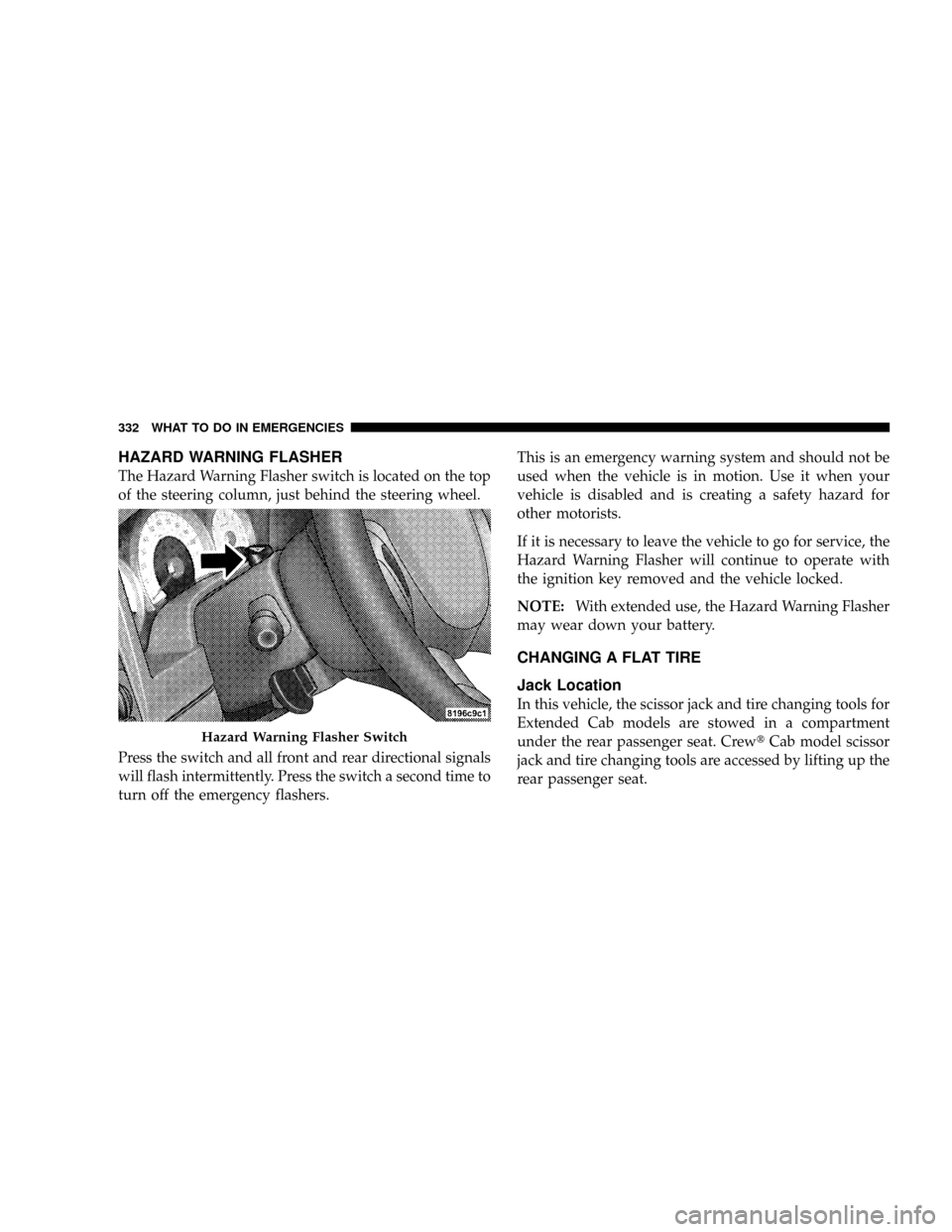
The Hazard Warning Flasher switch is located on the top
of the steering column, just behind the steering wheel.
Press the switch and all front and rear directional signals
will flash intermittently. Press the switch a second time to
turn off the emergency flashers.This is an emergency warning system and should not be
used when the vehicle is in motion. Use it when your
vehicle is disabled and is creating a safety hazard for
other motorists.
If it is necessary to leave the vehicle to go for service, the
Hazard Warning Flasher will continue to operate with
the ignition key removed and the vehicle locked.
NOTE:With extended use, the Hazard Warning Flasher
may wear down your battery.
CHANGING A FLAT TIRE
Jack Location
In this vehicle, the scissor jack and tire changing tools for
Extended Cab models are stowed in a compartment
under the rear passenger seat. CrewtCab model scissor
jack and tire changing tools are accessed by lifting up the
rear passenger seat.
Hazard Warning Flasher Switch
332 WHAT TO DO IN EMERGENCIES
Page 338 of 449
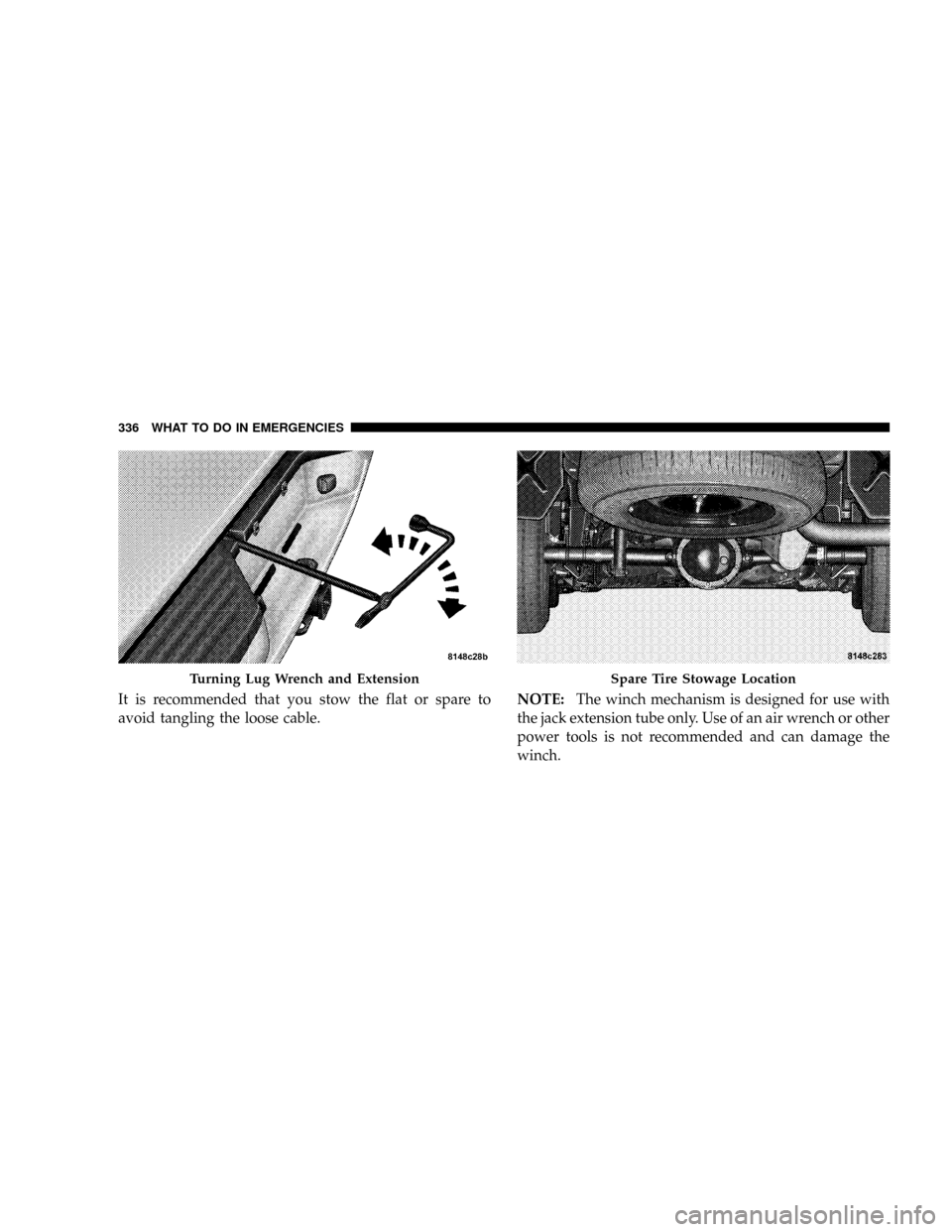
It is recommended that you stow the flat or spare to
avoid tangling the loose cable.NOTE:The winch mechanism is designed for use with
the jack extension tube only. Use of an air wrench or other
power tools is not recommended and can damage the
winch.
Turning Lug Wrench and ExtensionSpare Tire Stowage Location
336 WHAT TO DO IN EMERGENCIES