Page 344 of 449
WARNING!
A loose tire or jack thrown forward in a collision or
hard stop could injure someone in the vehicle. Al-
ways stow the jack, tools and the extra tire and wheel
in the places provided.
8. Lower the jack to its fully closed position. Stow the
replaced tire, jack, and tools as previously described.
9. Adjust the tire pressure when possible.
NOTE:Do not oil wheel studs. For chrome wheels, do
not substitute with chrome plated wheel nuts.
WARNING!
Carefully follow these tire changing warnings to
help prevent personal injury or damage to your
vehicle:
(Continued)
WARNING! (Continued)
²Always park on a firm, level surface as far from
the edge of the roadway as possible before raising
the vehicle.
²Block the wheel diagonally opposite the wheel to
be raised.
²Apply the parking brake firmly before jacking.
²Never start the engine with the vehicle on a jack.
²Do not let anyone sit in the vehicle when it is on a
jack.
²Do not get under the vehicle when it is on a jack.
²Only use the jack in the positions indicated.
²If working on or near a roadway, be extremely
careful of motor traffic.
²To assure that spare tires, flat or inflated, are
securely stowed, spares must be stowed with the
valve stem facing the ground.
342 WHAT TO DO IN EMERGENCIES
Page 346 of 449

If the indicator is dark or shows a green dot, proceed as
follows:
1. Wear eye protection and remove all metal jewelry such
as watch bands or bracelets, which might make an
unintended electrical contact.
2. Park the booster vehicle within cable reach but with-
out letting the vehicles touch. Set the parking brake, place
the automatic transmission in PARK and turn the ignition
OFF on both vehicles.
3. Turn off the heater, radio and all unnecessary electrical
loads.
4. Connect one end of a jumper cable to the positive
terminal of the booster battery. Connect the other end of
the same cable to the positive terminal of the discharged
battery.WARNING!
Do not permit vehicles to touch each other as this
could establish a ground connection and personal
injury could result.
5. Connect the other cable, first to the negative terminal
of the booster battery and then to the engine of the
vehicle with the discharged battery. Make sure you have
a good contact to a metal surface of the engine block.
WARNING!
²Do not connect the cable to the negative post of the
discharge battery. The resulting electrical spark
could cause the battery to explode.
(Continued)
344 WHAT TO DO IN EMERGENCIES
Page 364 of 449
could result in failure of the joint due to water, and dirt
contamination of the grease. This would require com-
plete replacement of the joint assembly. Refer to the
Service Manual for the detailed replacement procedure.
Body Lubrication
Locks and all body pivot points, including such items as
seat tracks, door hinge pivot points and rollers, liftgate,
tailgate, sliding doors and hood hinges, should be lubri-
cated periodically with a lithium based grease such as
MOPARtSpray White Lube to assure quiet, easy opera-
tion and to protect against rust and wear. Prior to the
application of any lubricant, the parts concerned should
be wiped clean to remove dust and grit; after lubricating
excess oil and grease should be removed. Particular
attention should also be given to hood latching compo-
nents to insure proper function. When performing other
underhood services, the hood latch, release mechanism
and safety catch should be cleaned and lubricated.The external lock cylinders should be lubricated twice a
year, preferably in the Fall and Spring. Apply a small
amount of a high quality lubricant such as MOPARt
Lock Cylinder Lubricant directly into the lock cylinder.
Windshield Wiper Blades
The rubber edges of the wiper blades and the windshield
should be cleaned periodically with a sponge or soft cloth
and a mild nonabrasive cleaner. This will remove accu-
mulations of salt or road film.
Operation of the wipers on dry glass for long periods
may cause deterioration of the wiper blades. Always use
washer fluid when using the wipers to remove salt or dirt
from a dry windshield.
Avoid using the wiper blades to remove frost or ice from
the windshield. Keep the blade rubber out of contact with
petroleum products such as engine oil, gasoline, etc.
362 MAINTAINING YOUR VEHICLE
Page 385 of 449
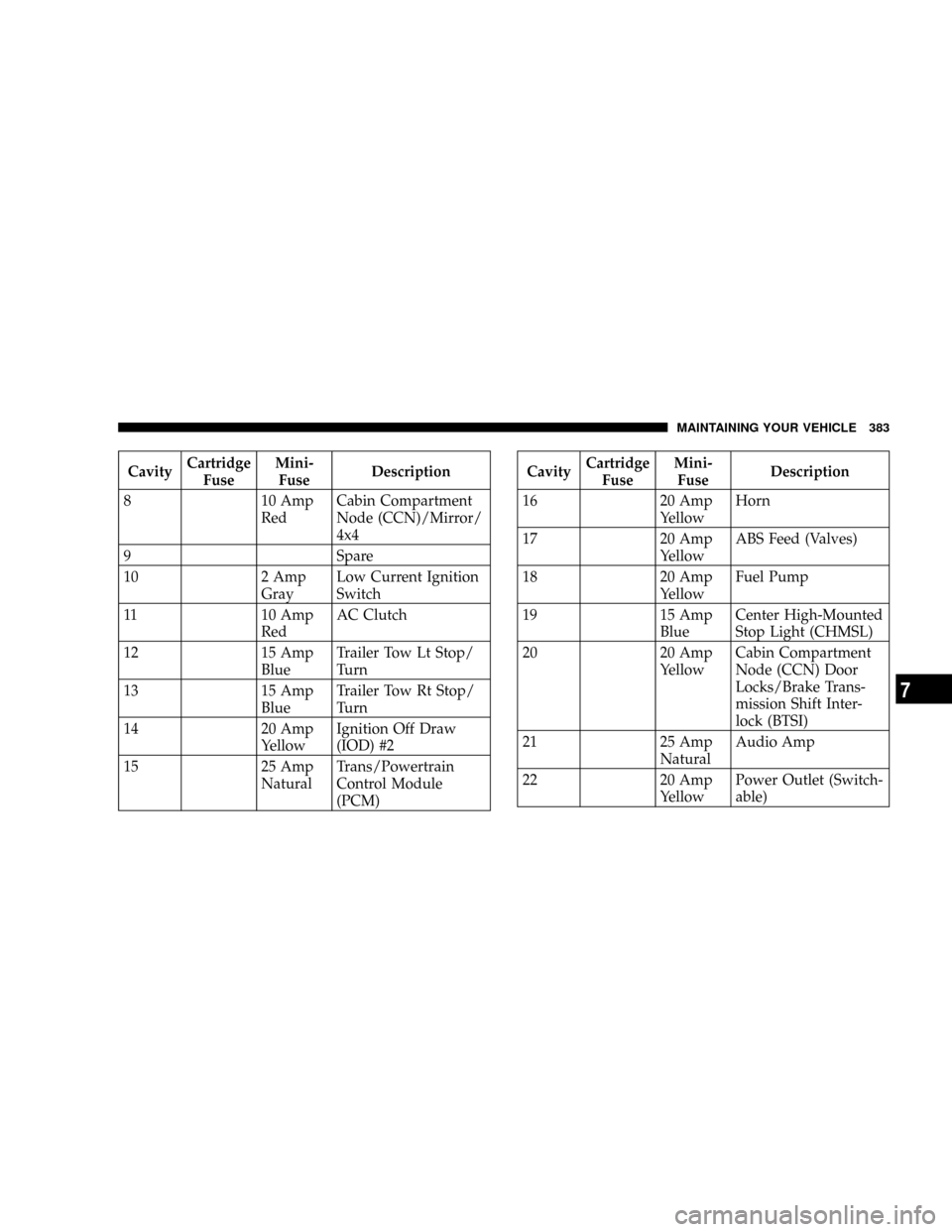
CavityCartridge
FuseMini-
FuseDescription
8 10 Amp
RedCabin Compartment
Node (CCN)/Mirror/
4x4
9 Spare
10 2 Amp
GrayLow Current Ignition
Switch
11 10 Amp
RedAC Clutch
12 15 Amp
BlueTrailer Tow Lt Stop/
Turn
13 15 Amp
BlueTrailer Tow Rt Stop/
Turn
14 20 Amp
YellowIgnition Off Draw
(IOD) #2
15 25 Amp
NaturalTrans/Powertrain
Control Module
(PCM)CavityCartridge
FuseMini-
FuseDescription
16 20 Amp
YellowHorn
17 20 Amp
YellowABS Feed (Valves)
18 20 Amp
YellowFuel Pump
19 15 Amp
BlueCenter High-Mounted
Stop Light (CHMSL)
20 20 Amp
YellowCabin Compartment
Node (CCN) Door
Locks/Brake Trans-
mission Shift Inter-
lock (BTSI)
21 25 Amp
NaturalAudio Amp
22 20 Amp
YellowPower Outlet (Switch-
able)
MAINTAINING YOUR VEHICLE 383
7
Page 387 of 449
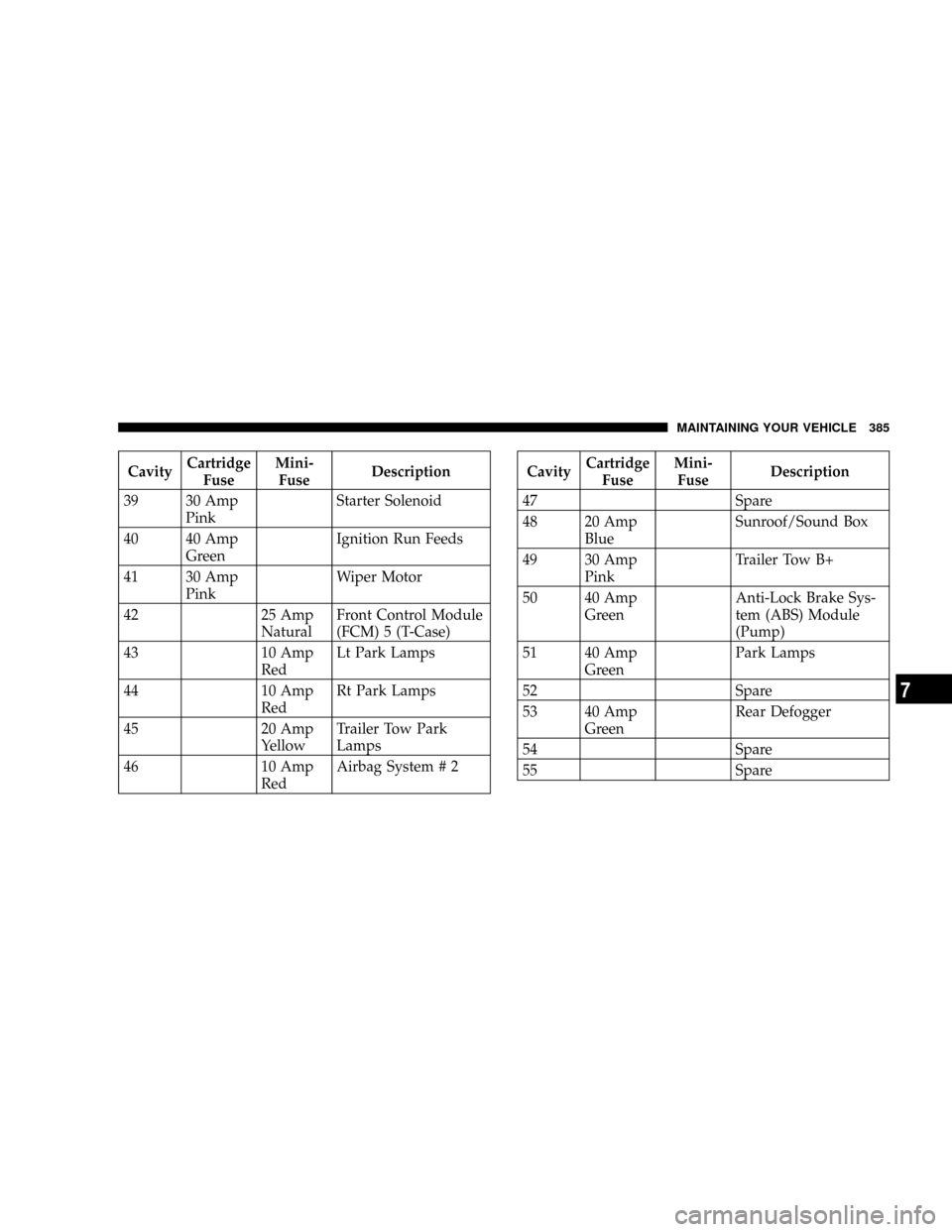
CavityCartridge
FuseMini-
FuseDescription
39 30 Amp
PinkStarter Solenoid
40 40 Amp
GreenIgnition Run Feeds
41 30 Amp
PinkWiper Motor
42 25 Amp
NaturalFront Control Module
(FCM) 5 (T-Case)
43 10 Amp
RedLt Park Lamps
44 10 Amp
RedRt Park Lamps
45 20 Amp
YellowTrailer Tow Park
Lamps
46 10 Amp
RedAirbag System # 2CavityCartridge
FuseMini-
FuseDescription
47 Spare
48 20 Amp
BlueSunroof/Sound Box
49 30 Amp
PinkTrailer Tow B+
50 40 Amp
GreenAnti-Lock Brake Sys-
tem (ABS) Module
(Pump)
51 40 Amp
GreenPark Lamps
52 Spare
53 40 Amp
GreenRear Defogger
54 Spare
55 Spare
MAINTAINING YOUR VEHICLE 385
7
Page 388 of 449
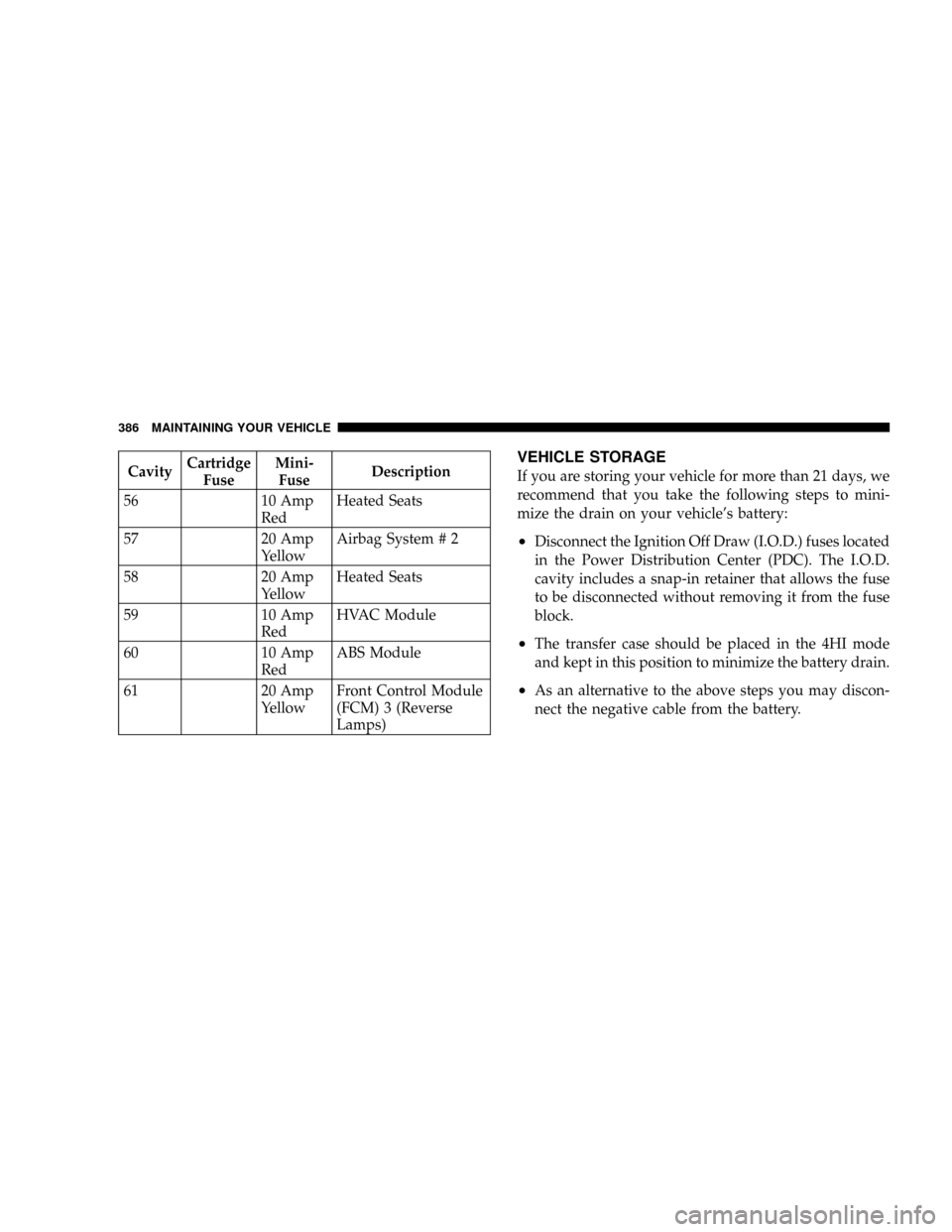
CavityCartridge
FuseMini-
FuseDescription
56 10 Amp
RedHeated Seats
57 20 Amp
YellowAirbag System # 2
58 20 Amp
YellowHeated Seats
59 10 Amp
RedHVAC Module
60 10 Amp
RedABS Module
61 20 Amp
YellowFront Control Module
(FCM) 3 (Reverse
Lamps)VEHICLE STORAGE
If you are storing your vehicle for more than 21 days, we
recommend that you take the following steps to mini-
mize the drain on your vehicle's battery:
²Disconnect the Ignition Off Draw (I.O.D.) fuses located
in the Power Distribution Center (PDC). The I.O.D.
cavity includes a snap-in retainer that allows the fuse
to be disconnected without removing it from the fuse
block.
²The transfer case should be placed in the 4HI mode
and kept in this position to minimize the battery drain.
²As an alternative to the above steps you may discon-
nect the negative cable from the battery.
386 MAINTAINING YOUR VEHICLE
Page 390 of 449
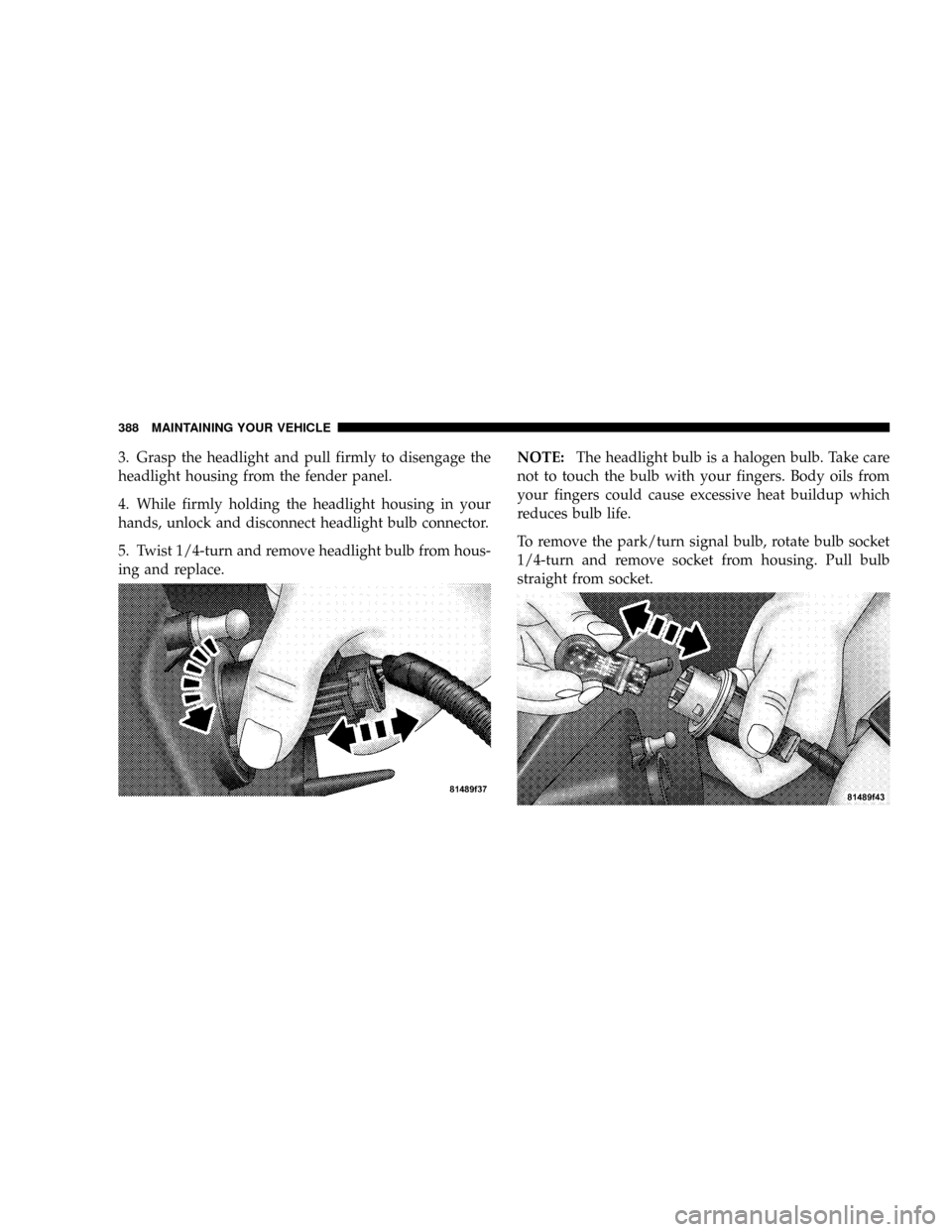
3. Grasp the headlight and pull firmly to disengage the
headlight housing from the fender panel.
4. While firmly holding the headlight housing in your
hands, unlock and disconnect headlight bulb connector.
5. Twist 1/4-turn and remove headlight bulb from hous-
ing and replace.NOTE:The headlight bulb is a halogen bulb. Take care
not to touch the bulb with your fingers. Body oils from
your fingers could cause excessive heat buildup which
reduces bulb life.
To remove the park/turn signal bulb, rotate bulb socket
1/4-turn and remove socket from housing. Pull bulb
straight from socket.
388 MAINTAINING YOUR VEHICLE
Page 392 of 449
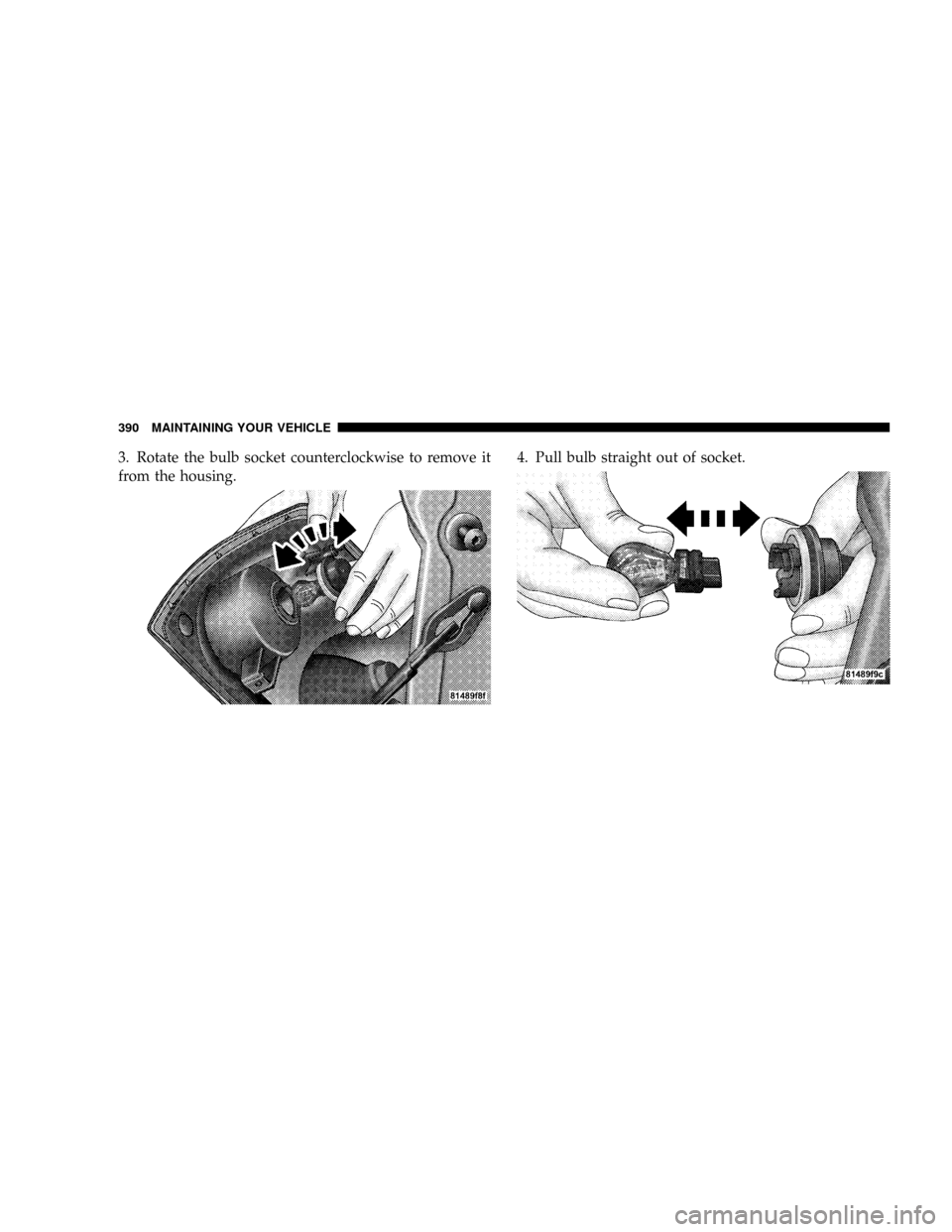
3. Rotate the bulb socket counterclockwise to remove it
from the housing.4. Pull bulb straight out of socket.
390 MAINTAINING YOUR VEHICLE