Page 250 of 469

switch position will remain in the ACC position until
the vehicle is stopped and the button is pressed twice
to the OFF position.
Keyless Go Functions – With Driver ’s Foot OFF the
Brake Pedal/Clutch Pedal (In PARK or NEUTRAL
Position)
The Keyless Go feature operates similar to an ignition
switch. It has four positions, OFF, ACC, ON/RUN and
START. To change the ignition switch positions without
starting the vehicle and use the accessories follow these
steps.
•Starting with the ignition switch in the OFF position:
•Press the ENGINE START/STOP button once to
change the ignition switch to the ACC position (EVIC
displays “IGNITION MODE ACCESSORY”),
•Press the ENGINE START/STOP button a second time
to change the ignition switch to the ON/RUN position
(EVIC displays “IGNITION MODE RUN”),
•Press the ENGINE START/STOP button a third time
to return the ignition switch to the OFF position (EVIC
displays “IGNITION MODE OFF”).
Extremely Cold Weather (Below�20°F or�29°C)
To ensure reliable starting at these temperatures, use of
an externally powered electric engine block heater (avail-
able from your authorized dealer) is recommended.
248 STARTING AND OPERATING
Page 251 of 469

If Engine Fails To Start
WARNING!
•Never pour fuel or other flammable liquids into the
throttle body air inlet opening in an attempt to start
the vehicle. This could result in a flash fire causing
serious personal injury.
•Do not attempt to push or tow your vehicle to get it
started. Vehicles equipped with an automatic trans-
mission cannot be started this way. Unburned fuel
could enter the catalytic converter and once the
engine has started, ignite and damage the converter
and vehicle. If the vehicle has a discharged battery,
booster cables may be used to obtain a start from a
booster battery or the battery in another vehicle. This
type of start can be dangerous if done improperly.
Refer to Section 6 for proper jump-starting proce-
dures and follow them carefully.
Clearing a Flooded Engine (Using ENGINE
START/STOP Button) — Automatic Transmission
Only
If the engine fails to start after you have followed the
“Normal Starting” or “Extreme Cold Weather�proce-
dures, it may be flooded. To clear any excess fuel, press
and hold the brake pedal, push the accelerator pedal all
the way to the floor and hold it, then press and release the
ENGINE START/STOP button once. The starter motor
will engage automatically, run for 10 seconds, and then
disengage. Once this occurs, release the accelerator pedal
and the brake pedal, wait 10 to 15 seconds, then repeat
the “Normal Starting” procedure.
Clearing a Flooded Engine (Using ENGINE
START/STOP Button) — Manual Transmission
Only
If the engine fails to start after you have followed the
“Normal Starting” or “Extreme Cold Weather�proce-
dures, it may be flooded. To clear any excess fuel, press
5
STARTING AND OPERATING 249
Page 253 of 469
WARNING!
Remember to disconnect the cord before driving.
Damage to the 110-115 Volt electrical cord could cause
electrocution.
MANUAL TRANSMISSION — IF EQUIPPED
Six-Speed Manual Transmission
WARNING!
You or others could be injured if you leave the
vehicle unattended without having the parking
brake fully applied. The parking brake should al-
ways be applied when the driver is not in the vehicle,
especially on an incline.
CAUTION!
•Never drive with your foot resting on the clutch
pedal, or try to hold the vehicle on a hill with the
clutch pedal partially engaged, as this will cause
abnormal wear on the clutch. Refer to “Electronic
Brake Control System/Hill Start Assist” in this
section.
•Failure to press the clutch pedal fully to the floor
may cause increased shift efforts, and may result
in damage to the clutch and transmission.
•Do not rest your hand on the shift lever while
driving, as this may result in transmission syn-
chronizer damage.
5
STARTING AND OPERATING 251
Page 256 of 469
1–4 Skip Shift
There are times when you must shift the transmission
directly from first gear to fourth gear instead of from first
gear to second gear. This is to help you get the best
possible fuel economy from your vehicle. This occurs
when the engine coolant (antifreeze) is higher than 106°F
(41°C), vehicle speed is greater than 19 mph (30 km/h)
but less than 21 mph (34 km/h), and the transmission is
in first gear, and the accelerator is at 1/4 throttle or less.
The 1–4 Skip Shift indicator message will be displayed
during these times.
When the 1–4 Skip Shift indicator message is displayed,
the shift mechanism will only allow shifts from first gear
to fourth gear. After you shift the transmission to fourth
gear, you can press the clutch in and shift to another
forward gear.
Downshifting
To maintain a safe speed and prolong brake life, down-
shift to maintain a safe speed when descending a steep
grade.
WARNING!
Skipping more than one gear while downshifting,
could cause you to lose control of your vehicle. You
could have an accident.
CAUTION!
•If you skip more than one gear while downshift-
ing or downshift at too high an engine speed, you
could damage the engine, transmission, or clutch.
•Do not downshift into first gear when the vehicle
is moving faster than 15 mph (24 km/h), as you
could damage the engine and/or clutch.
254 STARTING AND OPERATING
Page 257 of 469

AUTOMATIC TRANSMISSION — IF EQUIPPED
CAUTION!
Damage to the automatic transmission may occur if
the following precautions are not observed:
•Shift into PARK only after the vehicle has come to
a complete stop.
•Shift into or out of REVERSE only after the
vehicle has come to a complete stop and the engine
is at idle speed.
•Do not shift from REVERSE, PARK, or NEUTRAL
into any forward gear when the engine is above
idle speed.
•Before shifting into any gear, make sure your foot
is firmly on the brake pedal.
WARNING!
It is dangerous to move the shift lever out of PARK or
NEUTRAL if the engine speed is higher than idle
speed. If your foot is not firmly on the brake pedal,
the vehicle could accelerate quickly forward or in
reverse. You could lose control of the vehicle and hit
someone or something. Only shift into gear when the
engine is idling normally and when your right foot is
firmly on the brake pedal.
General Information
The automatic transmission selects individual gears au-
tomatically, dependent upon:
•Altitude
•Vehicle loading
•Driving style
5
STARTING AND OPERATING 255
Page 258 of 469
•Shift lever position
•Accelerator position
•Vehicle speed
The gear shifting process is continuously adapted, de-
pendent on the driving style, the driving situation, and
the road characteristics.
NOTE:
•After selecting any driving position, wait a moment to
allow the gear to engage fully before accelerating,
especially when the engine is cold.
•If there is a need to restart the engine, be sure to cycle
the key to the LOCK position before restarting. Trans-
mission engagement may be delayed up to 10 seconds
after restart if the key is not cycled to the LOCK
position first.
•The electronically-controlled transmission provides a
precise shift schedule. The transmission electronics are
self-calibrating. Therefore, the first few shifts on a new
vehicle may be somewhat abrupt or soft until after the
break-in period. This is a normal condition, and pre-
cision shifts will develop within a few shift cycles.
The shift lever is automatically locked while in the PARK
position. To move the shift lever out of the PARK
position, the brake pedal must be firmly pressed before
the shift lock will release.
Move the shift lever to the desired position only when the
engine is idling normally and the brake pedal is applied.
Do not release the brake pedal until ready to drive. The
vehicle may otherwise accelerate quickly when the shift
lever is in DRIVE or REVERSE position.
256 STARTING AND OPERATING
Page 259 of 469
WARNING!
Unintended movement of a vehicle could injure
those in and near the vehicle. As with all vehicles,
you should never exit a vehicle while the engine is
running. Before exiting a vehicle, you should always
shift the transmission into PARK, remove the key
from the ignition, and apply the parking brake. Once
the key is removed from the ignition, the transmis-
sion shift lever is locked in the PARK position,
securing the vehicle against unwanted movement.
Furthermore, you should never leave unattended
children inside a vehicle.
Over-Temperature Mode
The transmission electronics constantly monitor the
transmission oil temperature. If the transmission exceeds
normal operating temperature, the transmission will
change the way it shifts to help control the condition.This may result in a slightly different feeling or response
during normal operation in DRIVE position. After the
transmission cools down, it will return to normal
operation.
Brake/Transmission Shift Interlock System
This vehicle is equipped with a Brake Transmission Shift
Interlock (BTSI) system that holds the shift lever in the
PARK position when the ignition switch is in the LOCK
position and the engine is not running. To move the shift
lever out of the PARK position, the ignition switch must
be turned to any other ignition position (ACC, ON/
RUN) position, and the brake pedal must be pressed
whether or not the engine is running.
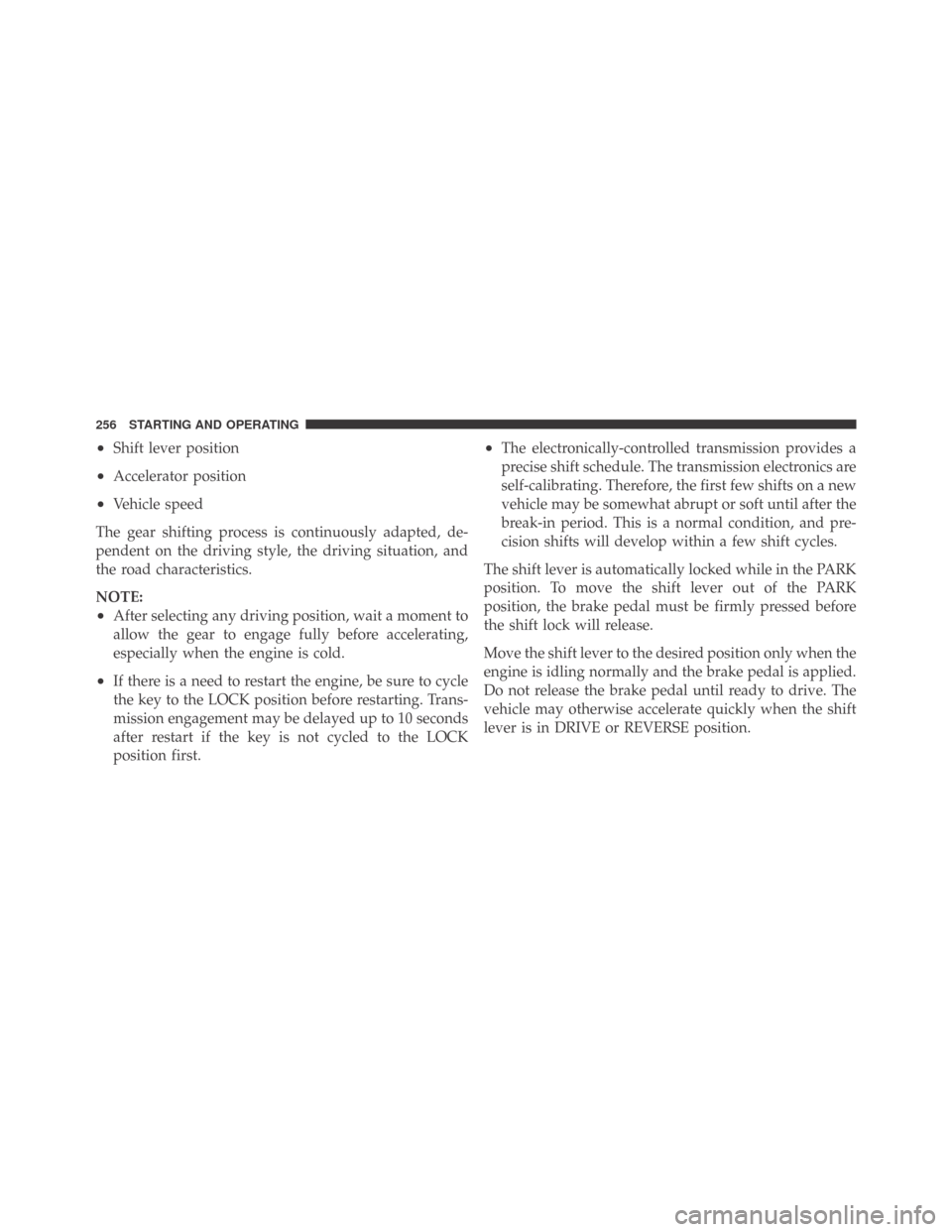
Brake/Transmission Interlock Manual Override
There is an override for the BTSI that allows you to move
the shift lever out of the PARK position if an electrical
system malfunction occurs (i.e., dead battery). To access
5
STARTING AND OPERATING 257
Page 260 of 469
the override (using a flat-bladed screwdriver), carefully
remove the override cover which is located to the right of
the shift lever.
1. Turn the key to the ACC or ON position without
starting the engine.
2. Firmly set the parking brake.
3. Press and maintain firm pressure on the brake pedal.
4. Using the screwdriver, press and hold the override tab
through the access port on the center console.
5. Move the shift lever into the NEUTRAL position.
6. The vehicle may then be started in NEUTRAL.
7. Reinstall the override cover.
Interlock Manual Override
258 STARTING AND OPERATING