2009 DODGE CHALLENGER spare wheel
[x] Cancel search: spare wheelPage 349 of 469
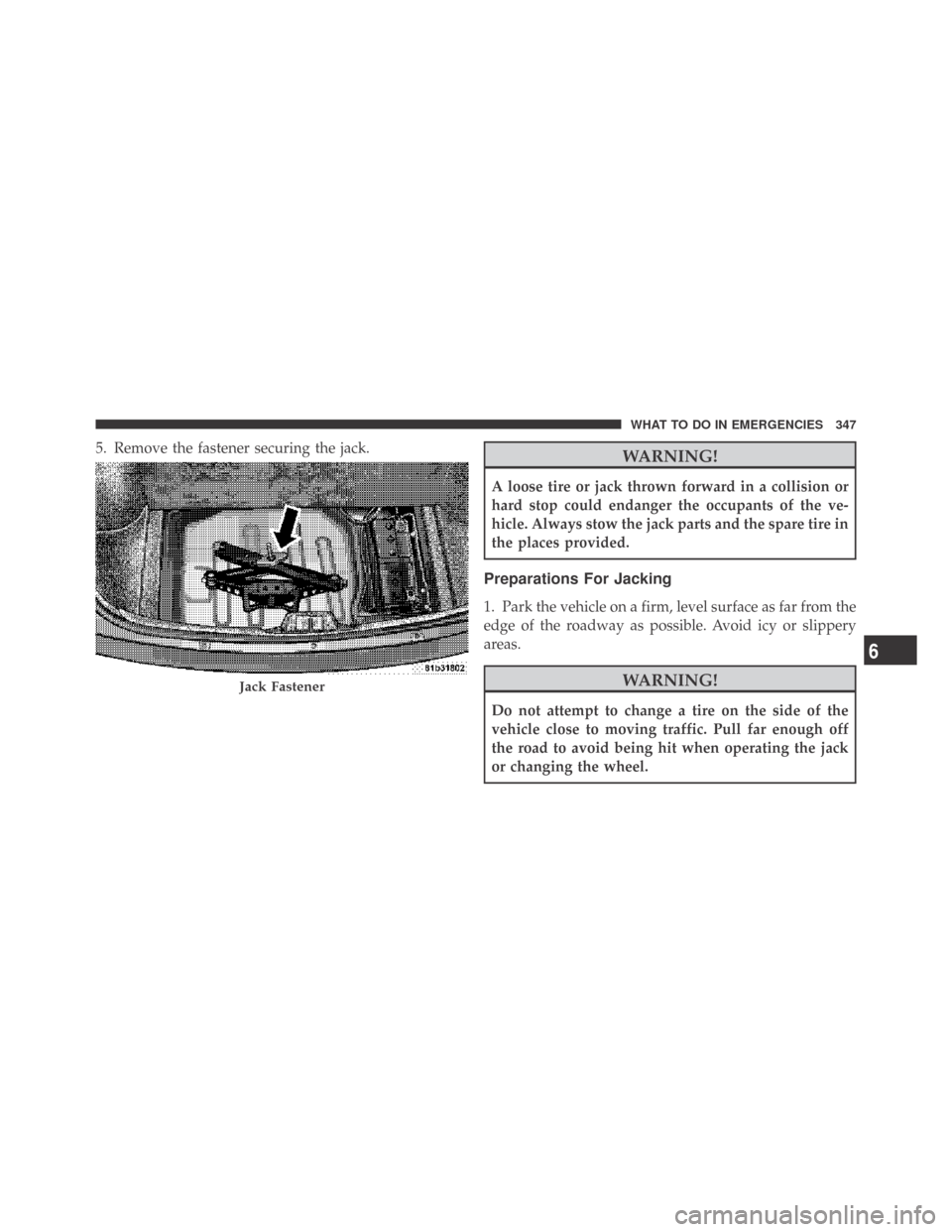
5. Remove the fastener securing the jack.WARNING!
A loose tire or jack thrown forward in a collision or
hard stop could endanger the occupants of the ve-
hicle. Always stow the jack parts and the spare tire in
the places provided.
Preparations For Jacking
1. Park the vehicle on a firm, level surface as far from the
edge of the roadway as possible. Avoid icy or slippery
areas.
WARNING!
Do not attempt to change a tire on the side of the
vehicle close to moving traffic. Pull far enough off
the road to avoid being hit when operating the jack
or changing the wheel.
Jack Fastener
6
WHAT TO DO IN EMERGENCIES 347
Page 351 of 469
WARNING! (Continued)
•Do not get under the vehicle when it is on a jack.
•Only use the jack in the positions indicated and
for lifting this vehicle during a tire change.
•If working on or near a roadway, be extremely
careful of motor traffic.
•To assure that spare tires, flat or inflated, are
securely stowed, spares must be stowed with the
valve stem facing the ground.
•Turn on the Hazard Warning flasher.
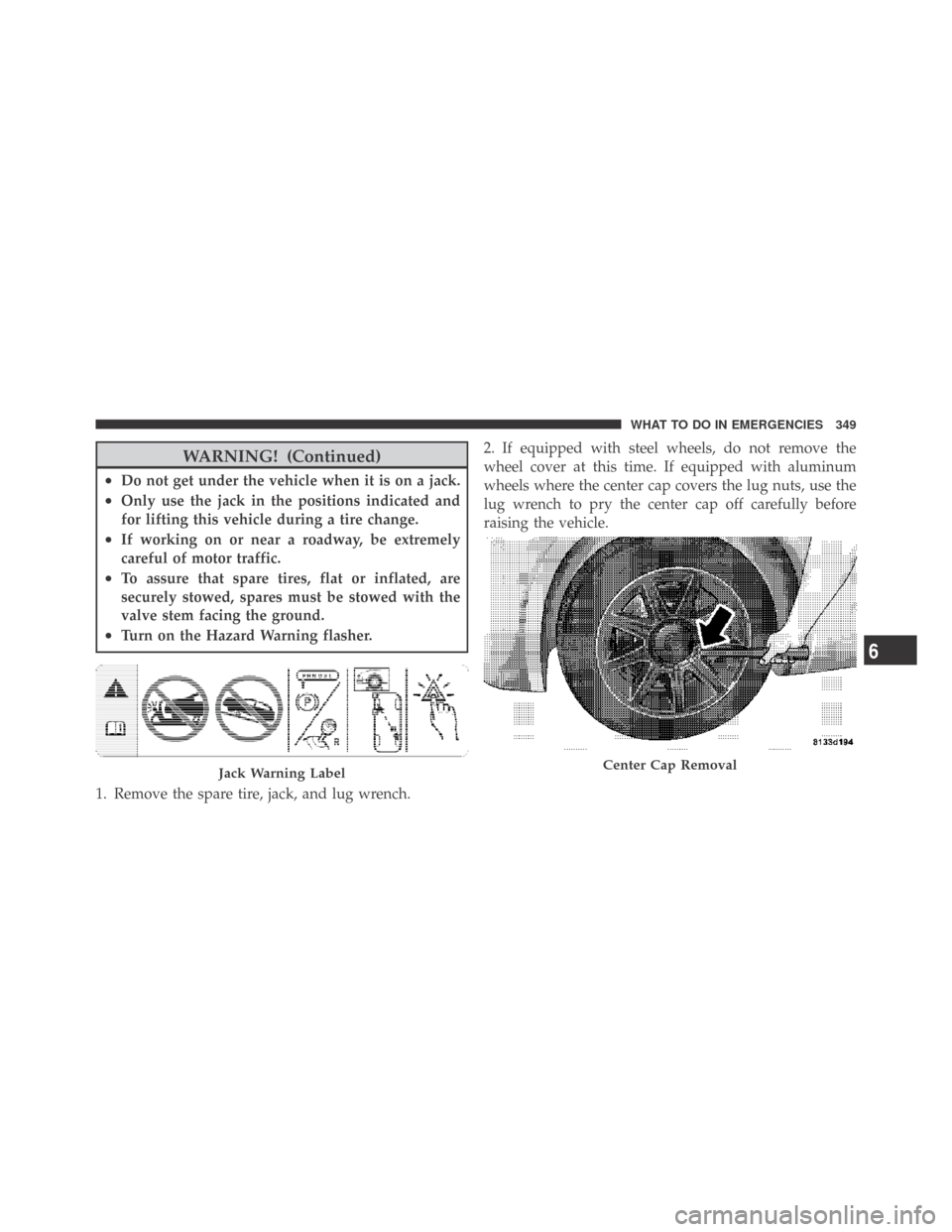
1. Remove the spare tire, jack, and lug wrench.2. If equipped with steel wheels, do not remove the
wheel cover at this time. If equipped with aluminum
wheels where the center cap covers the lug nuts, use the
lug wrench to pry the center cap off carefully before
raising the vehicle.
Jack Warning LabelCenter Cap Removal
6
WHAT TO DO IN EMERGENCIES 349
Page 353 of 469
5. Raise the vehicle just enough to remove the flat tire
and install the spare tire.
WARNING!
Raising the vehicle higher than necessary can make
the vehicle less stable. It could slip off the jack and
hurt someone near it. Raise the vehicle only enough
to remove the tire.
6. Remove the lug nuts, wheel cover (if equipped), and
tire. Remove the cover by hand. Do not pry it off.
7. Mount the spare tire.
NOTE:For vehicles so equipped, do not attempt to
install a center cap or wheel cover on the compact spare.
However, when reinstalling the road tire, follow the
procedure under “Wheel Cover or Center Cap Installa-
tion” in place of the remaining steps in this procedure.
Jack Engagement Locations6
WHAT TO DO IN EMERGENCIES 351
Page 354 of 469

8. Install the lug nuts with the cone shaped end of the
nut toward the wheel. Lightly tighten the lug nuts. To
avoid the risk of forcing the vehicle off the jack, do not
tighten the lug nuts fully until the vehicle is lowered to
the ground.
9. Lower the vehicle to the ground by turning the jack
handle counterclockwise.
10. Finish tightening the lug nuts. Push down on the
wrench while tightening for increased leverage. Alternate
lug nuts until each nut has been tightened twice. The
correct tightness of each lug nut is 100 ft/lb. (135 N·m). If
in doubt about the correct tightness, have them checked
with a torque wrench by your authorized dealer or at a
service station.11. Stow the jack, tools and flat tire. Make sure the base
of the jack faces the rear of the vehicle before tightening
down the fastener.
WARNING!
A loose tire or jack thrown forward in a collision or
hard stop could endanger the occupants of the ve-
hicle. Always stow the jack parts and the spare tire in
the places provided.
Compact Spare Tire
The compact spare tire is for temporary emergency use
with radial tires. It is engineered to be used on your style
vehicle only. Since this tire has limited tread life, the
original tire should be repaired (or replaced) and rein-
stalled at the first opportunity.
352 WHAT TO DO IN EMERGENCIES
Page 355 of 469
•Keep tire inflated to 60 psi (414 KPa) cold inflation
pressure.
•This tire is designed as an emergency spare only. Do
not exceed 50 mph (80 km/h) speed.
WARNING!
The limited-use spare tires are for emergency use
only. Installation of this limited-use spare tire affects
vehicle handling. With this tire, do not drive more
than 60 mph (100 km/h). Keep inflated to the cold tire
inflation pressure listed on either your tire placard or
limited-use spare tire and wheel assembly. Replace
(or repair) the original tire at the first opportunity
and reinstall it on your vehicle. Failure to do so could
result in loss of vehicle control.
Wheel Cover or Center Cap Installation (If
Equipped)
NOTE:Do not attempt to install a center cap or wheel
cover on the compact spare.
1. Mount the road tire on the axle. For vehicles equipped
with wheel covers, perform Steps 2 and 3. For vehicles
equipped with center caps, proceed to Step 4.
6
WHAT TO DO IN EMERGENCIES 353
Page 357 of 469
3. Align the valve notch in the wheel cover with the
valve stem on the wheel. Install the cover by hand,
snapping the cover over the two lug nuts. Do not use a
hammer or excessive force to install the cover.
4. Install the remaining lug nuts with the cone shaped
end of the nut toward the wheel. Lightly tighten the lug
nuts. To avoid the risk of forcing the vehicle off the jack,
do not tighten the lug nuts fully until the vehicle is
lowered to the ground.
5. Lower the vehicle to the ground by turning the jack
handle counterclockwise.
6. Finish tightening the lug nuts. Push down on the
wrench while tightening for increased leverage. Alternate
lug nuts until each nut has been tightened twice. The
correct tightness of each lug nut is 100 ft/lb. (135 N·m). If
in doubt about the correct tightness, have them checked
with a torque wrench by your authorized dealer or at a
service station.7. For vehicles equipped with center caps, install the
center cap by hand. Do not use a hammer or excessive
force to install the center cap.
8. Stow the jack, tools, and spare tire. Make sure the base
of the jack faces the rear of the vehicle before tightening
down the fastener.
WARNING!
A loose tire or jack thrown forward in a collision or
hard stop could endanger the occupants of the ve-
hicle. Always stow the jack parts and the spare tire in
the places provided.
6
WHAT TO DO IN EMERGENCIES 355
Page 462 of 469
Snow Chains (Tire Chains)................. 304
Snow Tires............................ 306
Sound System
Kicker.............................. 227
Spare Tire..........................300,345
Spark Plugs............................ 415
Specifications
Fuel (Gasoline)........................ 415
Oil ................................ 415
Speed Control (Cruise Control).............. 128
Speedometer........................... 156
Starting............................. 26,243
Automatic Transmission................. 244
Cold Weather......................... 248
Emergency (Jump Starting)............... 356
Engine Fails to Start.................... 249
Remote.............................. 26
Starting and Operating.................... 243
Starting Procedures...................... 243Steering
Column Controls...................... 122
Column Lock......................... 127
Power.............................. 273
TiltColumn .......................... 127
Wheel, Tilt........................... 127
Steering Wheel Mounted Sound
System Controls......................... 228
Storage............................... 407
Storage, Vehicle......................235,407
StoringYourVehicle ...................... 407
Stuck, Freeing.......................... 359
Sun Roof.............................. 139
Sunglasses Storage....................... 132
Sunroof Maintenance..................... 142
Supplemental Restraint System - Airbag........ 45
Sway Control, Trailer..................... 326
Synthetic Engine Oil...................... 375
System, Remote Starting.................... 26
460 INDEX
Page 467 of 469

INTRODUCTION INTRODUCTION HOW TO USE THIS MANUAL WARNINGS AND CAUTIONS VEHICLE IDENTIFICATION NUMBER VEHICLE MODIFICATIONS/ALTERATIONS THINGS TO KNOW BEFORE STARTING YOUR VEHICLE A WORD ABOUT YOUR KEYS
Wireless Ignition Node (WIN)Fob With Integrated KeyIgnition Key RemovalKey-In-Ignition ReminderSENTRY KEY Replacement KeysCustomer Key ProgrammingGeneral InformationVEHICLE SECURITY ALARM Rearming Of The SystemTo Arm The SystemTo Disarm The
SystemILLUMINATED ENTRY SYSTEM REMOTE KEYLESS ENTRY (RKE) To Unlock The DoorsTo Lock The DoorsExpress Down Window FeatureTo Open The TrunkUsing ThePanic AlarmProgramming Additional TransmittersTransmitter Battery ServiceGeneral
InformationREMOTE STARTING SYSTEM How To Use Remote StartDOOR LOCKS Manual Door LocksPower Door LocksWINDOWS Power WindowsWind BuffetingTRUNK LOCK AND RELEASE TRUNK SAFETY WARNING Trunk Emergency Release OCCUPANT
RESTRAINTS Lap/Shoulder BeltsLap/Shoulder Belt Untwisting ProcedureSeat Belt PretensionersEnhanced Seat Belt Use Reminder System (BeltAlert)Automatic Locking Mode - If EquippedSeat Belts and Pregnant WomenSeat Belt ExtenderDriver and Front Passenger
Supplemental Restraint System (SRS) - AirbagsEvent Data Recorder (EDR)Child RestraintENGINE BREAK-IN RECOMMENDATIONS SAFETY TIPS TransportingPassengersExhaust GasSafety Checks You Should Make Inside the VehiclePeriodic Safety Checks You Should
Make Outside the VehicleUNDERSTANDING THE FEATURES OF YOUR VEHICLE MIRRORS Automatic Dimming Mirror - If EquippedOutside MirrorsOutside Mirrors Folding FeaturePower MirrorsHeated Mirrors - If EquippedVanity MirrorsIlluminated Vanity Mirrors
Slide-On-Rod and Extender Features of Sun Visoruconnect phone - IF EQUIPPED OperationPhone Call Featuresuconnect phone FeaturesAdvanced Phone ConnectivityThings You Should Know About Your uconnect phoneGeneral InformationVOICE RECOGNITION (VR)
SYSTEM - IF EQUIPPED Voice Recognition (VR) System OperationCommandsVoice TrainingSEATS Easy Entry SeatsPower SeatsManual Front Seatback ReclineLumbar SupportHead RestraintsHeated SeatsFolding Rear SeatTO OPEN AND CLOSE THE HOOD LIGHTS
Headlight SwitchAutomatic Headlights - If EquippedHeadlights On with Wipers (Available with Auto Headlights Only)Headlight Time DelayDaytime Running Lights - If EquippedLights-On ReminderFog Lights - If EquippedMultifunction LeverOverhead Console Map/Reading
LightsInterior LightsWINDSHIELD WIPERS AND WASHERS Intermittent Wiper SystemMist FeatureWindshield WashersHeadlights On With Wipers (Available with Auto Headlights Only)TILT/TELESCOPING STEERING COLUMN ELECTRONIC SPEED CONTROL To
ActivateTo Set A Desired SpeedTo DeactivateTo Resume SpeedTo Vary the Speed SettingTo Accelerate For PassingOVERHEAD CONSOLE Courtesy/Reading LightsSunglasses StorageGARAGE DOOR OPENER - IF EQUIPPED Programming HomeLinkGate
Operator/Canadian ProgrammingUsing HomeLinkReprogramming A Single HomeLink ButtonSecurityTroubleshooting TipsGeneral InformationPOWER SUNROOF - IF EQUIPPED Opening Sunroof - PartiallyOpening Sunroof - ExpressClosing Sunroof - PartiallyClosing
Sunroof - ExpressPinch Protect FeaturePinch Protect OverrideVenting Sunroof - ExpressSunshade OperationWind BuffetingSunroof MaintenanceIgnition Off OperationSunroof Fully ClosedELECTRICAL POWER OUTLETS CUPHOLDERS Front CupholdersRear Cupholders
CONSOLE FEATURES Sliding Center Console ArmrestConsole StorageREAR WINDOW FEATURES Rear Window DefrosterUNDERSTANDING YOUR INSTRUMENT PANEL INSTRUMENT PANEL FEATURES INSTRUMENT CLUSTER - BASE INSTRUMENT CLUSTER
- PREMIUM INSTRUMENT CLUSTER DESCRIPTION ELECTRONIC VEHICLE INFORMATION CENTER (EVIC) Electronic Vehicle Information Center (EVIC) DisplaysEngine Oil Change Indicator SystemTrip FunctionsKeyless Go Display - If EquippedCompass Display
Driver-Selectable Surround Sound (DSS) - If EquippedSystem Warnings (Customer Information Features)Personal Settings (Customer-ProgrammableFeatures)SALES CODE REQ - AM/FM STEREO RADIO AND 6-DISC CD CHANGER (MP3/WMA AUX JACK) Operating
Instructions - Radio ModeOperation Instructions - (DISC MODE for CD and MP3/WMA Audio Play)Notes On Playing MP3/WMA FilesLIST Button (DISC Mode for MP3/WMA Play)INFO Button (DISC Mode for MP3/WMA Play)SALES CODE (RER/REN) - AM/FM/CD/DVD
RADIO - IF EQUIPPED Operating Instructions - Voice Recognition System (VR) - If EquippedOperating Instructions - uconnect phone - If EquippedClock Setting ProcedureSALES CODE RES - AM/FM STEREO RADIO WITH CD PLAYER (MP3 AUX JACK) Operating
Instructions - Radio ModeOperation Instructions - CD MODE For CD And MP3 Audio PlayNotes on Playing MP3 FilesOperation Instructions - Auxiliary ModeSALES CODE RES/RSC - AM/FM STEREO RADIO WITH CD PLAYER (MP3 AUX JACK) AND SIRIUS RADIO
Operating Instructions - Radio ModeOperation Instructions - CD MODE for CD and MP3 Audio PlayNotes On Playing MP3 FilesLIST Button (CD Mode for MP3 Play)INFO Button (CD Mode for MP3 Play)UNIVERSAL CONSUMER INTERFACE (UCI) - IF EQUIPPED
Connecting The iPodUsing This FeatureControlling The iPod Using Radio ButtonsPlay ModeList Or Browse Modeuconnect studios (SATELLITE RADIO) - IF EQUIPPED (REN/REQ/RER/RES RADIOS ONLY) System ActivationElectronic Serial Number/Sirius Identification
Number (ESN/SID)Selecting uconnect studios (Satellite) ModeSatellite AntennaReception QualityOperating Instructions - uconnect studios (Satellite) ModeOperating Instructions - uconnect phone (If Equipped)KICKER HIGH PERFORMANCE SOUND SYSTEM WITH
DRIVER-SELECTABLE SURROUND (DSS) - IF EQUIPPED REMOTE SOUND SYSTEM CONTROLS - IF EQUIPPED CD/DVD DISC MAINTENANCE RADIO OPERATION AND CELLULAR PHONES CLIMATE CONTROLS Manual Air Conditioning and Heating System
Operating TipsSTARTING AND OPERATING STARTING PROCEDURES Manual Transmission - If EquippedAutomatic Transmission - If EquippedKeyless Go - If EquippedNormal StartingExtremely Cold Weather (Below -20 degrees F or -29 degrees C)If Engine Fails To
StartAfter StartingENGINE BLOCK HEATER - IF EQUIPPED MANUAL TRANSMISSION - IF EQUIPPED Six-Speed Manual TransmissionAUTOMATIC TRANSMISSION - IF EQUIPPED General InformationBrake/Transmission Shift Interlock SystemBrake/Transmission
Interlock Manual OverrideFour-Speed Automatic Transmission (3.5L Engine)Five-Speed Automatic Transmission (5.7L Engine)Gear RangesAUTOSTICK - IF EQUIPPED Autostick OperationDRIVING ON SLIPPERY SURFACES AccelerationTractionDRIVING THROUGH
WATER Flowing/Rising WaterPOWER STEERING Power Steering Fluid CheckPARKING BRAKE Manual Transmission - If EquippedAutomatic Transmission - If EquippedBRAKE SYSTEM Anti-Lock Brake System (ABS) - If EquippedMULTI-DISPLACEMENT SYSTEM (MDS)
(IF EQUIPPED) - 5.7L ENGINE ONLY ELECTRONIC BRAKE CONTROL SYSTEM ABS (Anti-Lock Brake System) - If EquippedTCS (Traction Control System) - If EquippedBAS (Brake Assist System) - If EquippedHSA (Hill Start Assist) - Manual Transmission OnlyESP
(Electronic Stability Program) - If EquippedSynchronizing ESPESP/BAS Malfunction Indicator Light and ESP/TCS Indicator LightTIRE SAFETY INFORMATION Tire Markings Tire Loading and Tire PressureTIRES - GENERAL INFORMATION Tire PressureTire Inflation
PressuresRadial Ply TiresCompact Spare Tire - If EquippedTire SpinningTread Wear IndicatorsLife Of TireReplacement TiresTIRE CHAINS SNOW TIRES TIRE ROTATION RECOMMENDATIONS TIRE PRESSURE MONITOR SYSTEM (TPMS) Base SystemPremium
System - If EquippedGeneral InformationFUEL REQUIREMENTS 3.5L and 5.7L Engines (with Automatic Transmission)5.7L Engine (with Manual Transmission)Reformulated GasolineGasoline/Oxygenate BlendsE-85 Usage In Non-Flex Fuel VehiclesMMT In Gasoline
Materials Added to FuelFuel System CautionsCarbon Monoxide WarningsADDING FUEL Fuel Filler Cap (Gas Cap)Loose Fuel Filler Cap MessageVEHICLE LOADING Vehicle Certification LabelGross Vehicle Weight Rating (GVWR)Gross Axle Weight Rating (GAWR)
OverloadingLoadingTRAILER TOWING Common Towing DefinitionsTrailer Hitch ClassificationTrailer Towing Weights (Maximum Trailer Weight Ratings)Trailer and Tongue WeightTowing RequirementsTowing TipsRECREATIONAL TOWING (BEHIND MOTORHOME, ETC.)
WHAT TO DO IN EMERGENCIES HAZARD WARNING FLASHER IF YOUR ENGINE OVERHEATS TIREFIT TIRE REPAIR - IF EQUIPPED JACKING AND TIRE CHANGING Jack Location/Spare Tire StowagePreparations For JackingJacking and Changing a TireCompact
Spare TireWheel Cover or Center Cap Installation (If Equipped)JUMP-STARTING FREEING A STUCK VEHICLE TOWING A DISABLED VEHICLE Without The IgnitionKeyTowing This Vehicle Behind Another Vehicle (Flat Towing With All Four Wheels On The Ground)Towing
This Vehicle Behind Another Vehicle With A Tow DollyMAINTAINING YOUR VEHICLE ENGINE COMPARTMENT - 3.5L ENGINE COMPARTMENT - 5.7L ONBOARD DIAGNOSTICSYSTEM - OBD II Loose Fuel Filler CapEMISSIONS INSPECTION AND MAINTENANCE
PROGRAMS REPLACEMENT PARTS DEALER SERVICE MAINTENANCE PROCEDURES Engine OilEngine Oil FilterEngine Air Cleaner FilterMaintenance-Free BatteryAir Conditioner MaintenanceBody LubricationWindshield Wiper BladesAdding Washer FluidExhaust
SystemCooling SystemBrake SystemClutch Hydraulic System - Manual Transmission (If Equipped)Manual Transmission - If EquippedAutomatic Transmission - If EquippedRear AxleAppearance Care and Protection from CorrosionFUSES Integrated Power Module (IPM)
Rear Power Distribution CenterVEHICLE STORAGE REPLACEMENT LIGHT BULBS BULB REPLACEMENT Low Beam Headlamp, High Beam Headlamp, Park/Turn Lamp - Models with Halogen Headlamps - If EquippedLow Beam Headlamp, High Beam Headlamp, and
Park/Turn Lamp - Models with High Intensity Discharge (HID) Headlamps - If EquippedFront/Rear Side Marker LampTail/Turn and Stop LampCenter Tail/Backup LampCenter High-Mounted Stop Lamp (CHMSL)License LampFLUIDS AND CAPACITIES FLUIDS,
LUBRICANTS, AND GENUINE PARTS EngineChassisMAINTENANCE SCHEDULES EMISSION CONTROL SYSTEM MAINTENANCE MAINTENANCE SCHEDULE Required Maintenance IntervalsIF YOU NEED CONSUMER ASSISTANCE SUGGESTIONS FOR
OBTAINING SERVICE FOR YOUR VEHICLE Prepare For The AppointmentPrepare A ListBe Reasonable With RequestsIF YOU NEED ASSISTANCE Chrysler LLC Customer CenterChrysler Canada Inc. Customer CenterIn Mexico ContactCustomer Assistance For The
Hearing Or Speech Impaired (TDD/TTY)Service ContractWARRANTY INFORMATION (U.S. Vehicles Only) MOPAR PARTS REPORTING SAFETY DEFECTS In The 50 United States And Washington, D.CIn CanadaPUBLICATION ORDER FORMS DEPARTMENT OF
TRANSPORTATION UNIFORM TIRE QUALITY GRADES TreadwearTraction GradesTemperature GradesINDEX