Page 324 of 469
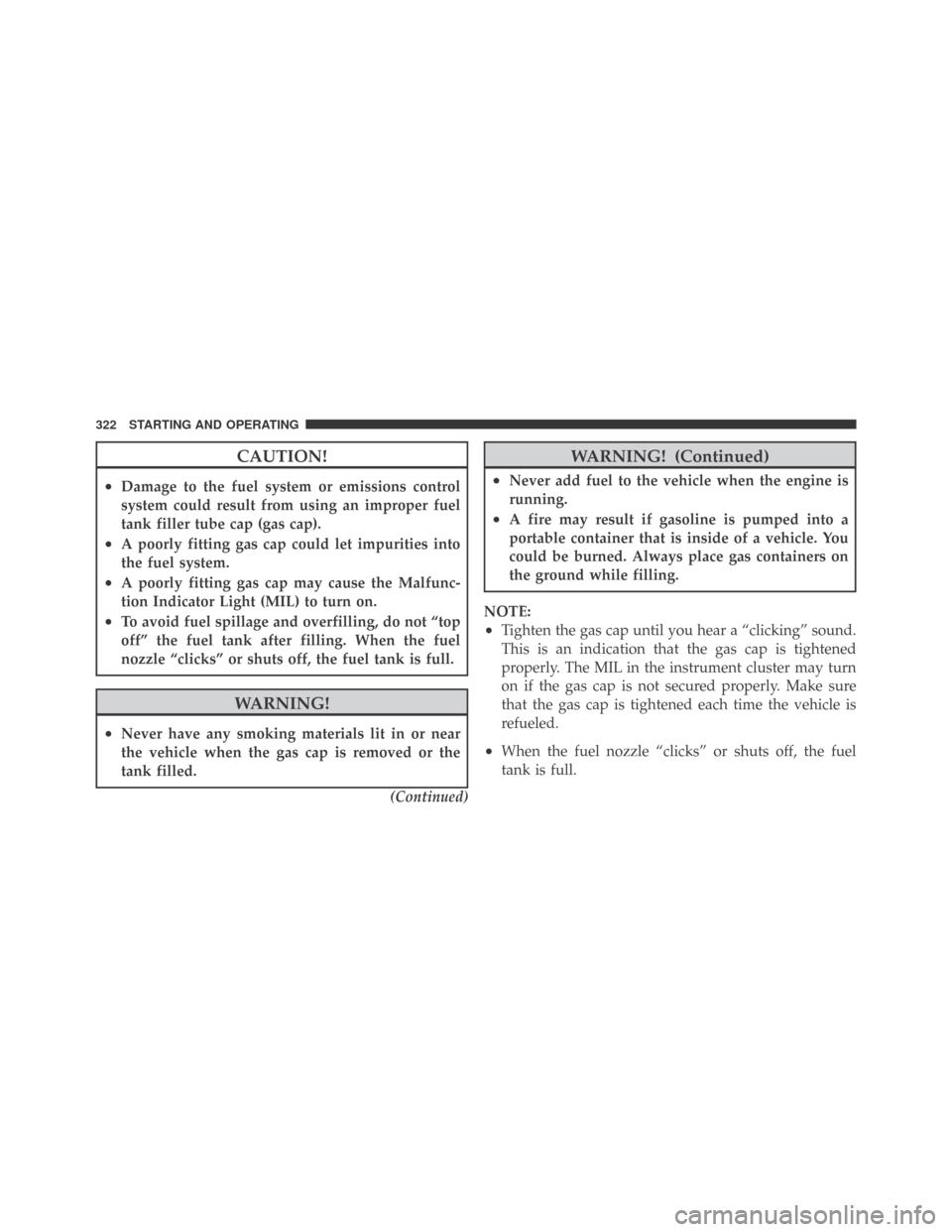
CAUTION!
•Damage to the fuel system or emissions control
system could result from using an improper fuel
tank filler tube cap (gas cap).
•A poorly fitting gas cap could let impurities into
the fuel system.
•A poorly fitting gas cap may cause the Malfunc-
tion Indicator Light (MIL) to turn on.
•To avoid fuel spillage and overfilling, do not “top
off” the fuel tank after filling. When the fuel
nozzle “clicks” or shuts off, the fuel tank is full.
WARNING!
•Never have any smoking materials lit in or near
the vehicle when the gas cap is removed or the
tank filled.
(Continued)
WARNING! (Continued)
•Never add fuel to the vehicle when the engine is
running.
•A fire may result if gasoline is pumped into a
portable container that is inside of a vehicle. You
could be burned. Always place gas containers on
the ground while filling.
NOTE:
•Tighten the gas cap until you hear a “clicking” sound.
This is an indication that the gas cap is tightened
properly. The MIL in the instrument cluster may turn
on if the gas cap is not secured properly. Make sure
that the gas cap is tightened each time the vehicle is
refueled.
•When the fuel nozzle “clicks” or shuts off, the fuel
tank is full.
322 STARTING AND OPERATING
Page 325 of 469
Loose Fuel Filler Cap Message
If the vehicle diagnostic system determines that the fuel
filler cap is loose, improperly installed, or damaged, a
“Check Gascap” message will display in the Electronic
Vehicle Information Center (EVIC). If this occurs, tighten
the fuel filler cap properly and press the TRIP ODOM-
ETER button to turn off the message. If the problem
continues, the message will appear the next time the
vehicle is started.
A loose, improperly installed, or damaged fuel filler cap
may also turn on the MIL. Refer to “Onboard Diagnostic
System” in Section 7.
VEHICLE LOADING
The load carrying capacity of your vehicle is shown on the
“Vehicle Certification Label.” This information should be
used for passenger and luggage loading as indicated.
Do not exceed the specified Gross Vehicle Weight Rating
(GVWR) or the Gross Axle Weight Rating (GAWR).
Vehicle Certification Label
Your vehicle has a Vehicle Certification Label affixed to
the rear of the driver’s door.
The label contains the following information:
•Name of manufacturer
•Month and year of manufacture
•Gross Vehicle Weight Rating (GVWR)
•Gross Axle Weight Rating (GAWR) front
•Gross Axle Weight Rating (GAWR) rear
•Vehicle Identification Number (VIN)
•Type of Vehicle
•Month Day and Hour of Manufacture (MDH)
The bar code allows a computer scanner to read the VIN.
5
STARTING AND OPERATING 323
Page 365 of 469
MAINTAINING YOUR VEHICLE
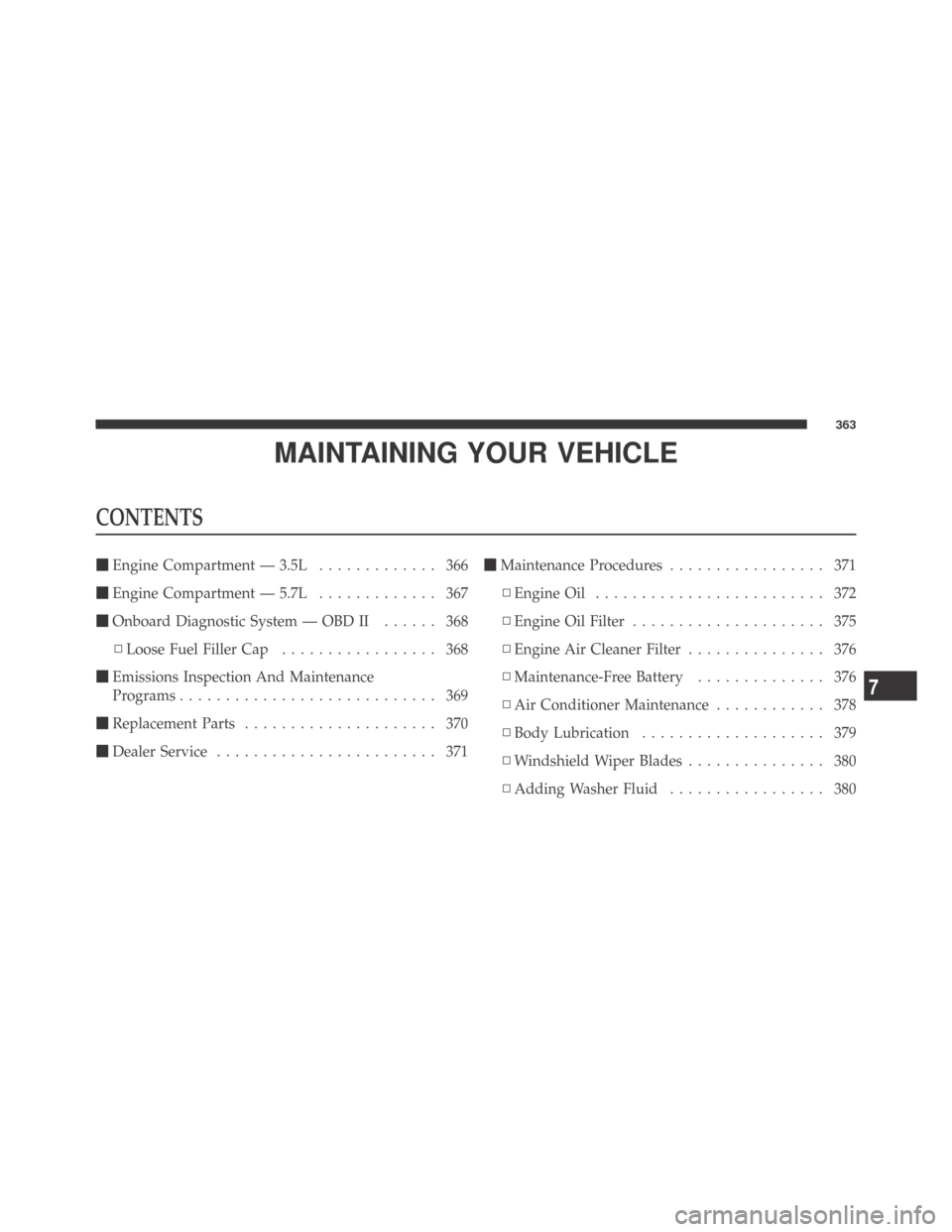
CONTENTS
�Engine Compartment — 3.5L............. 366
�Engine Compartment — 5.7L............. 367
�Onboard Diagnostic System — OBD II...... 368
▫Loose Fuel Filler Cap................. 368
�Emissions Inspection And Maintenance
Programs............................ 369
�Replacement Parts..................... 370
�Dealer Service........................ 371�Maintenance Procedures................. 371
▫Engine Oil......................... 372
▫Engine Oil Filter..................... 375
▫Engine Air Cleaner Filter............... 376
▫Maintenance-Free Battery.............. 376
▫Air Conditioner Maintenance............ 378
▫Body Lubrication.................... 379
▫Windshield Wiper Blades............... 380
▫Adding Washer Fluid................. 380
7
363
Page 370 of 469

ONBOARD DIAGNOSTIC SYSTEM — OBD II
Your vehicle is equipped with a sophisticated onboard
diagnostic system called OBD II. This system monitors
the performance of the emissions, engine, and automatic
transmission control systems. When these systems are
operating properly, your vehicle will provide excellent
performance and fuel economy, as well as engine emis-
sions well within current government regulations.
If any of these systems require service, the OBD II system
will turn on the Malfunction Indicator Light (MIL). It will
also store diagnostic codes and other information to
assist your service technician in making repairs. Al-
though your vehicle will usually be drivable and not
need towing, see your authorized dealer for service as
soon as possible.CAUTION!
•Prolonged driving with the MIL on could cause
further damage to the emissions control system. It
could also affect fuel economy and driveability.
The vehicle must be serviced before any emissions
tests can be performed.
•If the MIL is flashing while the engine is running,
severe catalytic converter damage and power loss
will soon occur. Immediate service is required.
Loose Fuel Filler Cap
If the vehicle diagnostic system determines that the fuel
filler cap is loose, improperly installed, or damaged, a
“Check Gascap” message will display in the Electronic
Vehicle Information Center (EVIC) (if equipped). If this
occurs, tighten the fuel filler cap properly and press the
368 MAINTAINING YOUR VEHICLE
Page 371 of 469

Trip Odometer button to turn off the message. If the
problem continues, the message will appear the next time
the vehicle is started.
A loose, improperly installed, or damaged fuel filler cap
may also turn on the MIL.
EMISSIONS INSPECTION AND MAINTENANCE
PROGRAMS
In some localities, it may be a legal requirement to pass
an inspection of this vehicle’s emissions control system.
Failure to pass could prevent vehicle registration.
For states that require an Inspection and Mainte-
nance (I/M), this check verifies the Malfunction
Indicator Light (MIL) is functioning and is not on
when the engine is running, and that the OBD II system
is ready for testing.
Normally, the OBD II system will be ready. The OBD II
system maynotbe ready if the vehicle was recentlyserviced, recently had a dead battery, or a battery replace-
ment. If the OBD II system should be determined not
ready for the I/M test, the vehicle may fail the test.
This vehicle has a simple ignition key-actuated test,
which you can use prior to going to the test station. To
check if this vehicle’s OBD II system is ready, you must
do the following:
1. Insert the ignition key into the ignition switch.
2. Turn the ignition to the ON position, but do not crank
or start the engine.
3. If you crank or start the engine, you will have to start
this test over.
4. As soon as you turn the ignition key to the ON
position, you will see the MIL symbol come on as part of
a normal bulb check.
7
MAINTAINING YOUR VEHICLE 369
Page 376 of 469
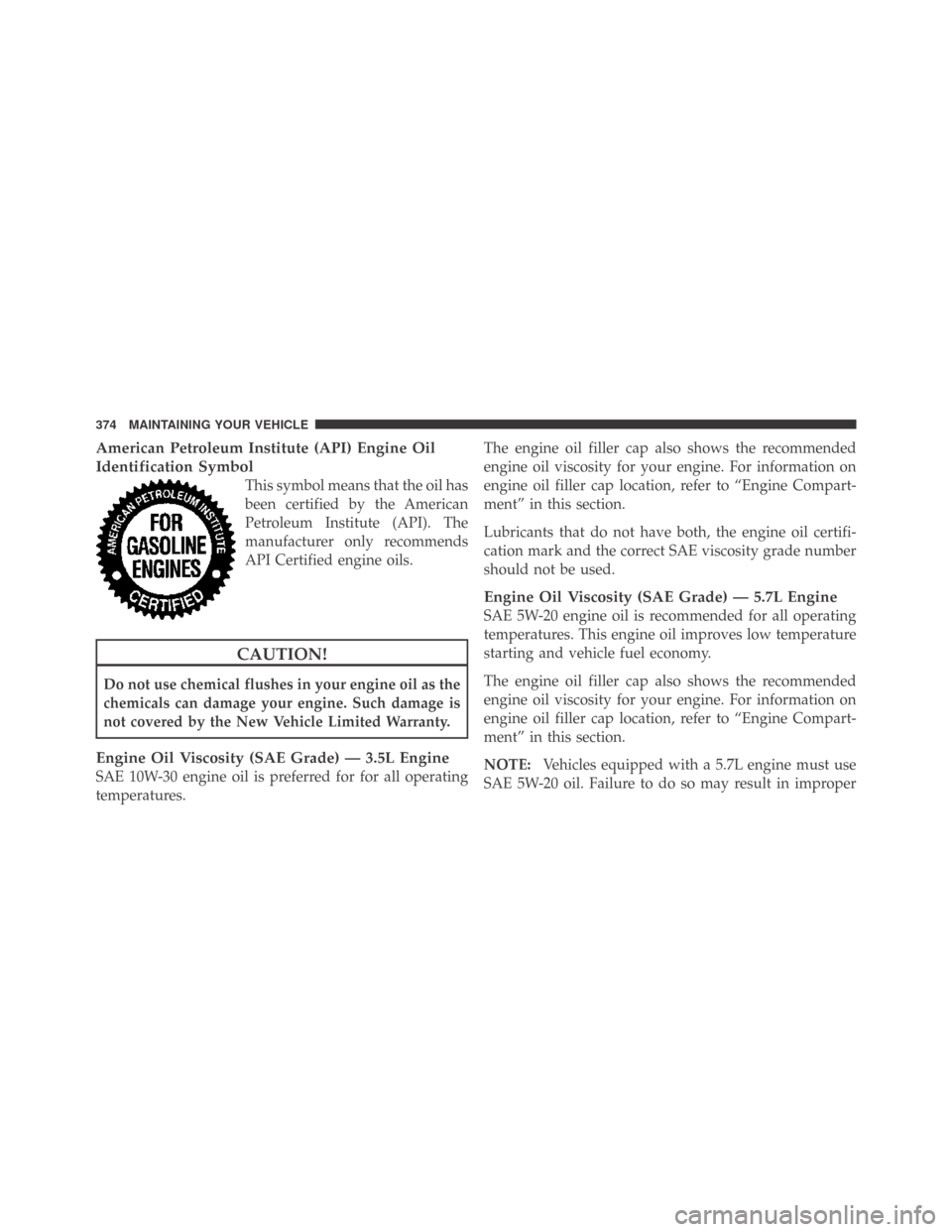
American Petroleum Institute (API) Engine Oil
Identification Symbol
This symbol means that the oil has
been certified by the American
Petroleum Institute (API). The
manufacturer only recommends
API Certified engine oils.
CAUTION!
Do not use chemical flushes in your engine oil as the
chemicals can damage your engine. Such damage is
not covered by the New Vehicle Limited Warranty.
Engine Oil Viscosity (SAE Grade) — 3.5L Engine
SAE 10W-30 engine oil is preferred for for all operating
temperatures.The engine oil filler cap also shows the recommended
engine oil viscosity for your engine. For information on
engine oil filler cap location, refer to “Engine Compart-
ment” in this section.
Lubricants that do not have both, the engine oil certifi-
cation mark and the correct SAE viscosity grade number
should not be used.
Engine Oil Viscosity (SAE Grade) — 5.7L Engine
SAE 5W-20 engine oil is recommended for all operating
temperatures. This engine oil improves low temperature
starting and vehicle fuel economy.
The engine oil filler cap also shows the recommended
engine oil viscosity for your engine. For information on
engine oil filler cap location, refer to “Engine Compart-
ment” in this section.
NOTE:Vehicles equipped with a 5.7L engine must use
SAE 5W-20 oil. Failure to do so may result in improper
374 MAINTAINING YOUR VEHICLE
Page 416 of 469
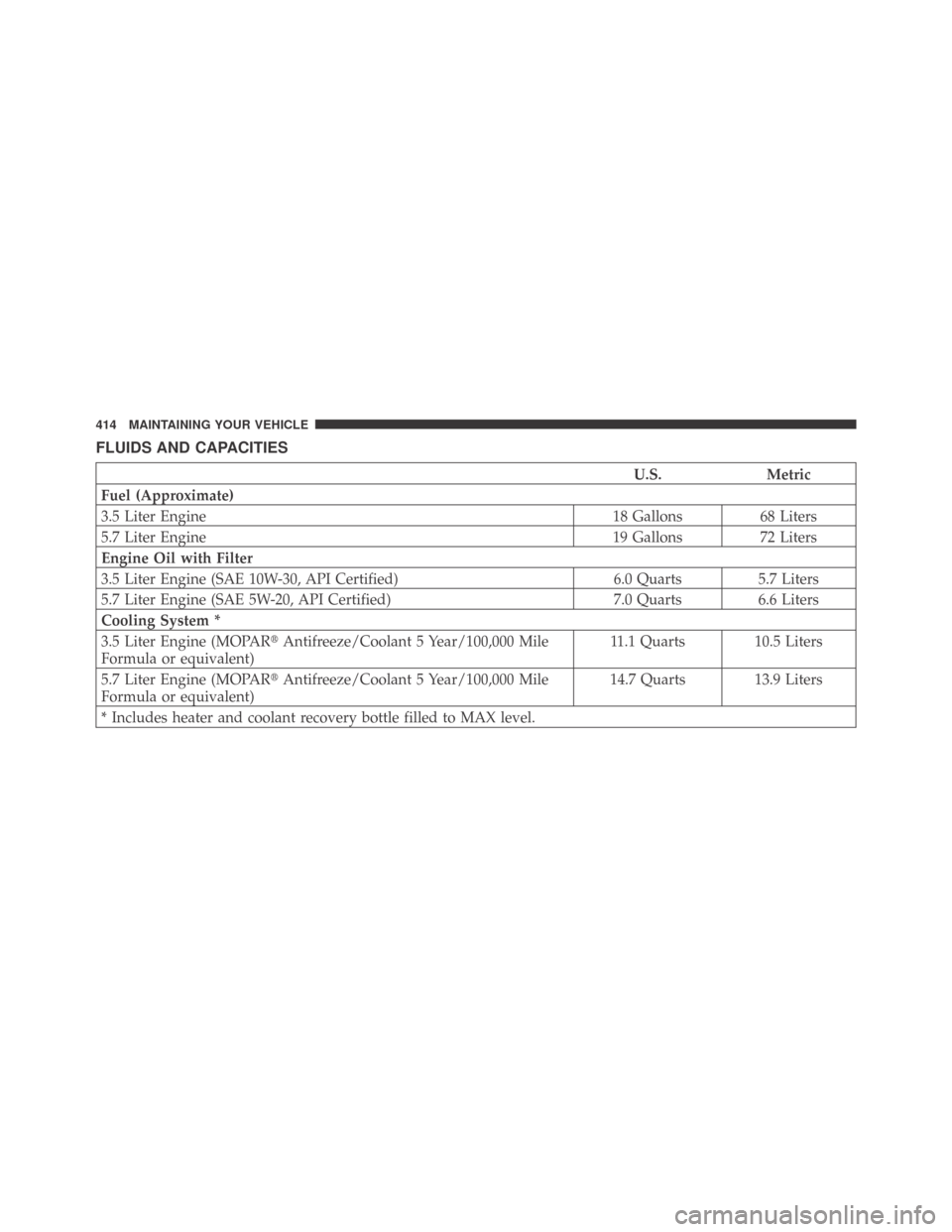
FLUIDS AND CAPACITIES
U.S. Metric
Fuel (Approximate)
3.5 Liter Engine 18 Gallons 68 Liters
5.7 Liter Engine 19 Gallons 72 Liters
Engine Oil with Filter
3.5 Liter Engine (SAE 10W-30, API Certified) 6.0 Quarts 5.7 Liters
5.7 Liter Engine (SAE 5W-20, API Certified) 7.0 Quarts 6.6 Liters
Cooling System *
3.5 Liter Engine (MOPAR�Antifreeze/Coolant 5 Year/100,000 Mile
Formula or equivalent)11.1 Quarts 10.5 Liters
5.7 Liter Engine (MOPAR�Antifreeze/Coolant 5 Year/100,000 Mile
Formula or equivalent)14.7 Quarts 13.9 Liters
* Includes heater and coolant recovery bottle filled to MAX level.
414 MAINTAINING YOUR VEHICLE
Page 417 of 469
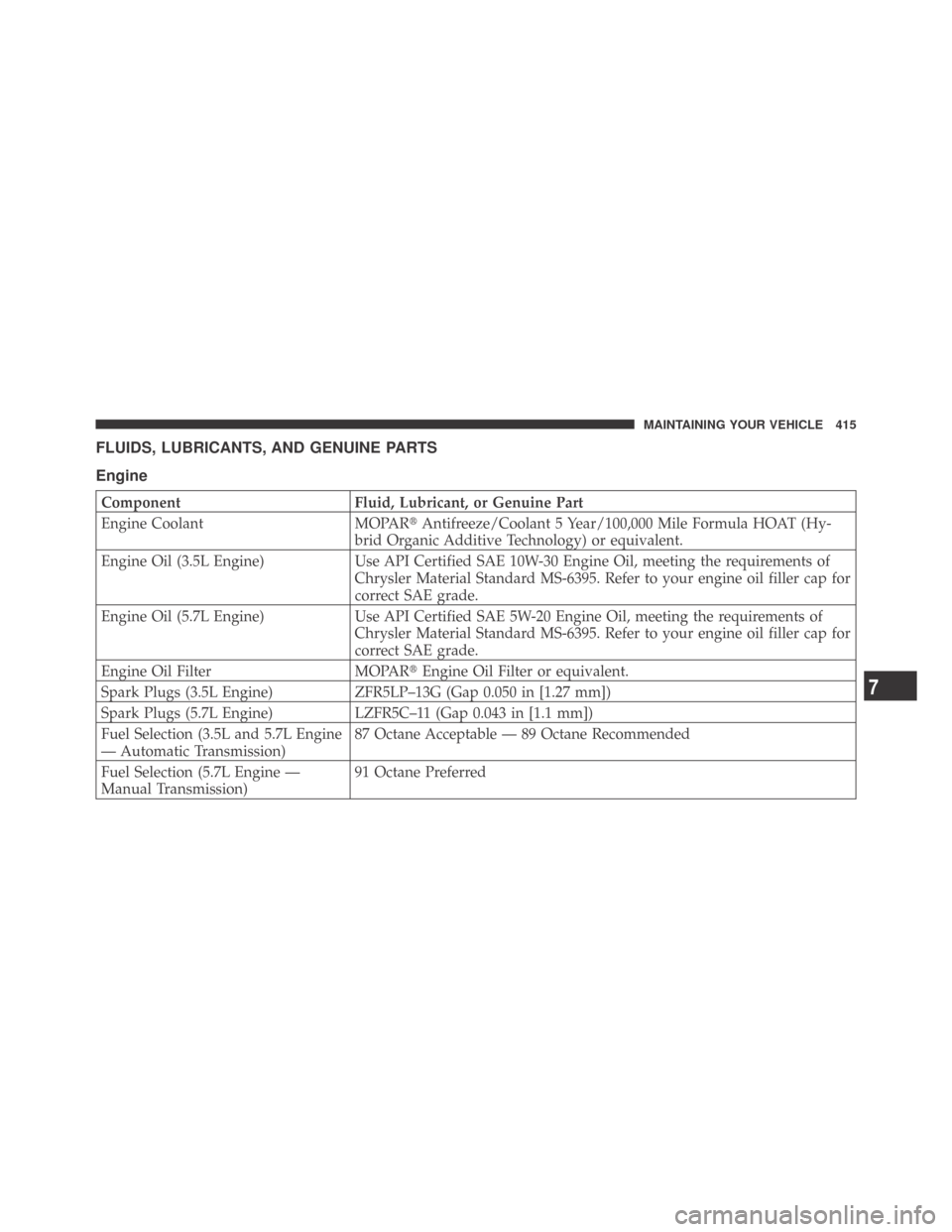
FLUIDS, LUBRICANTS, AND GENUINE PARTS
Engine
Component Fluid, Lubricant, or Genuine Part
Engine Coolant MOPAR�Antifreeze/Coolant 5 Year/100,000 Mile Formula HOAT (Hy-
brid Organic Additive Technology) or equivalent.
Engine Oil (3.5L Engine) Use API Certified SAE 10W-30 Engine Oil, meeting the requirements of
Chrysler Material Standard MS-6395. Refer to your engine oil filler cap for
correct SAE grade.
Engine Oil (5.7L Engine) Use API Certified SAE 5W-20 Engine Oil, meeting the requirements of
Chrysler Material Standard MS-6395. Refer to your engine oil filler cap for
correct SAE grade.
Engine Oil Filter MOPAR�Engine Oil Filter or equivalent.
Spark Plugs (3.5L Engine) ZFR5LP–13G (Gap 0.050 in [1.27 mm])
Spark Plugs (5.7L Engine) LZFR5C–11 (Gap 0.043 in [1.1 mm])
Fuel Selection (3.5L and 5.7L Engine
— Automatic Transmission)87 Octane Acceptable — 89 Octane Recommended
Fuel Selection (5.7L Engine —
Manual Transmission)91 Octane Preferred
7
MAINTAINING YOUR VEHICLE 415