Page 408 of 534

The automatic transaxle fluid and filter should be
changed if you REGULARLY tow a trailer for more than
45 minutes of continuous operation. Refer to the “Main-
tenance Schedule” in Section 8 of this manual for trans-
axle fluid change intervals.
NOTE:
•Check the automatic transaxle fluid level before tow-
ing.
•The six-speed automatic transaxle is sealed and re-
quires an authorized dealer to check the transaxle
fluid.
Towing Tips — Electronic Speed Control (If
Equipped)
•
Do not use in hilly terrain or with heavy loads.
•When using the speed control, if you experience speed
drops greater than 10 mph (16 km/h), disengage until
you can get back to cruising speed.
•Use speed control in flat terrain and with light loads to
maximize fuel efficiency.
Towing Tips — Cooling System
To reduce potential for engine and transaxle overheating,
take the following actions:
•City Driving
When stopped for short periods of time, put transaxle
gear selector lever in NEUTRAL but do not increase
engine idle speed.
•Highway Driving
Reduce speed.
•Air Conditioning
Turn off temporarily.
406 STARTING AND OPERATING
ProCarManuals.com
Page 412 of 534
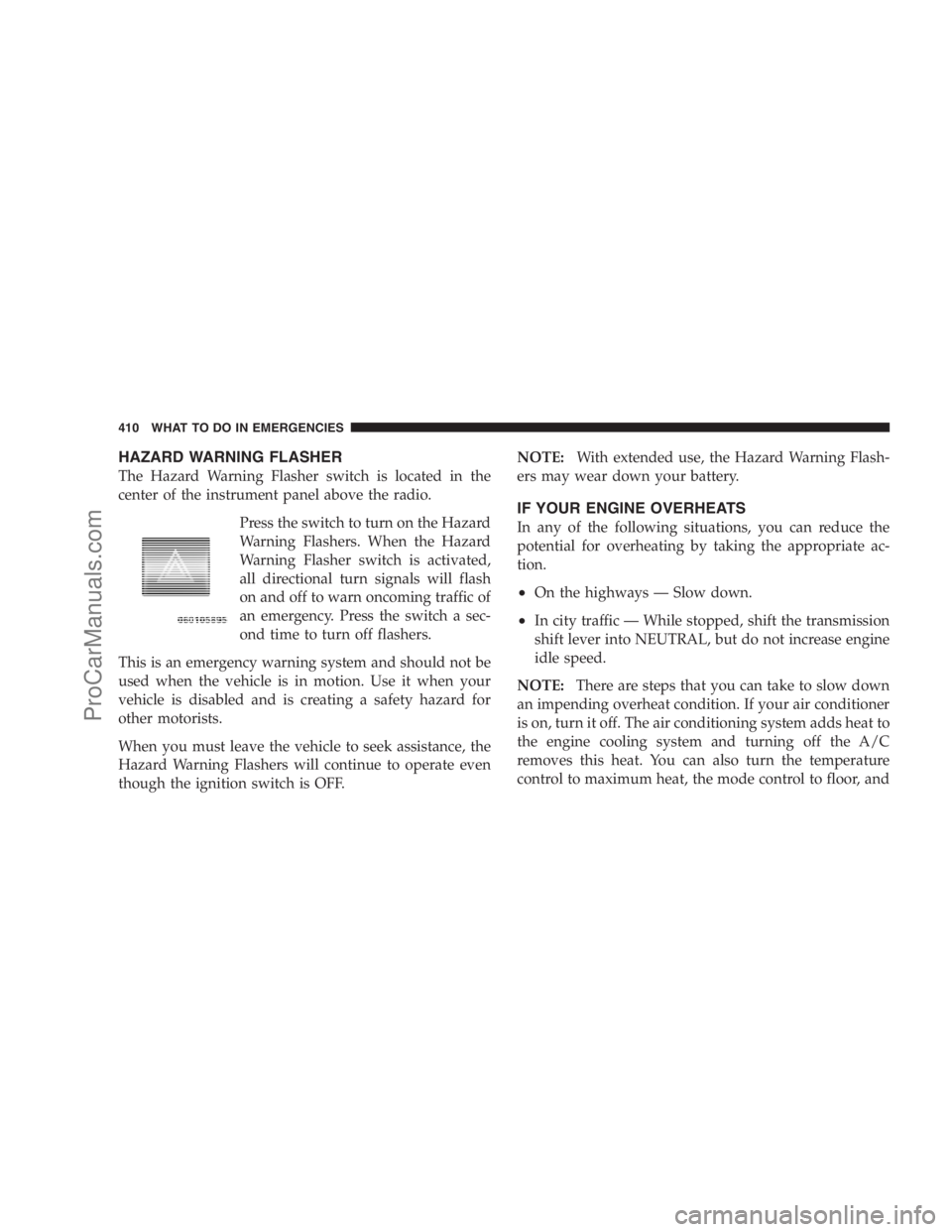
HAZARD WARNING FLASHER
The Hazard Warning Flasher switch is located in the
center of the instrument panel above the radio.
Press the switch to turn on the Hazard
Warning Flashers. When the Hazard
Warning Flasher switch is activated,
all directional turn signals will flash
on and off to warn oncoming traffic of
an emergency. Press the switch a sec-
ond time to turn off flashers.
This is an emergency warning system and should not be
used when the vehicle is in motion. Use it when your
vehicle is disabled and is creating a safety hazard for
other motorists.
When you must leave the vehicle to seek assistance, the
Hazard Warning Flashers will continue to operate even
though the ignition switch is OFF.NOTE:With extended use, the Hazard Warning Flash-
ers may wear down your battery.
IF YOUR ENGINE OVERHEATS
In any of the following situations, you can reduce the
potential for overheating by taking the appropriate ac-
tion.
•On the highways — Slow down.
•In city traffic — While stopped, shift the transmission
shift lever into NEUTRAL, but do not increase engine
idle speed.
NOTE:There are steps that you can take to slow down
an impending overheat condition. If your air conditioner
is on, turn it off. The air conditioning system adds heat to
the engine cooling system and turning off the A/C
removes this heat. You can also turn the temperature
control to maximum heat, the mode control to floor, and
410 WHAT TO DO IN EMERGENCIES
ProCarManuals.com
Page 413 of 534
the fan control to high. This allows the heater core to act
as a supplement to the radiator and aids in removing heat
from the engine cooling system.
CAUTION!
Driving with a hot cooling system could damage
your vehicle. If temperature gauge reads “H”, pull
over and stop the vehicle. Idle the vehicle with the air
conditioner turned off until the pointer drops back
into the normal range. If the pointer remains on the
“H”, turn the engine off immediately, and call for
service.
WARNING!
A hot engine cooling system is dangerous. You or
others could be badly burned by steam or boiling
coolant. You may want to call a service center if your
vehicle overheats. If you decide to look under the
hood yourself, see Section 7, Maintenance, of this
manual. Follow the warnings under the Cooling
System Pressure Cap paragraph.
WHAT TO DO IN EMERGENCIES 411
6
ProCarManuals.com
Page 433 of 534
MAINTAINING YOUR VEHICLE
CONTENTS
�Engine Compartment — 3.3/3.8L.......... 433
�Engine Compartment — 4.0L............. 434
�Onboard Diagnostic System — OBD II....... 435
▫Loose Fuel Filler Cap Message — Gascap . . . 435
�Emissions Inspection And Maintenance
Programs............................ 436
�Replacement Parts..................... 437
�Dealer Service........................ 438
�Maintenance Procedures................. 438▫Engine Oil......................... 438
▫Engine Oil Filter..................... 441
▫Engine Air Cleaner Filter............... 441
▫Exhaust System...................... 442
▫Maintenance-Free Battery............... 444
▫Air Conditioner Maintenance............ 446
▫Steering Shaft Seal.................... 448
▫Drive Shaft Universal Joints............. 448
▫Body Lubrication..................... 448
7
ProCarManuals.com
Page 448 of 534

Air Conditioner Maintenance
For best possible performance, your air conditioner
should be checked and serviced by an authorized dealer
at the start of each warm season. This service should
include cleaning of the condenser fins and a system
performance check. Drive belt tension should also be
checked at this time.
WARNING!
•Use only refrigerants and compressor lubricants
approved by the manufacturer for your air condi-
tioning system. Some unapproved refrigerants are
flammable and can explode, injuring you. Other
unapproved refrigerants or lubricants can cause
the system to fail, requiring costly repairs. Refer to
Section 3 of the Warranty Information book for
further warranty information.
(Continued)
WARNING! (Continued)
•The air conditioning system contains refrigerant
under high pressure. To avoid risk of personal
injury or damage to the system, adding refrigerant
or any repair requiring lines to be disconnected
should be done by an experienced repairman.
Refrigerant Recovery and Recycling
R-134a air conditioning refrigerant is a hydrofluoro-
carbon (HFC) that is endorsed by the Environmental
Protection Agency and is an ozone-saving product. How-
ever, the manufacturer recommends that air conditioning
service be performed by an authorized dealer, or other
authorized service facility, using recovery and recycling
equipment.
NOTE:Use only manufacturer-approved A/C System
Sealers, Stop Leak Products, Seal Conditioners, Compres-
sor Oil, or Refrigerants.
446 MAINTAINING YOUR VEHICLE
ProCarManuals.com
Page 458 of 534
•Keep the front of the radiator clean. If your vehicle is
equipped with air conditioning, also keep the front of
the condenser clean also.
•Do not change the thermostat for Summer or Winter
operation. If replacement is ever necessary, install
ONLY the correct type thermostat. Other designs may
result in unsatisfactory coolant performance, poor gas
mileage, and increased emissions.
Brakes
In order to assure brake system performance, all brake
system components should be inspected periodically.
Refer to the “Maintenance Schedule” in Section 8 for the
proper maintenance intervals.
WARNING!
Riding the brakes can lead to brake failure and
possibly an accident. Driving with your foot resting
or riding on the brake pedal can result in abnormally
high brake temperatures, excessive lining wear, and
possible brake damage. You wouldn’t have your full
braking capacity in an emergency.
Master Cylinder — Brake Fluid Level Check
The fluid level in the master cylinder should be checked
when performing underhood services, or immediately if
the brake system warning light indicates system failure.
Clean the top of the master cylinder area before removing
the cap. Add fluid to bring the level up to the top of the
“FULL” mark on the side of the master cylinder reservoir.
Overfilling of fluid is not recommended because it may
cause leaking in the system.
456 MAINTAINING YOUR VEHICLE
ProCarManuals.com
Page 463 of 534
road surfaces on which the vehicle is operated, extreme
hot or cold weather and other extreme conditions will
have an adverse effect on paint, metal trim, and under-
body protection.
The following maintenance recommendations will enable
you to obtain maximum benefit from the corrosion
resistance built into your vehicle.
What Causes Corrosion?
Corrosion is the result of deterioration or removal of
paint and protective coatings from your vehicle.
The most common causes are:
•Road salt, dirt and moisture accumulation
•Stone and gravel impact
•Insects, tree sap and tar
•Salt in the air near seacoast localities
•Atmospheric fallout/industrial pollutants
Washing
•
Wash your vehicle regularly. Always wash your ve-
hicle in the shade using MOPAR�Car Wash or a mild
car wash soap, and rinse the panels completely with
clear water.
•If insects, tar or other similar deposits have accumu-
lated on your vehicle, use MOPAR�Super Kleen Bug
and Tar Remover to remove.
•Use MOPAR�Cleaner Wax to remove road film, stains
and to protect your paint finish. Take care never to
scratch the paint.
•Avoid using abrasive compounds and power buffing
that may diminish the gloss or thin out the paint
finish.
MAINTAINING YOUR VEHICLE 461
7
ProCarManuals.com
Page 473 of 534
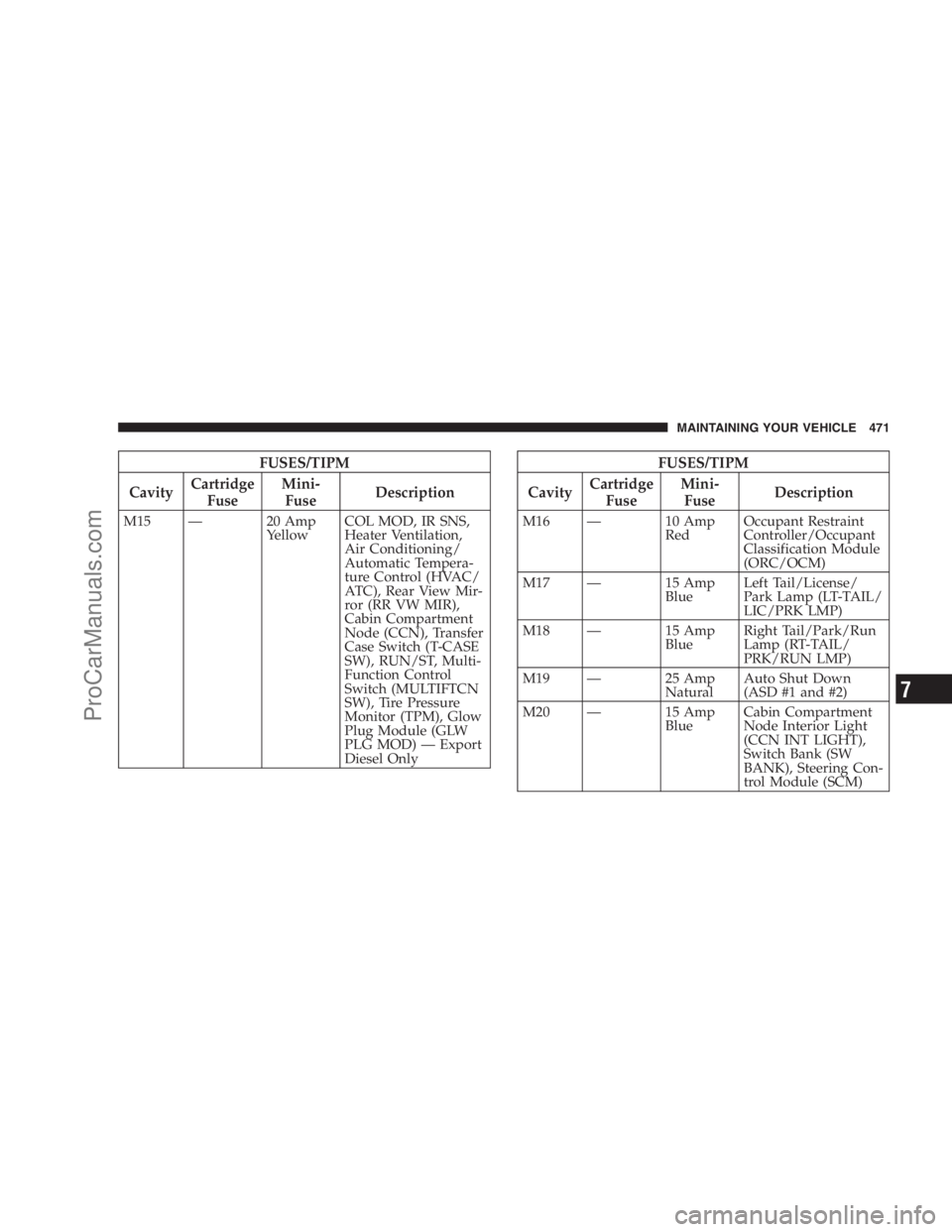
FUSES/TIPM
CavityCartridge
FuseMini-
FuseDescription
M15 — 20 Amp
YellowCOL MOD, IR SNS,
Heater Ventilation,
Air Conditioning/
Automatic Tempera-
ture Control (HVAC/
ATC), Rear View Mir-
ror (RR VW MIR),
Cabin Compartment
Node (CCN), Transfer
Case Switch (T-CASE
SW), RUN/ST, Multi-
Function Control
Switch (MULTIFTCN
SW), Tire Pressure
Monitor (TPM), Glow
Plug Module (GLW
PLG MOD) — Export
Diesel Only
FUSES/TIPM
CavityCartridge
FuseMini-
FuseDescription
M16 — 10 Amp
RedOccupant Restraint
Controller/Occupant
Classification Module
(ORC/OCM)
M17 — 15 Amp
BlueLeft Tail/License/
Park Lamp (LT-TAIL/
LIC/PRK LMP)
M18 — 15 Amp
BlueRight Tail/Park/Run
Lamp (RT-TAIL/
PRK/RUN LMP)
M19 — 25 Amp
NaturalAuto Shut Down
(ASD #1 and #2)
M20 — 15 Amp
BlueCabin Compartment
Node Interior Light
(CCN INT LIGHT),
Switch Bank (SW
BANK), Steering Con-
trol Module (SCM)
MAINTAINING YOUR VEHICLE 471
7
ProCarManuals.com