Page 324 of 534

�Anti-Lock Brake System (ABS)............ 341
▫Anti-Lock Brake Light................. 343
�Brake System......................... 343
�Electronic Brake Control System........... 344
▫Traction Control System (TCS)........... 345
▫Brake Assist System (BAS).............. 346
▫Electronic Stability Program (ESP)......... 347
▫ESP/BAS Warning Light............... 348
�Tire Safety Information.................. 349
▫Tire Markings....................... 349
▫Tire Identification Number (TIN).......... 353
▫Tire Loading And Tire Pressure........... 354
�Tires — General Information.............. 358▫Tire Pressure........................ 358
�Tire Chains.......................... 367
�Snow Tires.......................... 368
�Tire Rotation......................... 369
�Tire Pressure Monitor System (TPMS)....... 370
▫Basic TPMS Without EVIC — If Equipped . . . 372
▫Premium TPMS With EVIC — If Equipped . . 374
�Fuel Requirements..................... 378
▫3.3L/3.8L Gasoline Engine.............. 378
▫4.0L Gasoline Engine.................. 379
▫Reformulated Gasoline................. 379
▫Gasoline/Oxygenate Blends............. 380
▫E-85 Usage In Non-Flex Fuel Vehicles...... 380
322 STARTING AND OPERATING
ProCarManuals.com
Page 347 of 534
Traction Control System (TCS)
This system monitors the amount of wheel spin of each of
the driven wheels. If wheel spin is detected, brake
pressure is applied to the slipping wheel(s) and engine
power is reduced, to provide enhanced acceleration and
stability. A feature of the TCS functions similarly to a
limited-slip differential, and controls the wheel spin
across a driven axle. If one wheel on a driven axle is
spinning faster than the other, the system will apply the
brake of the spinning wheel. This will allow more engine
torque to be applied to the wheel that is not spinning.
This feature remains active even if the ESP is in the
“Partial Off” mode.
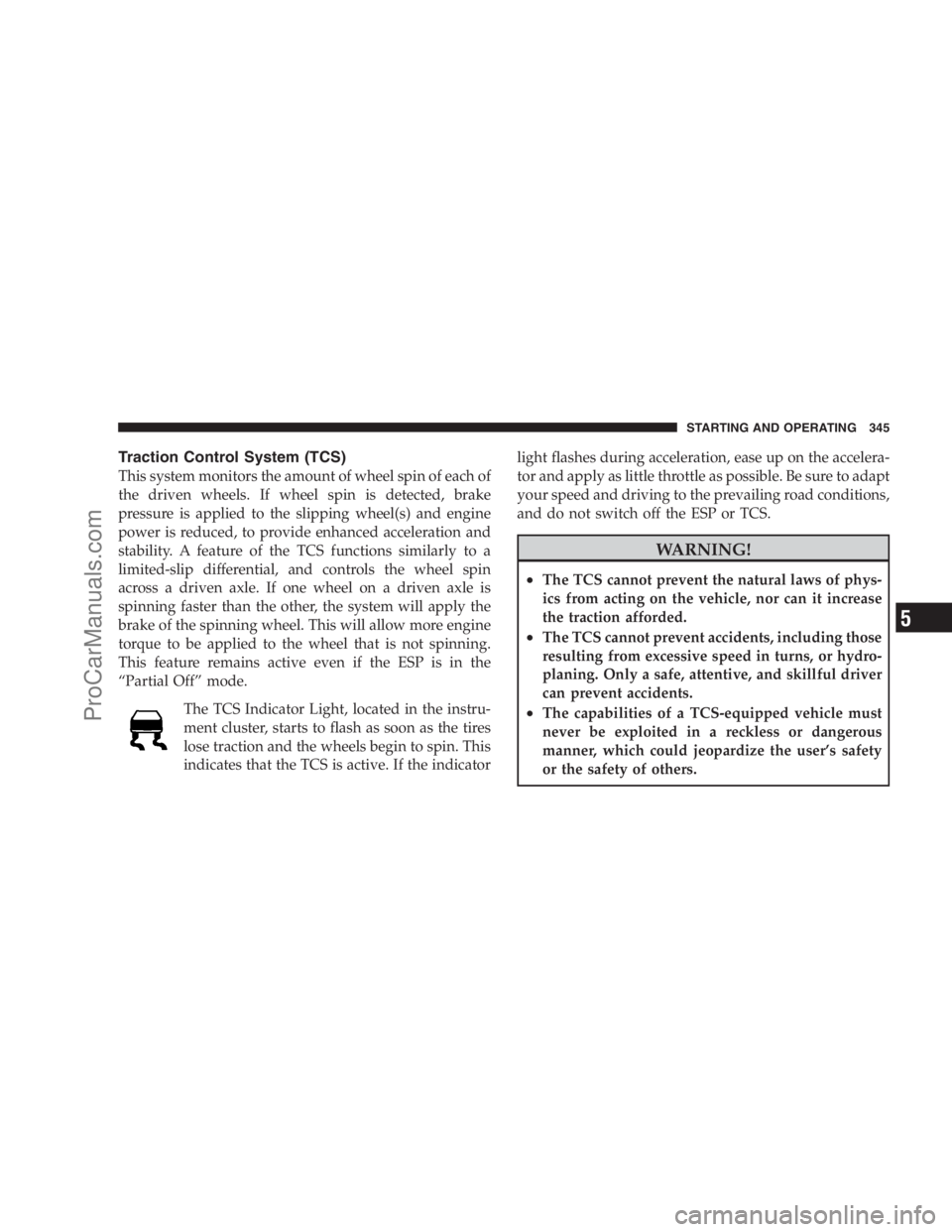
The TCS Indicator Light, located in the instru-
ment cluster, starts to flash as soon as the tires
lose traction and the wheels begin to spin. This
indicates that the TCS is active. If the indicatorlight flashes during acceleration, ease up on the accelera-
tor and apply as little throttle as possible. Be sure to adapt
your speed and driving to the prevailing road conditions,
and do not switch off the ESP or TCS.
WARNING!
•The TCS cannot prevent the natural laws of phys-
ics from acting on the vehicle, nor can it increase
the traction afforded.
•The TCS cannot prevent accidents, including those
resulting from excessive speed in turns, or hydro-
planing. Only a safe, attentive, and skillful driver
can prevent accidents.
•The capabilities of a TCS-equipped vehicle must
never be exploited in a reckless or dangerous
manner, which could jeopardize the user’s safety
or the safety of others.
STARTING AND OPERATING 345
5
ProCarManuals.com
Page 351 of 534
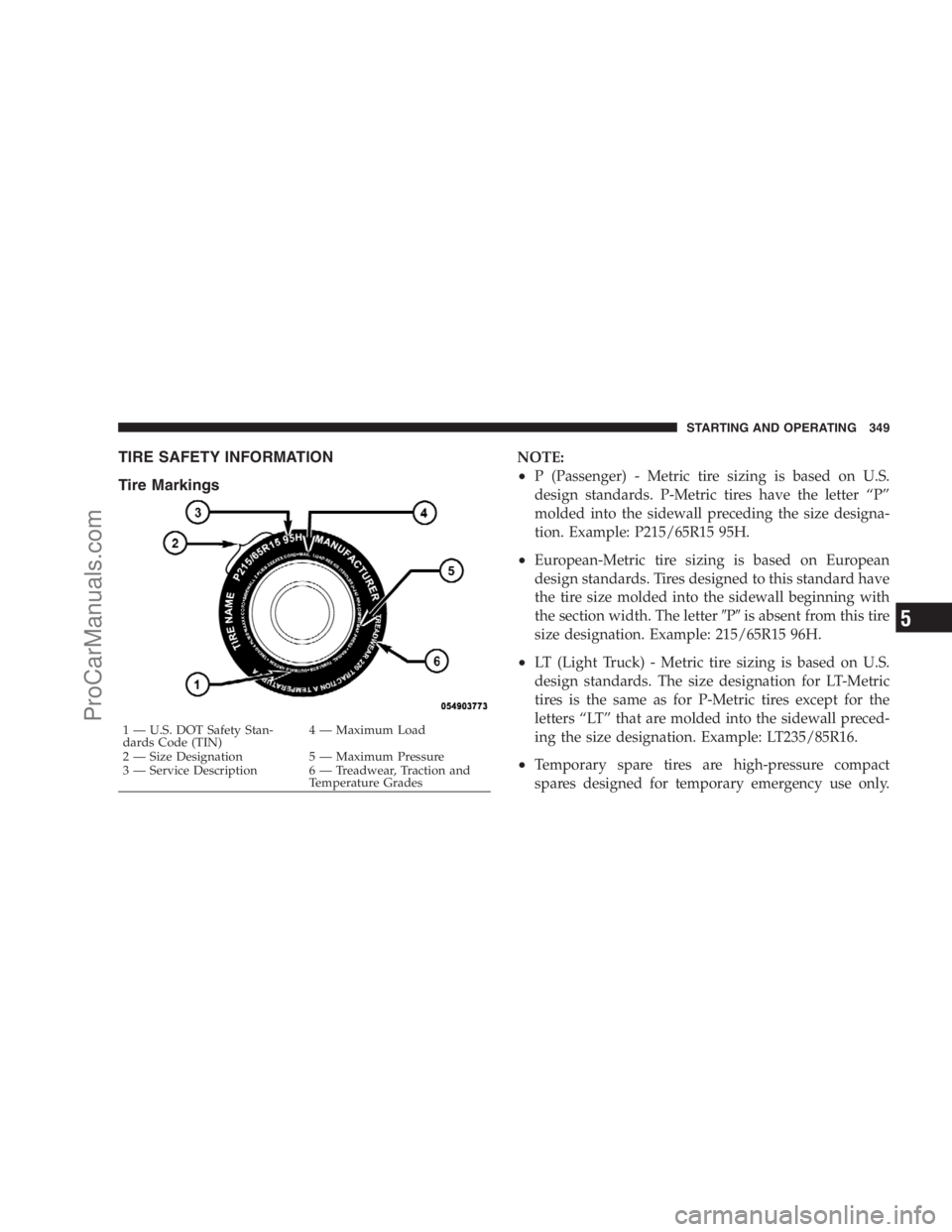
TIRE SAFETY INFORMATION
Tire MarkingsNOTE:
•P (Passenger) - Metric tire sizing is based on U.S.
design standards. P-Metric tires have the letter “P”
molded into the sidewall preceding the size designa-
tion. Example: P215/65R15 95H.
•European-Metric tire sizing is based on European
design standards. Tires designed to this standard have
the tire size molded into the sidewall beginning with
the section width. The letter�P�is absent from this tire
size designation. Example: 215/65R15 96H.
•LT (Light Truck) - Metric tire sizing is based on U.S.
design standards. The size designation for LT-Metric
tires is the same as for P-Metric tires except for the
letters “LT” that are molded into the sidewall preced-
ing the size designation. Example: LT235/85R16.
•Temporary spare tires are high-pressure compact
spares designed for temporary emergency use only.
1 — U.S. DOT Safety Stan-
dards Code (TIN)4 — Maximum Load
2 — Size Designation 5 — Maximum Pressure
3 — Service Description 6 — Treadwear, Traction and
Temperature GradesSTARTING AND OPERATING 349
5
ProCarManuals.com
Page 353 of 534
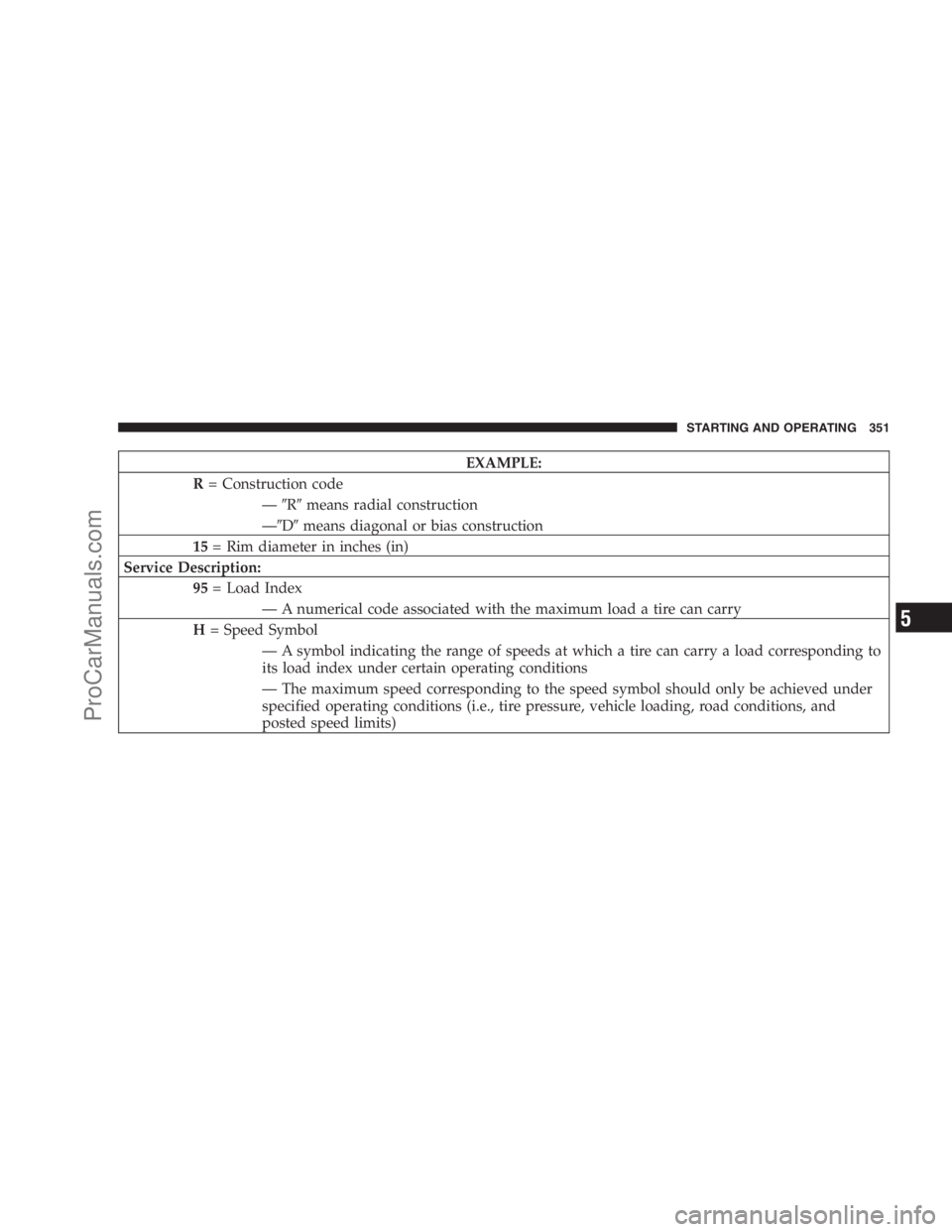
EXAMPLE:
R= Construction code
—�R�means radial construction
—�D�means diagonal or bias construction
15= Rim diameter in inches (in)
Service Description:
95= Load Index
— A numerical code associated with the maximum load a tire can carry
H= Speed Symbol
— A symbol indicating the range of speeds at which a tire can carry a load corresponding to
its load index under certain operating conditions
— The maximum speed corresponding to the speed symbol should only be achieved under
specified operating conditions (i.e., tire pressure, vehicle loading, road conditions, and
posted speed limits)
STARTING AND OPERATING 351
5
ProCarManuals.com
Page 354 of 534
EXAMPLE:
Load Identification:
�....blank....�= Absence of any text on the sidewall of the tire indicates a Standard Load (SL) Tire
Extra Load (XL)= Extra load (or reinforced) tire
Light Load= Light load tire
C, D, E= Load range associated with the maximum load a tire can carry at a specified pressure
Maximum Load— Maximum load indicates the maximum load this tire is designed to carry
Maximum Pressure— Maximum pressure indicates the maximum permissible cold tire inflation pressure for this
tire
352 STARTING AND OPERATING
ProCarManuals.com
Page 356 of 534
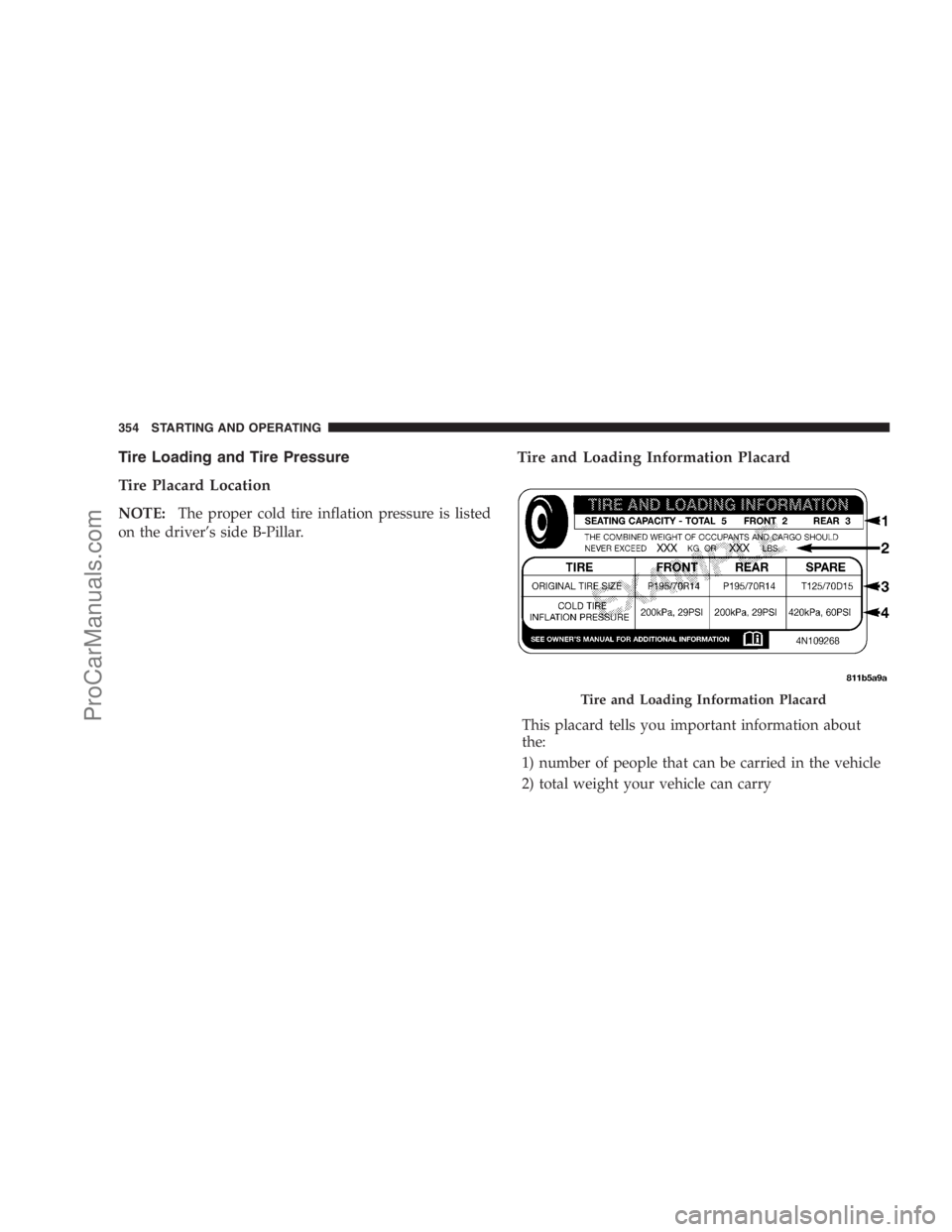
Tire Loading and Tire Pressure
Tire Placard Location
NOTE:The proper cold tire inflation pressure is listed
on the driver’s side B-Pillar.
Tire and Loading Information Placard
This placard tells you important information about
the:
1) number of people that can be carried in the vehicle
2) total weight your vehicle can carry
Tire and Loading Information Placard
354 STARTING AND OPERATING
ProCarManuals.com
Page 357 of 534
3) tire size designed for your vehicle
4) cold tire inflation pressures for the front, rear, and
spare tires.
Loading
The vehicle maximum load on the tire must not exceed
the load carrying capacity of the tire on your vehicle. You
will not exceed the tire’s load carrying capacity if you
adhere to the loading conditions, tire size, and cold tire
inflation pressures specified on the Tire and Loading
Information placard and in the “Vehicle Loading” section
of this manual.
NOTE:Under a maximum loaded vehicle condition,
gross axle weight ratings (GAWRs) for the front and rear
axles must not be exceeded. For further information on
GAWRs, vehicle loading, and trailer towing, refer to
“Vehicle Loading” in this section.
To determine the maximum loading conditions of your
vehicle, locate the statement “The combined weight ofoccupants and cargo should never exceed XXX kg or XXX
lbs.” on the Tire and Loading Information placard. The
combined weight of occupants, cargo/luggage and
trailer tongue weight (if applicable) should never exceed
the weight referenced here.
Steps for Determining Correct Load Limit
1. Locate the statement “The combined weight of occu-
pants and cargo should never exceed XXX kg or XXX lbs”
on your vehicle’s placard.
2. Determine the combined weight of the driver and
passengers that will be riding in your vehicle.
3. Subtract the combined weight of the driver and pas-
sengers from XXX kg or XXX lbs.
4. The resulting figure equals the available amount of
cargo and luggage load capacity. For example, if “XXX”
amount equals 1,400 lbs (635 kg) and there will be five
150 lb (68 kg) passengers in your vehicle, the amount of
STARTING AND OPERATING 355
5
ProCarManuals.com
Page 360 of 534

WARNING!
Overloading of your tires is dangerous. Overloading
can cause tire failure, affect vehicle handling, and
increase your stopping distance. Use tires of the
recommended load capacity for your vehicle. Never
overload them.
TIRES — GENERAL INFORMATION
Tire Pressure
Proper tire inflation pressure is essential to the safe and
satisfactory operation of your vehicle. Three primary
areas are affected by improper tire pressure.
Safety
WARNING!
•Improperly inflated tires are dangerous and can
cause accidents.
•Under-inflation increases tire flexing and can re-
sult in tire failure.
•Over-inflation reduces a tire’s ability to cushion
shock. Objects on the road and chuckholes can
cause damage that result in tire failure.
•Unequal tire pressures can cause steering prob-
lems. You could lose control of your vehicle.
•Over-inflated or under-inflated tires can affect
vehicle handling and can fail suddenly, resulting
in loss of vehicle control.
(Continued)
358 STARTING AND OPERATING
ProCarManuals.com