Page 332 of 534

When parking on a flat surface, place the shift lever in the
PARK position first, and then apply the parking brake.
When parking on a hill, it is important to set the parking
brake before placing the shift lever in PARK, otherwise
the load on the transaxle locking mechanism may make it
difficult to move the shift lever out of PARK. As an added
precaution, turn the front wheels toward the curb on a
downhill grade, and away from the curb on an uphill
grade.
WARNING!
•Never use the PARK position on an automatic
transaxle as a substitute for the parking brake.
Always apply the parking brake fully when
parked to guard against vehicle movement and
possible injury or damage.
(Continued)
WARNING! (Continued)
•Unintended movement of a vehicle could injure
those in and near the vehicle. As with all vehicles,
you should never exit a vehicle while the engine is
running. Before exiting a vehicle, you should
always move the shift lever into PARK, remove the
key from the ignition, and apply the parking
brake. Once the key is removed from the ignition,
the shift lever is locked in the PARK position,
securing the vehicle against unwanted movement.
Furthermore, you should never leave unattended
children or pets inside a vehicle.
The following indicators should be used to ensure that
you have placed the shift lever into the PARK position:
•When moving the shift lever into PARK, depress the
button on the shift lever and firmly move the lever all
the way forward until it stops.
330 STARTING AND OPERATING
ProCarManuals.com
Page 341 of 534

apparent, and/or the system is not functioning as antici-
pated. Coordinate inspection efforts through an autho-
rized dealer.
WARNING!
Fluid level should be checked on a level surface and
with the engine off to prevent injury from moving
parts and to ensure accurate fluid level reading. Do
not overfill. Use only manufacturers recommended
power steering fluid.
If necessary, add fluid to restore to the proper indicated
level. With a clean cloth, wipe any spilled fluid from all
surfaces. For correct fluid type, refer to ”Power Steering
Reservoir” under “Fluids, Lubricants, and Genuine
Parts” in this section.
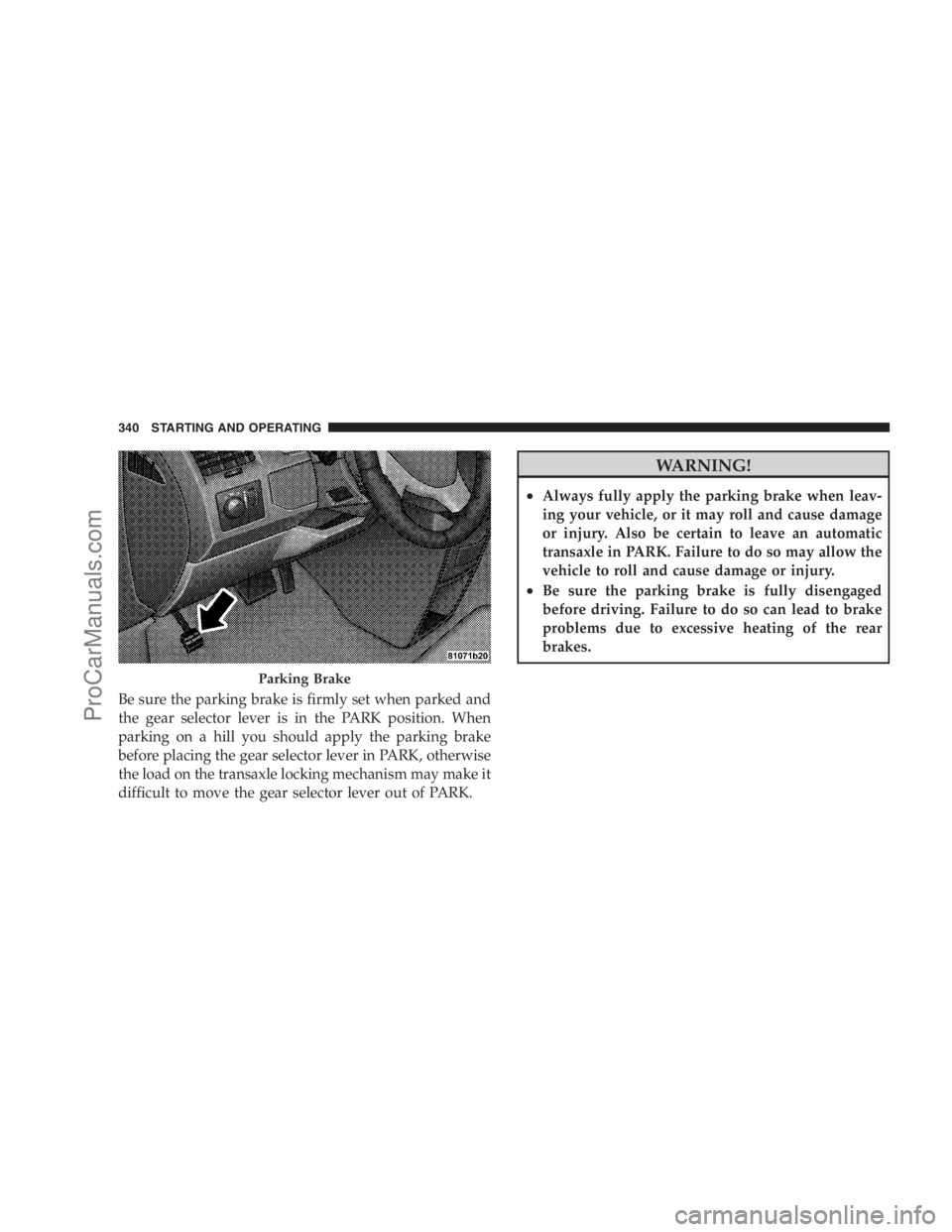
PARKING BRAKE
When the parking brake is applied with the ignition
switch ON, the brake light in the instrument cluster will
turn on.
NOTE:This light only shows that the parking brake is
applied. It does not show the degree of brake application.
Before leaving the vehicle, make sure that the parking
brake is fully applied and place the gear selector lever in
the PARK position. To release the parking brake, depress
the emergency break pedal a second time and let your
foot up as you feel the brake disengage.
STARTING AND OPERATING 339
5
ProCarManuals.com
Page 342 of 534
Be sure the parking brake is firmly set when parked and
the gear selector lever is in the PARK position. When
parking on a hill you should apply the parking brake
before placing the gear selector lever in PARK, otherwise
the load on the transaxle locking mechanism may make it
difficult to move the gear selector lever out of PARK.
WARNING!
•Always fully apply the parking brake when leav-
ing your vehicle, or it may roll and cause damage
or injury. Also be certain to leave an automatic
transaxle in PARK. Failure to do so may allow the
vehicle to roll and cause damage or injury.
•Be sure the parking brake is fully disengaged
before driving. Failure to do so can lead to brake
problems due to excessive heating of the rear
brakes.
Parking Brake
340 STARTING AND OPERATING
ProCarManuals.com
Page 343 of 534

WARNING!
NEVER leave children alone in a vehicle. Leaving
unattended children in a vehicle is dangerous for a
number of reasons. A child or others could be seri-
ously or fatally injured. Do not leave the key in the
ignition. A child could operate power windows,
other controls, or move the vehicle
When parking on a hill, turn the front wheels toward the
curb on a downhill grade, and away from the curb on an
uphill grade.
The parking brake should always be applied whenever
the driver is not in the vehicle.
ANTI-LOCK BRAKE SYSTEM (ABS)
ABS provides increased vehicle stability and brake per-
formance under most braking conditions. The system
automatically “pumps” the brakes during severe braking
conditions to prevent wheel lock-up.
ABS is activated during braking under certain road or
stopping conditions. ABS-inducing conditions can in-
clude ice, snow, gravel, bumps, railroad tracks, loose
debris, or panic stops.
You may experience the following when the brake system
goes into Anti-lock:
•The ABS motor running (it may continue to run for a
short time after the stop)
•A clicking sound of solenoid valves
•Brake pedal pulsations
STARTING AND OPERATING 341
5
ProCarManuals.com
Page 403 of 534
WARNING! (Continued)
Make certain that the load is secured in the trailer
and will not shift during travel. When trailering
cargo that is not fully secured, dynamic load shifts
can occur that may be difficult for the driver to
control. You could lose control of your vehicle and
have an accident.
•When hauling cargo or towing a trailer, do not over-
load your vehicle or trailer. Overloading can cause a
loss of control, poor performance or damage to brakes,
axle, engine, transaxle, steering, suspension, chassis
structure or tires.
•Safety chains must always be used between your
vehicle and trailer. Always connect the chains to the
frame or hook retainers of the vehicle hitch. Cross the
chains under the trailer tongue and allow enough
slack for turning corners.
•Vehicles with trailers should not be parked on a grade.
When parking, apply the parking brake on the tow
vehicle. Put the tow vehicle automatic transmission in
PARK. Always, block or�chock�the trailer wheels.
•GCWR must not be exceeded.
•Total weight must be distributed between the tow
vehicle and the trailer such that the following four
ratings are not exceeded:
1. GVWR
2. GTW
3. GAWR
4. Trailer tongue weight rating for that trailer hitch.
(This requirement may limit the ability to always
achieve the 10% to 15% range of trailer tongue weight
as a percentage of total trailer weight.)
STARTING AND OPERATING 401
5
ProCarManuals.com
Page 416 of 534
Preparations For Jacking
1. Park the vehicle on a firm level surface. Avoid ice or
slippery areas.
WARNING!
Do not attempt to change a tire on the side of the
vehicle close to moving traffic. Pull far enough off
the road to avoid being hit when operating the jack
or changing the wheel.
2. Set the parking brake.
3. Place the shift lever into PARK.
4. Turn OFF the ignition.
5. Turn on the Hazard Warning Flasher.
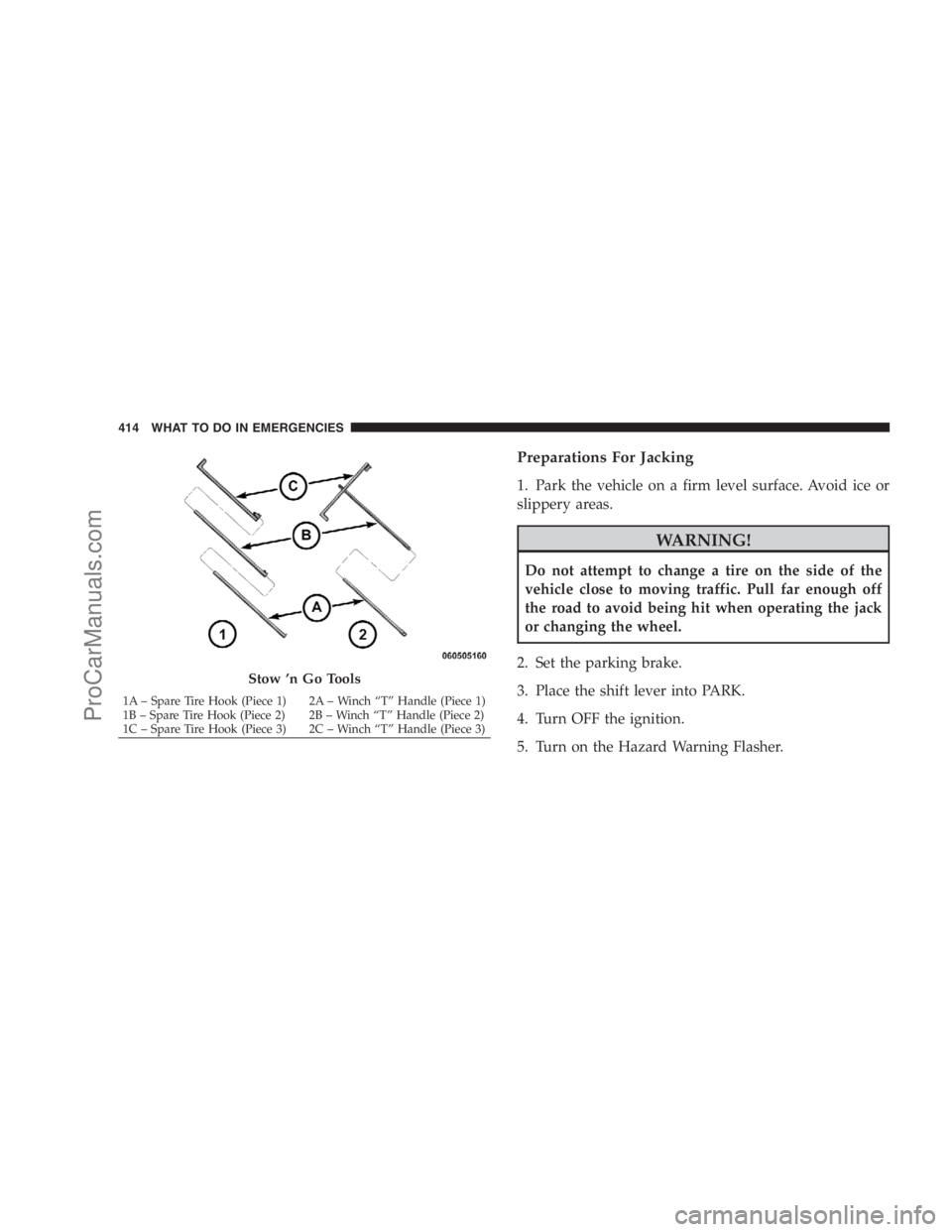
Stow ’n Go Tools
1A – Spare Tire Hook (Piece 1) 2A – Winch “T” Handle (Piece 1)
1B – Spare Tire Hook (Piece 2) 2B – Winch “T” Handle (Piece 2)
1C – Spare Tire Hook (Piece 3) 2C – Winch “T” Handle (Piece 3)
414 WHAT TO DO IN EMERGENCIES
ProCarManuals.com
Page 417 of 534
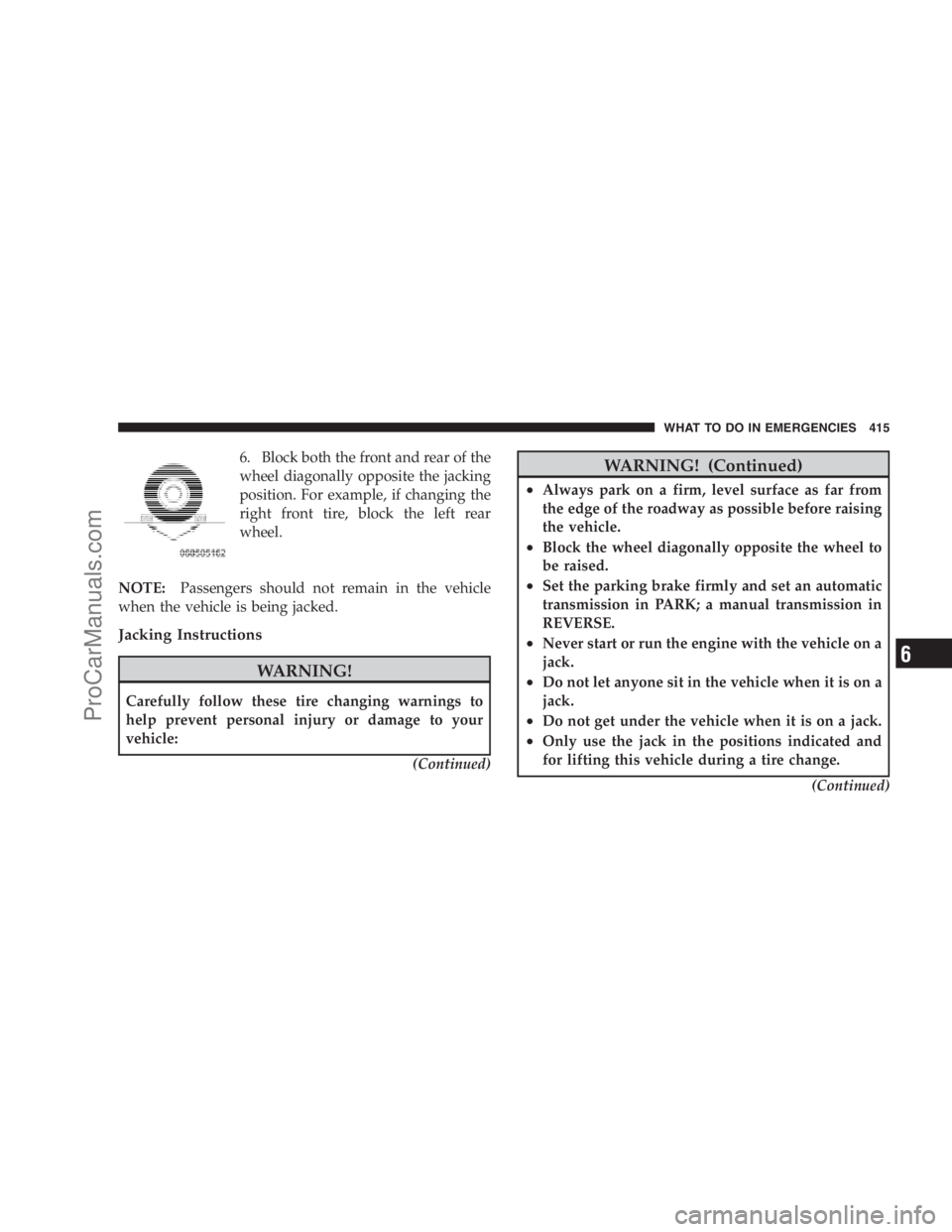
6. Block both the front and rear of the
wheel diagonally opposite the jacking
position. For example, if changing the
right front tire, block the left rear
wheel.
NOTE:Passengers should not remain in the vehicle
when the vehicle is being jacked.
Jacking Instructions
WARNING!
Carefully follow these tire changing warnings to
help prevent personal injury or damage to your
vehicle:
(Continued)
WARNING! (Continued)
•Always park on a firm, level surface as far from
the edge of the roadway as possible before raising
the vehicle.
•Block the wheel diagonally opposite the wheel to
be raised.
•Set the parking brake firmly and set an automatic
transmission in PARK; a manual transmission in
REVERSE.
•Never start or run the engine with the vehicle on a
jack.
•Do not let anyone sit in the vehicle when it is on a
jack.
•Do not get under the vehicle when it is on a jack.
•Only use the jack in the positions indicated and
for lifting this vehicle during a tire change.
(Continued)
WHAT TO DO IN EMERGENCIES 415
6
ProCarManuals.com
Page 427 of 534

WARNING! (Continued)
•Take special care to avoid the radiator cooling fan
whenever the hood is raised. The cooling fan is
electrically operated and can start anytime the
ignition switch is ON. You can be hurt by the fan.
•During cold weather when temperatures are be-
low the freezing point, electrolyte in a discharged
battery may freeze. Do not attempt jump-starting
because the battery could rupture or explode. The
battery temperature must be brought up above the
freezing point before attempting a jump-start.
When jump-starting, proceed as follows:
1. Wear eye protection and remove any metal jewelry,
such as watch bands or bracelets, that might make an
inadvertent electrical contact.2. When a boost is provided by a battery in another
vehicle, park that vehicle within booster cable reach and
do not let the vehicles touch. Set the parking brake, place
the automatic transmission shift lever into PARK and
turn the ignition switch to the OFF position for both
vehicles.
3. Turn OFF the heater, radio and all unnecessary elec-
trical loads.
4. Connect one end of a jumper cable to the positive
terminal of the discharged battery. Connect the other end
of the same cable to the positive terminal of the booster
battery.
WARNING!
Do not permit vehicles to touch each other, as this
could establish a ground connection and personal
injury could result.
WHAT TO DO IN EMERGENCIES 425
6
ProCarManuals.com