Page 305 of 411
CAUTION!
Damage to the fuel system or emission control sys-
tem could result from using an improper fuel tank
filler cap (gas cap). A poorly fitting cap could let
impurities into the fuel system.
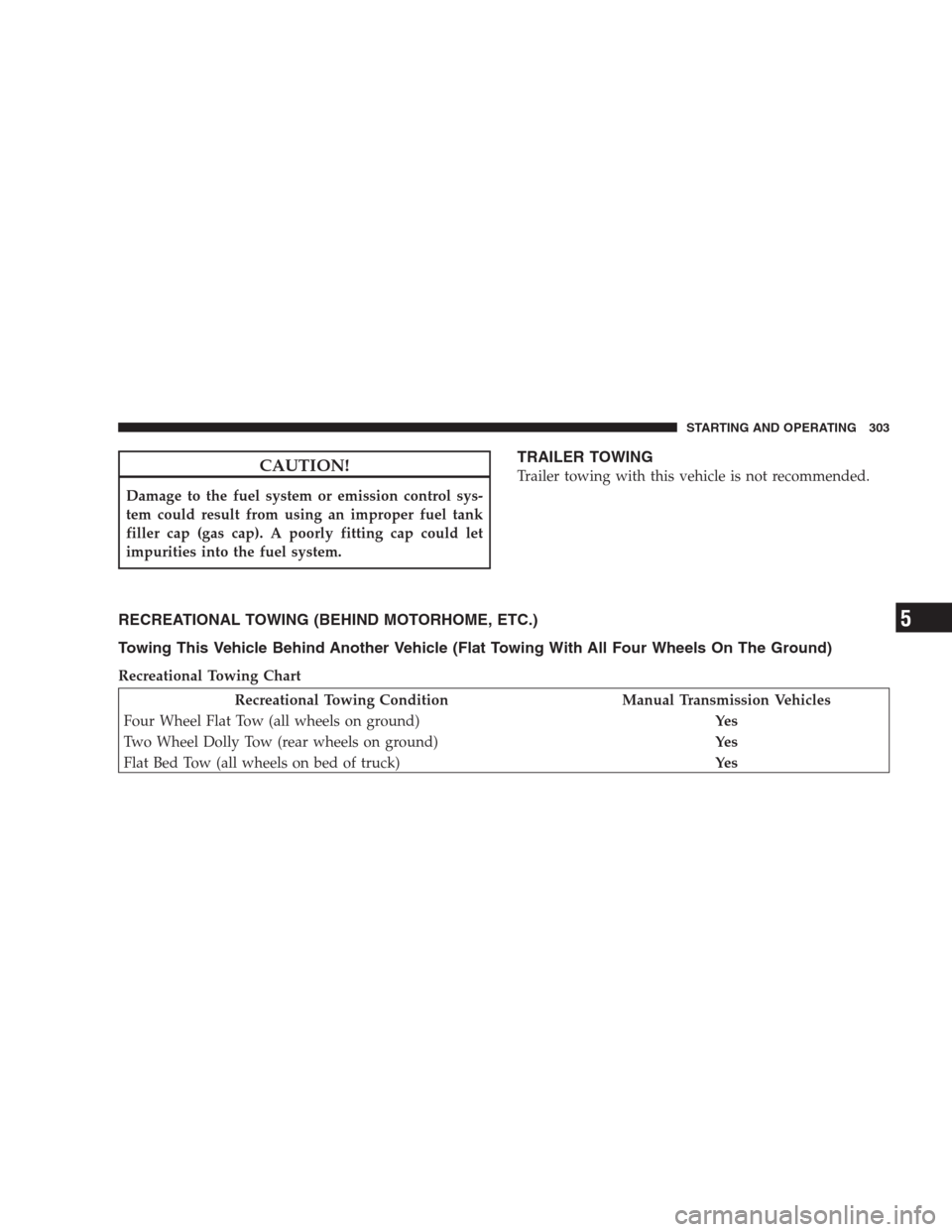
TRAILER TOWING
Trailer towing with this vehicle is not recommended.
RECREATIONAL TOWING (BEHIND MOTORHOME, ETC.)
Towing This Vehicle Behind Another Vehicle (Flat Towing With All Four Wheels On The Ground)
Recreational Towing Chart
Recreational Towing Condition Manual Transmission Vehicles
Four Wheel Flat Tow (all wheels on ground)Ye s
Two Wheel Dolly Tow (rear wheels on ground)Ye s
Flat Bed Tow (all wheels on bed of truck)Ye s
STARTING AND OPERATING 303
5
Page 306 of 411
NOTE: ONLYvehicles equipped withMANUAL
TRANSAXLESmay be recreationally towed at any legal
highway speed, for any distance, if theMANUAL
TRANSAXLEis inNEUTRALand the ignition key is in
the ACC position.CAUTION!
Rear wheel lifts should not be used. Internal damage
to the transmission will occur if a rear wheel lift is
used when recreational towing.
304 STARTING AND OPERATING
Page 307 of 411
WHAT TO DO IN EMERGENCIES
CONTENTS
�Hazard Warning Flasher................. 306
�If Your Engine Overheats................ 306
�TIREFIT Kit.......................... 308
▫TIREFIT Storage..................... 308
▫TIREFIT Usage Precautions.............. 308
▫TIREFIT Kit Components & Operation...... 311▫Sealing a Tire With TIREFIT............. 312
�Jump-Starting Procedures................ 317
�Freeing A Stuck Vehicle................. 319
�Towing A Disabled Vehicle............... 320
▫With Ignition Key.................... 320
▫Without The Ignition Key............... 322
6
Page 322 of 411

front wheels. Then shift back and forth between RE-
VERSE and 1st gear. Usually the least accelerator pedal
pressure to maintain the rocking motion without spin-
ning the wheels is most effective.
WARNING!
Fast spinning tires can be dangerous. Forces gener-
ated by excessive wheel speeds may cause axle, tire
damage or failure. A tire could explode and injure
someone. Do not spin your vehicle’s wheels faster
than 30 mph (48 km/h) or for longer than 30 seconds
continuously without stopping when you are stuck.
And don’t let anyone near a spinning wheel, no
matter what the speed.
CAUTION!
Racing the engine or spinning the wheels too fast
may lead to transaxle overheating and failure. It can
also damage the tires. Do not spin the wheels above
30 mph (48 km/h). Do not spin the wheels continu-
ously for more than 30 seconds.
TOWING A DISABLED VEHICLE
With Ignition Key
Automatic Transaxle
•
Front Wheel Drive (FWD) vehicles can be towed with
the front wheels elevated or on a flatbed truck (all four
wheels off the ground).
•All Wheel Drive (AWD) vehicles must be towed on a
flatbed truck (all four wheels off the ground).
320 WHAT TO DO IN EMERGENCIES
Page 323 of 411

CAUTION!
DO NOT flat tow any vehicle equipped with an
automatic transmission. Damage to the drivetrain
will result.
Manual Transaxle
•
Front Wheel Drive (FWD) or All Wheel Drive (AWD)
vehicles can be flat towed (all four wheels on the
ground) with the transmission in NEUTRAL.
•FWD vehicles can be towed with the front or rear
wheels elevated.
•FWD or AWD vehicles can be towed on a flatbed truck
(all wheels off the ground).
All Transaxles
If it is necessary to use the accessories while being towed
(wipers, defrosters, etc.), the key must be in the ON
position, not the ACC position. Make certain the trans-
mission remains in NEUTRAL.
CAUTION!
•If the vehicle being towed requires steering, the
ignition switch must be in the ACC position, not
in the LOCK position.
•Do not attempt to use sling type equipment when
towing. When securing the vehicle to a flat bed
truck, do not attach to front or rear suspension
components. Damage to your vehicle may result
from improper towing.
WHAT TO DO IN EMERGENCIES 321
6
Page 324 of 411
Without The Ignition Key
Special care must be taken when the vehicle is towed
with the ignition in the LOCK position. A dolly should be
used under the front wheels if the rear wheels are raised.
Proper towing equipment is necessary to prevent dam-
age to the vehicle.Battery power is required to release the brake/
transmission interlock system. There is a removable plug
in the right side of the shift lever housing that allows you
to insert your finger to override the system. The ignition
key must be in the ON position to use the override lever.
322 WHAT TO DO IN EMERGENCIES
Page 328 of 411
ONBOARD DIAGNOSTIC SYSTEM — OBD II
Your vehicle is equipped with a sophisticated Onboard
Diagnostic system called OBD II. This system monitors
the performance of the emissions, engine, and automatic
transaxle control systems. When these systems are oper-
ating properly, your vehicle will provide excellent per-
formance and fuel economy, as well as maintaining
engine emissions well within current government regu-
lations.
If any of these systems require service, the OBD II system
will turn on the Malfunction Indicator Light (MIL). It will
also store diagnostic codes and other information to
assist an authorized service technician in making repairs.
Although your vehicle will usually be drivable and not
need towing, see your authorized dealer for service as
soon as possible.CAUTION!
•Prolonged driving with the “Malfunction Indica-
tor Light” on could cause further damage to the
emission control system. It could also affect fuel
economy and driveability. The vehicle must be
serviced before any emissions tests can be per-
formed.
•If the “Malfunction Indicator Light” is flashing
while the engine is running, severe catalytic con-
verter damage and power loss will soon occur.
Immediate service is required.
Loose Fuel Filler Cap Message
After fuel is added, the vehicle diagnostic system can
determine if the fuel filler cap is possibly loose or
improperly installed. A “GASCAP” message will be
displayed in the instrument cluster. Tighten the gas cap
until a�clicking�sound is heard. This is an indication that
326 MAINTAINING YOUR VEHICLE
Page 341 of 411

WARNING!
A hot exhaust system can start a fire if you park over
materials that can burn. Such materials might be
grass or leaves coming into contact with your exhaust
system. Do not park or operate your vehicle in areas
where your exhaust system can contact anything that
can burn.
In unusual situations involving grossly malfunctioning
engine operation, a scorching odor may suggest severe
and abnormal catalyst overheating. If this occurs, stop
the vehicle, turn off the engine and allow it to cool.
Service, including a tune up to manufacturers specifica-
tions, should be obtained immediately.To minimize the possibility of catalyst damage:•Do not shut off the engine or interrupt the ignition
when the transaxle is in gear and the vehicle is in
motion.
•Do not try to start the engine by pushing or towing the
vehicle.
•Do not idle the engine with any spark plug wires
disconnected for prolonged period.
Cooling System
WARNING!
•When working near the radiator cooling fan, dis-
connect the fan motor lead or turn the ignition
switch to the OFF position. The fan is temperature
controlled and can start at any time the ignition
switch is in the ON position.
(Continued)
MAINTAINING YOUR VEHICLE 339
7