Page 306 of 411
NOTE: ONLYvehicles equipped withMANUAL
TRANSAXLESmay be recreationally towed at any legal
highway speed, for any distance, if theMANUAL
TRANSAXLEis inNEUTRALand the ignition key is in
the ACC position.CAUTION!
Rear wheel lifts should not be used. Internal damage
to the transmission will occur if a rear wheel lift is
used when recreational towing.
304 STARTING AND OPERATING
Page 307 of 411
WHAT TO DO IN EMERGENCIES
CONTENTS
�Hazard Warning Flasher................. 306
�If Your Engine Overheats................ 306
�TIREFIT Kit.......................... 308
▫TIREFIT Storage..................... 308
▫TIREFIT Usage Precautions.............. 308
▫TIREFIT Kit Components & Operation...... 311▫Sealing a Tire With TIREFIT............. 312
�Jump-Starting Procedures................ 317
�Freeing A Stuck Vehicle................. 319
�Towing A Disabled Vehicle............... 320
▫With Ignition Key.................... 320
▫Without The Ignition Key............... 322
6
Page 308 of 411
HAZARD WARNING FLASHER
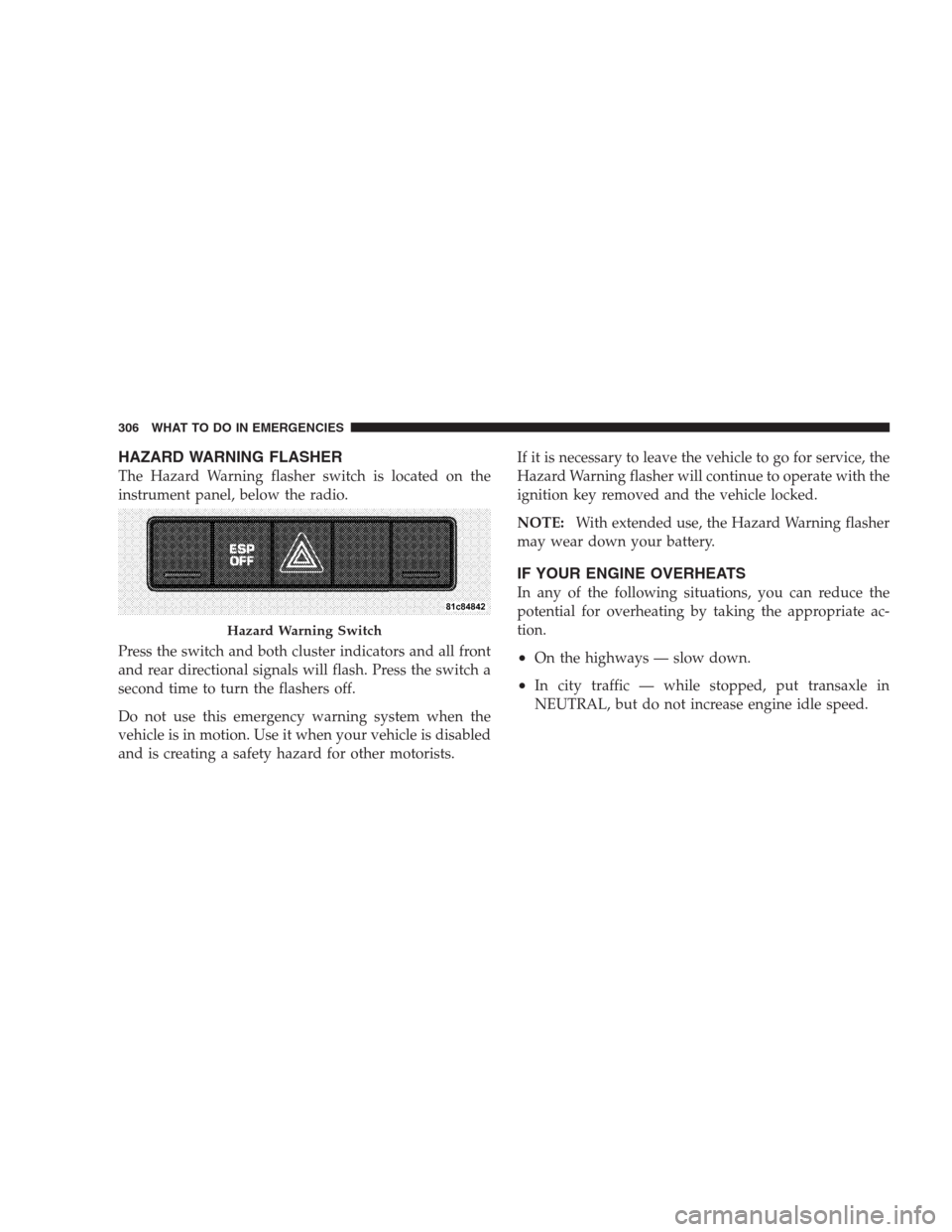
The Hazard Warning flasher switch is located on the
instrument panel, below the radio.
Press the switch and both cluster indicators and all front
and rear directional signals will flash. Press the switch a
second time to turn the flashers off.
Do not use this emergency warning system when the
vehicle is in motion. Use it when your vehicle is disabled
and is creating a safety hazard for other motorists.If it is necessary to leave the vehicle to go for service, the
Hazard Warning flasher will continue to operate with the
ignition key removed and the vehicle locked.
NOTE:With extended use, the Hazard Warning flasher
may wear down your battery.
IF YOUR ENGINE OVERHEATS
In any of the following situations, you can reduce the
potential for overheating by taking the appropriate ac-
tion.
•On the highways — slow down.
•In city traffic — while stopped, put transaxle in
NEUTRAL, but do not increase engine idle speed.
Hazard Warning Switch
306 WHAT TO DO IN EMERGENCIES
Page 314 of 411
Using the Air Pump Power Button
Push and release the button (3) once to turn
ON the TIREFIT kit. Push and release the
button (3) again to turn OFF the TIREFIT kit.
Sealing a Tire with TIREFIT
(A) Whenever You Stop to Use TIREFIT:
1. Turn ON the vehicle’s hazard warning flashers.
2. Verify that the valve stem (on the wheel with the
deflated tire) is in a position that is near to the ground.
This will allow the TIREFIT Hoses (6) and (7) to reach the
valve stem and keep the TIREFIT kit flat on the ground.
This will provide the best positioning of the kit when
injecting the sealant into the deflated tire and running the
air pump. Move the vehicle as necessary to place the
valve stem in this position before proceeding.3. Place the transmission in PARK (auto transmission) or
in Gear (manual transmission) and turn OFF the ignition.
4. Set the parking brake.
(B) Setting Up to Use TIREFIT:
1. Remove the gloves from the Accessory Storage Com-
partment (8) and place them on your hands.
2. Turn the Mode Select knob (4) to the
Sealant/Air Mode position.
3. Uncoil the Clear Sealant Hose (7) and then remove the
Yellow Cap from the fitting at the end of the hose.
4. Place the TIREFIT kit flat on the ground next to the
deflated tire.
312 WHAT TO DO IN EMERGENCIES
Page 319 of 411

(H) Sealant Bottle Replacement
1. Uncoil the Clear Sealant Hose (7).
2. Locate the rectangular SEALANT BOTTLE RELEASE
button in the recessed area where you place your fingers
to unlatch the hoses (6) (7) from their storage area.
3. Use the Yellow Cap on end of the Clear Sealant Hose
(7) to depress the SEALANT BOTTLE RELEASE button.
The Sealant Bottle (1) will pop up. Remove the bottle and
dispose of it accordingly.
4. Clean any remaining sealant from the TIREFIT hous-
ing.
5. Position the new Sealant Bottle (1) to the housing so
that the Clear Sealant Hose (7) aligns with the hose slot in
the front of the housing and the alignment keys on the
bottom of the bottle align with the alignment slots in thehousing. Then, press the bottle into the housing. An
audible click will be heard, indicating the bottle is locked
in place.
6. Verify the Yellow Cap is installed on the fitting at the
end of the Clear Sealant Hose (7) and return the hose to
its storage area.
7. Return the TIREFIT kit to its storage area in the
vehicle.
JUMP-STARTING PROCEDURES
WARNING!
•Take care to avoid the radiator cooling fan when-
ever the hood is raised. It can start anytime the
ignition switch is on. You can be hurt by the fan.
(Continued)
WHAT TO DO IN EMERGENCIES 317
6
Page 320 of 411

WARNING! (Continued)
•Do not attempt to push or tow your vehicle to get
it started. Vehicles equipped with an automatic
transaxle cannot be started this way and may be
damaged. Unburned fuel could enter the catalytic
converter and once the engine has started, ignite
and damage the converter and vehicle. If the
vehicle has a discharged battery, booster cables
may be used to obtain a start from another vehicle.
This type of start can be dangerous if done im-
properly, so follow this procedure carefully.
•Wear eye protection and remove any metal jewelry
such as watch bands or bracelets that might make
an inadvertent electrical contact. You could be
seriously injured.
NOTE: Disconnecting the battery with the ignition in
the ON position will cause vehicles with an automatictransaxle (CVT2) to go into “default mode” and turn on
the Malfunction Indicator Light (MIL). See your autho-
rized dealer to correct this condition.
1. When boosting from a battery in another vehicle, park
that vehicle within booster cable reach but without
letting the vehicles touch. Set the parking brake, place the
automatic transmission in PARK (the manual transmis-
sion in NEUTRAL) and turn the ignition to OFF for both
vehicles.
2. Turn off the heater, radio and all unnecessary electrical
loads.
3. Using the two finger screws on the cover, remove the
air intake duct covering the battery.
4. Connect one end of a jumper cable to the positive
terminal of the booster battery. Connect the other end of
the jumper cable to the positive terminal of the dis-
charged battery.
318 WHAT TO DO IN EMERGENCIES
Page 321 of 411
WARNING!
•Battery fluid is a corrosive acid solution; do not
allow battery fluid to contact eyes, skin or cloth-
ing. Don’t lean over the battery when attaching the
clamps or allow the clamps to touch each other. If
acid splashes in your eyes or on your skin, flush
the contaminated area immediately with large
quantities of water.
•A battery generates hydrogen gas which is flam-
mable and explosive. Keep flame or spark away
from the vent holes. Do not use a booster battery
or any other booster source with an output that
exceeds 12-Volts.
5. Connect the other cable, first to the negative terminal
of the booster battery and then to the negative terminal of
the discharged battery. Make sure you have a good
contact.6. If the vehicle is equipped with a Sentry Key�Immo-
bilizer, turn the ignition switch to the ON position for
three seconds before moving the ignition switch to the
START position.
7. Start the engine in the vehicle that has the booster
battery, let the engine idle a few minutes, then start the
engine in the vehicle with the discharged battery.
8. When removing the jumper cables, reverse the se-
quence exactly. Be careful of the moving belts and fan.
FREEING A STUCK VEHICLE
NOTE:If your vehicle is equipped with Traction Con-
trol or ESP, turn the system OFF before attempting to
“rock” the vehicle.
If your vehicle becomes stuck in mud, sand or snow, it
can often be moved by a rocking motion. Turn your
steering wheel right and left to clear the area around the
WHAT TO DO IN EMERGENCIES 319
6
Page 322 of 411

front wheels. Then shift back and forth between RE-
VERSE and 1st gear. Usually the least accelerator pedal
pressure to maintain the rocking motion without spin-
ning the wheels is most effective.
WARNING!
Fast spinning tires can be dangerous. Forces gener-
ated by excessive wheel speeds may cause axle, tire
damage or failure. A tire could explode and injure
someone. Do not spin your vehicle’s wheels faster
than 30 mph (48 km/h) or for longer than 30 seconds
continuously without stopping when you are stuck.
And don’t let anyone near a spinning wheel, no
matter what the speed.
CAUTION!
Racing the engine or spinning the wheels too fast
may lead to transaxle overheating and failure. It can
also damage the tires. Do not spin the wheels above
30 mph (48 km/h). Do not spin the wheels continu-
ously for more than 30 seconds.
TOWING A DISABLED VEHICLE
With Ignition Key
Automatic Transaxle
•
Front Wheel Drive (FWD) vehicles can be towed with
the front wheels elevated or on a flatbed truck (all four
wheels off the ground).
•All Wheel Drive (AWD) vehicles must be towed on a
flatbed truck (all four wheels off the ground).
320 WHAT TO DO IN EMERGENCIES