Page 318 of 475
TIRE ROTATION RECOMMENDATIONS
Tires on the front and rear axles of vehicles operate at
different loads and perform different steering, driving,
and braking functions. For these reasons, they wear at
unequal rates and tend to develop irregular wear pat-
terns. These effects can be reduced by timely rotation of
tires. The benefits of rotation are especially worthwhile
with aggressive tread designs such as those on all season
type tires. Rotation will increase tread life, help to main-
tain mud, snow and wet traction levels, and contribute to
a smooth, quiet ride.
Follow the recommended tire rotation frequency for your
type of driving found in the “Maintenance Schedules”
section of this manual. More frequent rotation is permis-
sible if desired. The reasons for any rapid or unusual
wear should be corrected prior to rotation being per-
formed.
316 STARTING AND OPERATING
Page 347 of 475
WARNING!
•Improper towing can lead to an injury accident.
Follow these guidelines to make your trailer tow-
ing as safe as possible:
•Make certain that the load is secured in the trailer
and that it will not shift during travel. When
trailering cargo that is not fully secured, dynamic
load shifts can occur that may be difficult for the
driver to control. You could lose control of your
vehicle and have an accident.
•When hauling cargo, or towing a trailer, do not
overload your vehicle or trailer. Overloading can cause
a loss of control, poor performance, or damage to
brakes, axle, engine, transaxle, steering, suspension,
chassis structure, or tires.
•Safety chains must always be used between your
vehicle and trailer. Always connect the chains to the
frame or hook retainers of the vehicle hitch. Cross the
chains under the trailer tongue and allow enough
slack for turning corners.
•Vehicles with trailers should not be parked on a grade.
When parking, apply the parking brake on the tow
vehicle. Put the tow vehicle automatic transaxle in
PARK. Always, block or�chock�the trailer wheels.
•GCWR must not be exceeded.
•Total weight must be distributed between the tow
vehicle and the trailer such that the following four
ratings are not exceeded:
1. GVWR
2. GTW
3. GAWR
STARTING AND OPERATING 345
5
Page 366 of 475

NOTE:Refer to “Maintenance Procedures” in Section 7
of this manual for information on accessing the battery
for service or replacement.
WARNING!
Any procedure other than above could result in:
•Personal injury caused by electrolyte squirting out
the battery vent;
•Personal injury or property damage due to battery
explosion;
•Damage to charging system of booster vehicle or
of immobilized vehicle.
FREEING A STUCK VEHICLE
If your vehicle becomes stuck in mud, sand, or snow, it
can often be moved by a rocking motion. Turn your
steering wheel right and left to clear the area around the
front wheels. Then shift back and forth between RE-
VERSE and FIRST gear. Usually the least accelerator
pedal pressure to maintain the rocking motion without
spinning the wheels is most effective.
NOTE:
If your vehicle is equipped with Traction Con-
trol, turn the system to Partial OFF before
attempting to “rock” the vehicle. Refer to “Par-
tial Off Mode” under “Electronic Stability Pro-
gram (ESP)” in Section 5 of this manual.
364 WHAT TO DO IN EMERGENCIES
Page 367 of 475
WARNING!
Fast spinning tires can be dangerous. Forces gener-
ated by excessive wheel speeds may cause axle and
tire damage or failure. A tire could explode and
injure someone. Do not spin your vehicle’s wheels
faster than 30 mph (48 km/h) or for longer than
30 seconds continuously without stopping when you
are stuck, and don’t let anyone near a spinning
wheel, no matter what the speed.
CAUTION!
Racing the engine or spinning the wheels too fast
may lead to transaxle overheating and failure. It can
also damage the tires. Do not spin the wheels above
30 mph (48 km/h). Do not spin the wheels continu-
ously for more than 30 seconds.
TOWING A DISABLED VEHICLE
With The Ignition Key
Your vehicle may be towed under the following condi-
tions: The shift lever must be in NEUTRAL, the distance
to be traveled must not exceed 15 miles (25 km), and the
towing speed must not exceed 25 mph (40 km/h).
Exceeding these towing limits may cause a transaxle
failure. If the transaxle is not operative, or if the vehicle is
to be towed more than 15 miles (25 km), the vehicle must
be transported either with a flatbed truck (all four wheels
off the ground) or with the front wheels off the ground.
CAUTION!
•If the vehicle being towed requires steering, the
ignition switch must be in the ON position, not in
the LOCK or ACC position.
(Continued)
WHAT TO DO IN EMERGENCIES 365
6
Page 371 of 475
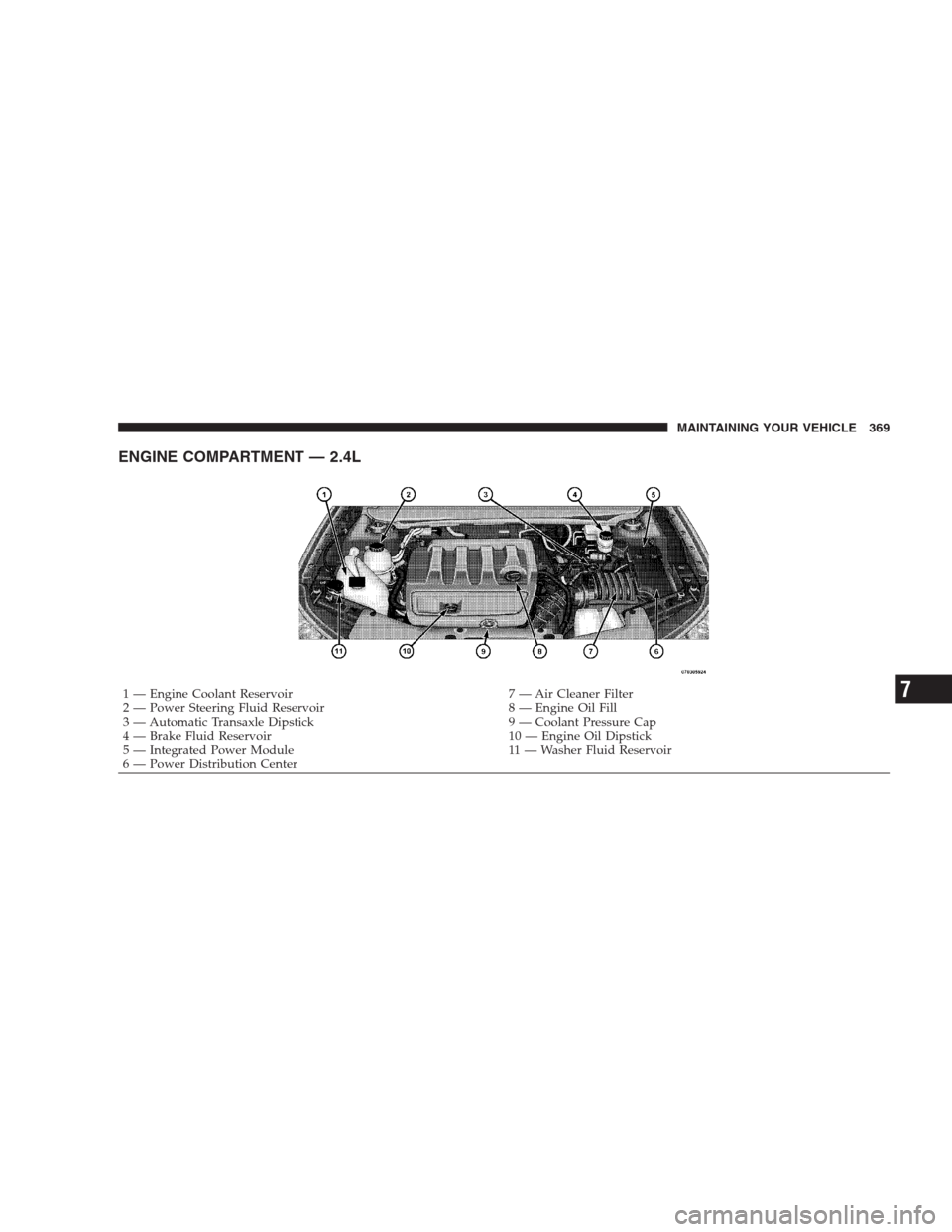
ENGINE COMPARTMENT — 2.4L
1 — Engine Coolant Reservoir 7 — Air Cleaner Filter
2 — Power Steering Fluid Reservoir 8 — Engine Oil Fill
3 — Automatic Transaxle Dipstick 9 — Coolant Pressure Cap
4 — Brake Fluid Reservoir 10 — Engine Oil Dipstick
5 — Integrated Power Module 11 — Washer Fluid Reservoir
6 — Power Distribution CenterMAINTAINING YOUR VEHICLE 3697
Page 372 of 475
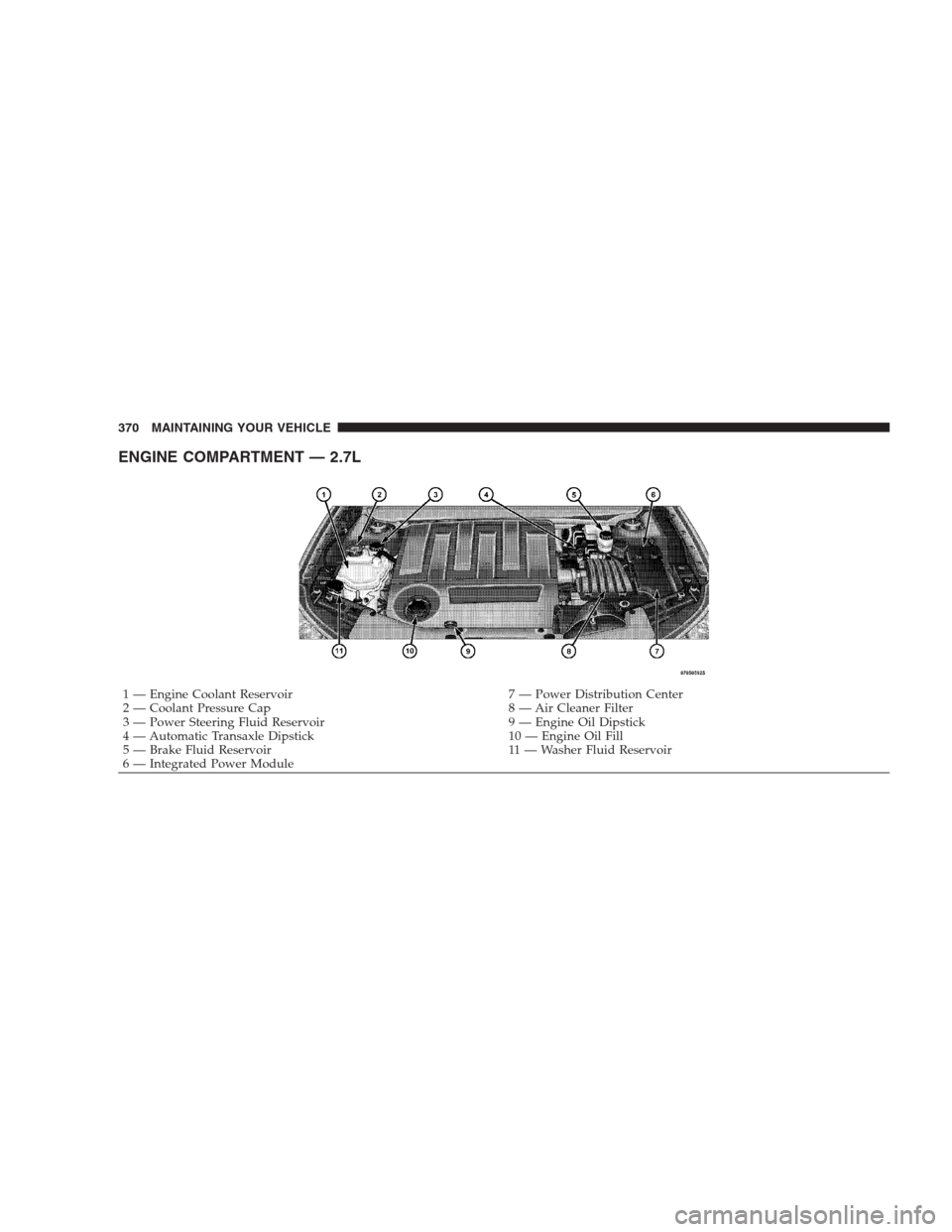
ENGINE COMPARTMENT — 2.7L
1 — Engine Coolant Reservoir 7 — Power Distribution Center
2 — Coolant Pressure Cap 8 — Air Cleaner Filter
3 — Power Steering Fluid Reservoir 9 — Engine Oil Dipstick
4 — Automatic Transaxle Dipstick 10 — Engine Oil Fill
5 — Brake Fluid Reservoir 11 — Washer Fluid Reservoir
6 — Integrated Power Module 370 MAINTAINING YOUR VEHICLE
Page 373 of 475
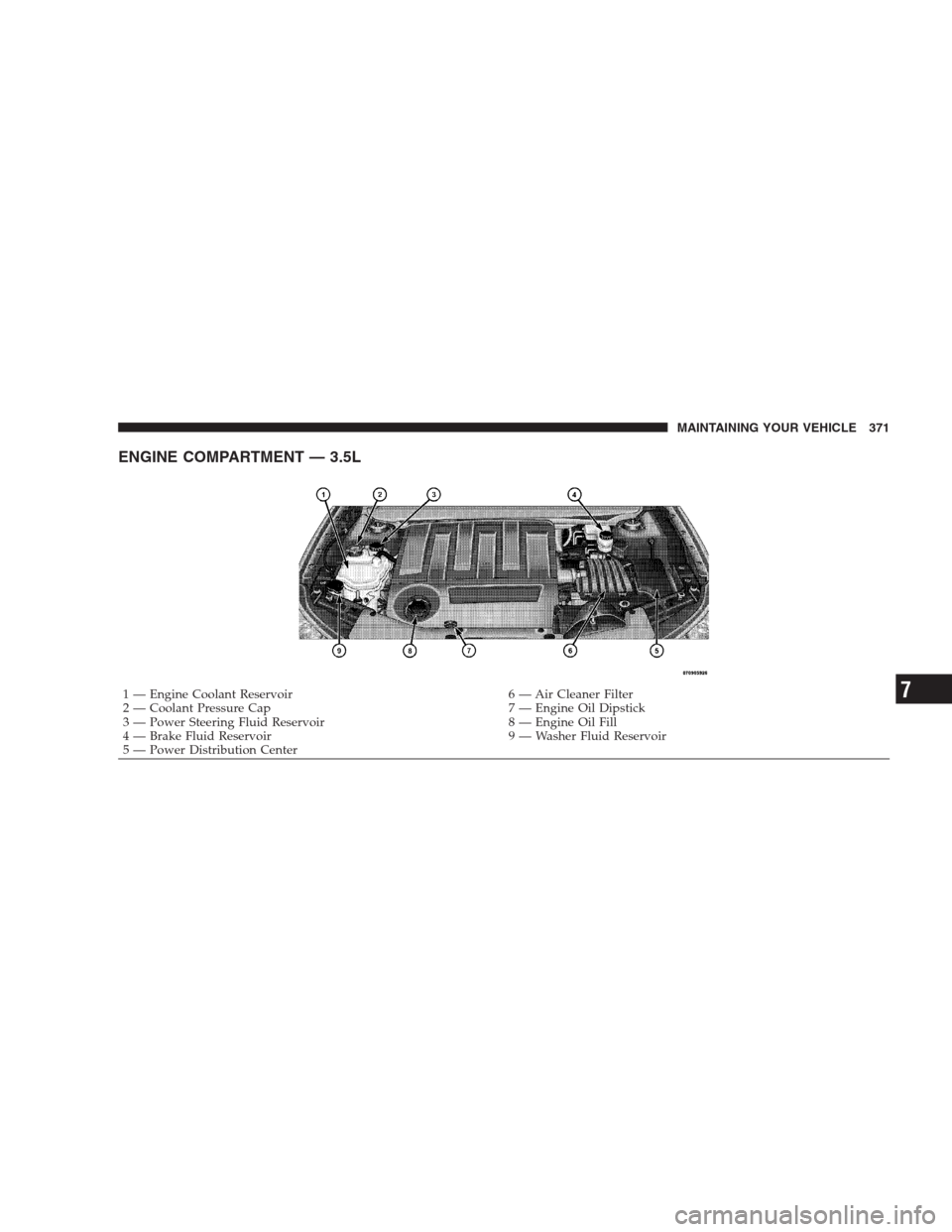
ENGINE COMPARTMENT — 3.5L
1 — Engine Coolant Reservoir 6 — Air Cleaner Filter
2 — Coolant Pressure Cap 7 — Engine Oil Dipstick
3 — Power Steering Fluid Reservoir 8 — Engine Oil Fill
4 — Brake Fluid Reservoir 9 — Washer Fluid Reservoir
5 — Power Distribution CenterMAINTAINING YOUR VEHICLE 3717
Page 382 of 475
Engine Air Cleaner Filter
WARNING!
The air induction system (air cleaner, hoses, etc.) can
provide a measure of protection in the case of engine
backfire. Do not remove the air induction system (air
cleaner, hoses, etc.) unless such removal is necessary
for repair or maintenance. Make sure that no one is
near the engine compartment before starting the
vehicle with the air induction system (air cleaner,
hoses, etc.) removed. Failure to do so can result in
serious personal injury.
Refer to the “Maintenance Schedule” in Section 8 of this
manual for the proper maintenance intervals.
Engine Air Cleaner Filter Selection
The quality of replacement engine air cleaner filters
varies considerably. Only high quality filters should be
used to assure most efficient service. MOPAR�engine air
cleaner filters are high quality and are recommended.
Maintenance-Free Battery
You will never have to add water, nor is periodic main-
tenance required.
NOTE:The battery is stored in a compartment behind
the left front fender and is accessible without removing
the tire and wheel. Remote battery terminals are located
in the engine compartment for jump-starting.
To access the battery, turn the steering wheel fully to the
right and remove the inner fender shield.
380 MAINTAINING YOUR VEHICLE