Page 267 of 475

▫Tread Wear Indicators................. 312
▫Life Of Tire........................ 313
▫Replacement Tires.................... 313
�Tire Chains.......................... 315
�Snow Tires.......................... 315
�Tire Rotation Recommendations........... 316
�Tire Pressure Monitor System (TPMS)....... 317
▫Base System........................ 319
▫Premium System — If Equipped......... 321
▫General Information.................. 325
�Fuel Requirements..................... 325
▫2.4L And 2.7L Engine................. 325
▫3.5L Engine........................ 326▫Reformulated Gasoline................ 327
▫Gasoline/Oxygenate Blends............. 327
▫E-85 Usage In Non-Flex Fuel Vehicles...... 328
▫MMT In Gasoline.................... 328
▫Materials Added To Fuel............... 329
▫Fuel System Cautions................. 329
▫Carbon Monoxide Warnings............ 330
�Flexible Fuel— 2.7L Only (Except California
Emission States)....................... 330
▫E-85 General Information............... 330
▫Ethanol Fuel (E-85)................... 332
▫Fuel Requirements................... 332
▫Selection Of Engine Oil For Flexible Fuel
Vehicles (E-85) And Gasoline Vehicles...... 333
STARTING AND OPERATING 265
5
Page 283 of 475
CAUTION! (Continued)
•Driving through standing water may cause dam-
age to your vehicle’s drivetrain components. Al-
ways inspect your vehicle’s fluids (i.e., engine oil,
transmission/transaxle, axle, etc.) for signs of con-
tamination (i.e., fluid that is milky or foamy in
appearance) after driving through standing water.
Do not continue to operate the vehicle if any fluid
appears contaminated, as this may result in further
damage. Such damage is not covered by the New
Vehicle Limited Warranty.
•Getting water inside your vehicle’s engine can
cause it to lock up and stall out, and cause serious
internal damage to the engine. Such damage is not
covered by the New Vehicle Limited Warranty.
WARNING!
•Driving through standing water limits your vehi-
cle’s traction capabilities. Do not exceed 5 mph
(8 km/h) when driving through standing water.
•Driving through standing water limits your vehi-
cle’s braking capabilities, which increases stop-
ping distances. Therefore, after driving through
standing water, drive slowly and lightly press on
the brake pedal several times to dry the brakes.
•Getting water inside your vehicle’s engine can
cause it to lock up and stall out, and leave you
stranded.
•Failure to follow these warnings may result in
injuries that are serious or fatal to you, your
passengers, and others around you.
STARTING AND OPERATING 281
5
Page 330 of 475
E-85 Usage In Non-Flex Fuel Vehicles
Non-FFV vehicles are compatible with gasoline contain-
ing 10% ethanol (E10). Gasoline with higher ethanol
content may void the vehicle’s warranty.
If a Non-FFV vehicle is inadvertently fueled with E-85
fuel, the engine will have some or all of these symptoms:
•operate in a lean mode
•OBD II “Malfunction Indicator Light” on
•poor engine performance
•poor cold start and cold drivability
•increased risk for fuel system component corrosion
To fix a Non-FFV vehicle inadvertently fueled once with
E-85 perform the following:
•drain the fuel tank (see your authorized dealer)
•change the engine oil and oil filter
•disconnect and reconnect the battery to reset the
engine controller memory
More extensive repairs will be required for prolonged
exposure to E-85 fuel.
MMT in Gasoline
MMT is a manganese containing metallic additive that is
blended into some gasoline to increase octane. Gasoline
blended with MMT provides no performance advantage
beyond gasoline of the same octane number without
MMT. Gasoline blended with MMT reduces spark plug
life and reduces emission system performance in some
vehicles. The manufacturer recommends that gasoline
without MMT be used in your vehicle. The MMT content
of gasoline may not be indicated on the gasoline pump,
therefore, you should ask your gasoline retailer whether
or not his/her gasoline contains MMT.
328 STARTING AND OPERATING
Page 335 of 475
Selection of Engine Oil For Flexible Fuel Vehicles
(E-85) and Gasoline Vehicles
FFV vehicles operated on E85 require specially formu-
lated engine oils. These special requirements are included
in MOPAR�engine oils, and in equivalent oils meeting
Chrysler Specification MS-6395. The manufacturer only
recommends engine oils that are API Certified and meet
the requirements of Material Standard MS-6395. MS-6395
contains additional requirements, developed during ex-
tensive fleet testing, to provide additional protection to
the manufacturer’s engines. Use MOPAR�or an equiva-
lent oil meeting the specification MS-6395.
NOTE:Your engine oil filler cap also describes the
correct engine oil to use.
Starting
The characteristics of E-85 fuel make it unsuitable for use
when ambient temperatures fall below 0°F (-18°C). In the
range of 0°F (-18°C) to 32°F (0°C), you may experience an
increase in the time it takes for your engine to start, and
a deterioration in driveability (sags and/or hesitations)
until the engine is fully warmed up.
Cruising Range
Because E-85 fuel contains less energy per gallon than
gasoline, you will experience an increase in fuel con-
sumption. You can expect your fuel economy and driving
range to decrease by about 30% compared to gasoline
operation.
Replacement Parts
All components in your Flexible Fuel Vehicle (FFV) are
designed to be compatible with ethanol. Always be sure
that your vehicle is serviced with correct ethanol com-
patible parts.
STARTING AND OPERATING 333
5
Page 353 of 475
WHAT TO DO IN EMERGENCIES
CONTENTS
�Hazard Warning Flasher................ 352
�If Your Engine Overheats................ 352
▫Engine Oil Overheating — 2.4L Engine Only
(If Equipped)....................... 353
�Jacking And Tire Changing............... 354
▫Preparations For Jacking............... 354
▫Jack Location....................... 355
▫Spare Tire Stowage................... 355▫Jacking Instructions................... 356
�Jump-Starting Procedure................ 361
�Freeing A Stuck Vehicle................. 364
�Towing A Disabled Vehicle............... 365
▫With The Ignition Key................. 365
▫Without The Ignition Key.............. 366
6
Page 355 of 475
the fan control to High. This allows the heater core to act
as a supplement to the radiator and aids in removing heat
from the engine cooling system.
CAUTION!
Driving with a hot cooling system could damage
your vehicle. If the pointer rises to the H (red) mark,
the instrument cluster will sound a chime. Pull over
and stop the vehicle with the engine at idle, when
safe. Turn off the air conditioning and wait until the
pointer drops back into the normal range. If the
pointer remains on the H (red) mark for more than a
minute, turn the engine off immediately and call for
service.
WARNING!
A hot engine cooling system is dangerous. You or
others could be badly burned by steam or boiling
coolant. You may want to call a service center if your
vehicle overheats. If you decide to look under the
hood yourself, refer to Section 7, Maintenance, of this
manual. Follow the warnings under the Cooling
System Pressure Cap paragraph.
Engine Oil Overheating — 2.4L Engine Only (If
Equipped)
During sustained high-speed driving or trailer tow up
long grades on hot day, the engine oil temperature may
become too hot. If this happens, the “HOTOIL” message
flashes, the vehicle speed will be reduced to 53 mph
(85 km/h) until the engine oil temperature is reduced.
WHAT TO DO IN EMERGENCIES 353
6
Page 369 of 475
MAINTAINING YOUR VEHICLE
CONTENTS
�Engine Compartment — 2.4L............. 369
�Engine Compartment — 2.7L............. 370
�Engine Compartment — 3.5L............. 371
�Onboard Diagnostic System — OBD II...... 372
▫Loose Fuel Filler Cap Message........... 373
�Emissions Inspection And Maintenance
Programs............................ 373
�Replacement Parts..................... 375
�Dealer Service........................ 375�Maintenance Procedures................. 376
▫Engine Oil......................... 376
▫Engine Oil Filter..................... 379
▫Engine Air Cleaner Filter............... 380
▫Maintenance-Free Battery.............. 380
▫Air Conditioner Maintenance............ 382
▫A/C Air Filter — If Equipped........... 383
▫Body Lubrication.................... 384
▫Adding Washer Fluid................. 385
7
Page 371 of 475
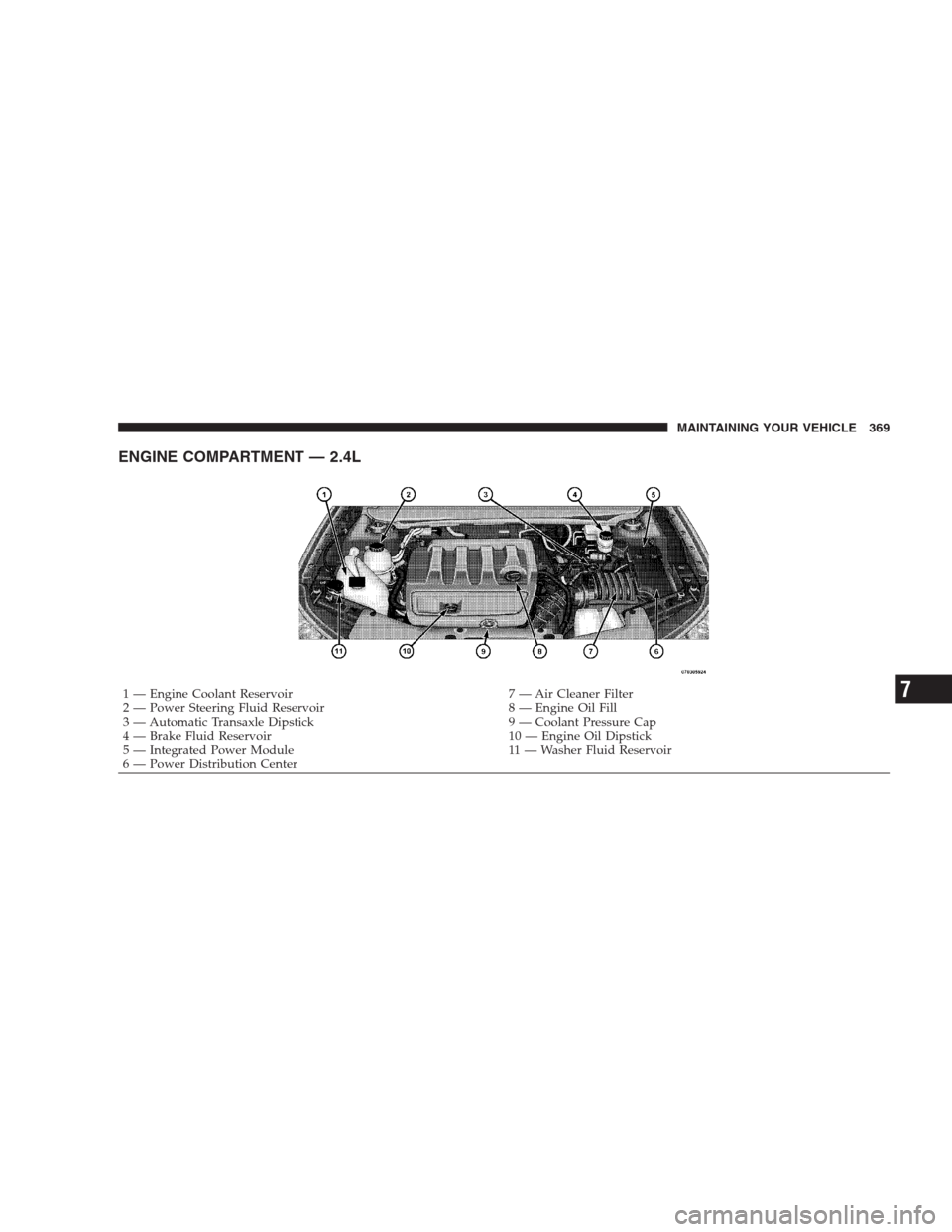
ENGINE COMPARTMENT — 2.4L
1 — Engine Coolant Reservoir 7 — Air Cleaner Filter
2 — Power Steering Fluid Reservoir 8 — Engine Oil Fill
3 — Automatic Transaxle Dipstick 9 — Coolant Pressure Cap
4 — Brake Fluid Reservoir 10 — Engine Oil Dipstick
5 — Integrated Power Module 11 — Washer Fluid Reservoir
6 — Power Distribution CenterMAINTAINING YOUR VEHICLE 3697