Page 305 of 410

CAUTION!
Racing the engine or spinning the wheels too fast
may lead to transaxle overheating and failure. It can
also damage the tires. Do not spin the wheels above
30 mph (48 km/h).
TOWING A DISABLED VEHICLE
Towing With The Key-In-Ignition
Four-Speed Automatic Transaxle
Your vehicle may be towed under the following condi-
tions: The steering column must be unlocked and the
shift lever must be in NEUTRAL, the distance to betowed must not exceed 100 miles (160 km), and the
towing speed must not exceed 44 mph (72 km/h). If the
transaxle is not operative, or if the vehicle is to be towed
more than 100 miles (160 km), the vehicle must be towed
with the front wheels off the ground to avoid damage to
the transaxle.
Manual Transaxle
Your vehicle may be towed in a forward direction, with
all four wheels on the ground, and the shift lever in the
NEUTRAL position. If the transaxle is not operative, the
vehicle must be towed with the front wheels off the
ground.
6
WHAT TO DO IN EMERGENCIES 303
Page 306 of 410
All Transaxles
CAUTION!
If the vehicle being towed requires steering, the
ignition switch must be in the ACC position, not in
the LOCK position.
Do not attempt to use sling-type equipment when
towing. When securing the vehicle to a flatbed truck,
do not attach it to front or rear suspension compo-
nents. Damage to your vehicle may result from
improper towing.
If it is necessary to use the accessories while being towed
(wipers, defrosters, etc.), the key must be in the ON
position, not the ACC position. Make certain the trans-
axle remains in NEUTRAL.
Towing Without The Key-In-Ignition
Special care must be taken when the vehicle is towed
with the ignition in the LOCK position. A dolly should be
used under the front wheels if the rear wheels are raised.
Proper towing equipment is necessary to prevent dam-
age to the vehicle.
Towing Behind Another Vehicle (Flat Towing with
all four wheels on the ground)
If your vehicle is equipped with a manual transaxle, it
may be towed in a forward direction, at any legal
highway speed, for any distance, if the transaxle is in
NEUTRAL.
If the ignition key is not available, vehicles with auto-
matic transaxles can not be flat towed at any time.
304 WHAT TO DO IN EMERGENCIES
Page 338 of 410
CAUTION!
Do not use abrasive or strong cleaning materials such
as steel wool or scouring powder, which will scratch
metal and painted surfaces.
Special Care
•
If you drive on salted or dusty roads, or if you drive
near the ocean, hose off the undercarriage at least once
a month.
•It is important that the drain holes in the lower edges
of the doors, rocker panels and trunk be kept clear and
open.
•If you detect any stone chips or scratches in the paint,
touch them up immediately. The cost of such repairs is
considered the responsibility of the owner.
•If your vehicle is damaged due to an accident or
similar cause which destroys the paint and protective
coating, have your vehicle repaired as soon as pos-
sible. The cost of such repairs is considered the respon-
sibility of the owner.
•If you carry special cargo such as chemicals, fertilizers,
de-icer salt, etc., be sure that such materials are well
packaged and sealed.
•If a lot of driving is done on gravel roads, consider
mud or stone shields behind each wheel.
•Use MOPAR�Touch-Up Paint on scratches as soon as
possible. Your authorized dealer has touch up paint to
match the color of your vehicle.
336 MAINTAINING YOUR VEHICLE
Page 339 of 410
Wheel And Wheel Trim Care
All wheels and wheel trim, especially aluminum and
chrome-plated wheels should be cleaned regularly with a
mild soap and water to prevent corrosion. To remove
heavy soil and/or excessive brake dust, use MOPAR�
Wheel Cleaner or equivalent, or select a nonabrasive,
non-acidic cleaner. Do not use scouring pads, steel wool,
a bristle brush, or metal polishes. Only MOPAR �or
equivalent is recommended. Do not use oven cleaner.
Avoid automatic car washes that use acidic solutions or
harsh brushes that may damage the wheels’ protective
finish.
Instrument Panel Cover
The instrument panel cover has a low glare surface,
which minimizes reflections in the windshield. Do not
use protectants or other products, which may cause
undesirable reflections. Use soap and warm water to
restore the low glare surface.
Stain Repel Fabric Cleaning Procedure — If
Equipped
Stain Repel seats may be cleaned in the following man-
ner:
•Remove as much of the stain as possible by blotting
with a clean, dry towel.
•Blot any remaining stain with a clean, damp towel.
•For tough stains, apply MOPAR� Total Clean or a mild
soap solution to a clean, damp cloth and remove the
stain. Use a fresh, damp towel to remove soap residue.
•For grease stains, apply MOPAR� Multi-Purpose
Cleaner to a clean, damp cloth and remove the stain.
Use a fresh, damp towel to remove soap residue.
•Do not use any solvents or protectants on Stain Repel
products.
7
MAINTAINING YOUR VEHICLE 337
Page 347 of 410
LIGHTS BULBS — ExteriorBulb No.
Low Beam Headlight ................... 9006XS
High Beam Headlight ................... 9005XS
Front Park/Turn Signal/
Side Marker Light ................... 4157NAKX
Front Fog Light ......................... 9145
Center High-Mounted Stop Light
(CHMSL) (Sedan) ................... 921–W16W
Rear Tail/Stop .......................... 3157
Rear Turn Signal ....................... 3757A
Backup Light ..................... 3157-P27/7W
License Light ........................... 168BULB REPLACEMENT
Headlights
CAUTION!
Do not touch the new headlight bulb with your
fingers. Oil contamination will severely shorten bulb
life.
1. Remove the headlight access cover splash shield,
located in the front wheel well opening.
7
MAINTAINING YOUR VEHICLE 345
Page 348 of 410
2. Disconnect the electrical connector(s).
3. Rotate the socket to the left one-quarter turn, and
replace the bulb.Front Parking, Turn Signal, and Side Marker
Lights
1. Remove the headlight access cover splash shield,
located in the front wheel well opening.
2. Disconnect the electrical connector.
346 MAINTAINING YOUR VEHICLE
Page 362 of 410
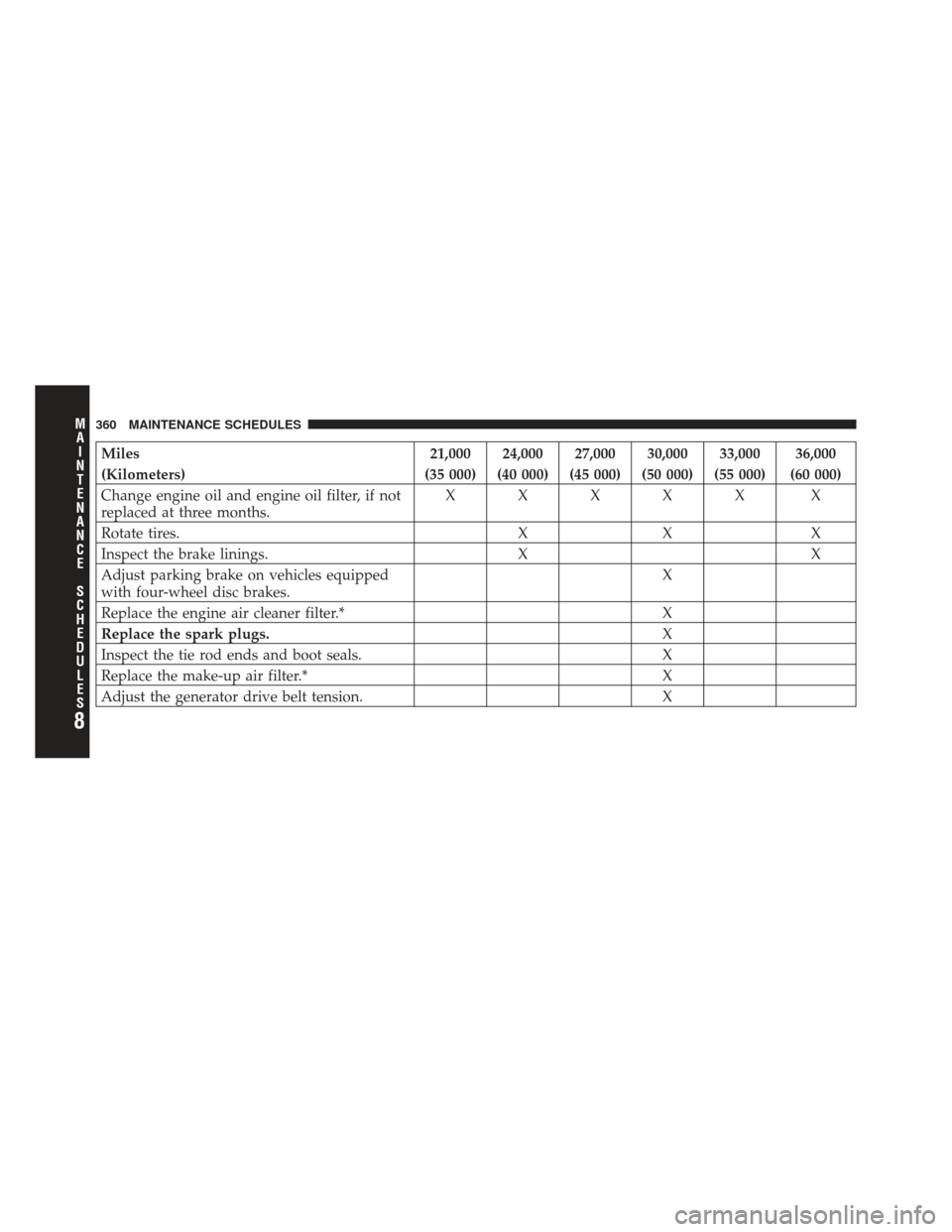
Miles21,000 24,000 27,000 30,000 33,000 36,000
(Kilometers) (35 000) (40 000) (45 000) (50 000) (55 000) (60 000)
Change engine oil and engine oil filter, if not
replaced at three months. XXXXX X
Rotate tires. XX X
Inspect the brake linings. XX
Adjust parking brake on vehicles equipped
with four-wheel disc brakes. X
Replace the engine air cleaner filter.* X
Replace the spark plugs. X
Inspect the tie rod ends and boot seals. X
Replace the make-up air filter.* X
Adjust the generator drive belt tension. X
8
M
A I
N T
E
N A
N CE
S
C
H E
D
U L
E
S360 MAINTENANCE SCHEDULES
Page 364 of 410
Miles57,000 60,000 63,000 66,000 69,000 72,000
(Kilometers) (95 000) (100 000) (105 000) (110 000) (115 000) (120 000)
Change engine oil and engine oil filter, if not
replaced at three months. XXXXX X
Rotate tires. XX X
Inspect the brake linings. XX
Adjust parking brake on vehicles equipped
with four-wheel disc brakes. X
Replace the engine air cleaner filter.* X
Replace the spark plugs and ignition cables. X
Inspect the tie rod ends and boot seal. X
Replace the make-up air filter.* X
Adjust the generator drive belt tension. X
Change the automatic transaxle fluid and
filter. X
Flush and replace engine coolant at
60 months, if not done at 102,000 miles
(170 000 km). X
8
M
A I
N T
E
N A
N CE
S
C
H E
D
U L
E
S362 MAINTENANCE SCHEDULES