Page 183 of 410

history information will be erased, and the averaging will
continue from where it was before the reset.
Distance To Empty (DTE)
Shows the estimated distance that can be travelled with
the fuel remaining in the tank. This estimated distance is
determined by a weighted average of the instantaneous
and average fuel economy, according to the current fuel
tank level. This is not resettable.
NOTE:Significant changes in driving style or vehicle
loading will greatly affect the actual drivable distance of
the vehicle, regardless of the DTE displayed value.
When the DTE value is less than 30 miles (48 km)
estimated driving distance, the DTE display will change
to a text display of LOW FUEL. This display will con-
tinue until the vehicle runs out of fuel. Adding a signifi-
cant amount of fuel to the vehicle will turn off the LOW FUEL text and a new DTE value will be displayed, based
on the current values in the DTE calculation and the
current fuel tank level.Elapsed Time
Shows the total elapsed time of travel since the last reset
when the ignition switch is in the ACC position. Elapsed
time will increment when the ignition switch is in the ON
or START position.
Tire Pressure Monitor (TPM)
Refer to Section 5 “Tire Pressure Monitoring System
(TPMS),” for system operation.
Personal Settings (Customer-Programmable
Features)
This allows the driver to set and recall features when the
shift lever is in PARK (automatic transmission) or the
vehicle is stopped (manual transmission).
4
UNDERSTANDING YOUR INSTRUMENT PANEL 181
Page 229 of 410
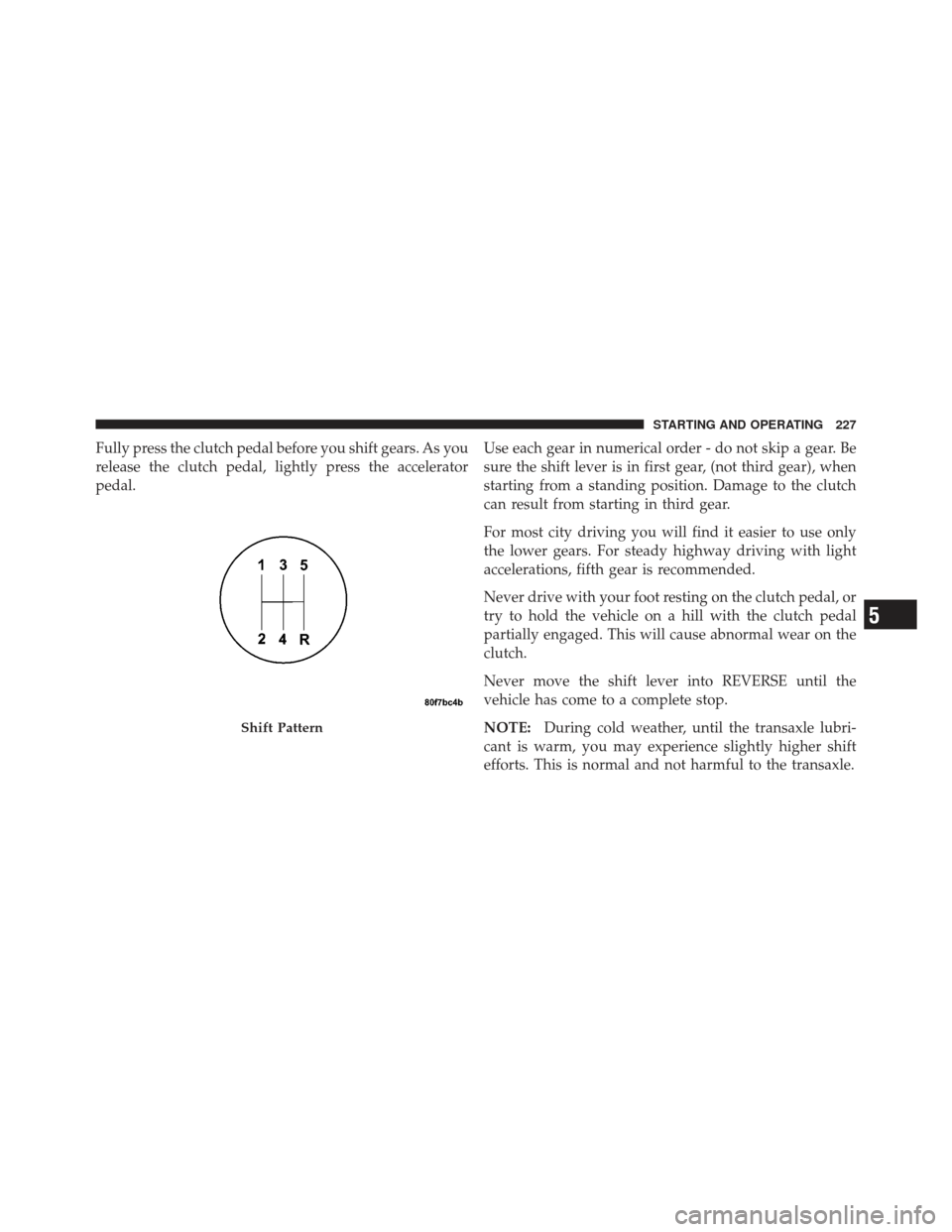
Fully press the clutch pedal before you shift gears. As you
release the clutch pedal, lightly press the accelerator
pedal.Use each gear in numerical order - do not skip a gear. Be
sure the shift lever is in first gear, (not third gear), when
starting from a standing position. Damage to the clutch
can result from starting in third gear.
For most city driving you will find it easier to use only
the lower gears. For steady highway driving with light
accelerations, fifth gear is recommended.
Never drive with your foot resting on the clutch pedal, or
try to hold the vehicle on a hill with the clutch pedal
partially engaged. This will cause abnormal wear on the
clutch.
Never move the shift lever into REVERSE until the
vehicle has come to a complete stop.
NOTE:
During cold weather, until the transaxle lubri-
cant is warm, you may experience slightly higher shift
efforts. This is normal and not harmful to the transaxle.
Shift Pattern
5
STARTING AND OPERATING 227
Page 232 of 410

CAUTION!
Damage to the transaxle may occur if the following
precautions are not observed:
•Shift into PARK only after the vehicle has come to
a complete stop.
•Shift into or out of REVERSE only after the
vehicle has come to a complete stop and the engine
is at idle speed.
•Do not shift from REVERSE, PARK, or NEUTRAL
into any forward gear when the engine is above
idle speed.
•Before shifting into any gear, make sure your foot
is firmly on the brake pedal.
NOTE: You must step on the brake pedal and press the
shift lever knob button before you will be able to move
the shift lever out of PARK.
Brake/Transmission Interlock System
This system prevents you from moving the shift lever out
of PARK and into any gear unless the brake pedal is
pressed. This system is active only while the ignition
switch is in the ON or ACC position. Always step on the
brake pedal and press the shift lever knob button
before shifting out of PARK.
NOTE: If a malfunction occurs, the system will function
normally, except you may be able to shift the vehicle from
PARK, without pressing the brake pedal. If this occurs
obtain service from an authorized dealer as soon as
possible.
Automatic Transaxle Ignition Interlock System
This system prevents the key from being removed unless
the shift lever is in PARK and the shift lever knob
pushbutton is out. It also prevents moving the shift lever
out of PARK unless the key is in the ACC or ON position,
and the brake pedal is pressed.
230 STARTING AND OPERATING
Page 233 of 410

NOTE:If a malfunction occurs, the system will trap the
key in the ignition cylinder to warn you that this safety
feature is inoperable. The engine can be started and
stopped but the key cannot be removed until you obtain
service.
Four-Speed Automatic Transaxle
NOTE: Under extreme cold temperatures (-6°F (-21°C)
and when in DRIVE, transmission operation may be
briefly limited to only second gear operation. Normal
operation will resume once the transmission temperature
has risen to a suitable level.
The electronically-controlled transaxle provides a precise
shift schedule. The transaxle electronics are self-
calibrating; therefore, the first few shifts on a new vehicle
may be somewhat abrupt. This is a normal condition, and
precision shifts will develop within a few shift cycles.
RESET Mode
The transaxle is monitored electronically for abnormal
conditions. If a condition is detected that could cause
damage, the transaxle shifts automatically into second
gear. The transaxle remains in second gear despite the
forward gear selected. PARK, REVERSE, and NEUTRAL
will continue to operate. This second gear limp-in feature
allows the vehicle to be driven to an authorized dealer for
service without damaging the transaxle.
In the event that the problem has been momentary, the
transaxle can be reset to regain all forward gears:
1. Stop the vehicle and move the shift lever into PARK.
2. Turn the ignition to OFF then restart the engine.
3. Move the shift lever into DRIVE and resume driving.
4. If the transaxle cannot be reset, authorized dealer
service is required.
5
STARTING AND OPERATING 231
Page 234 of 410

NOTE:Even if the transaxle can be reset, it is recom-
mended that you visit an authorized dealer at your
earliest possible convenience. Your authorized dealer has
diagnostic equipment to determine if the problem could
recur.
Gear Ranges
DO NOT race the engine when shifting from PARK or
NEUTRAL positions into another gear range.
PARK
This range supplements the parking brake by locking the
transmission. The engine can be started in this range.
Never use PARK while the vehicle is in motion. Apply
the parking brake when leaving the vehicle in this range.
Always apply the parking brake first, and then move the
shift lever into the PARK position.
WARNING!
Unintended movement of a vehicle could injure
those in and near the vehicle. As with all vehicles,
you should never exit a vehicle while the engine is
running. Before exiting a vehicle, you should always
shift the vehicle into PARK, remove the key from the
ignition, and apply the parking brake. Once the key
is removed from the ignition, the shift lever is locked
in the PARK position, securing the vehicle against
unwanted movement. Furthermore, you should never
leave unattended children inside a vehicle.
The following indicators should be used to ensure that
you have engaged the shift lever into the PARK position:
•When moving the shift lever into PARK, press the
button on the shift lever knob and firmly move the
lever all the way forward until it stops.
232 STARTING AND OPERATING
Page 235 of 410

•Look at the shift indicator window on the console to
ensure it is in the PARK position.
•When engaged in PARK, you will not be able to move
the shift lever rearward without pressing the lever
knob button.
CAUTION!
Before moving the shift lever out of PARK, you must
turn the ignition from LOCK to ON, so the steering
wheel and shift lever are released. Otherwise, dam-
age to the steering column or shift lever could result.
REVERSE
This range is for moving the vehicle backward. Shift into
REVERSE only after the vehicle has come to a complete
stop.
NEUTRAL
This range is used when vehicle is standing for pro-
longed periods with engine running. Engine may be
started in this range. Set the parking brake if you must
leave the vehicle.
WARNING!
Do not coast in NEUTRAL and never turn off the
ignition to coast down a hill. These are unsafe
practices that limit your response to changing traffic
or road conditions. You might lose control of the
vehicle and have an accident.
DRIVE/OVERDRIVE
This range should be used for most city and highway
driving. It provides smoothest upshifts and downshifts,
and best fuel economy.
5
STARTING AND OPERATING 233
Page 237 of 410

Operation
The Autostick�position is just below the OVERDRIVE
position and is identified by the word “Autostick”. When
you move the shift lever into the Autostick� position, it
can be moved from side to side. Moving the lever to the
left (-) triggers a downshift and to the right (+) an upshift.
The gear position will be shown in the gear display,
located in the instrument cluster.
NOTE:
•In Autostick� mode, the transaxle will only shift up
and down when the driver manually moves the shift
lever right (D+) or left (D-).
•An UPSHIFT message will appear in the Electronic
Vehicle Information Center (EVIC) portion of the in-
strument cluster. This message appears in order to alert
the driver to upshift to the next gear. The UPSHIFT
message will display while operating the vehicle at
higher engine revolutions per minute (RPM).
You can move the shift lever in or out of the Autostick�
mode at any time without taking your foot off the
accelerator pedal. If you choose the OVERDRIVE mode,
the transaxle will operate automatically; shifting between
the four available gears. When you wish to engage
Autostick�, simply move the shift lever to the Autostick�
position. The transaxle will remain in the current gear
until an upshift or downshift is chosen.
Move the shift lever back to the OVERDRIVE position to
shift out of the Autostick� mode.
General Information
•
You can start out in first, second, or third gear. Shifting
into fourth gear can occur only after vehicle speed
reaches 15 mph (24 km/h). The system will ignore
attempts to upshift at too low of a vehicle speed.
•The transaxle will automatically downshift to 1st gear
when coming to a stop.
5
STARTING AND OPERATING 235
Page 239 of 410

WARNING!
Rapid acceleration on slippery surfaces is dangerous.
Unequal traction can cause sudden pulling of the
front wheels. You could lose control of the vehicle
and possibly have an accident. Accelerate slowly and
carefully whenever there is likely to be poor traction
(ice, snow, wet, mud, loose sand, etc.).
Traction
When driving on wet or slushy roads, it is possible for a
wedge of water to build up between the tire and road
surface. This is hydroplaning and may cause partial or
complete loss of vehicle control and stopping ability. To
reduce this possibility, the following precautions should
be observed:
1. Slow down during rainstorms or when roads are
slushy.2. Slow down if the road has standing water or puddles.
3. Replace the tires when tread wear indicators first
become visible.
4. Keep the tires properly inflated.
5. Maintain enough distance between your vehicle and
the vehicle in front of you to avoid a collision in a sudden
stop.DRIVING THROUGH WATER
Driving through water more than a few inches/
centimeters deep will require extra caution to ensure
safety and prevent damage to your vehicle.
5
STARTING AND OPERATING 237