Page 68 of 410
•If the belt still can’t be tightened, or if pulling and
pushing on the restraint loosens the belt, disconnect
the latch plate from the buckle, turn the latch plate
around, and insert the latch plate into the buckle
again. If you still can’t make the child restraint secure,
try a different seating position.
•Buckle the child into the seat according to the child
restraint manufacturer’s directions.
•When your child restraint is not in use, secure it in the
vehicle with the seat belt or remove it from the vehicle.
Don’t leave it loose in the vehicle. In a sudden stop or
collision, it could strike the occupants or seat backs
and cause serious personal injury.
Automatic Locking Retractor (ALR)
To operate the switchable retractor, pull the belt from the
retractor until there is enough to pass it through the child
restraint and slide the latch plate into the buckle. Then
pull on the belt until it is fully extended from theretractor. Allow the belt to return into the retractor,
pulling on the excess webbing to tighten the lap portion
around the child restraint. Follow the instructions of the
child restraint manufacture.
NOTE:
To reset this feature you must let all of the belt
webbing return into the retractor. You will not be able to
pull out more webbing until all of the webbing has been
returned back into the retractor.
Lower Anchors and Tether for CHildren (LATCH)
Your vehicle is equipped with the child restraint anchor-
age system called LATCH, which stands for Lower
Anchors and Tether for CHildren. The LATCH system
provides for the installation of the child restraint without
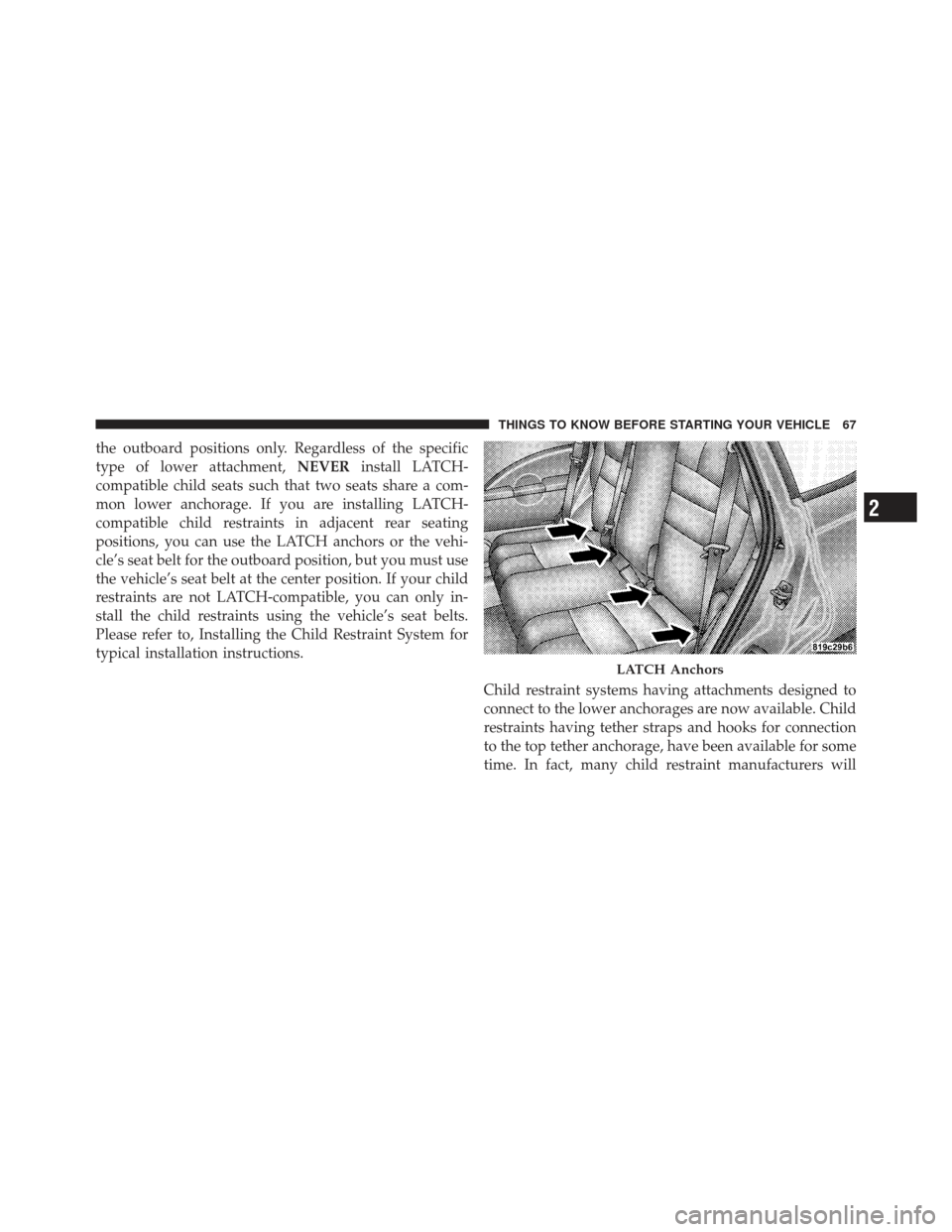
using the vehicle seat belt. All three rear seating positions
have lower and tether anchorages that are capable of
accommodating LATCH-compatible child seats having
flexible, webbing-mounted lower attachments. Child
seats with fixed lower attachments must be installed in
66 THINGS TO KNOW BEFORE STARTING YOUR VEHICLE
Page 69 of 410
the outboard positions only. Regardless of the specific
type of lower attachment,NEVERinstall LATCH-
compatible child seats such that two seats share a com-
mon lower anchorage. If you are installing LATCH-
compatible child restraints in adjacent rear seating
positions, you can use the LATCH anchors or the vehi-
cle’s seat belt for the outboard position, but you must use
the vehicle’s seat belt at the center position. If your child
restraints are not LATCH-compatible, you can only in-
stall the child restraints using the vehicle’s seat belts.
Please refer to, Installing the Child Restraint System for
typical installation instructions.
Child restraint systems having attachments designed to
connect to the lower anchorages are now available. Child
restraints having tether straps and hooks for connection
to the top tether anchorage, have been available for some
time. In fact, many child restraint manufacturers will
LATCH Anchors
2
THINGS TO KNOW BEFORE STARTING YOUR VEHICLE 67
Page 71 of 410
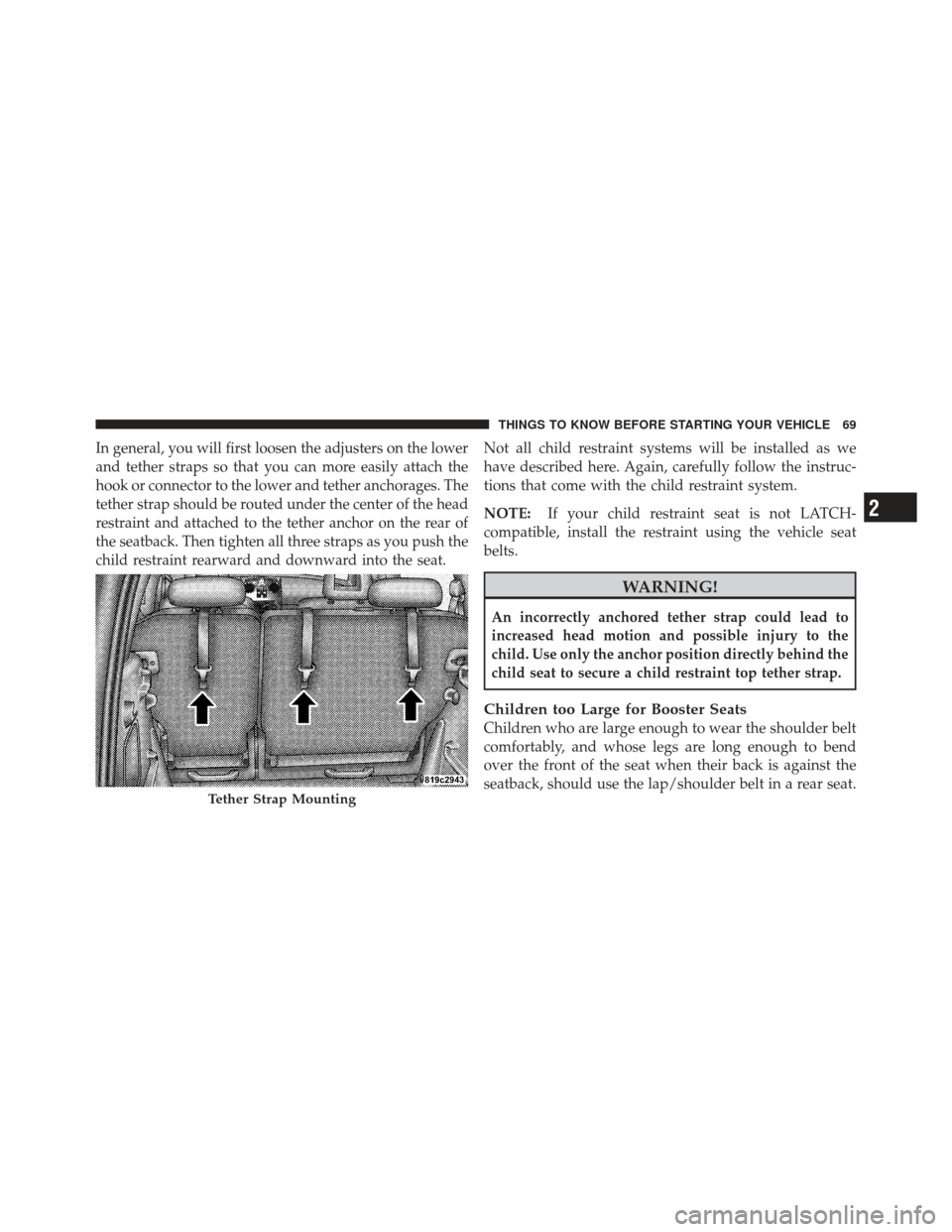
In general, you will first loosen the adjusters on the lower
and tether straps so that you can more easily attach the
hook or connector to the lower and tether anchorages. The
tether strap should be routed under the center of the head
restraint and attached to the tether anchor on the rear of
the seatback. Then tighten all three straps as you push the
child restraint rearward and downward into the seat.Not all child restraint systems will be installed as we
have described here. Again, carefully follow the instruc-
tions that come with the child restraint system.
NOTE:If your child restraint seat is not LATCH-
compatible, install the restraint using the vehicle seat
belts.
WARNING!
An incorrectly anchored tether strap could lead to
increased head motion and possible injury to the
child. Use only the anchor position directly behind the
child seat to secure a child restraint top tether strap.
Children too Large for Booster Seats
Children who are large enough to wear the shoulder belt
comfortably, and whose legs are long enough to bend
over the front of the seat when their back is against the
seatback, should use the lap/shoulder belt in a rear seat.
Tether Strap Mounting
2
THINGS TO KNOW BEFORE STARTING YOUR VEHICLE 69
Page 73 of 410
A new engine may consume some oil during its first few
thousand miles (kilometers) of operation. This should be
considered a normal part of the break-in and not inter-
preted as an indication of difficulty.
SAFETY TIPS
Transporting Passengers
NEVER TRANSPORT PASSENGERS IN THE CARGO
AREA.
WARNING!
•It is extremely dangerous to ride in a cargo area,
inside or outside of a vehicle. In a collision, people
riding in these areas are more likely to be seri-
ously injured or killed.(Continued)
WARNING! (Continued)
•Do not allow people to ride in any area of your
vehicle that is not equipped with seats and seat
belts.
•Be sure everyone in your vehicle is in a seat and
using a seat belt properly.
Exhaust Gas
WARNING!
Exhaust gases can injure or kill. They contain carbon
monoxide (CO), which is colorless and odorless.
Breathing it can make you unconscious and can
eventually poison you. To avoid breathing (CO)
follow these safety tips:
2
THINGS TO KNOW BEFORE STARTING YOUR VEHICLE 71
Page 77 of 410
UNDERSTANDING THE FEATURES OF YOUR VEHICLE
CONTENTS
�Mirrors .............................. 79
▫ Inside Day/Night Mirror ................ 79
▫ Outside Mirror — Driver Side ............ 79
▫ Outside Mirror — Passenger Side .......... 80
▫ Power Mirrors — If Equipped ............ 80
▫ Illuminated Vanity Mirrors — If Equipped . . . 81
▫ Sun Visor Sliding Feature ............... 81
� uconnect� phone — If Equipped ............ 82
▫ Operation .......................... 84 ▫
Phone Call Features ................... 91
▫ uconnect� phone Features ............... 94
▫ Advanced Phone Connectivity ............ 99
▫ Things You Should Know About Your
uconnect� phone..................... 101
▫ General Information .................. 110
� Seats .............................. 110
▫ Front Seat Adjustment — If Equipped ...... 110
▫ Six-Way Power Seat With Manual Recliner —
If Equipped .........................111
3
Page 78 of 410

▫Manual Lumbar — If Equipped .......... 112
▫ Folding Front Passenger Seat —
If Equipped ........................ 113
▫ Adjustable Head Restraints ............. 114
▫ Heated Seats — If Equipped ............ 114
▫ Folding Rear Seat .................... 116
▫ Tumbling Rear Seat ................... 118
▫ Rear Seat Removal ................... 120
� Emergency Seatback Release .............. 122
� To Open And Close The Hood ............ 123
� Lights ............................. 125
▫ Map/Reading Lights .................. 125
▫ Headlights ......................... 126 ▫
Parking And Instrument Panel Lights ...... 126
▫ Daytime Running Lights (DRL) —
If Equipped ........................ 127
▫ Lights — On Reminder ................ 127
▫ Fog Lights — If Equipped .............. 128
▫ Turn Signal Operation ................. 128
▫ High Beam/Low Beam Select Switch ...... 129
▫ Flash-To-Pass ....................... 130
� Windshield Wipers And Washers .......... 130
▫ Windshield Wiper Operation ............ 130
▫ Intermittent Wiper System .............. 131
▫ Windshield Washers .................. 132
▫ Mist Feature ........................ 132
76 UNDERSTANDING THE FEATURES OF YOUR VEHICLE
Page 112 of 410
General Information
This device complies with Part 15 of the FCC rules and
RSS 210 of Industry Canada. Operation is subject to the
following conditions:
•Changes or modifications not expressly approved by
the party responsible for compliance could void the
user’s authority to operate the equipment.
•This device may not cause harmful interference.
•This device must accept any interference received,
including interference that may cause undesired
operation.
SEATS
Front Seat Adjustment — If Equipped
The adjusting bar is located at the front of the seats, near
the floor. Pull the bar upward to move the seat to the
desired position.
Manual Adjusting Bar
110 UNDERSTANDING THE FEATURES OF YOUR VEHICLE
Page 116 of 410
Adjustable Head Restraints
Head restraints can reduce the risk of whiplash injury in
the event of a rear impact. Adjust the height of a head
restraint to a position that is appropriate for the height of
the person using the seat. To raise a head restraint, pull
up on the head restraint. To lower a head restraint, push
in the button that is part of the head restraint rod guide,
and push down on the head restraint.
Heated Seats — If Equipped
The heaters provide the same heat level for both cushion
and seatback. The driver and front passenger seats are
heated. The controls for each heater are located near the
bottom center of the instrument panel.
After turning the ignition ON, you can choose from High,
Low, or Off heat settings. Amber indicator lights in each
switch indicate the level of heat in use. Two indicator
lights will illuminate for High, one for Low, and none for
Off.Press the switch once to select High-level heat-
ing. Press the switch a second time to select
Low-level heating. Press the switch a third time
to shut Off the heating elements.
If High-level heating is selected, the system automatically
switches to Low-level heating and turns one indicator
light off after 30 minutes of continuous operation. It will
turn the heater and the remaining indicator light off after
an additional 30 minutes of continuous operation. If
Low-level heating is selected, the system automatically
turns the heater and the indicator light off after 30 min-
utes of continuous operation.
NOTE: Once a heat setting is selected, heat will be felt
within two to five minutes.
114 UNDERSTANDING THE FEATURES OF YOUR VEHICLE