Page 205 of 481
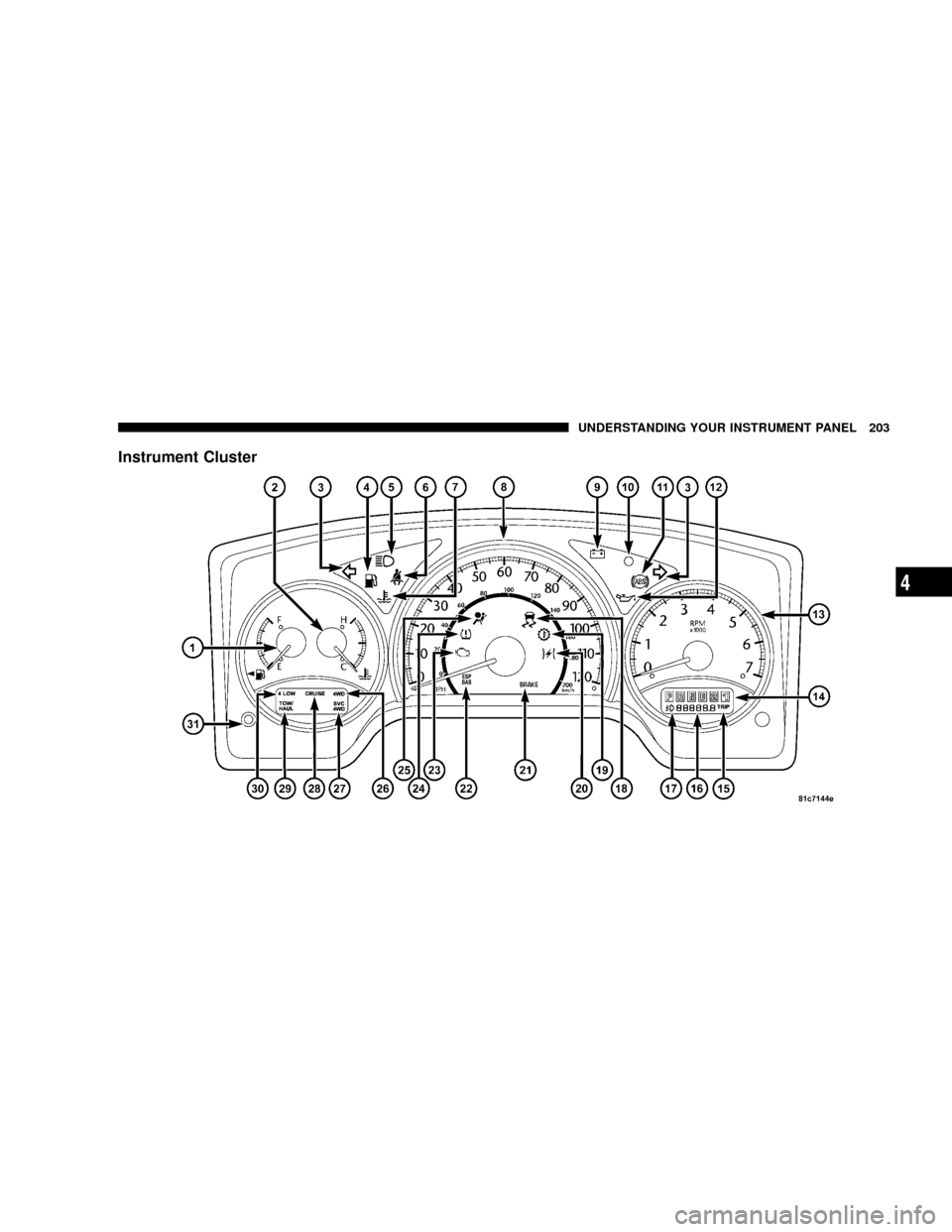
Instrument Cluster
UNDERSTANDING YOUR INSTRUMENT PANEL 203
4
Page 206 of 481

INSTRUMENT CLUSTER DESCRIPTION
1. Fuel Gauge
The fuel gauge shows level of fuel in the tank when
ignition switch is in the ON position.
2. Temperature Gauge
The temperature gauge shows engine coolant tempera-
ture. Any reading within the normal range indicates that
the engine cooling system is operating satisfactorily. The
gauge pointer will likely indicate a higher temperature
when driving in hot weather, up mountain grades, or
when towing a trailer. It should not be allowed to exceed
the upper limits of the normal operating range.
CAUTION!
Do not leave your vehicle unattended with the en-
gine running as you would not be able to react to the
temperature indicator if the engine overheats.The gauge pointer will remain near its last reading when
the engine is turned off. It will return to a true reading
when the engine is restarted.
3. Turn Signal Indicators
When a turn signal is activated, a right-pointing or
left-pointing arrow lights up and flashes to indicate the
direction of the turn. These indicators also indicate
proper operation of the front and rear turn signal lights.
If either indicator flashes at a faster rate than normal,
check for a defective bulb. If either indicator fails to light
up when the lever is moved, check for a defective fuse or
turn signal LED. A single chime is activated when the
left/right turn signal is left on with the engine RPM
vehicle speed greater than 15 mph (24 km/h) for more
than one mile.
4. Low Fuel Warning Light
This indicator lights when the fuel gauge reads
1/16 of a tank or less.
204 UNDERSTANDING YOUR INSTRUMENT PANEL
Page 209 of 481

When the voltage is above this value again, the malfunc-
tion indicator light should go out and the ABS is opera-
tional. If the malfunction indicator light stays illumi-
nated, have the system checked at an authorized dealer
as soon as possible.
12. Oil Pressure Warning Light
This light indicates low engine oil pressure. The
light should turn on momentarily when the engine
is started. If the light turns on while driving, stop the
vehicle and shut off the engine as soon as possible. A
chime will sound when this light turns on.
Do not operate the vehicle until the cause is corrected.
This light does not show how much oil is in the engine.
The engine oil level must be checked under the hood.
13. Tachometer
This gauge measures engine Revolutions-Per-Minute
(RPM x 1000).14. Shift Lever Indicator
The shift lever indicator is self-contained within the
instrument cluster. It displays the position of the auto-
matic transmission shift lever, and the relation of each
position to all other positions. For a good signal the
display will place a box around the selected transmission
range (PRND21). If the PRNDL displays only the char-
acters PRND21 (no boxes), have the system checked by
an authorized dealer.
15. Odometer / Trip Odometer
The two trip odometers show individual trip mileage. To
switch from odometer to trip odometers, press and
release the Trip Odometer button.
To reset a trip odometer, display the desired trip odom-
eter to be reset then push and hold the button until the
display resets (approximately two seconds).
UNDERSTANDING YOUR INSTRUMENT PANEL 207
4
Page 210 of 481

Vehicle Warning Messages
For non-Electronic Vehicle Information Center (EVIC)
equipped vehicles, when the appropriate conditions ex-
ist, messages such as ªdoor ajarº (indicates that a door(s)
may be ajar), ªgASCAPº (which indicates that your gas
cap is possibly loose or damaged),9CHANgE OILº
(indicates that the engine oil should be changed), ªLo-
WASHº (low washer fluid), and ªnoFUSEº (indicates
that the IOD fuse is removed from the Integrated Power
Module), will display in the odometer.
NOTE:If the vehicle is equipped with an EVIC, most
warnings will display in the EVIC. For additional infor-
mation, refer to ªElectronic Vehicle Information Center
(EVIC) Ð If Equippedº in Section 3.
The outside temperature will display in the odometer for
non-EVIC equipped vehicles. Pressing the trip odometer
RESET button toggles the feature back to the odometer.Change Oil Message
Your vehicle is equipped with an engine oil change
indicator system. The ªChange Oilº message will flash in
the instrument cluster odometer for approximately 12
seconds after a single chime has sounded to indicate the
next scheduled oil change interval. The engine oil change
indicator system is duty cycle based, which means the
engine oil change interval may fluctuate dependent upon
your personal driving style.
Unless reset, this message will continue to display each
time you turn the ignition switch to the ON/RUN
position. To turn off the message temporarily, press and
release the Trip Odometer button on the instrument
cluster. To reset the oil change indicator system (after
performing the scheduled maintenance) refer to the fol-
lowing procedure.
1. Turn the ignition switch to the ON position(Do not
start the engine).
208 UNDERSTANDING YOUR INSTRUMENT PANEL
Page 214 of 481

the parking brake is applied or a brake fault is detected.
If the light does not illuminate, have the light inspected
by an authorized dealer.
The light also will turn on when the parking brake is
applied with the ignition switch in the ON position.
NOTE:This light shows only that the parking brake is
applied. It does not show the degree of brake application.
22. Electronic Stability Program (ESP) / Brake Assist
System (BAS) Warning Lamp
The malfunction lamp for the Electronic Stabil-
ity Program (ESP) is combined with Brake
Assist System (BAS). The yellow ESP/BAS
warning lamp is in the instrument cluster it
comes on when the ignition switch is turned to the ON
position, it should go out with the engine running. If the
ESP/BAS warning lamp comes on continuously with the
engine running, a malfunction has been detected in either
the ESP or the BAS system. If this light remains on afterseveral ignition cycles, and the vehicle has been driven
several miles at speeds greater than 30 mph (48 km/h),
see an authorized dealer as soon as possible.
NOTE:The ESP control system will make buzzing or
clicking sounds when it is actively operating.
23. Malfunction Indicator Light (MIL)
The Malfunction Indicator Light (MIL) is part of
an onboard diagnostic system which monitors
the emissions and engine control system. If the
vehicle is ready for emissions testing, the MIL will come
on when the ignition is first turned on and remain on, as
a bulb check, until the engine is started. If the vehicle is
not ready for emissions testing, the MIL will come on
when the ignition is first turned on and remain on for 15
seconds, then blink for 10 seconds, and remain on until
the vehicle is started. If the MIL does not come on during
starting, see an authorized dealer as soon as possible.
212 UNDERSTANDING YOUR INSTRUMENT PANEL
Page 285 of 481

The ªTOW/HAUL Indicator Lightº will illuminate in the
instrument cluster to indicate when the switch has been
activated. Pressing the switch a second time restores
normal operation. If the TOW/HAUL mode is desired,
the button must be pressed each time the engine is
started.
Torque Converter Clutch
A feature designed to improve fuel economy is included
in all automatic transmissions. A clutch within the torque
converter engages automatically at a calibrated speed at
light throttle. It engages at higher speeds under heavier
acceleration. This may result in a slightly different feeling
or response during normal operation in high gear. When
the vehicle speed drops below a calibrated speed, or
during acceleration, the clutch automatically and
smoothly disengages. The feature is operational in
OVERDRIVE and in DRIVE.
NOTE:The torque converter clutch will not engage
until the transmission fluid and engine coolant are warm
(usually after 1-3 miles [1.6 - 4.8 km] of driving). Because
the engine speed is higher when the torque converter
clutch is not engaged, it may seem as if the transmission
is not shifting into Overdrive when cold. This is normal.
Pressing the TOW/HAUL button, when the transmission
TOW/HAUL Button
STARTING AND OPERATING 283
5
Page 288 of 481

NOTE:The transfer case NEUTRAL position is to be
used for recreational towing only. Refer to ªRecreational
Towingº in this section for specific procedures on shifting
into and out of NEUTRAL.
Transfer Case Position Indicator Lights
Transfer case position indicator lights are located on the
instrument cluster. If there are no indicator lights on or
flashing, the transfer case position is four-wheel drive
(4WD) and indicates the current and desired transfer case
selection (4WD,4WD LOCK).
The ªSVC 4WD Warning Lightº monitors the electric
shift 4WD system. If this light remains on after engine
start up or illuminates during driving, it means that the
4WD system is not functioning properly and that service
is required. See your authorized dealer for service.
WARNING!
Always engage the parking brake when powering
down the vehicle if the(SVC 4WD Warning Lightº is
illuminated. Not engaging the parking brake may
allow the vehicle to roll, which may cause personal
injury.
NOTE:Do not attempt to make a shift while only the
front or rear wheels are spinning. The NV 244 Generation
II transfer case is not equipped with a synchronizer and
therefore the front and rear driveshaft speeds must be
equal for the shift to take place. Shifting while only the
front or rear wheels are spinning can cause damage to the
transfer case.
286 STARTING AND OPERATING
Page 297 of 481

Be sure the parking brake is firmly set when parked and
the shift lever is in PARK position. When parking on a
hill, you should apply the parking brake before placing
the shift lever in PARK; otherwise the load on the
transmission locking mechanism may make it difficult to
move the shift lever out of PARK.NOTE:The instrument cluster brake warning light
indicates only that the parking brake is applied. You must
be sure the parking brake is fully applied before leaving
the vehicle.
When parking on a hill, turn the front wheels toward the
curb on a downhill grade and away from the curb on an
uphill grade.
The parking brake should be applied whenever the
driver is not in the vehicle.
WARNING!
²Always fully apply the parking brake when leav-
ing your vehicle, or the vehicle may roll and cause
damage or injury. Also be certain to leave an
automatic transmission in Park. Failure to do so
may cause the vehicle to roll and cause damage or
injury.
(Continued)Parking Brake
STARTING AND OPERATING 295
5