Page 370 of 493
winter months to reduce carbon monoxide emissions.
Fuels blended with these oxygenates may be used in
your vehicle.
CAUTION!
DO NOT use gasolines containing Methanol or E85
Ethanol. Use of these blends may result in starting
and driveability problems and may damage critical
fuel system components.
Problems that result from using methanol/gasoline or
E85 ethanol blends are not the responsibility of the
manufacturer. While MTBE is an oxygenate made from
methanol, it does not have the negative effects of
Methanol.
E-85 Usage In Non-Flex Fuel Vehicles
Non-FFV vehicles are compatible with gasoline contain-
ing 10% ethanol (E10). Gasoline with higher ethanol
content may void the vehicle’s warranty.If a Non-FFV vehicle is inadvertently fueled with E-85
fuel, the engine will have some or all of these symptoms:
•operate in a lean mode
•OBD II “Malfunction Indicator Light” on
•poor engine performance
•poor cold start and cold drivability
•increased risk for fuel system component corrosion
To fix a Non-FFV vehicle inadvertently fueled once with
E-85 perform the following:
•drain the fuel tank (see your authorized dealer)
•change the engine oil and oil filter
•disconnect and reconnect the battery to reset the
engine controller memory
More extensive repairs will be required for prolonged
exposure to E-85 fuel.
368 STARTING AND OPERATING
Page 380 of 493
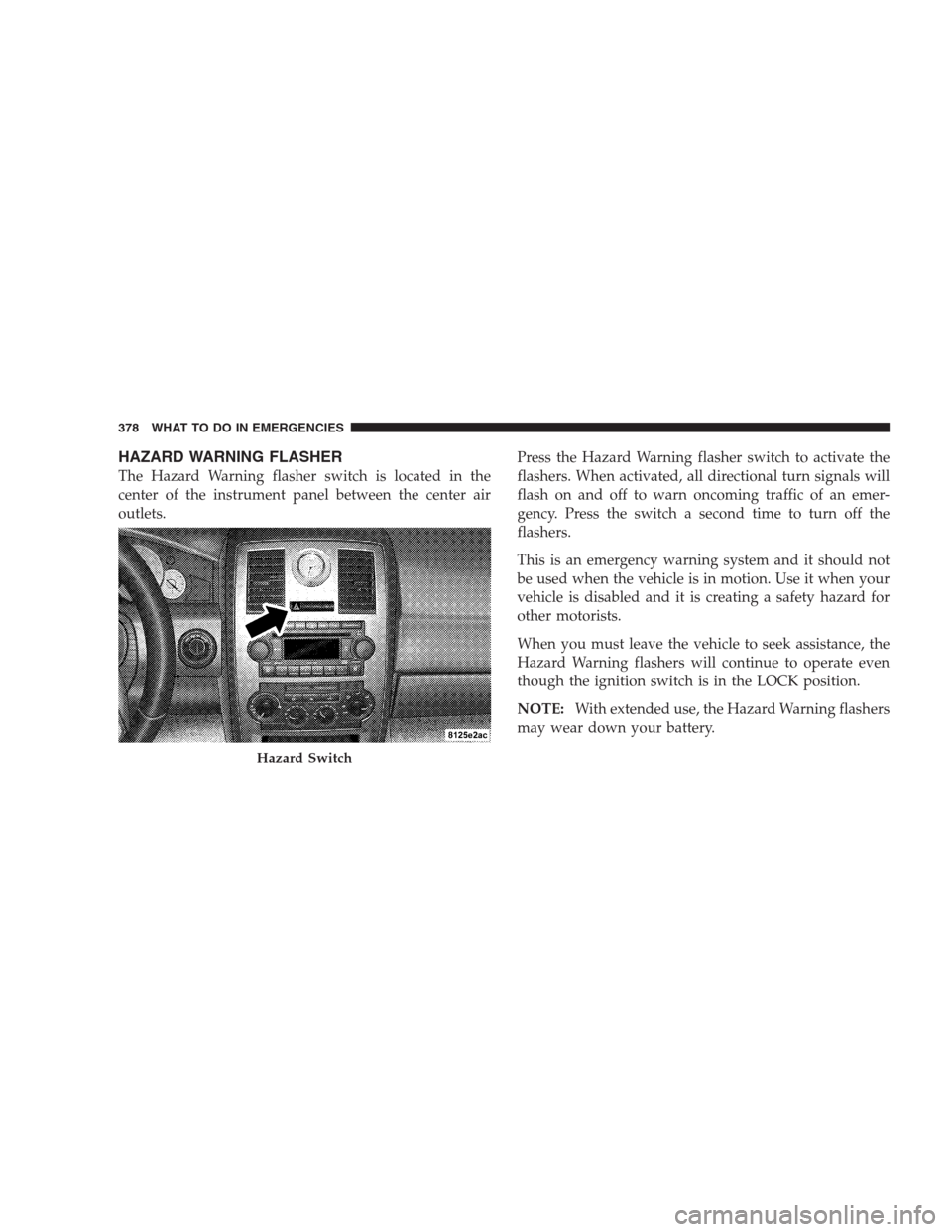
HAZARD WARNING FLASHER
The Hazard Warning flasher switch is located in the
center of the instrument panel between the center air
outlets.Press the Hazard Warning flasher switch to activate the
flashers. When activated, all directional turn signals will
flash on and off to warn oncoming traffic of an emer-
gency. Press the switch a second time to turn off the
flashers.
This is an emergency warning system and it should not
be used when the vehicle is in motion. Use it when your
vehicle is disabled and it is creating a safety hazard for
other motorists.
When you must leave the vehicle to seek assistance, the
Hazard Warning flashers will continue to operate even
though the ignition switch is in the LOCK position.
NOTE:With extended use, the Hazard Warning flashers
may wear down your battery.
Hazard Switch
378 WHAT TO DO IN EMERGENCIES
Page 387 of 493
NOTE:
•If a pressure of at least 19 psi (1.3 bar) cannot be
maintained in the tire, the tire is too badly damaged.
Do not attempt to drive the vehicle further. Call for
assistance.
•Do not operate the electric air pump for more than
eight minutes to avoid overheating. The air pump may
be used again once it has cooled down.
•Replace the TIREFIT sealant bottle 5 once every four
years to assure optimum operation of the system.
•If TIREFIT is liquid, clean water and a damp cloth will
remove the material from the vehicle or tire and wheel
components. Once TIREFIT sealing material has dried,
it can easily be peeled off and properly discarded.
•Do not exceed 55 mph (90 km/h) until the tire has
been inspected.
JUMP-STARTING PROCEDURES
WARNING!
•Take care to avoid the radiator cooling fan when-
ever the hood is raised. It can start anytime the
ignition switch is ON. You can be hurt by the fan.
•Do not attempt to push or tow your vehicle to get
it started. Vehicles equipped with an automatic
transmission cannot be started this way. Unburned
fuel could enter the catalytic converter and once
the engine has started, ignite and damage the
converter and vehicle. If the vehicle has a dis-
charged battery, booster cables may be used to
obtain a start from another vehicle. This type of
start can be dangerous if done improperly, so
follow this procedure carefully.
(Continued)
WHAT TO DO IN EMERGENCIES 385
6
Page 388 of 493
WARNING! (Continued)
•Battery fluid is a corrosive acid solution; do not
allow battery fluid to contact eyes, skin, or cloth-
ing. Don’t lean over battery when attaching
clamps or allow the clamps to touch each other. If
acid splashes in eyes or on skin, flush contami-
nated area immediately with large quantities of
water.
•A battery generates hydrogen gas, which is flam-
mable and explosive. Keep flame or spark away
from the vent holes.
•Do not use a booster battery or any other booster
source with an output that exceeds 12-Volts.
•The battery in this vehicle has a vent hose that
should not be disconnected and should only be
replaced with a battery of the same type (vented).NOTE:The battery is stored under an access cover in
the trunk. Remote battery terminals are located in the
engine compartment for jump-starting.
1. Wear eye protection and remove any metal jewelry
such as watchbands or bracelets that might make an
inadvertent electrical contact.
2. When boost is provided by a battery in another
vehicle, park that vehicle within booster cable reach, but
do not allow the vehicles to touch one another.
WARNING!
Do not permit vehicles to touch each other as this
could establish a ground connection and personal
injury could result.
3. Set the parking brake, place the automatic transmis-
sion in PARK, and turn the ignition switch to the LOCK
position on both vehicles.
386 WHAT TO DO IN EMERGENCIES
Page 389 of 493
4. Turn off the heater, radio, and all unnecessary electri-
cal loads.
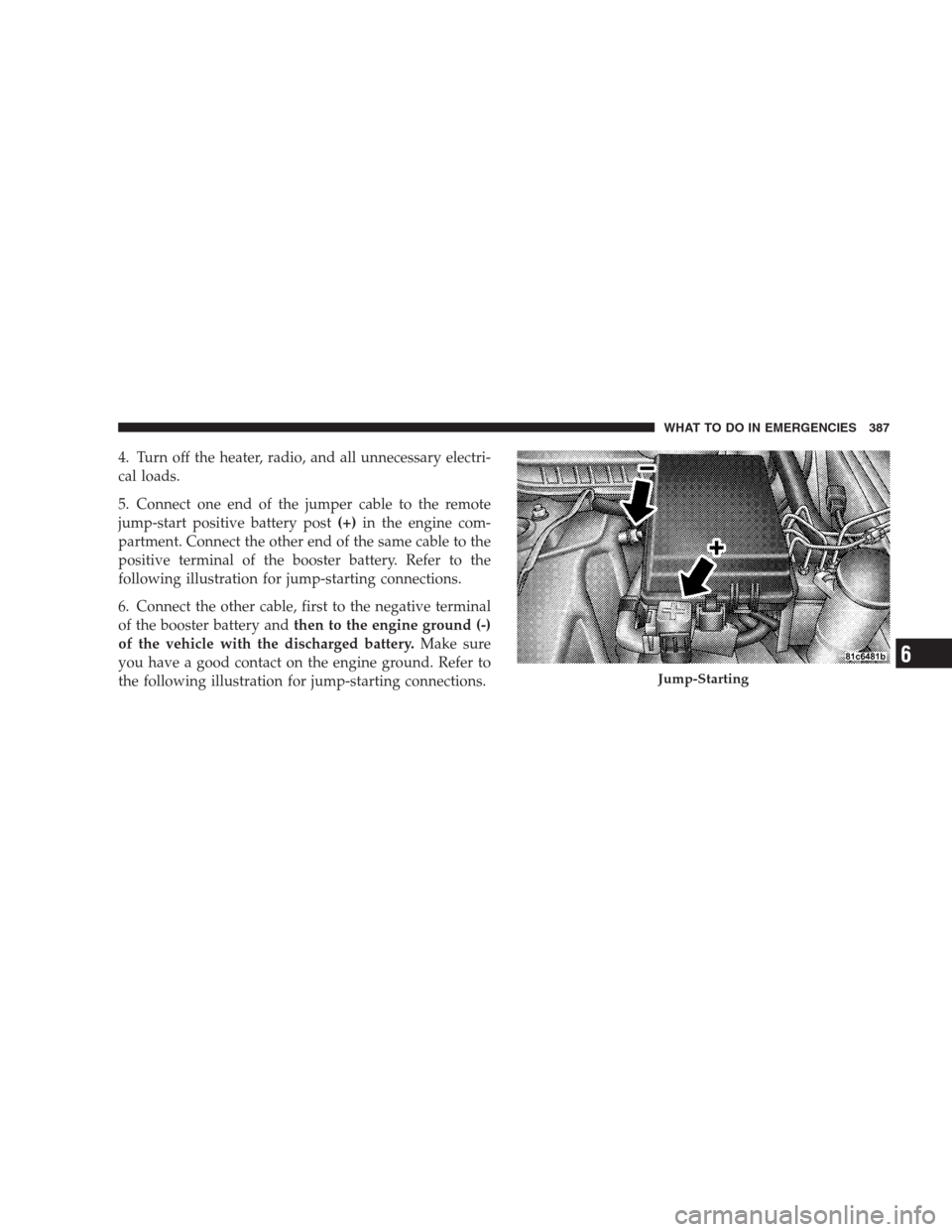
5. Connect one end of the jumper cable to the remote
jump-start positive battery post(+)in the engine com-
partment. Connect the other end of the same cable to the
positive terminal of the booster battery. Refer to the
following illustration for jump-starting connections.
6. Connect the other cable, first to the negative terminal
of the booster battery andthen to the engine ground (-)
of the vehicle with the discharged battery.Make sure
you have a good contact on the engine ground. Refer to
the following illustration for jump-starting connections.
Jump-Starting
WHAT TO DO IN EMERGENCIES 387
6
Page 390 of 493
WARNING!
•You should not try to start your vehicle by pushing
or towing.
•Do not connect the cable to the negative post of the
discharged battery. The resulting electrical spark
could cause the battery to explode.
•During cold weather when temperatures are be-
low the freezing point, electrolyte in a discharged
battery may freeze. Do not attempt jump-starting
because the battery could rupture or explode. The
battery temperature must be brought above the
freezing point before attempting jump-start.
7. Start the engine in the vehicle that has the booster
battery. Let the engine idle a few minutes. Then, start the
engine in the vehicle with the discharged battery.NOTE:Refer to�Synchronizing ESP�under�Electronic
Stability Program�in Section 5 if the ESP/BAS light (in
the instrument cluster) remains on continuously after
starting the engine of the vehicle with the discharged
battery.
8. When removing the jumper cables, reverse the above
sequence exactly. Be careful of the moving belts and fan.
WARNING!
Any procedure other than above could result in:
•Personal injury caused by electrolyte squirting out
the battery vent
•Personal injury or property damage due to battery
explosion
•Damage to charging system of booster vehicle or
of immobilized vehicle
388 WHAT TO DO IN EMERGENCIES
Page 395 of 493
MAINTAINING YOUR VEHICLE
CONTENTS
�Engine Compartment — 6.1L............. 395
�Onboard Diagnostic System — OBD II...... 396
▫Loose Fuel Filler Cap................. 397
�Emissions Inspection And Maintenance
Programs............................ 397
�Replacement Parts..................... 399
�Dealer Service........................ 399
�Maintenance Procedures................. 399
▫Engine Oil......................... 400▫Engine Oil Filter..................... 402
▫Engine Air Cleaner Filter............... 403
▫Maintenance-Free Battery.............. 404
▫Air Conditioner Maintenance............ 405
▫A/C Air Filter...................... 406
▫Body Lubrication.................... 407
▫Windshield Wiper Blades............... 407
▫Windshield Washers.................. 408
▫Exhaust System..................... 408
7
Page 397 of 493
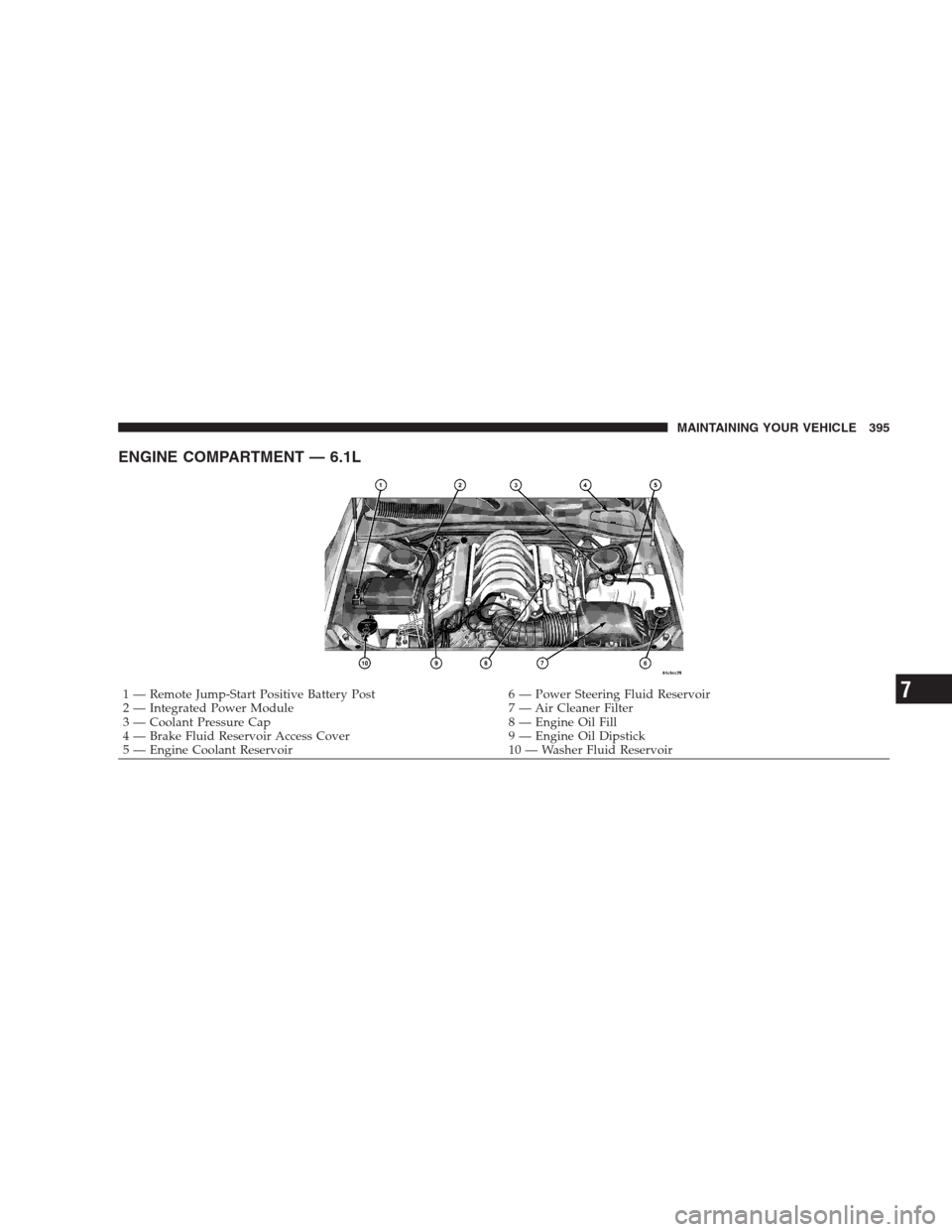
ENGINE COMPARTMENT — 6.1L
1 — Remote Jump-Start Positive Battery Post 6 — Power Steering Fluid Reservoir
2 — Integrated Power Module 7 — Air Cleaner Filter
3 — Coolant Pressure Cap 8 — Engine Oil Fill
4 — Brake Fluid Reservoir Access Cover 9 — Engine Oil Dipstick
5 — Engine Coolant Reservoir 10 — Washer Fluid ReservoirMAINTAINING YOUR VEHICLE 3957