Page 390 of 493
WARNING!
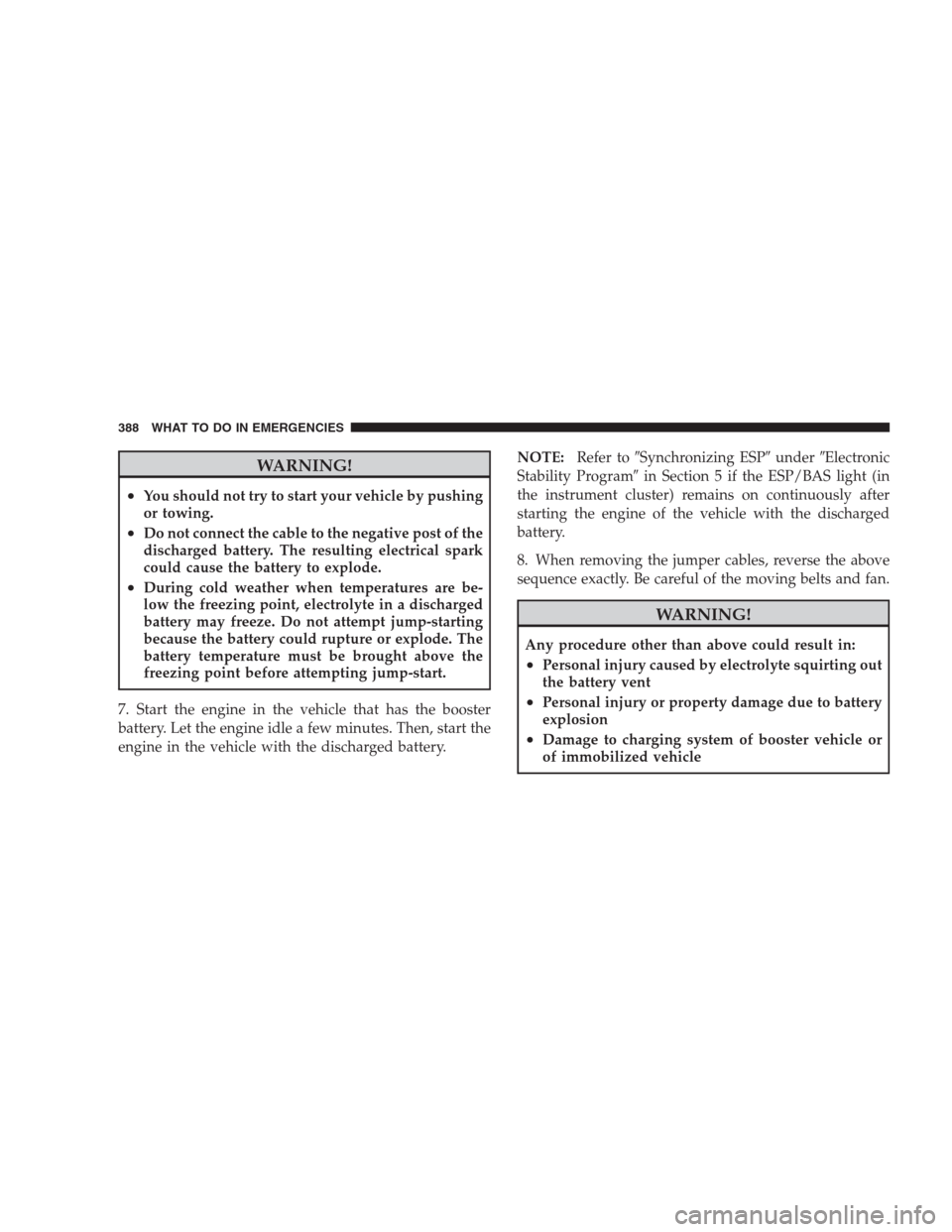
•You should not try to start your vehicle by pushing
or towing.
•Do not connect the cable to the negative post of the
discharged battery. The resulting electrical spark
could cause the battery to explode.
•During cold weather when temperatures are be-
low the freezing point, electrolyte in a discharged
battery may freeze. Do not attempt jump-starting
because the battery could rupture or explode. The
battery temperature must be brought above the
freezing point before attempting jump-start.
7. Start the engine in the vehicle that has the booster
battery. Let the engine idle a few minutes. Then, start the
engine in the vehicle with the discharged battery.NOTE:Refer to�Synchronizing ESP�under�Electronic
Stability Program�in Section 5 if the ESP/BAS light (in
the instrument cluster) remains on continuously after
starting the engine of the vehicle with the discharged
battery.
8. When removing the jumper cables, reverse the above
sequence exactly. Be careful of the moving belts and fan.
WARNING!
Any procedure other than above could result in:
•Personal injury caused by electrolyte squirting out
the battery vent
•Personal injury or property damage due to battery
explosion
•Damage to charging system of booster vehicle or
of immobilized vehicle
388 WHAT TO DO IN EMERGENCIES
Page 396 of 493
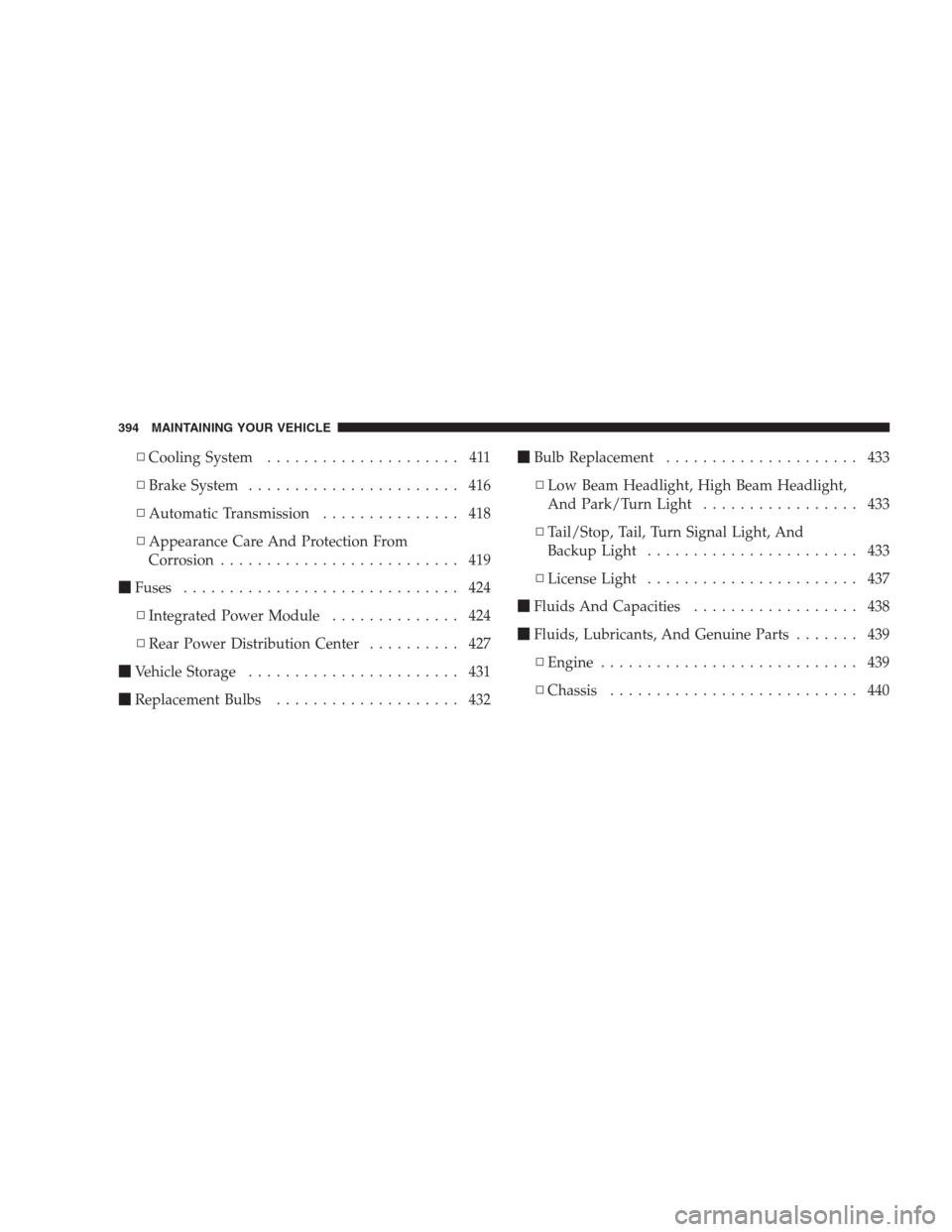
▫Cooling System..................... 411
▫Brake System....................... 416
▫Automatic Transmission............... 418
▫Appearance Care And Protection From
Corrosion.......................... 419
�Fuses.............................. 424
▫Integrated Power Module.............. 424
▫Rear Power Distribution Center.......... 427
�Vehicle Storage....................... 431
�Replacement Bulbs.................... 432�Bulb Replacement..................... 433
▫Low Beam Headlight, High Beam Headlight,
And Park/Turn Light................. 433
▫Tail/Stop, Tail, Turn Signal Light, And
Backup Light....................... 433
▫License Light....................... 437
�Fluids And Capacities.................. 438
�Fluids, Lubricants, And Genuine Parts....... 439
▫Engine............................ 439
▫Chassis........................... 440
394 MAINTAINING YOUR VEHICLE
Page 398 of 493
ONBOARD DIAGNOSTIC SYSTEM — OBD II
Your vehicle is equipped with a sophisticated onboard
diagnostic system called OBD II. This system monitors
the performance of the emissions, engine, and automatic
transmission control systems. When these systems are
operating properly, your vehicle will provide excellent
performance and fuel economy, as well as engine emis-
sions well within current government regulations.
If any of these systems require service, the OBD II system
will turn on the Malfunction Indicator Light (MIL). It will
also store diagnostic codes and other information to
assist your service technician in making repairs. Al-
though your vehicle will usually be drivable and not
need towing, see your authorized dealer for service as
soon as possible.CAUTION!
Prolonged driving with the MIL on could cause
further damage to the emissions control system. It
could also affect fuel economy and driveability. The
vehicle must be serviced before any emissions tests
can be performed.
If the MIL is flashing while the engine is running,
severe catalytic converter damage and power loss
will soon occur. Immediate service is required.
396 MAINTAINING YOUR VEHICLE
Page 399 of 493
Loose Fuel Filler Cap
If the vehicle diagnostic system determines that the fuel
filler cap is loose, improperly installed, or damaged, a
“Check Gascap” message will display in the Electronic
Vehicle Information Center (EVIC) (if equipped). If this
occurs, tighten the fuel filler cap properly and press the
TRIP ODOMETER button to turn off the message. If the
problem continues, the message will appear the next time
the vehicle is started.
A loose, improperly installed, or damaged fuel filler cap
may also turn on the MIL.
EMISSIONS INSPECTION AND MAINTENANCE
PROGRAMS
In some localities, it may be a legal requirement to pass
an inspection of your vehicle’s emissions control system.
Failure to pass could prevent vehicle registration.For states that require an Inspection and Mainte-
nance (I/M), this check verifies the Malfunction
Indicator Light (MIL) is functioning and is not on
when the engine is running, and that the OBD II system
is ready for testing.
Normally, the OBD II system will be ready. The OBD II
system maynotbe ready if your vehicle was recently
serviced, recently had a dead battery, or a battery replace-
ment. If the OBD II system should be determined not
ready for the I/M test, your vehicle may fail the test.
Your vehicle has a simple ignition key-actuated test,
which you can use prior to going to the test station. To
check if your vehicle’s OBD II system is ready, you must
do the following:
1. Insert your ignition key into the ignition switch.
2. Turn the ignition to the ON position, but do not crank
or start the engine.
MAINTAINING YOUR VEHICLE 397
7
Page 419 of 493
Master Cylinder - Brake Fluid Level Check
Check the fluid level in the master cylinder immediately
if the brake system warning light indicates system fail-
ure.
Check the fluid level in the master cylinder when per-
forming underhood services.
Clean the top of the master cylinder area before removing
the cap. Add fluid to bring the level up to the top of the
“FULL” mark on the side of the master cylinder reservoir.
Overfilling of fluid is not recommended because it may
cause leaking in the system.
Add enough fluid to bring the level up to the require-
ments described on the brake fluid reservoir. With disc
brakes, fluid level can be expected to fall as the brake
pads wear. However, low fluid level may be caused by a
leak and a checkup may be needed.Use only manufacturer’s recommended brake fluid. Re-
fer to “Fluids, Lubricants, and Genuine Parts” in this
section for the correct fluid type.
WARNING!
•Overfilling the brake fluid reservoir can result in
spilling brake fluid on hot engine parts and the
brake fluid catching fire.
•Use of a brake fluid that may have a lower initial
boiling point, or is unidentified as to specification,
may result in sudden brake failure during hard
prolonged braking. You could have an accident.
Use only brake fluid that has been in a tightly closed
container to avoid contamination from foreign matter or
moisture.
MAINTAINING YOUR VEHICLE 417
7
Page 425 of 493
Cleaning Headlights
Your vehicle has plastic headlights that are lighter and
less susceptible to stone breakage than glass headlights.
Plastic is not as scratch resistant as glass and therefore
different lens cleaning procedures must be followed.
To minimize the possibility of scratching the lenses and
reducing light output, avoid wiping with a dry cloth. To
remove road dirt, wash with a mild soap solution fol-
lowed by rinsing.
Do not use abrasive cleaning components, solvents, steel
wool or other aggressive material to clean the lenses.
Glass Surfaces
All glass surfaces should be cleaned on a regular basis
with MOPAR�Glass Cleaner or any commercial
household-type glass cleaner. Never use an abrasive type
cleaner. Use caution when cleaning the inside rear win-
dow equipped with electric defrosters or the right rearquarter window equipped with the radio antenna. Do
not use scrapers or other sharp instruments that may
scratch the elements.
When cleaning the rear view mirror, spray cleaner on the
towel or rag that you are using. Do not spray cleaner
directly on the mirror.
Cleaning Plastic Instrument Cluster Lenses
The lenses in front of the instruments in this vehicle are
molded in clear plastic. When cleaning the lenses, care
must be taken to avoid scratching the plastic.
1. Clean with a wet soft rag or micro-fiber towel. A mild
soap solution may be used, but do not use high alcohol
content or abrasive cleaners. If soap is used, wipe clean
with a clean damp rag.
2. Dry with a soft tissue.
MAINTAINING YOUR VEHICLE 423
7
Page 431 of 493
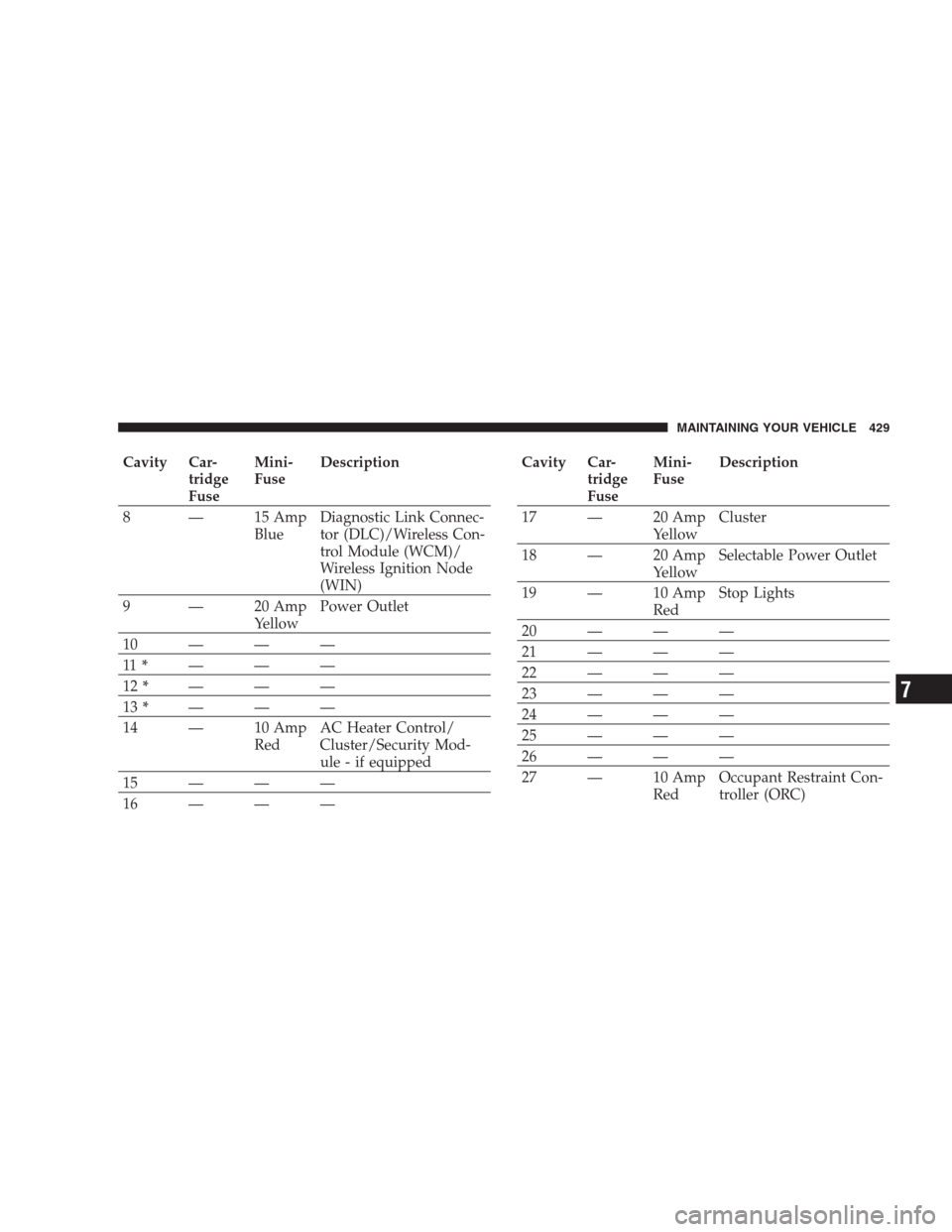
Cavity Car-
tridge
FuseMini-
FuseDescription
8 — 15 Amp
BlueDiagnostic Link Connec-
tor (DLC)/Wireless Con-
trol Module (WCM)/
Wireless Ignition Node
(WIN)
9 — 20 Amp
YellowPower Outlet
10———
11*———
12*———
13*———
14 — 10 Amp
RedAC Heater Control/
Cluster/Security Mod-
ule - if equipped
15———
16———Cavity Car-
tridge
FuseMini-
FuseDescription
17 — 20 Amp
YellowCluster
18 — 20 Amp
YellowSelectable Power Outlet
19 — 10 Amp
RedStop Lights
20———
21———
22———
23———
24———
25———
26———
27 — 10 Amp
RedOccupant Restraint Con-
troller (ORC)
MAINTAINING YOUR VEHICLE 429
7
Page 432 of 493
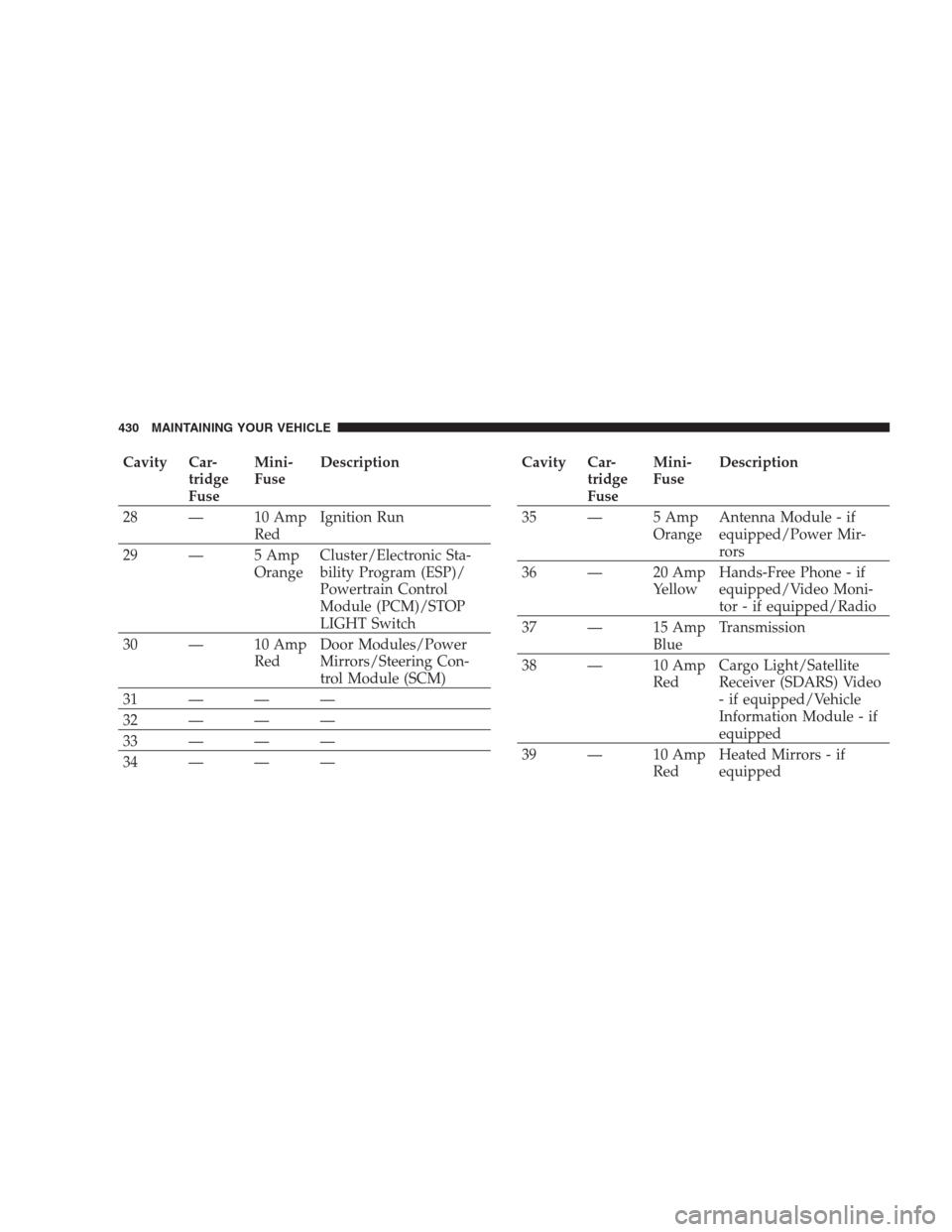
Cavity Car-
tridge
FuseMini-
FuseDescription
28 — 10 Amp
RedIgnition Run
29 — 5 Amp
OrangeCluster/Electronic Sta-
bility Program (ESP)/
Powertrain Control
Module (PCM)/STOP
LIGHT Switch
30 — 10 Amp
RedDoor Modules/Power
Mirrors/Steering Con-
trol Module (SCM)
31———
32———
33———
34———Cavity Car-
tridge
FuseMini-
FuseDescription
35 — 5 Amp
OrangeAntenna Module - if
equipped/Power Mir-
rors
36 — 20 Amp
YellowHands-Free Phone - if
equipped/Video Moni-
tor - if equipped/Radio
37 — 15 Amp
BlueTransmission
38 — 10 Amp
RedCargo Light/Satellite
Receiver (SDARS) Video
- if equipped/Vehicle
Information Module - if
equipped
39 — 10 Amp
RedHeated Mirrors - if
equipped
430 MAINTAINING YOUR VEHICLE