Page 393 of 526
Towing Tips
Before setting out on a trip, practice turning, stopping,
and backing up the trailer in an area located away from
heavy traffic.
Towing Tips — Automatic Transmission
The DRIVE range can be selected when towing. How-
ever, if frequent shifting occurs while in this range, the
“3” range should be selected.
NOTE:Using the “3” range while operating the vehicle
under heavy operating conditions will improve perfor-
mance and extend transmission life by reducing exces-
sive shifting and heat build up. This action will also
provide better engine braking.
If you REGULARLY tow a trailer for more than 45 min-
utes of continuous operation, then change the automatic
transmission fluid and filter according to the interval
specified for “police, taxi, fleet, or frequent trailer tow-
ing” in the Maintenance Schedule.
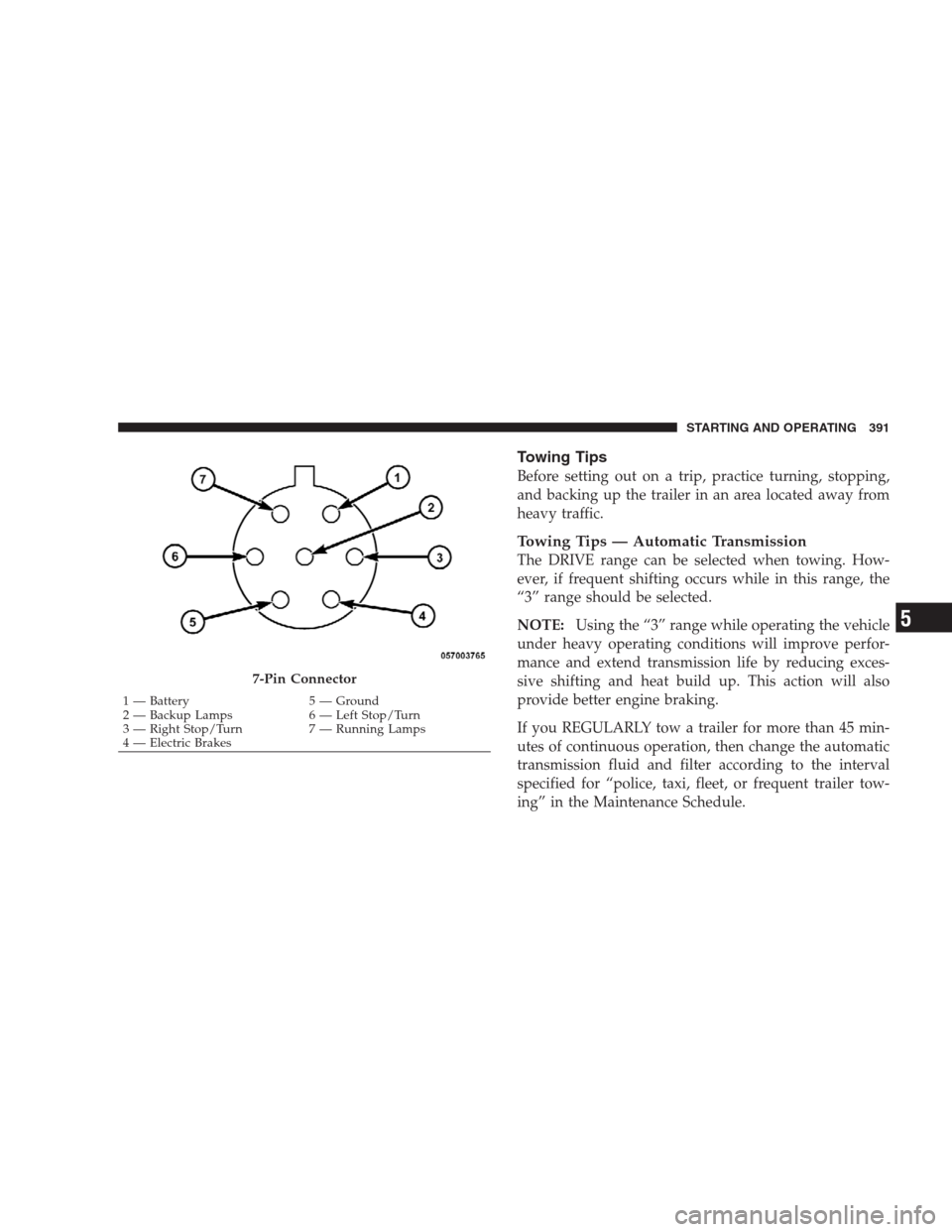
7-Pin Connector
1 — Battery 5 — Ground
2 — Backup Lamps 6 — Left Stop/Turn
3 — Right Stop/Turn 7 — Running Lamps
4 — Electric BrakesSTARTING AND OPERATING 391
5
Page 402 of 526
Preparations For Jacking
1. Park the vehicle on a firm level surface as far from the
edge of the roadway as possible. Avoid icy or slippery
areas.
2. Set the parking brake.
3. Place the shift lever into PARK.
4. Turn OFF the ignition.
5. Turn on the Hazard Warning flashers.
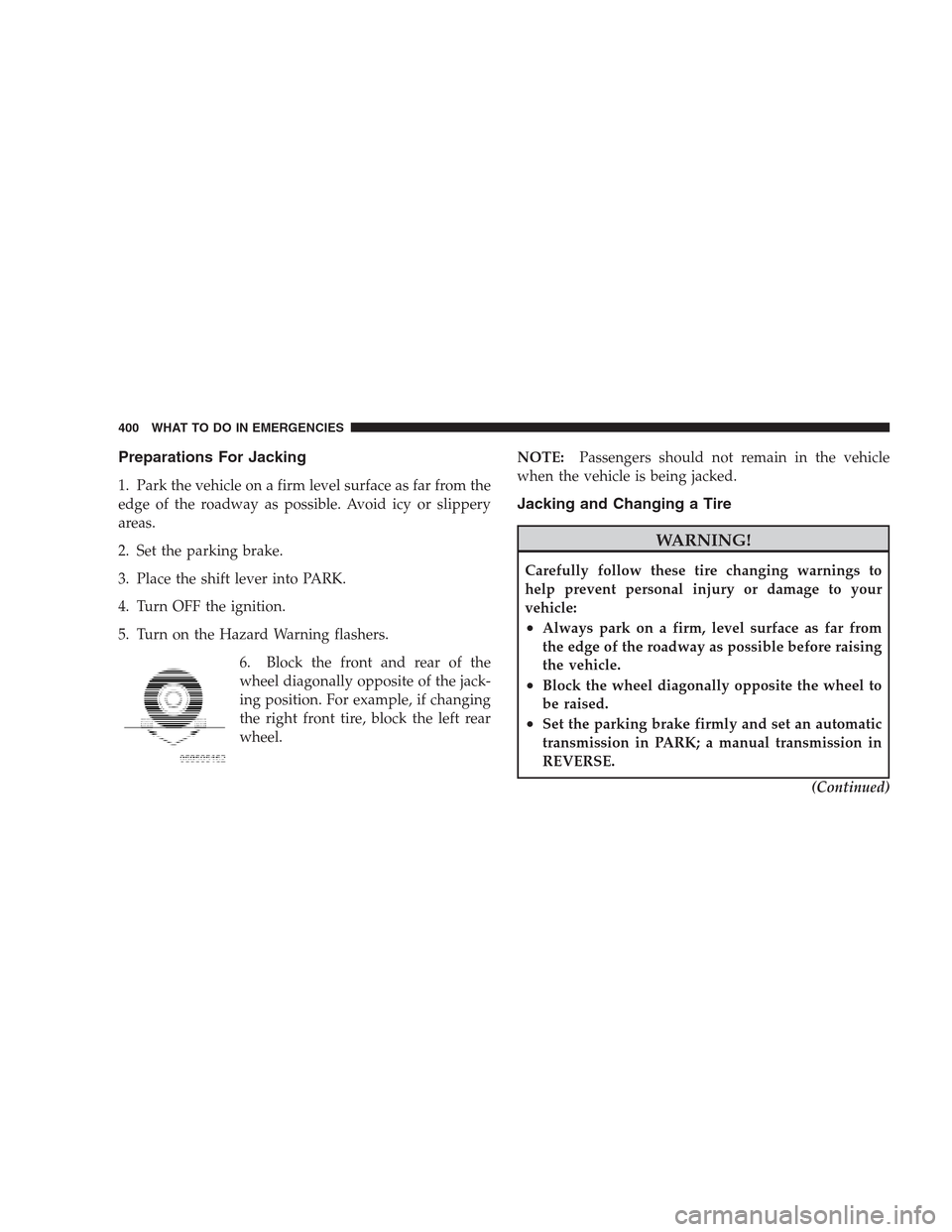
6. Block the front and rear of the
wheel diagonally opposite of the jack-
ing position. For example, if changing
the right front tire, block the left rear
wheel.NOTE:Passengers should not remain in the vehicle
when the vehicle is being jacked.
Jacking and Changing a Tire
WARNING!
Carefully follow these tire changing warnings to
help prevent personal injury or damage to your
vehicle:
•Always park on a firm, level surface as far from
the edge of the roadway as possible before raising
the vehicle.
•Block the wheel diagonally opposite the wheel to
be raised.
•Set the parking brake firmly and set an automatic
transmission in PARK; a manual transmission in
REVERSE.
(Continued)
400 WHAT TO DO IN EMERGENCIES
Page 411 of 526
NOTE:The battery is stored under an access cover in
the trunk. Remote battery terminals are located in the
engine compartment for jump-starting.
1. Wear eye protection and remove any metal jewelry
such as watchbands or bracelets that might make an
inadvertent electrical contact.
2. When boost is provided by a battery in another
vehicle, park that vehicle within booster cable reach, but
do not allow the vehicles to touch one another.
WARNING!
Do not permit vehicles to touch each other as this
could establish a ground connection and personal
injury could result.
3. Set the parking brake, place the automatic transmis-
sion in PARK, and turn the ignition switch to the LOCK
position on both vehicles.4. Turn off the heater, radio, and all unnecessary electri-
cal loads.
5. Connect one end of the jumper cable to the remote
jump-start positive battery post(+)in the engine com-
partment. Connect the other end of the same cable to the
positive terminal of the booster battery. Refer to the
following illustration for jump-starting connections.
6. Connect the other cable, first to the negative terminal
of the booster battery andthen to the engine ground (-)
of the vehicle with the discharged battery.Make sure
you have a good contact on the engine ground. Refer to
the following illustration for jump-starting connections.
WHAT TO DO IN EMERGENCIES 409
6
Page 418 of 526
▫Windshield Washers/Headlight Washers
— If Equipped...................... 431
▫Exhaust System..................... 432
▫Cooling System..................... 435
▫Brake System....................... 440
▫Automatic Transmission............... 442
▫All Wheel Drive (AWD) — If Equipped.... 443
▫Appearance Care And Protection From
Corrosion.......................... 444
�Fuses.............................. 449
▫Integrated Power Module.............. 449
▫Rear Power Distribution Center.......... 451
�Vehicle Storage....................... 456
�Replacement Bulbs.................... 456�Bulb Replacement..................... 458
▫Low Beam Headlight, High Beam Headlight,
Park/Turn Light, Inner Park Light, And
Outer Park Light – 300 Models........... 458
▫Low Beam Headlight, High Beam Headlight,
And Park/Turn Light – 300C............ 460
▫Backup Light, Side Marker Light, And
Tail/Stop Turn Light — 300 Models....... 461
▫Tail/Stop, Tail, Turn Signal Light, And
Backup Light — 300C Models........... 464
▫License Light....................... 467
�Fluids And Capacities.................. 468
�Fluids, Lubricants, And Genuine Parts....... 470
▫Engine............................ 470
▫Chassis........................... 471
416 MAINTAINING YOUR VEHICLE
Page 419 of 526
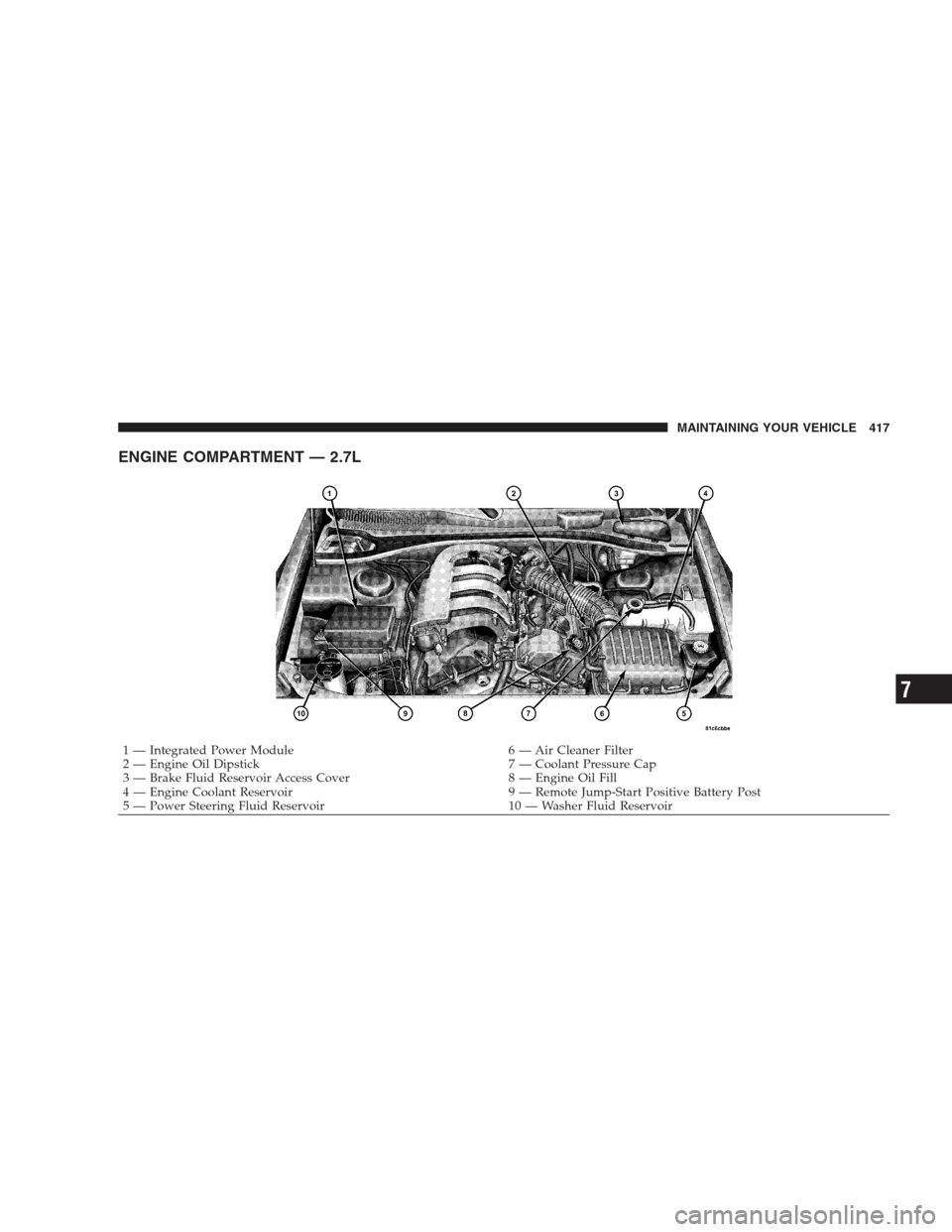
ENGINE COMPARTMENT — 2.7L
1 — Integrated Power Module 6 — Air Cleaner Filter
2 — Engine Oil Dipstick 7 — Coolant Pressure Cap
3 — Brake Fluid Reservoir Access Cover 8 — Engine Oil Fill
4 — Engine Coolant Reservoir 9 — Remote Jump-Start Positive Battery Post
5 — Power Steering Fluid Reservoir 10 — Washer Fluid ReservoirMAINTAINING YOUR VEHICLE 417
7
Page 420 of 526
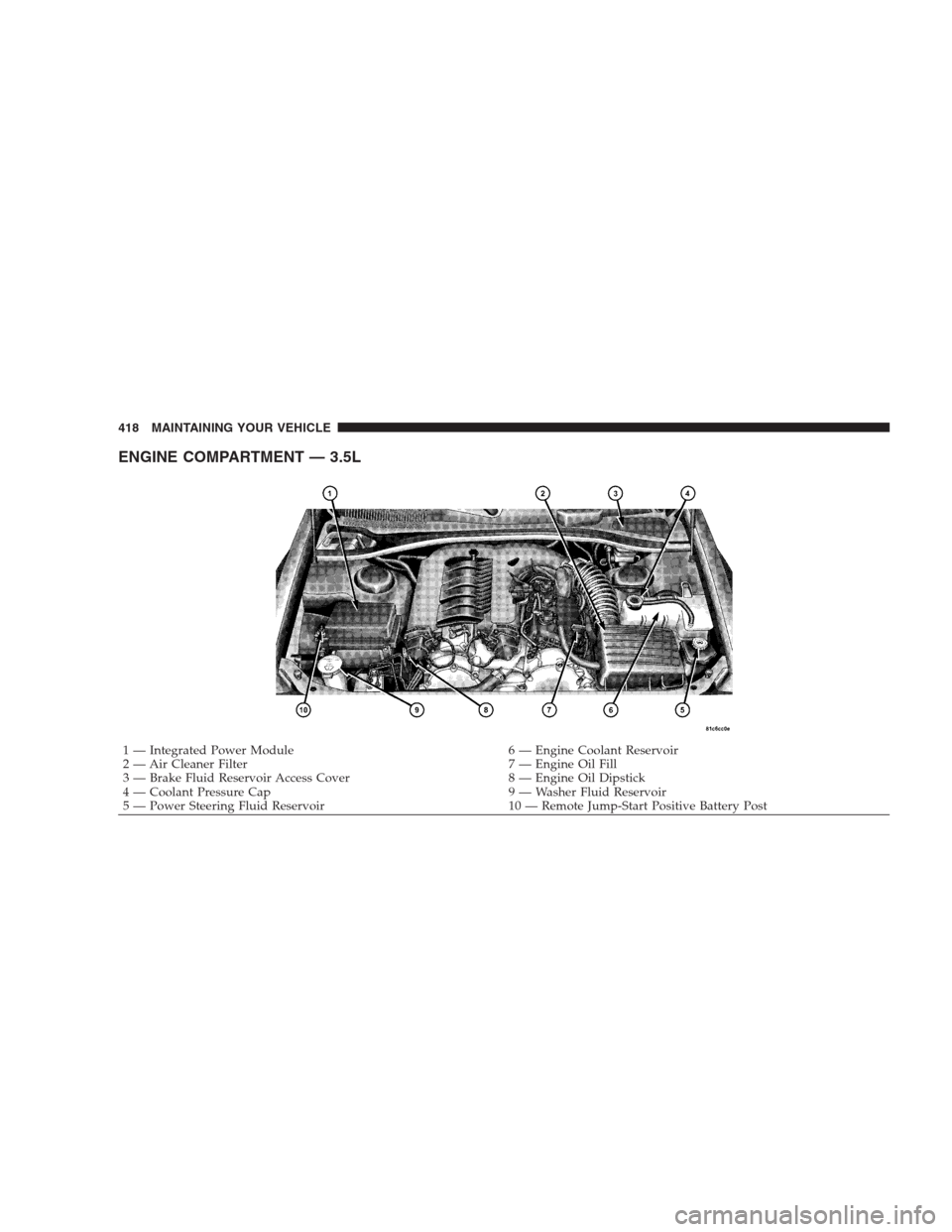
ENGINE COMPARTMENT — 3.5L
1 — Integrated Power Module 6 — Engine Coolant Reservoir
2 — Air Cleaner Filter 7 — Engine Oil Fill
3 — Brake Fluid Reservoir Access Cover 8 — Engine Oil Dipstick
4 — Coolant Pressure Cap 9 — Washer Fluid Reservoir
5 — Power Steering Fluid Reservoir 10 — Remote Jump-Start Positive Battery Post 418 MAINTAINING YOUR VEHICLE
Page 421 of 526
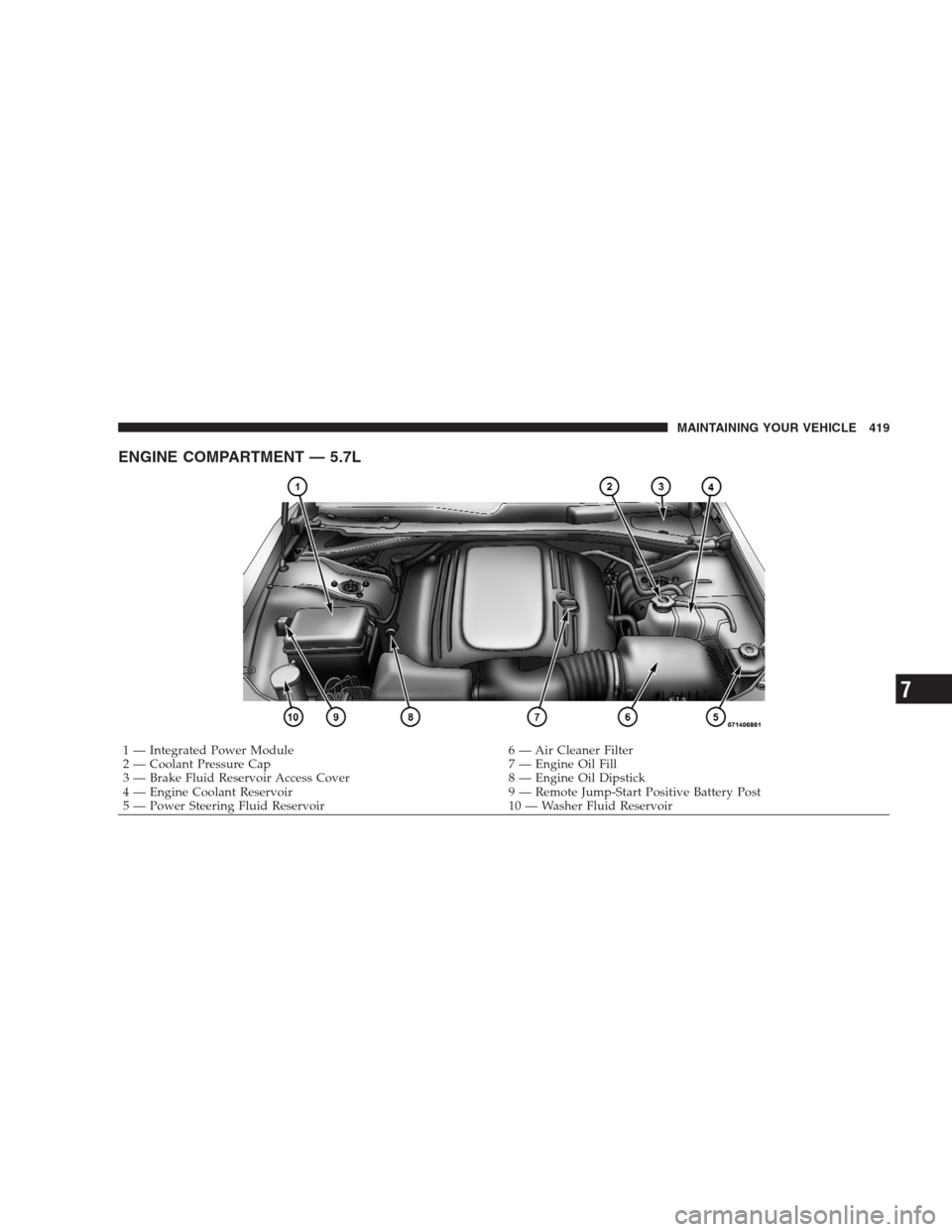
ENGINE COMPARTMENT — 5.7L
1 — Integrated Power Module 6 — Air Cleaner Filter
2 — Coolant Pressure Cap 7 — Engine Oil Fill
3 — Brake Fluid Reservoir Access Cover 8 — Engine Oil Dipstick
4 — Engine Coolant Reservoir 9 — Remote Jump-Start Positive Battery Post
5 — Power Steering Fluid Reservoir 10 — Washer Fluid ReservoirMAINTAINING YOUR VEHICLE 419
7
Page 442 of 526
If an examination of your engine compartment shows no
evidence of radiator or hose leaks, the vehicle may be
safely driven. The vapor will soon dissipate.
•Do not overfill the coolant recovery bottle.
•Check engine coolant (antifreeze) freeze point in the
radiator and in the coolant recovery bottle. If engine
coolant (antifreeze) needs to be added, contents of
coolant recovery bottle must also be protected against
freezing.
•If frequent engine coolant (antifreeze) additions are
required, or if the level in the coolant recovery bottle
does not drop when the engine cools, the cooling
system should be pressure tested for leaks.
•Maintain engine coolant (antifreeze) concentration at
50% HOAT engine coolant (antifreeze) (minimum)
and distilled water for proper corrosion protection of
your engine, which contains aluminum components.
•Make sure that the radiator and coolant recovery
bottle overflow hoses are not kinked or obstructed.
•Keep the front of the radiator clean. If your vehicle is
equipped with air conditioning, keep the front of the
condenser clean, also.
•Do not change the thermostat for Summer or Winter
operation. If replacement is ever necessary, install
ONLY the correct type thermostat. Other designs may
result in unsatisfactory engine coolant (antifreeze)
performance, poor gas mileage, and increased
emissions.
Brake System
In order to assure brake system performance, all brake
system components should be inspected periodically.
Refer to the “Maintenance Schedule” in Section 8 for
proper maintenance intervals.
440 MAINTAINING YOUR VEHICLE