Page 395 of 526
RECREATIONAL TOWING (BEHIND
MOTORHOME, ETC.)
Two-Wheel Drive and All-Wheel Drive
Recreational towing for this vehicle is not recommended.
NOTE:If the vehicle requires towing, make sure all four
wheels are off the ground.
STARTING AND OPERATING 393
5
Page 397 of 526
WHAT TO DO IN EMERGENCIES
CONTENTS
�Hazard Warning Flasher................ 396
�If Your Engine Overheats................ 396
�Jacking And Tire Changing............... 397
▫Jack Location/Spare Tire Stowage........ 398
▫Preparations For Jacking............... 400
▫Jacking And Changing a Tire............ 400
▫Compact Spare Tire................... 405
▫Wheel Cover Or Center Cap Installation
(If Equipped)....................... 406�Jump-Starting Procedures................ 408
�Freeing A Stuck Vehicle................. 411
�Towing A Disabled Vehicle............... 412
▫Without The Ignition Key.............. 412
▫Towing This Vehicle Behind Another
Vehicle............................ 412
▫Towing This Vehicle Behind Another Vehicle
With A Tow Dolly.................... 414
6
Page 412 of 526
WARNING!
•You should not try to start your vehicle by pushing
or towing.
•Do not connect the cable to the negative post of the
discharged battery. The resulting electrical spark
could cause the battery to explode.
•During cold weather when temperatures are be-
low the freezing point, electrolyte in a discharged
battery may freeze. Do not attempt jump-starting
because the battery could rupture or explode. The
battery temperature must be brought above the
freezing point before attempting jump-start.
7. Start the engine in the vehicle that has the booster
battery. Let the engine idle a few minutes then start the
engine in the vehicle with the discharged battery.
NOTE:Refer to�Synchronizing ESP�under�Electronic
Stability Program�in Section 5 if the ESP/BAS light (in
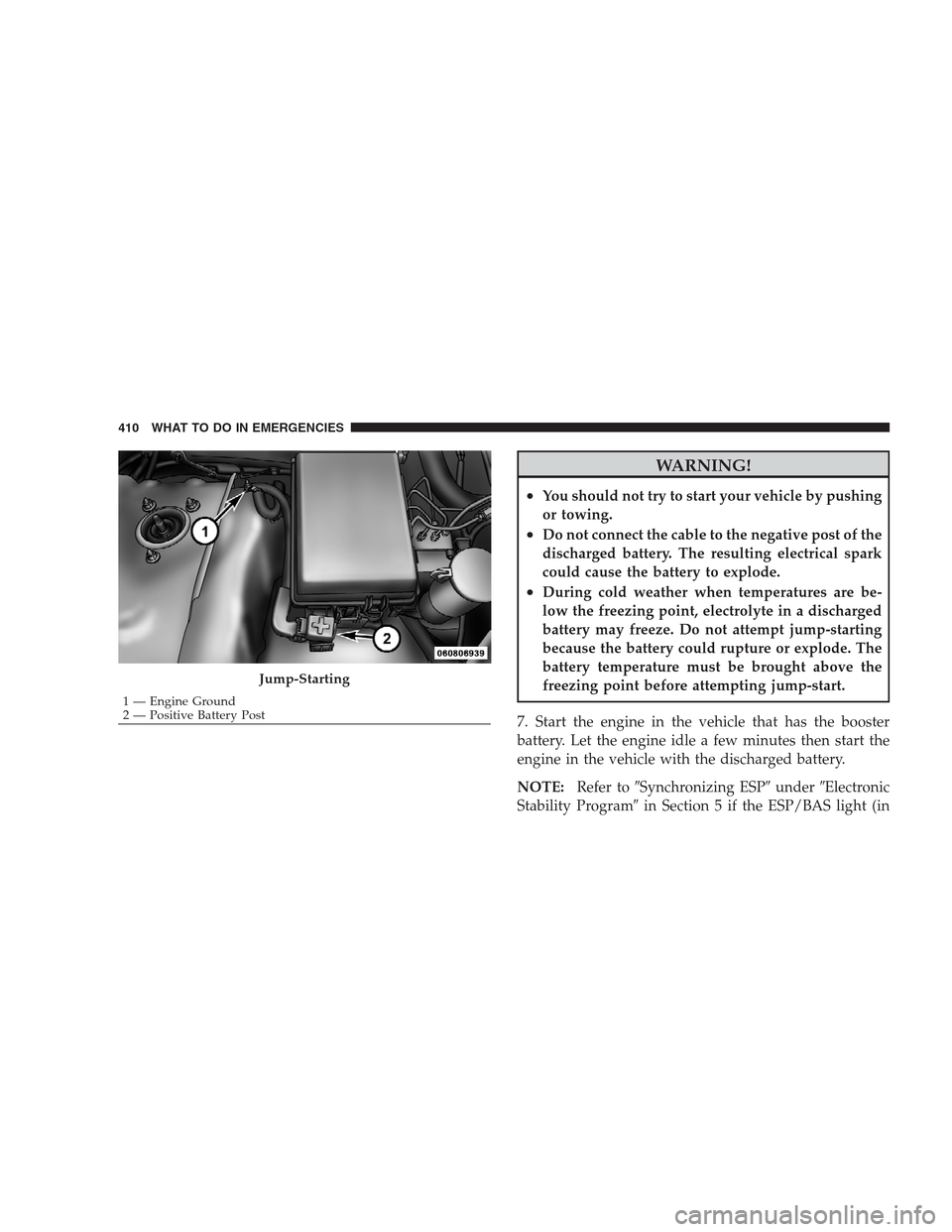
Jump-Starting
1 — Engine Ground
2 — Positive Battery Post 410 WHAT TO DO IN EMERGENCIES
Page 414 of 526
CAUTION! (Continued)
•Racing the engine or spinning the wheels too fast
may lead to transmission overheating and failure.
It can also damage the tires. Do not spin the
wheels above 35 mph (55 km/h).
WARNING!
Fast spinning tires can be dangerous. Forces gener-
ated by excessive wheel speeds may cause tire dam-
age or failure. A tire could explode and injure some-
one. Do not spin your vehicle’s wheels faster than
35 mph (55 km/h) when you are stuck, and don’t let
anyone near a spinning wheel, no matter what the
speed.
TOWING A DISABLED VEHICLE
Without The Ignition Key
Special care must be taken when the vehicle is towed
with the ignition in the LOCK position. The only ap-
proved method of towing without the ignition key is
with a flatbed truck. Proper towing equipment is neces-
sary to prevent damage to the vehicle.
Towing This Vehicle Behind Another Vehicle
Flatbed towing is recommended. DO NOT tow an AWD
vehicle with the rear wheels on the ground unless the
rear driveshaft is removed and the transmission is in
NEUTRAL.
Vehicles WITHOUT AWD may be towed (with rear
wheels on the ground) with the transmission in NEU-
TRAL under the following conditions:
•The distance to be traveled must not exceed 15 miles
(24 km).
412 WHAT TO DO IN EMERGENCIES
Page 415 of 526
•The towing speed must not exceed 30 mph (48 km/h).
CAUTION!
Exceeding these towing limits may cause transmis-
sion failure.
Vehicles equipped with AWD can be towed with the
transmission in NEUTRAL and the rear wheels OFF the
ground (or the rear driveshaft removed) with no limita-
tion on speed or distance.
CAUTION!
•Do not attempt to tow this vehicle from the front
with sling type towing equipment. Damage to the
front fascia will result.
(Continued)
CAUTION! (Continued)
•If the transmission is not operative or if the
vehicle is to be towed more than 15 miles (24 km),
then the only approved method of towing is with
a flatbed truck. Otherwise, damage to the trans-
mission may result.
•Do not tow the vehicle from the rear. Damage to
the rear sheet metal and fascia will occur.
•Do not push or tow this vehicle with another
vehicle as damage to the bumper fascia and trans-
mission may result.
If you must use the accessories (wipers, defrosters, etc.)
while being towed, the key must be in the ON position,
not the ACC position. Make certain the transmission
remains in NEUTRAL.
WHAT TO DO IN EMERGENCIES 413
6
Page 416 of 526
Towing This Vehicle Behind Another Vehicle With
A Tow Dolly
The manufacturerdoes not recommendthat you tow this
vehicle on a tow dolly. Vehicle damage may occur.
414 WHAT TO DO IN EMERGENCIES
Page 422 of 526
ONBOARD DIAGNOSTIC SYSTEM — OBD II
Your vehicle is equipped with a sophisticated onboard
diagnostic system called OBD II. This system monitors
the performance of the emissions, engine, and automatic
transmission control systems. When these systems are
operating properly, your vehicle will provide excellent
performance and fuel economy, as well as engine emis-
sions well within current government regulations.
If any of these systems require service, the OBD II system
will turn on the Malfunction Indicator Light (MIL). It will
also store diagnostic codes and other information to
assist your service technician in making repairs. Al-
though your vehicle will usually be drivable and not
need towing, see your authorized dealer for service as
soon as possible.CAUTION!
Prolonged driving with the MIL on could cause
further damage to the emissions control system. It
could also affect fuel economy and driveability. The
vehicle must be serviced before any emissions tests
can be performed.
If the MIL is flashing while the engine is running,
severe catalytic converter damage and power loss
will soon occur. Immediate service is required.
Loose Fuel Filler Cap
If the vehicle diagnostic system determines that the fuel
filler cap is loose, improperly installed, or damaged, a
“Check Gascap” message will display in the Electronic
Vehicle Information Center (EVIC) (if equipped). If this
occurs, tighten the fuel filler cap properly and press the
TRIP ODOMETER button to turn off the message. If the
problem continues, the message will appear the next time
the vehicle is started.
420 MAINTAINING YOUR VEHICLE
Page 436 of 526
WARNING!
A hot exhaust system can start a fire if you park over
materials that can burn. Such materials might be
grass or leaves coming into contact with your exhaust
system. Do not park or operate your vehicle in areas
where your exhaust system can contact anything that
can burn.
In unusual situations involving grossly malfunctioning
engine operation, a scorching odor may indicate severe
and abnormal catalyst overheating. If this should occur,
safely bring the vehicle to a complete stop, shut the
engine OFF, and allow the vehicle to cool. Thereafter,
obtain service, including a tune-up to manufacturer’s
specifications immediately.To minimize the possibility of catalyst damage:•Do not shut off the engine or interrupt the ignition
when the transmission is in gear and the vehicle is in
motion.
•Do not try to start the engine by pushing or towing the
vehicle.
•Do not idle the engine with any spark plug wires
disconnected or removed, such as when diagnostic
testing, or for prolonged periods during very rough
idling or malfunctioning operating conditions.
434 MAINTAINING YOUR VEHICLE