2009 CHEVROLET UPLANDER instrument panel
[x] Cancel search: instrument panelPage 312 of 464

Tire Pressure Monitor Operation.....................5-58
Tire Inspection and Rotation...........................5-62
When It Is Time for New Tires.......................5-63
Buying New Tires.........................................5-64
Different Size Tires and Wheels......................5-66
Uniform Tire Quality Grading..........................5-67
Wheel Alignment and Tire Balance..................5-69
Wheel Replacement......................................5-69
Tire Chains..................................................5-70
Accessory Inator.........................................5-71
If a Tire Goes Flat........................................5-73
Changing a Flat Tire.....................................5-74
Removing the Spare Tire and Tools................5-75
Removing the Flat Tire and Installing the
Spare Tire................................................5-77
Secondary Latch System...............................5-84
Storing a Flat or Spare Tire and Tools............5-86
Compact Spare Tire......................................5-88
Appearance Care............................................5-89
Interior Cleaning...........................................5-89
Fabric/Carpet...............................................5-91
Leather.......................................................5-91
Instrument Panel, Vinyl, and Other
Plastic Surfaces........................................5-92
Child Restraint Pad.......................................5-92Care of Safety Belts and Built-in Child
Restraint Harness......................................5-92
Weatherstrips...............................................5-92
Washing Your Vehicle...................................5-93
Cleaning Exterior Lamps/Lenses.....................5-93
Finish Care..................................................5-94
Windshield, Backglass, and Wiper Blades.........5-94
Aluminum Wheels.........................................5-95
Tires...........................................................5-95
Sheet Metal Damage.....................................5-96
Finish Damage............................................
.5-96
Underbody Maintenance................................5-96
Chemical Paint Spotting.................................5-96
Vehicle Identication......................................5-97
Vehicle Identication Number (VIN).................5-97
Service Parts Identication Label.....................5-97
Electrical System............................................5-97
Add-On Electrical Equipment..........................5-97
Headlamp Wiring..........................................5-98
Windshield Wiper Fuses................................5-98
Power Windows and Other Power Options.......5-98
Fuses and Circuit Breakers............................5-98
Instrument Panel Fuse Block..........................5-98
Underhood Fuse Block................................5-100
Capacities and Specications........................5-104
Section 5 Service and Appearance Care
5-2
Page 315 of 464
If doing some of your own service work, use the proper
service manual. It tells you much more about how to
service the vehicle than this manual can. To order
the proper service manual, seeService Publications
Ordering Information on page 7-15.
This vehicle has an airbag system. Before attempting
to do your own service work, seeServicing Your
Airbag-Equipped Vehicle on page 1-90.
Keep a record with all parts receipts and list the
mileage and the date of any service work performed.
SeeMaintenance Record on page 6-15.
Adding Equipment to the Outside of
the Vehicle
Things added to the outside of the vehicle can affect the
airow around it. This can cause wind noise and can
affect fuel economy and windshield washer performance.
Check with your dealer/retailer before adding equipment
to the outside of the vehicle.
Fuel
Use of the recommended fuel is an important part of
the proper maintenance of this vehicle. To help keep the
engine clean and maintain optimum vehicle performance,
we recommend the use of gasoline advertised as TOP
TIER Detergent Gasoline.
The 8th digit of the Vehicle Identication Number (VIN)
shows the code letter or number that identies the
vehicle’s engine. The VIN is at the top left of the
instrument panel. SeeVehicle Identification Number
(VIN) on page 5-97.
If the vehicle has the 3.9L V6 engine (VIN Code W),
you can use either unleaded gasoline or ethanol fuel
containing up to 85% ethanol (E85). SeeFuel E85
(85% Ethanol) on page 5-8. If your vehicle has the
3.9L V6 engine (VIN Code 1), use only regular unleaded
gasoline.
5-5
Page 318 of 464

Fuel E85 (85% Ethanol)
The 8th digit of the Vehicle Identication Number (VIN)
shows the code letter or number that identies the
vehicle’s engine. The VIN is at the top left of the
instrument panel. SeeVehicle Identification Number
(VIN) on page 5-97.
If the vehicle has the 3.9L V6 engine (VIN Code W),
you can use either unleaded gasoline or ethanol
fuel containing up to 85% ethanol (E85). SeeFuel on
page 5-5. In all other engines, use only the unleaded
gasoline described underGasoline Octane on page 5-6.
Only vehicles that have the 3.9L V6 engine
(VIN Code W) can use 85% ethanol fuel (E85).
We encourage the use of E85 in vehicles that are
designed to use it. The ethanol in E85 is a “renewable”
fuel, meaning it is made from renewable sources such
as corn and other crops.Many service stations will not have an 85% ethanol
fuel (E85) pump available. The U. S. Department
of Energy has an alternative fuels website
(www.eere.energy.gov/afdc/infrastructure/locator.html)
that can help you nd E85 fuel. Those stations that do
have E85 should have a label indicating ethanol content.
Do not use the fuel if the ethanol content is greater
than 85%.
At a minimum, E85 should meet ASTM Specication
D 5798. By denition, this means that fuel labeled E85
will have an ethanol content between 70% and 85%.
Filling the fuel tank with fuel mixtures that do not meet
ASTM specications can affect drivability and could
cause the malfunction indicator lamp to come on.
To ensure quick starts in the wintertime, the E85 fuel
must be formulated properly for your climate according
to ASTM specication D 5798. If you have trouble
starting on E85, it could be because the E85 fuel is not
properly formulated for your climate. If this happens,
switching to gasoline or adding gasoline to the fuel tank
can improve starting. For good starting and heater
efficiency below 32°F (0°C), the fuel mix in the fuel tank
should contain no more than 70% ethanol. It is best
not to alternate repeatedly between gasoline and E85.
5-8
Page 323 of 464
Hood Release
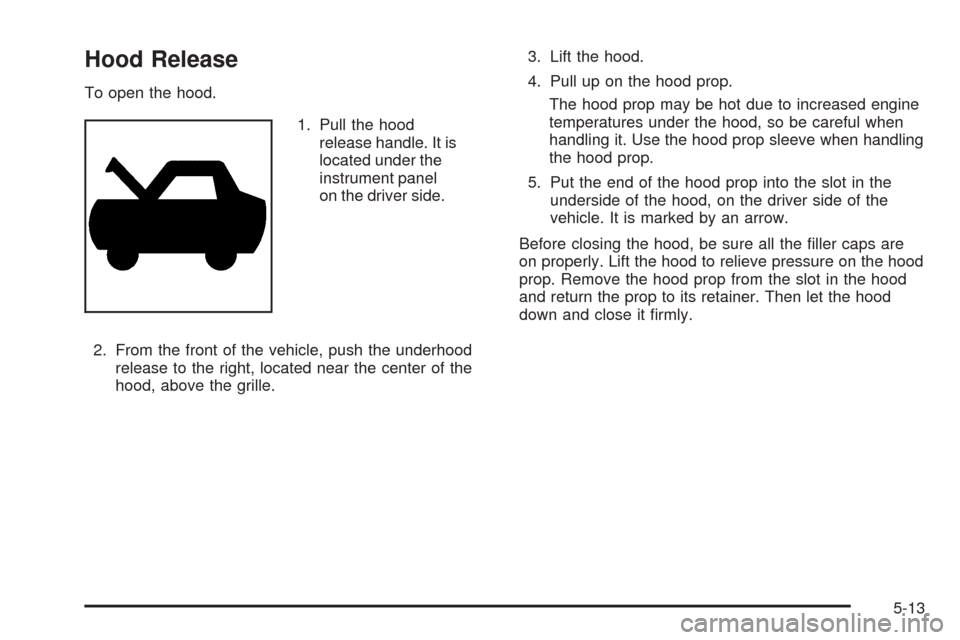
To open the hood.
1. Pull the hood
release handle. It is
located under the
instrument panel
on the driver side.
2. From the front of the vehicle, push the underhood
release to the right, located near the center of the
hood, above the grille.3. Lift the hood.
4. Pull up on the hood prop.
The hood prop may be hot due to increased engine
temperatures under the hood, so be careful when
handling it. Use the hood prop sleeve when handling
the hood prop.
5. Put the end of the hood prop into the slot in the
underside of the hood, on the driver side of the
vehicle. It is marked by an arrow.
Before closing the hood, be sure all the ller caps are
on properly. Lift the hood to relieve pressure on the hood
prop. Remove the hood prop from the slot in the hood
and return the prop to its retainer. Then let the hood
down and close it rmly.
5-13
Page 338 of 464

8. Then ll the coolant recovery tank to the full
cold mark.
9. Put the cap back on the coolant recovery tank.
Notice:If the pressure cap is not tightly installed,
coolant loss and possible engine damage may
occur. Be sure the cap is properly and tightly
secured.
Radiator Pressure Cap
Notice:The radiator cap on your vehicle is a
pressure-type cap and must be tightly installed to
prevent coolant loss and possible engine damage
from overheating. Be sure the cap is properly
closed.
SeeEngine Compartment Overview on page 5-14for
more information on location.
Engine Overheating
The vehicle has several indicators to warn of engine
overheating.
There is an engine coolant temperature gage on the
vehicle’s instrument panel. SeeEngine Coolant
Temperature Gage on page 3-37.
The vehicle might have an ENGINE COOLANT HOT
message displayed in the Driver Information Center
(DIC). SeeDIC Warnings and Messages on page 3-51. Filling the Coolant Recovery Tank
5-28
Page 368 of 464

Federal Communications
Commission (FCC) and Industry
and Science Canada
The Tire Pressure Monitor System (TPMS) operates
on a radio frequency and complies with Part 15 of
the FCC Rules. Operation is subject to the following
two conditions:
1. This device may not cause harmful interference.
2. This device must accept any interference received,
including interference that may cause undesired
operation.
The TPMS operates on a radio frequency and complies
with RSS-210 of Industry and Science Canada.
Operation is subject to the following two conditions:
1. This device may not cause interference.
2. This device must accept any interference received,
including interference that may cause undesired
operation of the device.
Changes or modications to this system by other than
an authorized service facility could void authorization to
use this equipment.
Tire Pressure Monitor Operation
Your vehicle may have a Tire Pressure Monitor System
(TPMS) designed to warn the driver when a low tire
pressure condition exists. TPMS sensors are mounted
onto each tire and wheel assembly, excluding the spare
tire and wheel assembly. The TPMS sensors monitor
the air pressure in the vehicle’s tires and transmits
the tire pressure readings to a receiver located in the
vehicle.
When a low tire pressure
condition is detected, the
TPMS illuminates the low
tire pressure warning light
located on the instrument
panel cluster.
At the same time a message to check the pressure in
a specic tire appears on the Driver Information Center
(DIC) display. The low tire pressure warning light and the
DIC warning message come on at each ignition cycle
until the tires are inated to the correct ination pressure.
5-58
Page 402 of 464
Instrument Panel, Vinyl, and Other
Plastic Surfaces
A soft cloth dampened with water may be used to
remove dust. If a more thorough cleaning is necessary, a
clean soft cloth dampened with a mild soap solution can
be used to gently remove dust and dirt. Never use spot
lifters or removers on plastic surfaces. Many commercial
cleaners and coatings that are sold to preserve and
protect soft plastic surfaces may permanently change
the appearance and feel of your interior and are not
recommended. Do not use silicone or wax-based
products, or those containing organic solvents to clean
your vehicle’s interior because they can alter the
appearance by increasing the gloss in a non-uniform
manner.
Some commercial products may increase gloss on your
instrument panel. The increase in gloss may cause
annoying reections in the windshield and even make
it difficult to see through the windshield under certain
conditions.
Child Restraint Pad
The built-in child restraint pad is attached to the seat
frame with fastener strips. You can remove the pad and
hand wash it with mild soap and water.
Care of Safety Belts and Built-in
Child Restraint Harness
Keep the safety belts and the built-in child restraint
harness clean and dry.
{CAUTION:
Do not bleach or dye safety belts or the built-in
child restraint harness. If you do, they may be
severely weakened. In a crash, they might not be
able to provide adequate protection. Clean the
safety belts and the child restraint harness only
with mild soap and lukewarm water.
Weatherstrips
Silicone grease on weatherstrips will make them last
longer, seal better, and not stick or squeak. Apply
silicone grease with a clean cloth. During very cold,
damp weather frequent application may be required.
SeeRecommended Fluids and Lubricants on page 6-11.
5-92
Page 407 of 464
Vehicle Identication
Vehicle Identication Number (VIN)
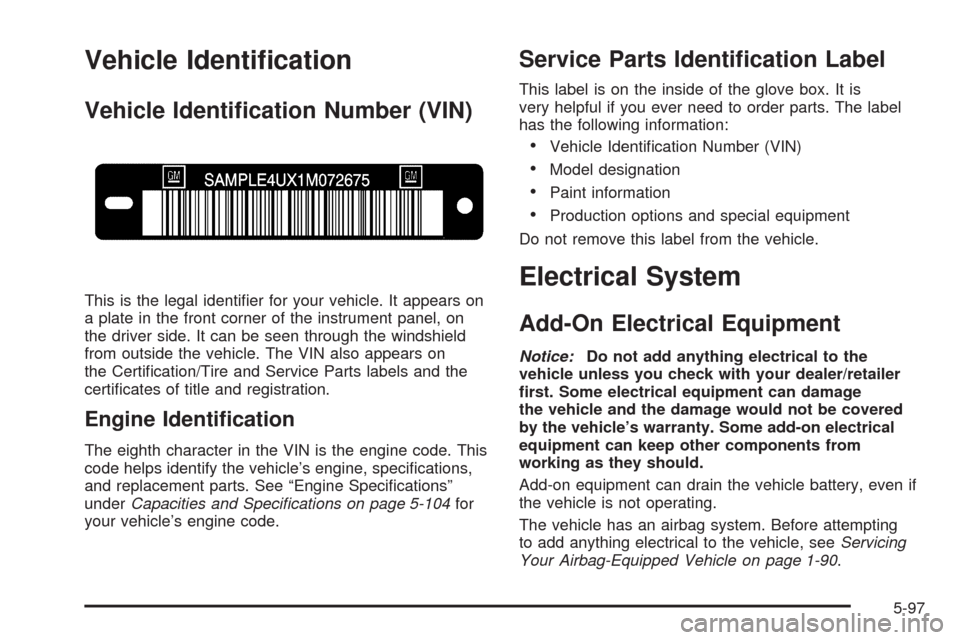
This is the legal identier for your vehicle. It appears on
a plate in the front corner of the instrument panel, on
the driver side. It can be seen through the windshield
from outside the vehicle. The VIN also appears on
the Certication/Tire and Service Parts labels and the
certicates of title and registration.
Engine Identication
The eighth character in the VIN is the engine code. This
code helps identify the vehicle’s engine, specications,
and replacement parts. See “Engine Specications”
underCapacities and Specifications on page 5-104for
your vehicle’s engine code.
Service Parts Identication Label
This label is on the inside of the glove box. It is
very helpful if you ever need to order parts. The label
has the following information:
Vehicle Identication Number (VIN)
Model designation
Paint information
Production options and special equipment
Do not remove this label from the vehicle.
Electrical System
Add-On Electrical Equipment
Notice:Do not add anything electrical to the
vehicle unless you check with your dealer/retailer
rst. Some electrical equipment can damage
the vehicle and the damage would not be covered
by the vehicle’s warranty. Some add-on electrical
equipment can keep other components from
working as they should.
Add-on equipment can drain the vehicle battery, even if
the vehicle is not operating.
The vehicle has an airbag system. Before attempting
to add anything electrical to the vehicle, seeServicing
Your Airbag-Equipped Vehicle on page 1-90.
5-97