2009 CHEVROLET UPLANDER climate control
[x] Cancel search: climate controlPage 263 of 464

RSE On-Screen Display (OSD) Menu
To use the RSE OSD menu when using a DVD or an
auxiliary device:
1. Press
zon the remote control or on the DVD
faceplate, if the vehicle does not have rear seat
climate control.
2. Use
q,Q,r,Randrto navigate the
screen.
This menu lets you select default preferences for video
format, language preference, brightness, color, contrast,
and tint. Not all DVDs support all the feature defaults in
the setup menus. If a feature is not supported, the
defaults are provided by the DVD media. To exit this
menu press
z,orqon the remote control, or
faceplate if there is no rear seat climate control, or wait
for the menu to time out.
The default language selection applies to all
future DVDs.To use the RSE OSD menu when using a CD or
an MP3:
1. Press
zon the remote control or on the DVD
faceplate, if the vehicle does not have rear seat
climate control.
2. Use
q,Q,r,Randrto navigate the
screen.
This menu lets you select default preferences for
language and playback settings. To exit this menu press
z,orqon the remote control, or faceplate if there
is no rear seat climate control, or wait for the menu
to time out.
Battery Replacement
To change the remote control batteries, do the following:
1. Slide the rear cover back on the remote control.
2. Replace the two batteries in the compartment. Make
sure that they are installed correctly using the
diagram on the inside of the battery compartment.
3. Replace the battery cover.
If the remote control is to be stored for a long period of
time, remove the batteries and keep them in a cool,
dry place.
3-103
Page 291 of 464
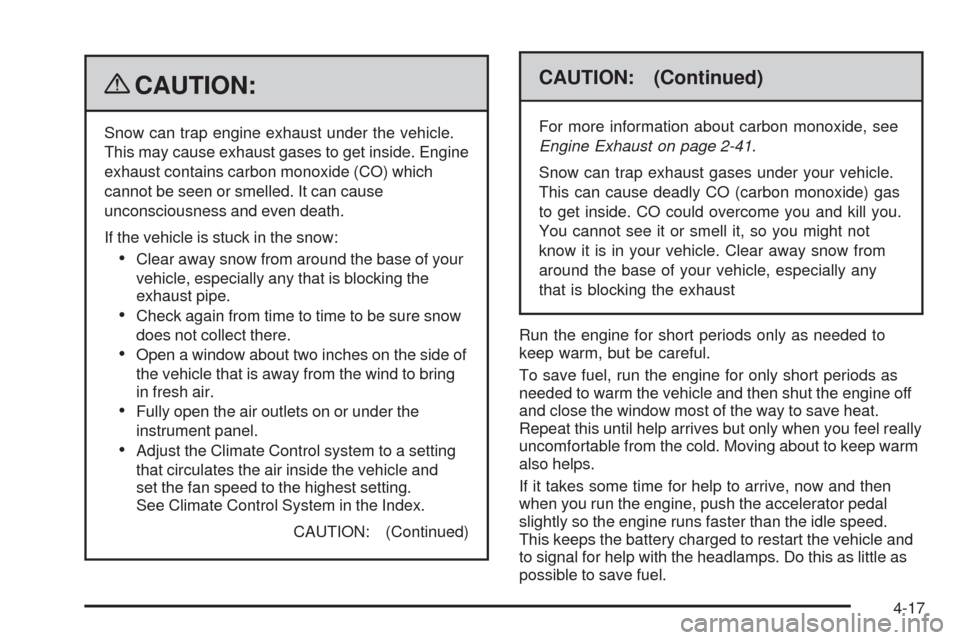
{CAUTION:
Snow can trap engine exhaust under the vehicle.
This may cause exhaust gases to get inside. Engine
exhaust contains carbon monoxide (CO) which
cannot be seen or smelled. It can cause
unconsciousness and even death.
If the vehicle is stuck in the snow:
Clear away snow from around the base of your
vehicle, especially any that is blocking the
exhaust pipe.
Check again from time to time to be sure snow
does not collect there.
Open a window about two inches on the side of
the vehicle that is away from the wind to bring
in fresh air.
Fully open the air outlets on or under the
instrument panel.
Adjust the Climate Control system to a setting
that circulates the air inside the vehicle and
set the fan speed to the highest setting.
See Climate Control System in the Index.
CAUTION: (Continued)
CAUTION: (Continued)
For more information about carbon monoxide, see
Engine Exhaust on page 2-41.
Snow can trap exhaust gases under your vehicle.
This can cause deadly CO (carbon monoxide) gas
to get inside. CO could overcome you and kill you.
You cannot see it or smell it, so you might not
know it is in your vehicle. Clear away snow from
around the base of your vehicle, especially any
that is blocking the exhaust
Run the engine for short periods only as needed to
keep warm, but be careful.
To save fuel, run the engine for only short periods as
needed to warm the vehicle and then shut the engine off
and close the window most of the way to save heat.
Repeat this until help arrives but only when you feel really
uncomfortable from the cold. Moving about to keep warm
also helps.
If it takes some time for help to arrive, now and then
when you run the engine, push the accelerator pedal
slightly so the engine runs faster than the idle speed.
This keeps the battery charged to restart the vehicle and
to signal for help with the headlamps. Do this as little as
possible to save fuel.
4-17
Page 306 of 464
Safety Chains
You should always attach chains between your vehicle
and your trailer. Cross the safety chains under the tongue
of the trailer to help prevent the tongue from contacting
the road if it becomes separated from the hitch.
Instructions about safety chains may be provided by the
hitch manufacturer or by the trailer manufacturer. Follow
the manufacturer’s recommendation for attaching safety
chains and do not attach them to the bumper. Always
leave just enough slack so you can turn with your rig.
Never allow safety chains to drag on the ground.
Trailer Brakes
If your trailer weighs more than 1,000 lbs (450 kg)
loaded, then it needs its own brakes – and they must be
adequate. Be sure to read and follow the instructions
for the trailer brakes so you will be able to install, adjust,
and maintain them properly.
Because your vehicle may have anti-lock brakes, do not
try to tap into your vehicle’s brake system. If you do,
both brake systems will not work well, or at all.
Driving with a Trailer
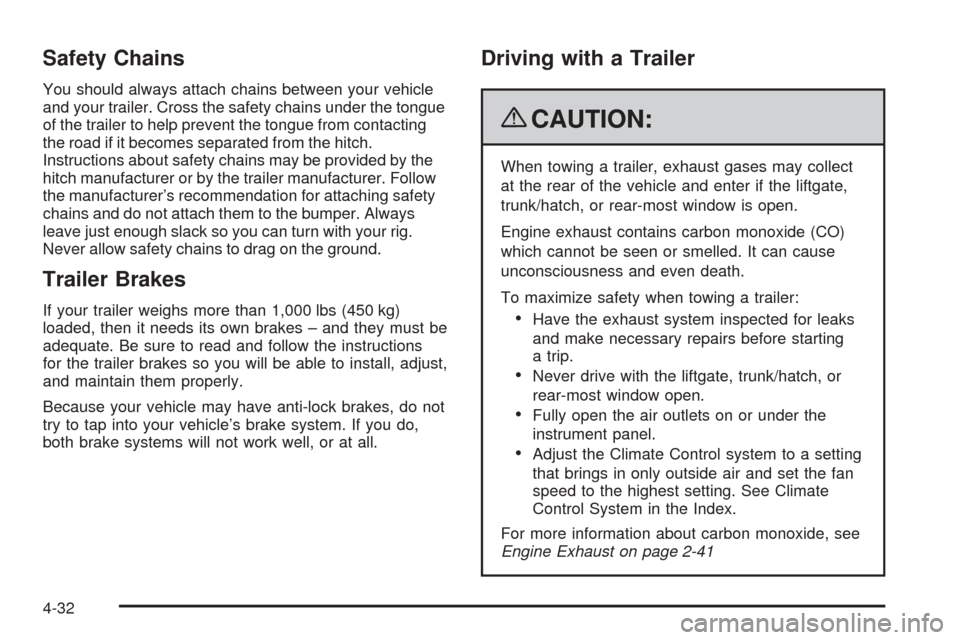
{CAUTION:
When towing a trailer, exhaust gases may collect
at the rear of the vehicle and enter if the liftgate,
trunk/hatch, or rear-most window is open.
Engine exhaust contains carbon monoxide (CO)
which cannot be seen or smelled. It can cause
unconsciousness and even death.
To maximize safety when towing a trailer:
Have the exhaust system inspected for leaks
and make necessary repairs before starting
a trip.
Never drive with the liftgate, trunk/hatch, or
rear-most window open.
Fully open the air outlets on or under the
instrument panel.
Adjust the Climate Control system to a setting
that brings in only outside air and set the fan
speed to the highest setting. See Climate
Control System in the Index.
For more information about carbon monoxide, see
Engine Exhaust on page 2-41
4-32
Page 377 of 464
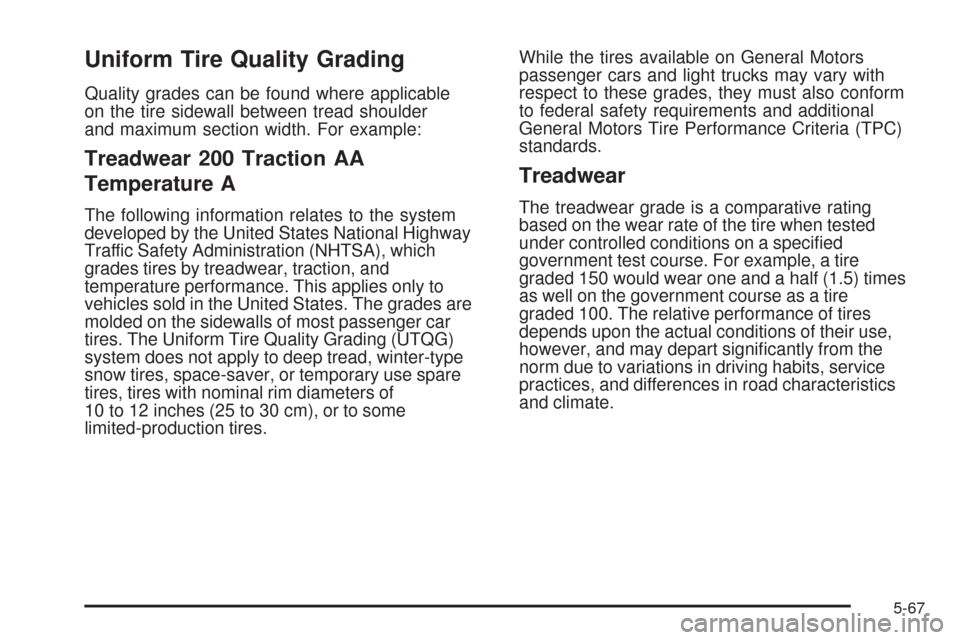
Uniform Tire Quality Grading
Quality grades can be found where applicable
on the tire sidewall between tread shoulder
and maximum section width. For example:
Treadwear 200 Traction AA
Temperature A
The following information relates to the system
developed by the United States National Highway
Traffic Safety Administration (NHTSA), which
grades tires by treadwear, traction, and
temperature performance. This applies only to
vehicles sold in the United States. The grades are
molded on the sidewalls of most passenger car
tires. The Uniform Tire Quality Grading (UTQG)
system does not apply to deep tread, winter-type
snow tires, space-saver, or temporary use spare
tires, tires with nominal rim diameters of
10 to 12 inches (25 to 30 cm), or to some
limited-production tires.While the tires available on General Motors
passenger cars and light trucks may vary with
respect to these grades, they must also conform
to federal safety requirements and additional
General Motors Tire Performance Criteria (TPC)
standards.
Treadwear
The treadwear grade is a comparative rating
based on the wear rate of the tire when tested
under controlled conditions on a specied
government test course. For example, a tire
graded 150 would wear one and a half (1.5) times
as well on the government course as a tire
graded 100. The relative performance of tires
depends upon the actual conditions of their use,
however, and may depart signicantly from the
norm due to variations in driving habits, service
practices, and differences in road characteristics
and climate.
5-67
Page 412 of 464

Fuses Usage
BLANK Not Used
BLANK Not Used
BLANK Not Used
5 Not Used
6 Air Conditioning Clutch
7 Horn
8 Left Low-Beam
9Powertrain Control Module,
Electronic Throttle Control
10 Not Used
11 Transmission Solenoid
12 Right Low-Beam
13 Antilock Brake System
14 Powertrain Control Module Ignition
15 Electronic IgnitionFuses Usage
16 Fuel Injector
17Climate Control, RPA, Cruise
Control
18 Electronic Throttle Control
19 Engine Sensor, Evaporator
20 Airbag
21 Not Used
22 Not Used
23 Auxiliary Power
24 Front Windshield Washer
25 AC/DC Inverter
26 Rear Blower
27 Front Blower
28 Front Windshield Wiper
5-102
Page 414 of 464

Capacities and Specications
The following approximate capacities are given in English and metric measurements. SeeRecommended Fluids and
Lubricants on page 6-11for more information.
ApplicationCapacities
English Metric
Air Conditioning Refrigerant R134aFor the air conditioning system refrigerant charge
amount, see the refrigerant caution label located
under the hood. See your dealer/retailer for more
information.
Automatic Transmission — Pan Removal and Replacement 7.4 qt 7.0 L
Cooling System
3.9L V6 Engine Front Climate Controls Only 10.8 qt 10.2 L
3.9L V6 Engine with Rear Climate Controls 12.2 qt 11.6 L
Engine Oil with Filter 4.0 qt 3.8 L
Fuel Capacity
Regular 20.0 gal 75.7 L
Extended 25.1 gal 95.0 L
Wheel Nut Torque 100 ft lb 140Y
All capacities are approximate. When adding, be sure to ll to the approximate level, as recommended in this
manual. Recheck uid level after lling.
Engine VIN Code Transaxle Spark Plug Gap
3.9L V6 Flexible Fuel W Automatic 0.040 inches (1.01 mm)
3.9L V6 1 Automatic 0.040 inches (1.01 mm)
5-104
Page 453 of 464
Child Restraints
Built-In Child Restraint..................................1-67
Child Restraint Systems...............................1-49
Infants and Young Children...........................1-46
Lower Anchors and Tethers for Children..........1-53
Older Children.............................................1-43
Securing a Child Restraint in a
Rear Seat Position...................................1-60
Securing a Child Restraint in the
Right Front Seat Position..........................1-62
Where to Put the Restraint...........................1-51
Chime Level Adjustment.................................3-113
Cigarette Lighter.............................................3-22
Cleaning
Aluminum Wheels........................................5-95
Child Restraint Pad......................................5-92
Exterior Lamps/Lenses.................................5-93
Fabric/Carpet..............................................5-91
Finish Care.................................................5-94
Instrument Panel, Vinyl, and Other
Plastic Surfaces.......................................5-92
Interior.......................................................5-89
Leather......................................................5-91
Tires..........................................................5-95
Underbody Maintenance...............................5-96
Washing Your Vehicle...................................5-93
Weatherstrips..............................................5-92
Windshield, Backglass, and Wiper Blades.......5-94Climate Control System...................................3-22
Air Filter, Passenger Compartment.................3-29
Dual ..........................................................3-25
Outlet Adjustment........................................3-27
Rear ..........................................................3-28
Clock, Setting.................................................3-77
Collision Damage Repair..................................7-11
Compact Spare Tire........................................5-88
Compass.......................................................3-49
Content Theft-Deterrent....................................
2-27
Control of a Vehicle.......................................... 4-3
Convenience Center........................................2-61
Convenience Net............................................2-60
Coolant
Engine.......................................................5-24
Engine Temperature Gage............................3-37
Cooling System..............................................5-23
Cruise Control................................................3-10
Cruise Control Light........................................3-42
Cupholders....................................................2-55
Customer Assistance Information
Courtesy Transportation................................7-10
Customer Assistance for
Text Telephone (TTY) Users........................ 7-6
Customer Assistance Offices........................... 7-6
Customer Satisfaction Procedure..................... 7-2
GM Mobility Reimbursement Program............... 7-7
Reporting Safety Defects to General Motors.....7-15
3
Page 454 of 464

Customer Assistance Information (cont.)
Reporting Safety Defects to the
Canadian Government..............................7-15
Reporting Safety Defects to the
United States Government.........................7-14
Roadside Assistance Program......................... 7-7
Service Publications Ordering Information........7-15
D
Daytime Running Lamps/Automatic
Headlamp System.......................................3-14
Defensive Driving............................................. 4-2
Delayed Lighting.............................................3-16
Delayed Locking.............................................2-12
DIC Compass.................................................3-49
Disc, MP3......................................................3-89
Doing Your Own Service Work........................... 5-4
Dome Lamp ...................................................3-16
Door
Automatic Door Lock....................................2-12
Delayed Locking..........................................2-12
Dual Sliding Doors.......................................2-13
Locks........................................................2-10
Power Door Locks.......................................2-11
Power Sliding Door......................................2-16
Programmable Automatic Door Unlock............2-13Driver Information Center (DIC).........................3-43
DIC Operation and Displays..........................3-44
DIC Vehicle Personalization..........................3-68
DIC Warnings and Messages........................3-51
Driving
At Night.....................................................4-12
Before a Long Trip......................................4-14
Defensive..................................................... 4-2
Drunken....................................................... 4-2
Highway Hypnosis.......................................4-14
Hill and Mountain Roads..............................4-15
In Rain and on Wet Roads...........................4-13
Rocking Your Vehicle to Get it Out.................4-18
Winter........................................................4-16
Dual Climate Control System............................3-25
DVD
Rear Seat Entertainment System...................3-93
E
EDR .............................................................7-16
Electrical System
Add-On Equipment......................................5-97
Fuses and Circuit Breakers...........................5-98
Headlamp Wiring.........................................5-98
Instrument Panel Fuse Block.........................5-98
Power Windows and Other Power Options......5-98
4