2009 CHEVROLET TRAVERSE transmission oil
[x] Cancel search: transmission oilPage 86 of 422

Retained Accessory
Power (RAP)
These vehicle accessories can be
used for up to 10 minutes after
the ignition key is turned off:
Audio System
Power Windows
Sunroof (if equipped)
Power to the windows and sunroof
will work up to 10 minutes or
until a door is opened.
The radio continues to work for
10 minutes or until the driver’s door
is opened.
For an additional 10 minutes of
operation, close all the doors and
turn the key to ON/RUN and
then back to LOCK/OFF.
All these features will work when
the key is in the ON/RUN or
ACC/ACCESSORY positions.
Starting the Engine
Move the shift lever to P (Park) or
N (Neutral). The engine will not start
in any other position. To restart the
engine when the vehicle is already
moving, use N (Neutral) only.
Notice:Do not try to shift to
P (Park) if the vehicle is moving.
If you do, you could damage
the transmission. Shift to P (Park)
only when the vehicle is stopped.
Starting Procedure
1. With your foot off the accelerator
pedal, turn the ignition to START.
When the engine starts, let go of
the key. The idle speed will slow
down as the engine warms. Do
not race the engine immediately
after starting it. Operate the
engine and transmission gently to
allow the oil to warm up and
lubricate all moving parts.The vehicle has a
Computer-Controlled Cranking
System. This feature assists
in starting the engine and
protects components. If the
ignition key is turned to the
START position, and then
released when the engine
begins cranking, the engine
will continue cranking for a
few seconds or until the vehicle
starts. If the engine does not
start and the key is held in
START, cranking will be stopped
after 15 seconds to prevent
cranking motor damage.
To prevent gear damage, this
system also prevents cranking if
the engine is already running.
Engine cranking can be stopped
by turning the ignition switch
to the ACC/ACCESSORY
or LOCK/OFF position.
2-22 Features and Controls
Page 87 of 422

Notice:Cranking the engine for
long periods of time, by returning
the key to the START position
immediately after cranking has
ended, can overheat and damage
the cranking motor, and drain the
battery. Wait at least 15 seconds
between each try, to let the
cranking motor cool down.
2. If the engine does not start after
5-10 seconds, especially in very
cold weather (below 0°F or
−18°C), it could be ooded with
too much gasoline. Try pushing
the accelerator pedal all the way
to the oor and holding it there as
you hold the key in START for
up to a maximum of 15 seconds.
Wait at least 15 seconds between
each try, to allow the cranking
motor to cool down. When the
engine starts, let go of the key
and accelerator. If the vehicle
starts briey but then stops again,repeat these steps. This clears
the extra gasoline from the
engine. Do not race the engine
immediately after starting it.
Operate the engine and
transmission gently until the oil
warms up and lubricates all
moving parts.
Notice:The engine is designed to
work with the electronics in the
vehicle. If you add electrical parts
or accessories, you could change
the way the engine operates.
Before adding electrical
equipment, check with your
dealer/retailer. If you do not, the
engine might not perform
properly. Any resulting damage
would not be covered by the
vehicle warranty.Engine Coolant Heater
The engine coolant heater can
provide easier starting and better
fuel economy during engine
warm-up in cold weather conditions
at or below 0°F (−18°C). Vehicles
with an engine coolant heater should
be plugged in at least four hours
before starting. Some models
may have an internal thermostat
in the cord which will prevent engine
coolant heater operation at
temperatures above 0°F (−18°C).
To Use the Engine Coolant
Heater
1. Turn off the engine.
2. Open the hood and unwrap the
electrical cord. The cord is
located on the driver side of the
engine compartment. It is
routed around the windshield
washer uid reservoir.
Features and Controls 2-23
Page 281 of 422

Parking on Hills
{CAUTION
Parking the vehicle on a hill with
the trailer attached can be
dangerous. If something goes
wrong, the rig could start to move.
People can be injured, and both
the vehicle and the trailer can be
damaged. When possible, always
park the rig on a at surface.
If parking the rig on a hill:
1. Press the brake pedal, but do not
shift into P (Park) yet. Turn the
wheels into the curb if facing
downhill or into traffic if facing
uphill.
2. Have someone place chocks
under the trailer wheels.3. When the wheel chocks are in
place, release the brake pedal
until the chocks absorb the load.
4. Reapply the brake pedal. Then
apply the parking brake and shift
the transmission into P (Park).
5. Release the brake pedal.
Leaving After Parking on
a Hill
1. Apply and hold the brake pedal
while you:
start the engine,
shift into a gear, and
release the parking brake.
2. Let up on the brake pedal.
3. Drive slowly until the trailer is
clear of the chocks.
4. Stop and have someone pick up
and store the chocks.
Maintenance When Trailer
Towing
The vehicle needs service more
often when pulling a trailer. See
Scheduled Maintenance on page 6-3
for more information. Things that
are especially important in trailer
operation are automatic transmission
uid, engine oil, axle lubricant, belts,
cooling system and brake system.
It is a good idea to inspect these
before and during the trip.
Check periodically to see that all
hitch nuts and bolts are tight.
Trailer Wiring Harness
The vehicle is equipped with the
following wiring harness for towing
a trailer.
Driving Your Vehicle 4-33
Page 283 of 422

Service and
Appearance Care
ServiceService................................5-3
Accessories and
Modications.......................5-3
California Proposition 65
Warning.............................5-4
California Perchlorate
Materials Requirements........5-4
Doing Your Own
Service Work......................5-4
Adding Equipment to the
Outside of the Vehicle...........5-4
FuelFuel....................................5-5
Gasoline Octane...................5-5
Gasoline Specications..........5-5
California Fuel......................5-5
Additives..............................5-5
Fuels in Foreign Countries......5-6
Filling the Tank.....................5-7
Filling a Portable Fuel
Container...........................5-8
Checking Things Under
the Hood
Checking Things Under
the Hood............................5-9
Hood Release.......................5-9
Engine Compartment
Overview..........................5-10
Engine Oil..........................5-11
Engine Oil Life System.........5-13
Engine Air Cleaner/Filter.......5-15
Automatic Transmission
Fluid................................5-16
Cooling System...................5-17
Engine Coolant...................5-17
Engine Overheating.............5-22
Overheated
Engine Protection
Operating Mode.................5-23
Power Steering Fluid............5-24
Windshield Washer Fluid......5-24
Brakes...............................5-25
Battery...............................5-28
Jump Starting.....................5-29
Headlamp AimingHeadlamp Aiming................5-33
Bulb ReplacementBulb Replacement...............5-33
Halogen Bulbs....................5-33
Taillamps, Turn Signal,
Stoplamps and
Sidemarker Lamps.............5-33
Replacement Bulbs..............5-34
Windshield Wiper Blade
Replacement
Windshield Wiper Blade
Replacement.....................5-35
TiresTires..................................5-36
Tire Sidewall Labeling..........5-37
Tire Terminology and
Denitions.........................5-39
Ination - Tire Pressure........5-42
Tire Pressure Monitor
System.............................5-43
Tire Pressure Monitor
Operation..........................5-45
Tire Inspection and
Rotation............................5-48
When It Is Time for New
Tires................................5-50
Buying New Tires................5-50
Service and Appearance Care 5-1
Page 293 of 422

A. Radiator Pressure Cap. See
Cooling System on page 5-17.
B. Engine Coolant Recovery Cap.
SeeCooling System on
page 5-17.
C. Remote Negative (−) Terminal.
SeeJump Starting on page 5-29.
D.Underhood Fuse Block on
page 5-88.
E. Remote Positive (+) Terminal.
SeeJump Starting on page 5-29.
F.Power Steering Fluid on
page 5-24.
G. Engine Oil Fill Cap. See “When
to Add Engine Oil” underEngine
Oil on page 5-11.H. Engine Oil Dipstick. See
“Checking Engine Oil” under
Engine Oil on page 5-11.
I. Automatic Transmission
Fluid Dipstick. See “Checking
the Fluid Level” underAutomatic
Transmission Fluid on page 5-16.
J. Brake Master Cylinder Reservoir.
See “Brake Fluid” underBrakes
on page 5-25.
K.Engine Air Cleaner/Filter on
page 5-15.
L. Windshield Washer Fluid
Reservoir. See “Adding Washer
Fluid” underWindshield
Washer Fluid on page 5-24.Engine Oil
Checking Engine Oil
It is a good idea to check the engine
oil level at each fuel ll. In order to
get an accurate reading, the oil must
be warm and the vehicle must be on
level ground.
The engine oil dipstick handle
is a yellow loop. SeeEngine
Compartment Overview on
page 5-10for the location of the
engine oil dipstick.
1. Turn off the engine and give the
oil several minutes to drain back
into the oil pan. If this is not
done, the oil dipstick might not
show the actual level.
2. Pull out the dipstick and clean it
with a paper towel or cloth, then
push it back in all the way.
Remove it again, keeping the tip
down, and check the level.
Service and Appearance Care 5-11
Page 372 of 422
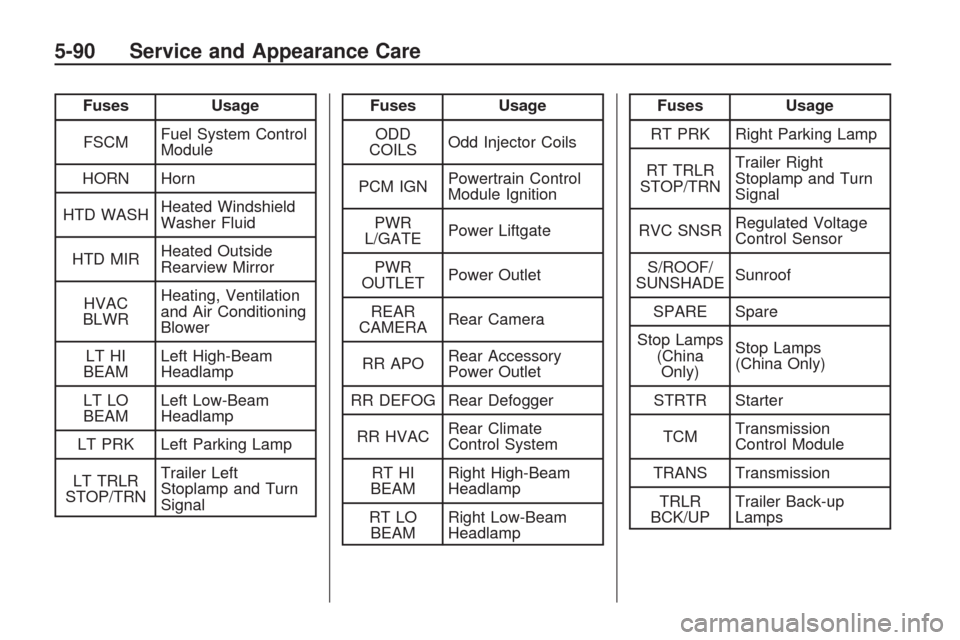
Fuses Usage
FSCMFuel System Control
Module
HORN Horn
HTD WASHHeated Windshield
Washer Fluid
HTD MIRHeated Outside
Rearview Mirror
HVAC
BLWRHeating, Ventilation
and Air Conditioning
Blower
LT HI
BEAMLeft High-Beam
Headlamp
LT LO
BEAMLeft Low-Beam
Headlamp
LT PRK Left Parking Lamp
LT TRLR
STOP/TRNTrailer Left
Stoplamp and Turn
SignalFuses Usage
ODD
COILSOdd Injector Coils
PCM IGNPowertrain Control
Module Ignition
PWR
L/GATEPower Liftgate
PWR
OUTLETPower Outlet
REAR
CAMERARear Camera
RR APORear Accessory
Power Outlet
RR DEFOG Rear Defogger
RR HVACRear Climate
Control System
RT HI
BEAMRight High-Beam
Headlamp
RT LO
BEAMRight Low-Beam
HeadlampFuses Usage
RT PRK Right Parking Lamp
RT TRLR
STOP/TRNTrailer Right
Stoplamp and Turn
Signal
RVC SNSRRegulated Voltage
Control Sensor
S/ROOF/
SUNSHADESunroof
SPARE Spare
Stop Lamps
(China
Only)Stop Lamps
(China Only)
STRTR Starter
TCMTransmission
Control Module
TRANS Transmission
TRLR
BCK/UPTrailer Back-up
Lamps
5-90 Service and Appearance Care
Page 374 of 422

Capacities and Specications
The following approximate capacities are given in English and metric conversions. SeeRecommended Fluids and
Lubricants on page 6-12 for more information.
Application Capacities
English Metric
Air Conditioning Refrigerant R134a For the air conditioning system refrigerant charge
amount, see the refrigerant caution label located
under the hood. See your dealer/retailer for more information.
Cooling System 11.4 qt 10.8 L
Engine Oil with Filter 5.5 qt 5.2 L
Fuel Tank 22.0 gal 83.3 L
Transmission Fluid* 5.3 qt 5.0 L
Wheel Nut Torque 140 lb ft 190 Y
*See Automatic Transmission Fluid on page 5-16 for information on checking uid level.
All capacities are approximate. When adding, be sure to ll to the approximate level, as recommended in this
manual. Recheck uid level after lling.
Engine Specications
Engine VIN CodeTransmission Spark Plug Gap
3.6L V6 Engine DAutomatic 0.043 in (1.10 mm)
5-92 Service and Appearance Care
Page 382 of 422

(e)Make sure the safety belt
reminder light and safety belt
assemblies are working properly.
Look for any other loose or damaged
safety belt system parts. If you see
anything that might keep a safety
belt system from doing its job, have
it repaired. Have any torn or frayed
safety belts replaced. Also see
Checking the Restraint Systems
on page 1-59.
(f)Lubricate all key lock cylinders,
hood latch assemblies, secondary
latches, pivots, spring anchor and
release pawl, hood and door hinges,
rear folding seats, and liftgate
hinges. More frequent lubrication
may be required when exposed to
a corrosive environment. Applying
silicone grease on weatherstrips with
a clean cloth will make them last
longer, seal better, and not stick
or squeak.
(g)A fluid loss in any vehicle system
could indicate a problem. Have the
system inspected and repaired and
the fluid level checked. Add fluid if
needed.(h)Change automatic transmission
fluid if the vehicle is mainly driven
under one or more of these
conditions:
In heavy city traffic where the
outside temperature regularly
reaches 90°F (32°C) or higher.
In hilly or mountainous terrain.
When doing frequent trailer
towing.
Uses such as found in taxi, police,
or delivery service.
(i)Drain, flush, and refill cooling
system. This service can be
complex; you should have your
dealer/retailer perform this service.
See Engine Coolant on page 5-17 for
what to use. Inspect hoses. Clean
radiator, condenser, pressure cap,
and filler neck. Pressure test the
cooling system and pressure cap.(j)Check system for interference or
binding and for damaged or missing
parts. Replace parts as needed.
Replace any components that have
high effort or excessive wear. Do not
lubricate accelerator or cruise control
cables.
(k)Visually inspect belt for fraying,
excessive cracks, or obvious
damage. Replace belt if necessary.
(l)If driving regularly under dusty
conditions, inspect the filter at each
engine oil change.
(m)Change transfer case fluid if the
vehicle is mainly driven under one
or more of these conditions:
In heavy city traffic where the
outside temperature regularly
reaches 90°F (32°C) or higher.
In hilly or mountainous terrain.
When doing frequent trailer
towing.
Uses such as found in taxi, police,
or delivery service.
6-8 Maintenance Schedule