2009 CHEVROLET TRAVERSE belt
[x] Cancel search: beltPage 257 of 422
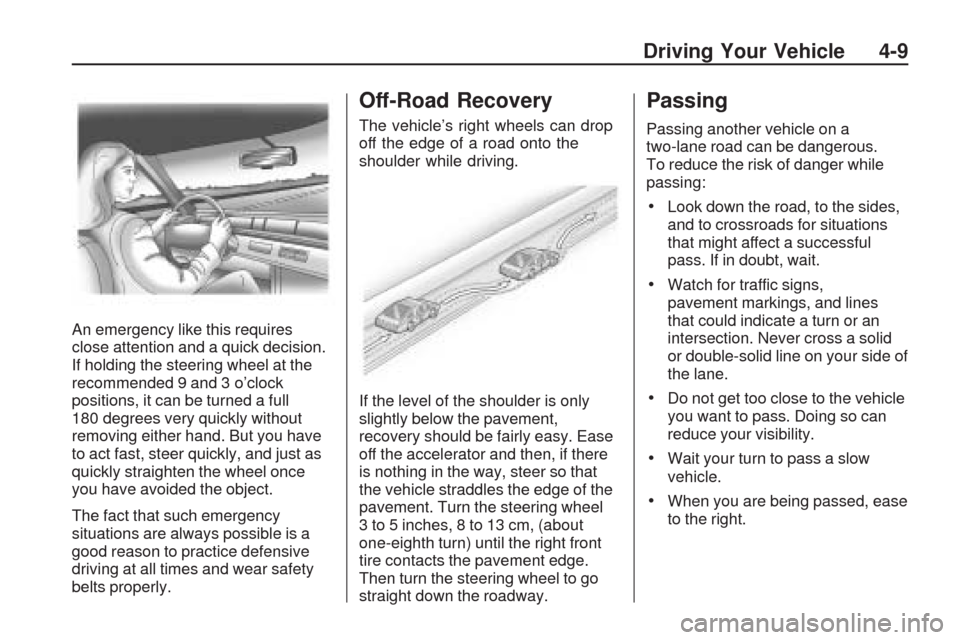
An emergency like this requires
close attention and a quick decision.
If holding the steering wheel at the
recommended 9 and 3 o’clock
positions, it can be turned a full
180 degrees very quickly without
removing either hand. But you have
to act fast, steer quickly, and just as
quickly straighten the wheel once
you have avoided the object.
The fact that such emergency
situations are always possible is a
good reason to practice defensive
driving at all times and wear safety
belts properly.
Off-Road Recovery
The vehicle’s right wheels can drop
off the edge of a road onto the
shoulder while driving.
If the level of the shoulder is only
slightly below the pavement,
recovery should be fairly easy. Ease
off the accelerator and then, if there
is nothing in the way, steer so that
the vehicle straddles the edge of the
pavement. Turn the steering wheel
3 to 5 inches, 8 to 13 cm, (about
one-eighth turn) until the right front
tire contacts the pavement edge.
Then turn the steering wheel to go
straight down the roadway.
Passing
Passing another vehicle on a
two-lane road can be dangerous.
To reduce the risk of danger while
passing:
Look down the road, to the sides,
and to crossroads for situations
that might affect a successful
pass. If in doubt, wait.
Watch for traffic signs,
pavement markings, and lines
that could indicate a turn or an
intersection. Never cross a solid
or double-solid line on your side of
the lane.
Do not get too close to the vehicle
you want to pass. Doing so can
reduce your visibility.
Wait your turn to pass a slow
vehicle.
When you are being passed, ease
to the right.
Driving Your Vehicle 4-9
Page 281 of 422

Parking on Hills
{CAUTION
Parking the vehicle on a hill with
the trailer attached can be
dangerous. If something goes
wrong, the rig could start to move.
People can be injured, and both
the vehicle and the trailer can be
damaged. When possible, always
park the rig on a at surface.
If parking the rig on a hill:
1. Press the brake pedal, but do not
shift into P (Park) yet. Turn the
wheels into the curb if facing
downhill or into traffic if facing
uphill.
2. Have someone place chocks
under the trailer wheels.3. When the wheel chocks are in
place, release the brake pedal
until the chocks absorb the load.
4. Reapply the brake pedal. Then
apply the parking brake and shift
the transmission into P (Park).
5. Release the brake pedal.
Leaving After Parking on
a Hill
1. Apply and hold the brake pedal
while you:
start the engine,
shift into a gear, and
release the parking brake.
2. Let up on the brake pedal.
3. Drive slowly until the trailer is
clear of the chocks.
4. Stop and have someone pick up
and store the chocks.
Maintenance When Trailer
Towing
The vehicle needs service more
often when pulling a trailer. See
Scheduled Maintenance on page 6-3
for more information. Things that
are especially important in trailer
operation are automatic transmission
uid, engine oil, axle lubricant, belts,
cooling system and brake system.
It is a good idea to inspect these
before and during the trip.
Check periodically to see that all
hitch nuts and bolts are tight.
Trailer Wiring Harness
The vehicle is equipped with the
following wiring harness for towing
a trailer.
Driving Your Vehicle 4-33
Page 284 of 422

Different Size Tires and
Wheels.............................5-52
Uniform Tire Quality
Grading............................5-52
Wheel Alignment and Tire
Balance............................5-54
Wheel Replacement.............5-54
Tire Chains.........................5-55
If a Tire Goes Flat...............5-56
Tire Sealant and
Compressor Kit..................5-57
Tire Sealant and
Compressor Kit Storage......5-64
Changing a Flat Tire............5-65
Removing the Spare Tire
and Tools.........................5-66
Removing the Flat Tire
and Installing the
Spare Tire........................5-68
Secondary Latch System......5-72
Storing a Flat or Spare
Tire and Tools...................5-74
Compact Spare Tire.............5-77
Appearance CareInterior Cleaning..................5-78
Fabric/Carpet......................5-79
Leather..............................5-80Instrument Panel, Vinyl,
and Other Plastic
Surfaces...........................5-80
Care of Safety Belts............5-80
Weatherstrips......................5-81
Washing Your Vehicle..........5-81
Cleaning Exterior Lamps/
Lenses.............................5-81
Finish Care.........................5-81
Windshield, Backglass, and
Wiper Blades....................5-82
Aluminum or Chrome-Plated
Wheels and Trim................5-83
Tires..................................5-83
Sheet Metal Damage...........5-84
Finish Damage....................5-84
Underbody Maintenance.......5-84
Chemical Paint Spotting........5-84
Vehicle IdenticationVehicle Identication
Number (VIN)....................5-85
Service Parts Identication
Label...............................5-85
Electrical SystemHigh Voltage Devices and
Wiring..............................5-85
Add-On Electrical
Equipment........................5-86
Windshield Wiper Fuses.......5-86
Power Windows and Other
Power Options...................5-86
Fuses and Circuit Breakers. . .5-86
Instrument Panel
Fuse Block.......................5-86
Underhood Fuse Block.........5-88
Capacities and SpecicationsCapacities and
Specications....................5-92
5-2 Service and Appearance Care
Page 286 of 422

California Proposition 65
Warning
Most motor vehicles, including this
one, contain and/or emit chemicals
known to the State of California
to cause cancer and birth defects or
other reproductive harm. Engine
exhaust, many parts and systems
(including some inside the vehicle),
many uids, and some component
wear by-products contain and/or
emit these chemicals.
California Perchlorate
Materials Requirements
Certain types of automotive
applications, such as airbag
initiators, seat belt pretensioners,
and lithium batteries contained in
remote keyless transmitters, may
contain perchlorate materials.
Special handling may be necessary.
For additional information, see
www.dtsc.ca.gov/hazardouswaste/
perchlorate.
Doing Your Own
Service Work
{CAUTION
You can be injured and the
vehicle could be damaged if you
try to do service work on a vehicle
without knowing enough about it.
Be sure you have sufficient
knowledge, experience, the
proper replacement parts, and
tools before attempting any
vehicle maintenance task.
Be sure to use the proper
nuts, bolts, and other
fasteners. English and metric
fasteners can be easily
confused. If the wrong
fasteners are used, parts
can later break or fall off.
You could be hurt.
If doing some of your own service
work, use the proper service
manual. It tells you much moreabout how to service the vehicle
than this manual can. To order the
proper service manual, see
Service Publications Ordering
Information on page 7-15.
This vehicle has an airbag system.
Before attempting to do your
own service work, seeServicing
Your Airbag-Equipped Vehicle
on page 1-57.
Keep a record with all parts receipts
and list the mileage and the date
of any service work performed. See
Maintenance Record on page 6-16.Adding Equipment to the
Outside of the Vehicle
Things added to the outside of
the vehicle can affect the airow
around it. This can cause wind noise
and can affect fuel economy and
windshield washer performance.
Check with your dealer/retailer
before adding equipment to
the outside of the vehicle.
5-4 Service and Appearance Care
Page 321 of 422
Tire Size
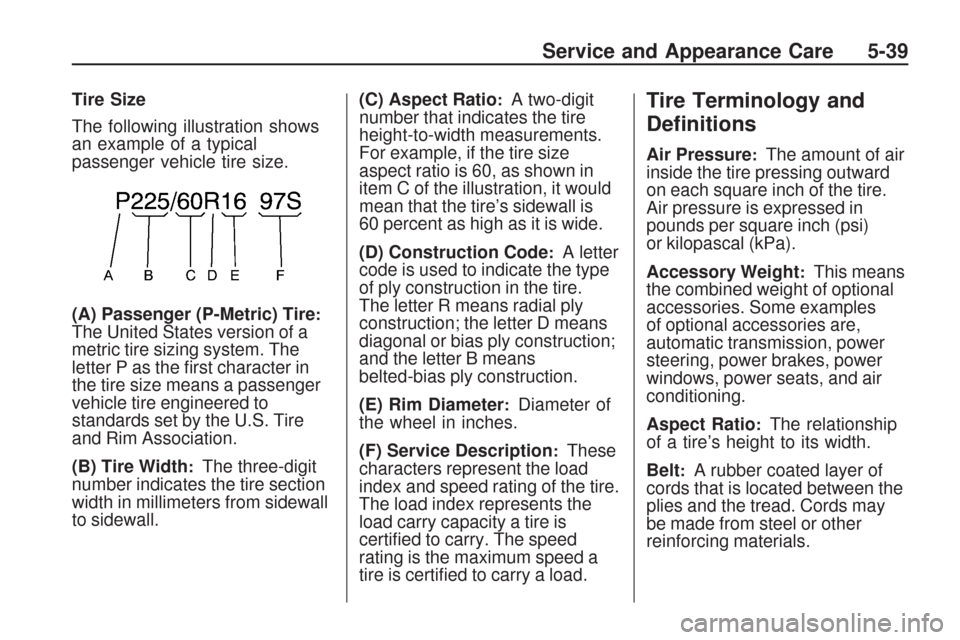
The following illustration shows
an example of a typical
passenger vehicle tire size.
(A) Passenger (P-Metric) Tire
:The United States version of a
metric tire sizing system. The
letter P as the rst character in
the tire size means a passenger
vehicle tire engineered to
standards set by the U.S. Tire
and Rim Association.
(B) Tire Width
:The three-digit
number indicates the tire section
width in millimeters from sidewall
to sidewall.(C) Aspect Ratio
:A two-digit
number that indicates the tire
height-to-width measurements.
For example, if the tire size
aspect ratio is 60, as shown in
item C of the illustration, it would
mean that the tire’s sidewall is
60 percent as high as it is wide.
(D) Construction Code
:A letter
code is used to indicate the type
of ply construction in the tire.
The letter R means radial ply
construction; the letter D means
diagonal or bias ply construction;
and the letter B means
belted-bias ply construction.
(E) Rim Diameter
:Diameter of
the wheel in inches.
(F) Service Description
:These
characters represent the load
index and speed rating of the tire.
The load index represents the
load carry capacity a tire is
certied to carry. The speed
rating is the maximum speed a
tire is certied to carry a load.
Tire Terminology and
Denitions
Air Pressure:The amount of air
inside the tire pressing outward
on each square inch of the tire.
Air pressure is expressed in
pounds per square inch (psi)
or kilopascal (kPa).
Accessory Weight
:This means
the combined weight of optional
accessories. Some examples
of optional accessories are,
automatic transmission, power
steering, power brakes, power
windows, power seats, and air
conditioning.
Aspect Ratio
:The relationship
of a tire’s height to its width.
Belt
:A rubber coated layer of
cords that is located between the
plies and the tread. Cords may
be made from steel or other
reinforcing materials.
Service and Appearance Care 5-39
Page 333 of 422

GM’s exclusive TPC Spec
system considers over a dozen
critical specications that impact
the overall performance of your
vehicle, including brake system
performance, ride and handling,
traction control, and tire pressure
monitoring performance. GM’s
TPC Spec number is molded
onto the tire’s sidewall near the
tire size. If the tires have an
all-season tread design, the TPC
Spec number will be followed by
an MS for mud and snow. See
Tire Sidewall Labeling on
page 5-37for additional
information.
GM recommends replacing tires
in sets of four. This is because
uniform tread depth on all tires
will help keep your vehicle
performing most like it did when
the tires were new. Replacing
less than a full set of tires can
affect the braking and handling
performance of your vehicle.SeeTire Inspection and Rotation
on page 5-48for information on
proper tire rotation.
{CAUTION
Mixing tires could cause you
to lose control while driving.
If you mix tires of different
sizes, brands, or types (radial
and bias-belted tires), the
vehicle may not handle
properly, and you could have a
crash. Using tires of different
sizes, brands, or types may
also cause damage to your
vehicle. Be sure to use the
correct size, brand, and type of
tires on all wheels. It is all right
to drive with your compact
spare temporarily, as it was
developed for use on your
vehicle. SeeCompact Spare
Tire on page 5-77.
{CAUTION
If you use bias-ply tires on the
vehicle, the wheel rim anges
could develop cracks after
many miles of driving. A tire
and/or wheel could fail
suddenly, causing a crash.
Use only radial-ply tires with
the wheels on the vehicle.
If you must replace your vehicle’s
tires with those that do not have
a TPC Spec number, make sure
they are the same size, load
range, speed rating, and
construction type (radial and
bias-belted tires) as your
vehicle’s original tires.
Vehicles that have a tire pressure
monitoring system could give
an inaccurate low-pressure
warning if non-TPC Spec rated
tires are installed on your vehicle.
Service and Appearance Care 5-51
Page 362 of 422
Leather
A soft cloth dampened with
water can be used to remove dust.
If a more thorough cleaning is
necessary, a soft cloth dampened
with a mild soap solution can be
used. Allow the leather to dry
naturally. Do not use heat to dry.
Never use steam to clean leather.
Never use spot lifters or spot
removers on leather. Many
commercial leather cleaners
and coatings that are sold to
preserve and protect leather may
permanently change the appearance
and feel of the leather and are not
recommended. Do not use silicone
or wax-based products, or those
containing organic solvents to
clean the vehicle’s interior because
they can alter the appearance by
increasing the gloss in a non-uniform
manner. Never use shoe polish on
leather.
Instrument Panel, Vinyl,
and Other Plastic
Surfaces
A soft cloth dampened with
water may be used to remove dust.
If a more thorough cleaning is
necessary, a clean soft cloth
dampened with a mild soap solution
can be used to gently remove dust
and dirt. Never use spot lifters or
removers on plastic surfaces. Many
commercial cleaners and coatings
that are sold to preserve and
protect soft plastic surfaces may
permanently change the appearance
and feel of the interior and are not
recommended. Do not use silicone
or wax-based products, or those
containing organic solvents to clean
the vehicle’s interior because they
can alter the appearance by
increasing the gloss in a non-uniform
manner.Some commercial products may
increase gloss on the instrument
panel. The increase in gloss
may cause annoying reections in
the windshield and even make
it difficult to see through the
windshield under certain conditions.
Care of Safety Belts
Keep belts clean and dry.
{CAUTION
Do not bleach or dye safety belts.
It may severely weaken them.
In a crash, they might not be able
to provide adequate protection.
Clean safety belts only with mild
soap and lukewarm water.
5-80 Service and Appearance Care
Page 375 of 422

Maintenance
Schedule
Maintenance ScheduleIntroduction..........................6-1
Maintenance Requirements.....6-1
Your Vehicle and the
Environment........................6-1
Using the Maintenance
Schedule............................6-2
Scheduled Maintenance.........6-3
Additional Required Services. . .6-6
Maintenance Footnotes..........6-7
Owner Checks and Services. . .6-9
At Each Fuel Fill...................6-9
At Least Once a Month..........6-9
At Least Once a Year..........6-10
Recommended Fluids and
Lubricants.........................6-12
Maintenance Replacement
Parts................................6-14
Engine Drive Belt Routing.....6-15
Maintenance Record............6-16
Maintenance
Schedule
Introduction
Important: Keep engine oil at the
proper level and change as
recommended.
Have you purchased the GM
Protection Plan? The Plan
supplements the vehicle warranties.
See the Warranty and Owner
Assistance booklet or your
dealer/retailer for details.
Maintenance
Requirements
Notice:Maintenance intervals,
checks, inspections, replacement
parts, and recommended uids
and lubricants as prescribed
in this manual are necessary to
keep this vehicle in good working
condition. Any damage caused
by failure to follow scheduled
maintenance might not be
covered by the vehicle warranty.
Your Vehicle and the
Environment
Proper vehicle maintenance not only
helps to keep the vehicle in good
working condition, but also helps the
environment. All recommended
maintenance is important. Improper
vehicle maintenance can even affect
the quality of the air we breathe.
Maintenance Schedule 6-1