Page 305 of 422

If No Steam Is Coming From
The Engine Compartment
If an engine overheat warning is
displayed but no steam can be seen
or heard, the problem may not be
too serious. Sometimes the
engine can get a little too hot when
the vehicle:
Climbs a long hill on a hot day.
Stops after high-speed driving.
Idles for long periods in traffic.
Tows a trailer.
If the overheat warning is displayed
with no sign of steam:
1. Turn the air conditioning off.
2. Turn the heater on to the highest
temperature and to the highest
fan speed. Open the windows as
necessary.3. If in a traffic jam, shift to
N (Neutral), otherwise, shift
to the highest gear while
driving —D (Drive) or L (Low).
If the temperature overheat gage is
no longer in the overheat zone or an
overheat warning no longer displays,
the vehicle can be driven. Continue
to drive the vehicle slow for about
10 minutes. Keep a safe vehicle
distance from the car in front of you.
If the warning does not come back
on, continue to drive normally.
If the warning continues, pull over,
stop, and park the vehicle right away.
If there is no sign of steam, idle
the engine for three minutes while
parked. If the warning is still
displayed, turn off the engine until it
cools down. Also, see “Overheated
Engine Protection Operating Mode”
next in this section.
Overheated
Engine Protection
Operating Mode
This emergency operating mode lets
the vehicle be driven to a safe place
in an emergency situation. If an
overheated engine condition exists,
an overheat protection mode which
alternates ring groups of cylinders
helps prevent engine damage. In this
mode, there is a signicant loss in
power and engine performance.
The temperature gage indicates an
overheat condition exists. Driving
extended distances and/or towing a
trailer in the overheat protection
mode should be avoided.
Notice:After driving in the
overheated engine protection
operating mode, to avoid engine
damage, allow the engine to cool
before attempting any repair.
The engine oil will be severely
degraded. Repair the cause of
coolant loss, change the oil and
reset the oil life system. See
Engine Oil on page 5-11.
Service and Appearance Care 5-23
Page 372 of 422
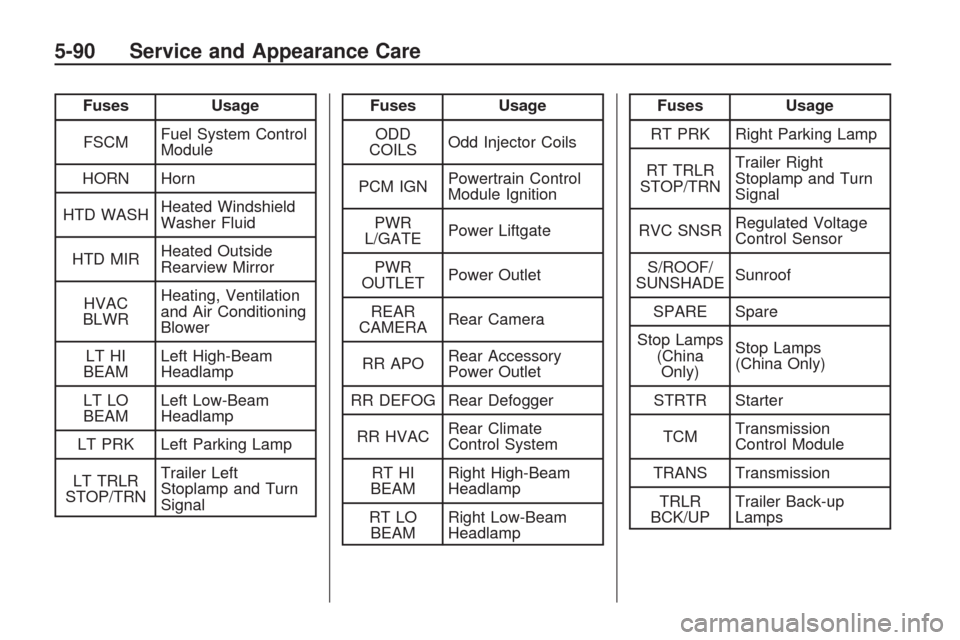
Fuses Usage
FSCMFuel System Control
Module
HORN Horn
HTD WASHHeated Windshield
Washer Fluid
HTD MIRHeated Outside
Rearview Mirror
HVAC
BLWRHeating, Ventilation
and Air Conditioning
Blower
LT HI
BEAMLeft High-Beam
Headlamp
LT LO
BEAMLeft Low-Beam
Headlamp
LT PRK Left Parking Lamp
LT TRLR
STOP/TRNTrailer Left
Stoplamp and Turn
SignalFuses Usage
ODD
COILSOdd Injector Coils
PCM IGNPowertrain Control
Module Ignition
PWR
L/GATEPower Liftgate
PWR
OUTLETPower Outlet
REAR
CAMERARear Camera
RR APORear Accessory
Power Outlet
RR DEFOG Rear Defogger
RR HVACRear Climate
Control System
RT HI
BEAMRight High-Beam
Headlamp
RT LO
BEAMRight Low-Beam
HeadlampFuses Usage
RT PRK Right Parking Lamp
RT TRLR
STOP/TRNTrailer Right
Stoplamp and Turn
Signal
RVC SNSRRegulated Voltage
Control Sensor
S/ROOF/
SUNSHADESunroof
SPARE Spare
Stop Lamps
(China
Only)Stop Lamps
(China Only)
STRTR Starter
TCMTransmission
Control Module
TRANS Transmission
TRLR
BCK/UPTrailer Back-up
Lamps
5-90 Service and Appearance Care
Page 373 of 422
Fuses Usage
TRLR BRK Trailer Brake
TRLR PRK
LAMPTrailer Parking
Lamps
TRLR PWR Trailer Power
WPR/WSWWindshield
Wiper/Washer
Relays Usage
A/C
CMPRSR
CLTCHAir Conditioning
Compressor Clutch
AUX VAC
PUMPAuxiliary Vacuum
Pump
CRNK Switched Power
FAN 1 Cooling Fan 1
FAN 2 Cooling Fan 2
FAN 3 Cooling Fan 3
FOG LAMP Fog Lamps
HI BEAMHigh-Beam
Headlamps
Relays Usage
HID/LO
BEAMHigh Intensity
Discharge (HID)
Low-Beam
Headlamps
HORN Horn
IGN Ignition Main
LT TRLR
STOP/TRNTrailer Left
Stoplamp and Turn
Signal Lamp
PRK LAMP Park Lamp
PWR/TRN Powertrain
RR DEFOGRear Window
Defogger
RT TRLR
STOP/TRNTrailer Right
Stoplamp and Turn
Signal Lamp
Stop Lamps
(China
Only)Stop Lamps
(China Only)
TRLR
BCK/UPTrailer Back-up
Lamps
WPR Windshield Wiper
WPR HIWindshield Wiper
High Speed
Service and Appearance Care 5-91
Page 382 of 422

(e)Make sure the safety belt
reminder light and safety belt
assemblies are working properly.
Look for any other loose or damaged
safety belt system parts. If you see
anything that might keep a safety
belt system from doing its job, have
it repaired. Have any torn or frayed
safety belts replaced. Also see
Checking the Restraint Systems
on page 1-59.
(f)Lubricate all key lock cylinders,
hood latch assemblies, secondary
latches, pivots, spring anchor and
release pawl, hood and door hinges,
rear folding seats, and liftgate
hinges. More frequent lubrication
may be required when exposed to
a corrosive environment. Applying
silicone grease on weatherstrips with
a clean cloth will make them last
longer, seal better, and not stick
or squeak.
(g)A fluid loss in any vehicle system
could indicate a problem. Have the
system inspected and repaired and
the fluid level checked. Add fluid if
needed.(h)Change automatic transmission
fluid if the vehicle is mainly driven
under one or more of these
conditions:
In heavy city traffic where the
outside temperature regularly
reaches 90°F (32°C) or higher.
In hilly or mountainous terrain.
When doing frequent trailer
towing.
Uses such as found in taxi, police,
or delivery service.
(i)Drain, flush, and refill cooling
system. This service can be
complex; you should have your
dealer/retailer perform this service.
See Engine Coolant on page 5-17 for
what to use. Inspect hoses. Clean
radiator, condenser, pressure cap,
and filler neck. Pressure test the
cooling system and pressure cap.(j)Check system for interference or
binding and for damaged or missing
parts. Replace parts as needed.
Replace any components that have
high effort or excessive wear. Do not
lubricate accelerator or cruise control
cables.
(k)Visually inspect belt for fraying,
excessive cracks, or obvious
damage. Replace belt if necessary.
(l)If driving regularly under dusty
conditions, inspect the filter at each
engine oil change.
(m)Change transfer case fluid if the
vehicle is mainly driven under one
or more of these conditions:
In heavy city traffic where the
outside temperature regularly
reaches 90°F (32°C) or higher.
In hilly or mountainous terrain.
When doing frequent trailer
towing.
Uses such as found in taxi, police,
or delivery service.
6-8 Maintenance Schedule
Page 421 of 422

Tire Sealant and
Compressor Kit................5-64
Tires..................................5-36
Aluminum or
Chrome-Plated Wheels,
Cleaning......................5-83
Buying New Tires.............5-50
Chains............................5-55
Changing a Flat Tire.........5-65
Cleaning..........................5-83
Compact Spare................5-77
Different Size...................5-52
If a Tire Goes Flat............5-56
Ination - Tire Pressure.....5-42
Inspection and Rotation.....5-48
Installing the Spare Tire.....5-68
Pressure Monitor
Operation.....................5-45
Pressure Monitor System . . . 5-43
Removing the Flat Tire......5-68
Removing the Spare Tire
and Tools.....................5-66
Sealant and
Compressor Kit.............5-57
Secondary Latch System....5-72
Sidewall Labeling..............5-37
Storing a Flat or Spare Tire
and Tools.....................5-74Tires (cont.)
Terminology and
Denitions....................5-39
Uniform Tire Quality
Grading.......................5-52
Wheel Alignment and
Tire Balance.................5-54
Wheel Replacement..........5-54
When It Is Time for
New Tires....................5-50
Tow/Haul Mode ....................2-26
Tow/Haul Mode Light............3-43
Towing
Recreational Vehicle..........4-21
Towing a Trailer................4-25
Your Vehicle.....................4-21
Traction
StabiliTrak®System............ 4-5
Transmission
Fluid, Automatic................5-16
Transmission Operation,
Automatic........................2-24
Transportation, Courtesy......... 7-9
Turn and Lane-Change
Signals............................. 3-6
Turn Signal/Multifunction
Lever................................ 3-6
U
Ultrasonic Rear Parking
Assist (URPA)..................2-36
Uniform Tire Quality
Grading...........................5-52
Universal Home Remote
System...........................2-47
Operation........................2-47
V
Vehicle
Control............................. 4-3
Loading...........................4-16
Running While Parked.......2-30
Symbols.............................. iii
Vehicle Customization, DIC....3-65
Vehicle Data Recording and
Privacy............................7-16
Vehicle Data Recording,
Radio Frequency (RFID)....7-17
Vehicle Identication
Number (VIN)...................5-85
Service Parts Identication
Label...........................5-85
Vehicle, Remote Start............. 2-6
INDEX i-11
