2009 CHEVROLET TRAIL BLAZER tire size
[x] Cancel search: tire sizePage 73 of 484
Any object, such as an aftermarket seat heater or a
comfort enhancing pad or device, installed under or
on top of the seat fabric, could also interfere with the
operation of the passenger sensing system. This
could either prevent proper deployment of the
passenger airbag(s) or prevent the passenger
sensing system from properly turning off the
passenger airbag(s). SeePassenger Sensing
System on page 1-63.
If you have any questions about this, you should
contact Customer Assistance before you modify
your vehicle. The phone numbers and addresses
for Customer Assistance are in Step Two of
the Customer Satisfaction Procedure in this manual.
SeeCustomer Satisfaction Procedure on page 7-2.
If your vehicle has rollover roof-rail airbags, see
Different Size Tires and Wheels on page 5-77
for additional important information.Q:Because I have a disability, I have to get my
vehicle modied. How can I nd out whether
this will affect my airbag system?
A:If you have questions, call Customer Assistance.
The phone numbers and addresses for Customer
Assistance are in Step Two of the Customer
Satisfaction Procedure in this manual. See
Customer Satisfaction Procedure on page 7-2.
In addition, your dealer/retailer and the service manual
have information about the location of the airbag
sensors, sensing and diagnostic module and airbag
wiring.
1-69
Page 248 of 484

Your Driving, the Road, and
the Vehicle
Driving for Better Fuel Economy
Driving habits can affect fuel mileage. Here are some
driving tips to get the best fuel economy possible.
Avoid fast starts and accelerate smoothly.
Brake gradually and avoid abrupt stops.
Avoid idling the engine for long periods of time.
When road and weather conditions are appropriate,
use cruise control, if equipped.
Always follow posted speed limits or drive more
slowly when conditions require.
Keep vehicle tires properly inated.
Combine several trips into a single trip.
Replace the vehicle’s tires with the same TPC Spec
number molded into the tire’s sidewall near the size.
Follow recommended scheduled maintenance.
Defensive Driving
Defensive driving means “always expect the
unexpected.” The rst step in driving defensively is to
wear your safety belt — SeeSafety Belts: They Are for
Everyone on page 1-13.
{CAUTION:
Assume that other road users (pedestrians,
bicyclists, and other drivers) are going to be
careless and make mistakes. Anticipate what
they might do and be ready. In addition:
Allow enough following distance between you
and the driver in front of you.
Focus on the task of driving.
Driver distraction can cause collisions resulting in
injury or possible death. These simple defensive
driving techniques could save your life.
4-2
Page 280 of 484
Tire and Loading Information Label
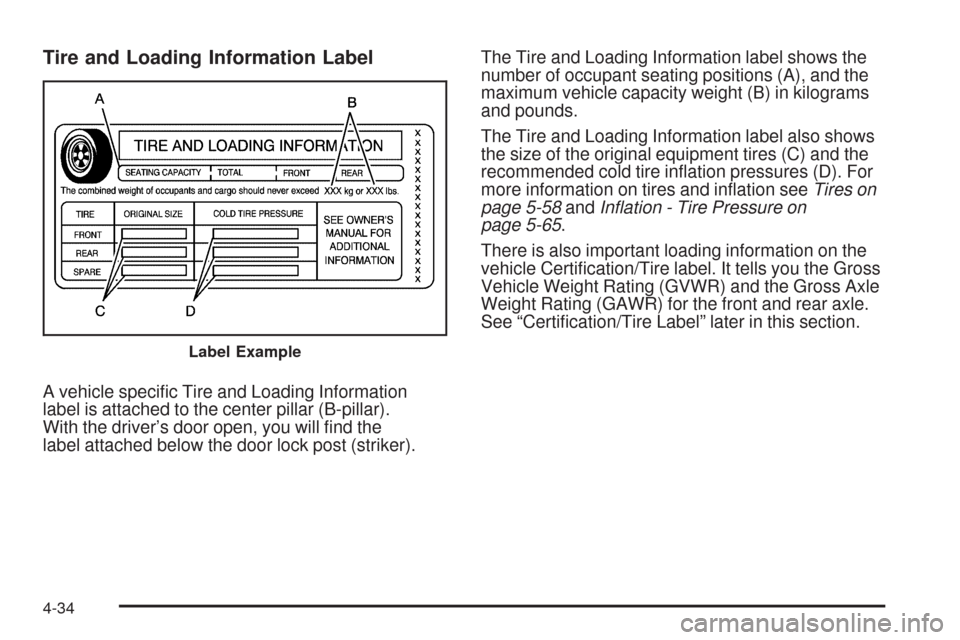
A vehicle specic Tire and Loading Information
label is attached to the center pillar (B-pillar).
With the driver’s door open, you will nd the
label attached below the door lock post (striker).The Tire and Loading Information label shows the
number of occupant seating positions (A), and the
maximum vehicle capacity weight (B) in kilograms
and pounds.
The Tire and Loading Information label also shows
the size of the original equipment tires (C) and the
recommended cold tire ination pressures (D). For
more information on tires and ination seeTires on
page 5-58andInflation - Tire Pressure on
page 5-65.
There is also important loading information on the
vehicle Certication/Tire label. It tells you the Gross
Vehicle Weight Rating (GVWR) and the Gross Axle
Weight Rating (GAWR) for the front and rear axle.
See “Certication/Tire Label” later in this section.
Label Example
4-34
Page 284 of 484

Certication/Tire Label
A vehicle specic Certication/Tire label is found
on the rear edge of the driver’s door. The label
shows the size of your vehicle’s original tires and
the ination pressures needed to obtain the gross
weight capacity of your vehicle. This is called
Gross Vehicle Weight Rating (GVWR). The GVWR
includes the weight of the vehicle, all occupants,
fuel, cargo, and trailer tongue weight, if pulling a
trailer.
The Certication/Tire label also tells you the
maximum weights for the front and rear axles,
called Gross Axle Weight Rating (GAWR).To nd out the actual loads on your front and rear
axles, you need to go to a weigh station and weigh
your vehicle. Your dealer can help you with this.
Be sure to spread out your load equally on both
sides of the centerline.
Never exceed the GVWR for your vehicle, or the
GAWR for either the front or rear axle.
And, if you do have a heavy load, you should
spread it out.
Similar appearing vehicles may have different
GVWRs and capacity weights. Please note your
vehicle’s Certication/Tire label or consult your
dealer for additional details.
{CAUTION:
Do not load the vehicle any heavier than the
Gross Vehicle Weight Rating (GVWR), or
either the maximum front or rear Gross Axle
Weight Rating (GAWR). If you do, parts on the
vehicle can break, and it can change the way
your vehicle handles. These could cause you
to lose control and crash. Also, overloading
can shorten the life of the vehicle.
4-38
Page 308 of 484
Tire Pressure Monitor Operation.....................5-69
Tire Inspection and Rotation...........................5-73
When It Is Time for New Tires.......................5-74
Buying New Tires.........................................5-75
Different Size Tires and Wheels......................5-77
Uniform Tire Quality Grading..........................5-78
Wheel Alignment and Tire Balance..................5-80
Wheel Replacement......................................5-80
Tire Chains..................................................5-81
If a Tire Goes Flat........................................5-82
Tire Sealant and Compressor Kit....................5-83
Tire Sealant and Compressor Kit Storage.........5-92
Changing a Flat Tire.....................................5-93
Removing the Spare Tire and Tools................5-94
Removing the Flat Tire and Installing the
Spare Tire................................................5-97
Secondary Latch System..............................5-103
Storing a Flat or Spare Tire and Tools...........5-106
Spare Tire.................................................5-109
Appearance Care..........................................5-109
Interior Cleaning.........................................5-109
Fabric/Carpet..............................................5-111
Leather......................................................5-111
Instrument Panel, Vinyl, and Other
Plastic Surfaces.......................................5-112Care of Safety Belts....................................5-112
Weatherstrips.............................................5-112
Washing Your Vehicle..................................5-113
Cleaning Exterior Lamps/Lenses....................5-113
Finish Care................................................5-114
Windshield, Backglass, and Wiper Blades.......5-114
Aluminum Wheels.......................................5-115
Tires.........................................................5-115
Sheet Metal Damage...................................5-116
Finish Damage...........................................5-116
Underbody Maintenance...............................5-116
Chemical Paint Spotting...............................5-116
Vehicle Identication.....................................5-117
Vehicle Identication Number (VIN)................5-117
Service Parts Identication Label...................5-117
Electrical System..........................................5-118
Add-On Electrical Equipment.........................5-118
Headlamps.................................................5-118
Windshield Wiper Fuses...............................5-118
Power Windows and Other Power Options......5-118
Fuses and Circuit Breakers..........................5-119
Engine Compartment Fuse Block...................5-119
Rear Underseat Fuse Block..........................5-122
Capacities and Specications........................5-125
Section 5 Service and Appearance Care
5-2
Page 365 of 484

Low-Prole Performance Tire
If your vehicle has P255/50R20 size tires, they are
classied as low-prole performance tires. These
tires are designed for very responsive driving on
wet or dry pavement. You may also notice more
road noise with low-prole performance tires and
that they tend to wear faster.
Notice:If the vehicle has low-prole tires,
they are more susceptible to damage from road
hazards or curb impact than standard prole
tires. Tire and/or wheel assembly damage can
occur when coming into contact with road
hazards like, potholes, or sharp edged objects,
or when sliding into a curb. The vehicle
warranty does not cover this type of damage.
Keep tires set to the correct ination pressure
and, when possible avoid contact with curbs,
potholes, and other road hazards.
Winter Tires
For cold weather driving conditions you may prefer to
get tires designed for snow or ice, if your vehicle has
P255/50R20 size tires. See your dealer for details
regarding winter tire availability and proper tire
selection. Also, seeBuying New Tires on page 5-75.
If you choose to use winter tires:
Use tires of the same brand and tread type on all
four wheel positions.
Use only radial ply tires of the same size, load
range, and speed rating as your original equipment
tires.
Winter tires with the same speed rating as your original
equipment tires may not be available for H, V, W, Y
and ZR speed rated tires. If you choose winter tires with
a lower speed rating, never exceed the tire’s maximum
speed capability.
5-59
Page 366 of 484

Tire Sidewall Labeling
Useful information about a tire is molded into the
sidewall. The following illustration is an example
of a typical P-Metric tire sidewall.
(A) Tire Size
:The tire size code is a combination
of letters and numbers used to dene a particular
tire’s width, height, aspect ratio, construction
type, and service description. See the “Tire Size”
illustration later in this section for more detail.(B) TPC Spec (Tire Performance Criteria
Specication)
:Original equipment tires designed
to GM’s specic tire performance criteria have a
TPC specication code molded onto the sidewall.
GM’s TPC specications meet or exceed all federal
safety guidelines.
(C) DOT (Department of Transportation)
:The Department of Transportation (DOT) code
indicates that the tire is in compliance with the
U.S. Department of Transportation Motor Vehicle
Safety Standards.
(D) Tire Identication Number (TIN)
:The letters
and numbers following DOT code are the Tire
Identication Number (TIN). The TIN shows the
manufacturer and plant code, tire size, and date the
tire was manufactured. The TIN is molded onto both
sides of the tire, although only one side may have
the date of manufacture.
(E) Tire Ply Material
:The type of cord and
number of plies in the sidewall and under the tread.
(F) Uniform Tire Quality Grading (UTQG)
:Tire
manufacturers are required to grade tires based
on three performance factors: treadwear, traction,
and temperature resistance. For more information,
seeUniform Tire Quality Grading on page 5-78.Passenger (P-Metric) Tire
5-60
Page 367 of 484

(G) Maximum Cold Ination Load Limit:Maximum load that can be carried and the
maximum pressure needed to support that load.
For information on recommended tire pressure
seeInflation - Tire Pressure on page 5-65
andLoading the Vehicle on page 4-33.
Tire Size
The following examples show the different parts of
a tire size.
(A) Passenger (P-Metric) Tire
:The United States
version of a metric tire sizing system. The letter P
as the rst character in the tire size means a
passenger vehicle tire engineered to standards
set by the U.S. Tire and Rim Association.(B) Tire Width
:The three-digit number indicates
the tire section width in millimeters from sidewall
to sidewall.
(C) Aspect Ratio
:A two-digit number that
indicates the tire height-to-width measurements.
For example, if the tire size aspect ratio is 75, as
shown in item C of the passenger (P-Metric) tire
illustration, it would mean that the tire’s sidewall
is 75 percent as high as it is wide.
(D) Construction Code
:A letter code is used to
indicate the type of ply construction in the tire. The
letter R means radial ply construction; the letter D
means diagonal or bias ply construction; and the
letter B means belted-bias ply construction.
(E) Rim Diameter
:Diameter of the wheel in
inches.
(F) Service Description
:The service description
indicates the load range and speed rating of a
tire. The load index can range from 1 to 279.
Speed ratings range from A to Z.Passenger (P-Metric) Tire
5-61