Page 131 of 484

To slide the crossrails to where you want them, pull up
on the lever on each side of the crossrail. This
releases the crossrail and allows you to slide it. When
the crossrail is where you want it, press down on
the levers to lock it into place.
Notice:Loading cargo on the luggage carrier that
weighs more than 220 lbs (100 kg) or hangs over the
rear or sides of the vehicle may damage your
vehicle. Load cargo so that it rests on the slats as
far forward as possible and against the side
rails, making sure to fasten it securely.
Do not exceed the maximum vehicle capacity when
loading your vehicle. For more information on vehicle
capacity and loading, seeLoading the Vehicle on
page 4-33.
To prevent damage or loss of cargo as you are driving,
check now and then to make sure the luggage carrier
is locked and cargo is still securely fastened.
When the luggage carrier is not in use, place the
crossrails at the following positions for wind noise
reduction. Place one crossrail at the rear most point of
the vehicle and the other crossrail above the opening
of the rear door.Rear Floor Storage Cover
{CAUTION:
If any removable convenience item is not secured
properly, it can move around in a collision or
sudden stop. People in the vehicle could be
injured. Be sure to secure any such item properly.
The vehicle has a rear cargo area with a removable
storage cover.
To remove the rear oor storage cover, do the following:
1. Press the latch release and lift up the latch
handle.
2. Raise the cover slightly to unhook it.
3. Pull the cover towards the rear of the vehicle to
release it from the forward mounting slots.
To reinstall the rear oor storage cover, reverse the
previous steps. Make sure the cover is secure by
applying slight pressure to the latch until it clicks.
2-55
Page 279 of 484

Notice:Never use recovery hooks to tow the
vehicle. Your vehicle could be damaged and it would
not be covered by warranty.
For vehicles with recovery hooks at the front of the
vehicle, you can use them if you’re stuck off-road and
need to be pulled to some place where you can continue
driving.
Loading the Vehicle
It is very important to know how much weight your
vehicle can carry. This weight is called the vehicle
capacity weight and includes the weight of all
occupants, cargo, and all nonfactory-installed
options. Two labels on your vehicle show how
much weight it was designed to carry, the Tire and
Loading Information label and the Certication/Tire
label.
{CAUTION:
Do not load the vehicle any heavier than the
Gross Vehicle Weight Rating (GVWR), or
either the maximum front or rear Gross Axle
Weight Rating (GAWR). If you do, parts on the
vehicle can break, and it can change the way
your vehicle handles. These could cause you
to lose control and crash. Also, overloading
can shorten the life of the vehicle.
4-33
Page 280 of 484
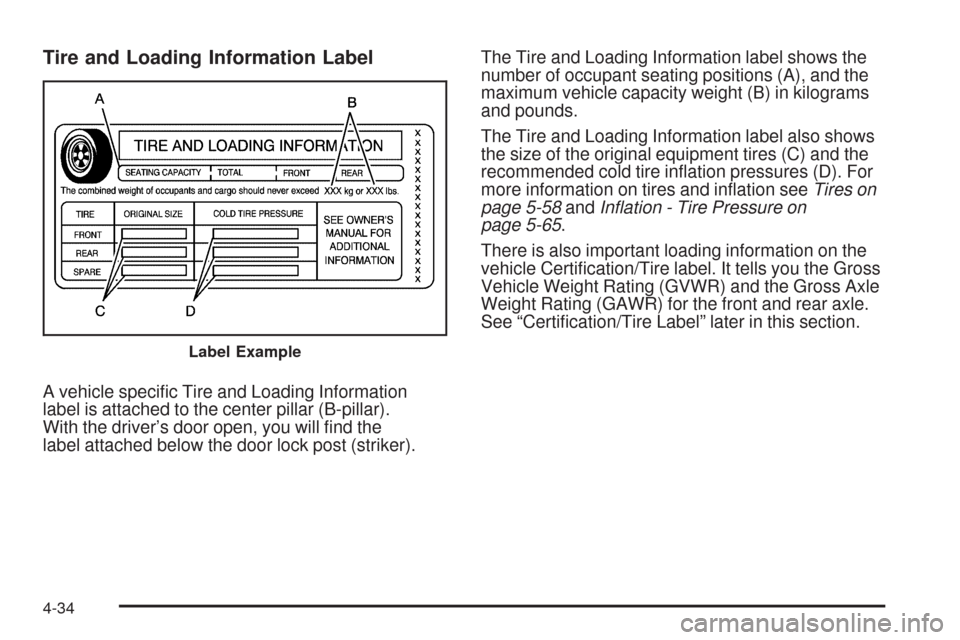
Tire and Loading Information Label
A vehicle specic Tire and Loading Information
label is attached to the center pillar (B-pillar).
With the driver’s door open, you will nd the
label attached below the door lock post (striker).The Tire and Loading Information label shows the
number of occupant seating positions (A), and the
maximum vehicle capacity weight (B) in kilograms
and pounds.
The Tire and Loading Information label also shows
the size of the original equipment tires (C) and the
recommended cold tire ination pressures (D). For
more information on tires and ination seeTires on
page 5-58andInflation - Tire Pressure on
page 5-65.
There is also important loading information on the
vehicle Certication/Tire label. It tells you the Gross
Vehicle Weight Rating (GVWR) and the Gross Axle
Weight Rating (GAWR) for the front and rear axle.
See “Certication/Tire Label” later in this section.
Label Example
4-34
Page 281 of 484

Steps for Determining Correct Load Limit
1.Locate the statement “The combined weight
of occupants and cargo should never exceed
XXX kg or XXX lbs” on your vehicle’s placard.
2.Determine the combined weight of the driver
and passengers that will be riding in your
vehicle.
3.Subtract the combined weight of the driver
and passengers from XXX kg or XXX lbs.
4.The resulting gure equals the available
amount of cargo and luggage load capacity.
For example, if the “XXX” amount equals
1400 lbs and there will be ve 150 lb
passengers in your vehicle, the amount of
available cargo and luggage load capacity is
650 lbs (1400−750 (5 x 150) = 650 lbs).
5.Determine the combined weight of luggage
and cargo being loaded on the vehicle. That
weight may not safely exceed the available
cargo and luggage load capacity calculated
in Step 4.
6.If your vehicle will be towing a trailer, the load
from your trailer will be transferred to your
vehicle. Consult this manual to determine how
this reduces the available cargo and luggage
load capacity of your vehicle. SeeTowing a
Trailer on page 4-48for important information
on towing a trailer, towing safety rules and
trailering tips.
4-35
Page 283 of 484
Item Description Total
AVehicle Capacity
Weight for
Example 3=1,000 lbs
(453 kg)
BSubtract Occupant
Weight 200 lbs
(91 kg)×5=1,000 lbs
(453 kg)
CAvailable Cargo
Weight=0 lbs (0 kg)Refer to your vehicle’s Tire and Loading
Information label for specic information about
your vehicle’s capacity weight and seating
positions. The combined weight of the driver,
passengers, and cargo should never exceed your
vehicle’s capacity weight.
Your vehicle may have an electronically controlled
air suspension system that automatically keeps
your vehicle level as you load and unload your
vehicle. SeeElectronically Controlled Air
Suspension System on page 4-47for additional
information.
Example 3
4-37
Page 284 of 484

Certication/Tire Label
A vehicle specic Certication/Tire label is found
on the rear edge of the driver’s door. The label
shows the size of your vehicle’s original tires and
the ination pressures needed to obtain the gross
weight capacity of your vehicle. This is called
Gross Vehicle Weight Rating (GVWR). The GVWR
includes the weight of the vehicle, all occupants,
fuel, cargo, and trailer tongue weight, if pulling a
trailer.
The Certication/Tire label also tells you the
maximum weights for the front and rear axles,
called Gross Axle Weight Rating (GAWR).To nd out the actual loads on your front and rear
axles, you need to go to a weigh station and weigh
your vehicle. Your dealer can help you with this.
Be sure to spread out your load equally on both
sides of the centerline.
Never exceed the GVWR for your vehicle, or the
GAWR for either the front or rear axle.
And, if you do have a heavy load, you should
spread it out.
Similar appearing vehicles may have different
GVWRs and capacity weights. Please note your
vehicle’s Certication/Tire label or consult your
dealer for additional details.
{CAUTION:
Do not load the vehicle any heavier than the
Gross Vehicle Weight Rating (GVWR), or
either the maximum front or rear Gross Axle
Weight Rating (GAWR). If you do, parts on the
vehicle can break, and it can change the way
your vehicle handles. These could cause you
to lose control and crash. Also, overloading
can shorten the life of the vehicle.
4-38
Page 297 of 484

Weight of the Trailer Tongue
The tongue load (A) of any trailer is an important weight
to measure because it affects the total gross weight
of the vehicle. The Gross Vehicle Weight (GVW)
includes the curb weight of the vehicle, any cargo
carried in it, and the people who will be riding in the
vehicle. If there are a lot of options, equipment,
passengers or cargo in the vehicle, it will reduce the
tongue weight the vehicle can carry, which will also
reduce the trailer weight the vehicle can tow. If towing
a trailer, the tongue load must be added to the GVW
because the vehicle will be carrying that weight, too.
SeeLoading the Vehicle on page 4-33for more
information about the vehicle’s maximum load capacity.The trailer tongue weight (A) should be 10 percent
to 15 percent of the total loaded trailer weight, up to a
maximum or 400 lbs (181 kg) with a weight carrying
hitch. The trailer tongue weight (A) should be 10 percent
to 15 percent of the total loaded trailer weight, up to a
maximum of 900 lbs (408 kg) with a weight distributing
hitch.
4-51
Page 298 of 484

Do not exceed the maximum allowable tongue weight
for the vehicle. Choose the shortest hitch extension that
will position the hitch ball closest to the vehicle. This
will help reduce the effect of trailer tongue weight on the
rear axle.
After loading the trailer, weigh the trailer and then the
tongue, separately, to see if the weights are proper.
If they are not, adjustments might be made by moving
some items around in the trailer.
Trailering may be limited by the vehicle’s ability to carry
tongue weight. Tongue weight cannot cause the vehicle
to exceed the GVWR (Gross Vehicle Weight Rating) or
the RGAWR (Rear Gross Axle Weight Rating). The effect
of additional weight may reduce your trailering capacity
more than the total of the additional weight.Consider the following example:
A vehicle model base weight is 5,500 lbs (2 495 kg);
2,800 lbs (1 270 kg) at the front axle and 2,700 lbs
(1 225 kg) at the rear axle. It has a GVWR of 7,200 lbs
(3 266 kg), a RGAWR of 4,000 lbs (1 814 kg) and a
GCWR (Gross Combination Weight Rating) of
14,000 lbs (6 350 kg). The trailer rating should be:
Expect tongue weight to be at least 10 percent of trailer
weight (850 lbs (386 kg)) and because the weight is
applied well behind the rear axle, the effect on the rear
axle is greater than just the weight itself, as much as
1.5 times as much. The weight at the rear axle could be
850 lbs (386 kg) X 1.5 = 1,275 lbs (578 kg). Since the
rear axle already weighs 2,700 lbs (1 225 kg), adding
1,275 lbs (578 kg) brings the total to 3,975 lbs (1 803 kg).
This is very close to, but within the limit for RGAWR as
well. The vehicle is set to trailer up to 8,500 lbs
(3 856 kg).
4-52