2009 CHEVROLET TRAIL BLAZER engine
[x] Cancel search: enginePage 152 of 484

Electric Power Management
The vehicle has Electric Power Management (EPM) that
estimates the battery’s temperature and state of charge.
It then adjusts the voltage for best performance and
extended life of the battery.
When the battery’s state of charge is low, the voltage is
raised slightly to quickly bring the charge back up. When
the state of charge is high, the voltage is lowered slightly
to prevent overcharging. If the vehicle has a voltmeter
gage or a voltage display on the Driver Information
Center (DIC), you may see the voltage move up or
down. This is normal. If there is a problem, an alert
will be displayed.
The battery can be discharged at idle if the electrical
loads are very high. This is true for all vehicles. This is
because the generator (alternator) may not be spinning
fast enough at idle to produce all the power that is
needed for very high electrical loads.
A high electrical load occurs when several of the
following are on, such as: headlamps, high beams,
fog lamps, rear window defogger, climate control fan at
high speed, heated seats, engine cooling fans, trailer
loads, and loads plugged into accessory power outlets.
EPM works to prevent excessive discharge of the
battery. It does this by balancing the generator’s output
and the vehicle’s electrical needs. It can increase engineidle speed to generate more power, whenever needed.
It can temporarily reduce the power demands of some
accessories.
Normally, these actions occur in steps or levels, without
being noticeable. In rare cases at the highest levels of
corrective action, this action may be noticeable to the
driver. If so, a Driver Information Center (DIC) message
might be displayed, such as BATTERY SAVER ACTIVE,
BATTERY VOLTAGE LOW, or LOW BATTERY. If this
message is displayed, it is recommended that the driver
reduce the electrical loads as much as possible. SeeDIC
Warnings and Messages on page 3-51.
Battery Run-Down Protection
This feature shuts off the dome, courtesy, and vanity
lamps if they are left on for more than 20 minutes when
the ignition is off. This helps to keep the battery from
running down.
If the battery run-down protection shuts off the interior
lamps, it may be necessary to do one of the following to
return to normal operation:
Shut off all lamps and close all doors.
Turn the ignition key to ON/RUN.
This feature also turns off the parking lamps and
headlamps under most circumstances, if they are left
on. Turn the exterior lamps knob to turn them back on.
3-18
Page 154 of 484

Climate Controls
Dual Climate Control System
With this system the heating, cooling, and ventilation
can be controlled for the vehicle.
A.B. Fan Control
C. Driver and Passenger
Temperature Controls
D. Air Delivery Mode
ControlE. Recirculation
F. Air Conditioning
G. Rear Window
Defogger
Driver’s Side Temperature Lever:Raise or lower
the lever to increase or decrease the temperature
on the driver’s side of the vehicle.Passenger Side Temperature Lever:Raise or lower
the lever to increase or decrease the temperature on
the passenger side of the vehicle. This right lever
also adjusts the temperature to the rear seat outlets.
When the temperature outside is 0°F (-18°C) or lower,
use the engine coolant heater, if the vehicle has one,
to provide warmer air faster to the vehicle.
9(Fan Control):Turn clockwise or counterclockwise
to increase or decrease the fan speed. If the knob is in off
mode, outside air still enters the vehicle, and is directed
based on the position of the air delivery mode knob.
The temperature can still be adjusted using the
temperature knob.
Air Delivery Mode Control:Turn clockwise or
counterclockwise to change the airow direction
inside the vehicle.
To change the current mode, select one of the following:
H(Vent):Air is directed to the instrument panel
outlets.
)(Bi-Level):Air is divided between the instrument
panel and oor outlets. Some air is directed toward the
windshield and the side window outlets. Cooler air is
directed to the upper vents and warmer air to the oor
outlets.
3-20
Page 155 of 484

6(Floor):Air is directed to the oor outlets, with
some air directed to the windshield and the side window
outlets. The recirculation button cannot be selected
while in oor mode.
-(Defog):This mode clears the windows of fog or
moisture. Air is directed to the oor, windshield and
side window outlets. The recirculation button cannot
be selected while in defog mode.
1(Defrost):This mode clears the windows of fog or
frost more quickly. Air is directed to the windshield and
the side window outlets, with some air directed to the
oor outlets. The air conditioning compressor may run
to dehumidify the air to prevent window fogging.
The recirculation button cannot be selected while
in defrost mode.
Do not drive the vehicle until all the windows are clear.
#(Air Conditioning):Press to turn the
air-conditioning system on or off. An indicator light
comes on and the system begins to cool and dehumidify
the air inside of the vehicle. You may notice a slight
change in engine performance when the air conditioning
compressor shuts off and turns on again. This is normal.
@(Recirculation):Press to turn the recirculation
mode on. An indicator light comes to show that the
recirculation is on. This mode recirculates and helps to
quickly cool the air inside the vehicle. It can be used to
help prevent outside air and odors from entering the
vehicle. The air conditioning compressor will also come
on when this mode is activated. While in recirculation
mode, the windows may fog when the weather is cold
and damp. To clear the fog, select either the defog or
defrost mode and increase fan speed.
3-21
Page 157 of 484

Outside Air Temperature Display
A new outside temperature reading is displayed if
the vehicle has been off for more than three hours.
If the vehicle has been off for less than three hours,
the old temperature reading may be displayed because
underhood heat is affecting the true outside temperature.
Underhood heat can also affect the outside temperature
while the engine is running. It may also take several
minutes of driving before the display updates to
the actual outside temperature.
Automatic Operation
AUTO (Automatic):When automatic operation is
active, the system controls the air delivery mode,
fan speed, and temperature inside the vehicle.
Use the steps below to place the entire system in
automatic mode:
1. Press AUTO.
When AUTO is selected, the air conditioning and air
inlet are automatically controlled. The air conditioning
compressor will run continuously when the outside
temperature is over approximately 40°F (4°C).
The air inlet will normally be set to outside air.
If it is hot outside, the air inlet automatically changes
to recirculate inside air to help quickly cool down
the vehicle.2. Set the driver’s and passenger’s temperature.
To nd your comfort setting, start with a 72°F (22°C)
temperature setting and allow about 20 minutes for
the system to adjust. Turn the driver or passenger
side temperature knob to adjust the temperature
setting as necessary. If a temperature setting of
60°F (15°C) is chosen, the system will remain at the
maximum cooling setting. If a temperature setting of
90°F (32°C) is chosen, the system remains at the
maximum heat setting. Choosing either maximum
setting may not cause the vehicle to heat or cool
any faster.Manual Operation
9(Off):Press to turn off the entire climate control
system. Outside air still enters the vehicle, and will be
directed to the oor. The system turns on by pressing
either AUTO, air delivery mode, fan control, or by
adjusting either temperature knob.
Driver’s Side Temperature Knob:Turn clockwise
or counterclockwise to increase or decrease the
temperature on the driver side of the vehicle.
The display will show the temperature setting
decreasing or increasing and an arrow pointing
toward the driver. This knob can also adjust the
passenger side temperature setting if the two
are linked.
3-23
Page 159 of 484

#A/C (Air Conditioning):Press to turn the air
conditioning system on or off. When the system is on,
the system automatically begins to cool and dehumidify
the air inside of the vehicle. The air conditioning symbol
appears on the display when the air conditioning is on
and turns off when the air conditioning is off.
If the air conditioning is turned off while in front defrost
or defog mode, the air conditioning symbol turns off,
however, the A/C compressor remains on to help
de-humidify the air inside the vehicle. If one of the
other modes is selected, the compressor will then
turn the A/C off until it is selected again or the AUTO
button is pressed.
To avoid fogging the inside glass on rainy and humid
days at a temperature above freezing, press the air
conditioning button to run the A/C compressor. Also it is
best to avoid the use of the recirculation mode except
when maximum air conditioning performance is needed
or for short times to avoid exterior odors.
You may notice a slight change in engine performance
when the air-conditioning compressor shuts off and turns
on again. This is normal.@(Recirculation):Press to turn the recirculation
mode on or off. An indicator light comes on to show
that recirculation is on. This mode recirculates and
helps to quickly cool the air inside the vehicle. It can
be used to help prevent outside air and odors from
entering the vehicle. Recirculation mode can be used
with vent and bi-level modes, but it cannot be used
with oor, defog or defrost modes.
If recirculation mode is selected with oor, defog,
or defrost modes, the indicator ashes three times
and turns off to indicate the selection is not available.
The air conditioning compressor may also run while
in recirculation mode. This is normal and helps to
prevent window fogging.
If the weather is cold and damp, the system may cause
the windows to fog while using recirculation mode.
If the windows do start to fog, select defog or defrost
mode and increase fan speed.
Recirculation mode, if selected, will be cleared when the
engine is turned off.
3-25
Page 162 of 484

If the vehicle has the rear seat audio system, the lower
buttons are used to adjust the rear seat climate control
system. The temperature of the air coming through the
rear outlets is determined by the front passenger
temperature setting.
P(On/Off):Press to turn the rear climate controls on
or off.
z9y(Fan Control):Press to increase or decrease
the fan speed.
z\y(Air Delivery Mode Control):Press to
change the direction of airow (panel, bi-level or oor)
to the rear seat area.
The rear control only turns on if the front climate control
system is on and not in defrost mode.
Warning Lights, Gages, and
Indicators
Warning lights and gages can signal that something is
wrong before it becomes serious enough to cause an
expensive repair or replacement. Paying attention to
the warning lights and gages could prevent injury.
Warning lights come on when there may be or is a
problem with one of the vehicle’s functions. Some
warning lights come on briey when the engine is
started to indicate they are working.
Gages can indicate when there may be or is a problem
with one of the vehicle’s functions. Often gages and
warning lights work together to indicate a problem with
the vehicle.
When one of the warning lights comes on and stays on
while driving, or when one of the gages shows there
may be a problem, check the section that explains
what to do. Follow this manual’s advice. Waiting to
do repairs can be costly and even dangerous.
3-28
Page 164 of 484
Speedometer and Odometer
The speedometer the vehicle speed in both miles per
hour (mph) and kilometers per hour (km/h).
The odometer shows how far the vehicle has been
driven, in either miles (used in the United States)
or kilometers (used in Canada).
The odometer mileage can be checked without the
vehicle running. Press the trip stem located on
the instrument panel cluster.
If the vehicle needs a new odometer installed, the new
one will be set to the correct mileage total of the old
odometer.
Trip Odometer
The trip odometer can tell you how far your vehicle has
been driven since you last set the trip odometer to zero.
The odometer works together with the Driver Information
Center (DIC). You can set a Trip A and Trip B odometer.
See “Trip Information” underDIC Operation and Displays
on page 3-48.
The odometer mileage can be checked without the
vehicle running. Press the trip stem on the instrument
panel cluster.
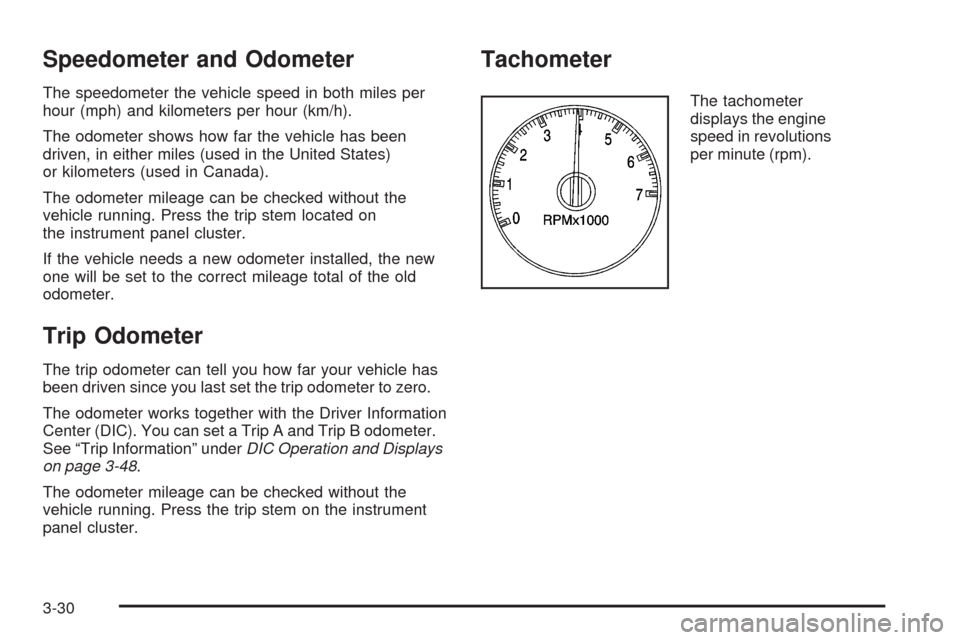
Tachometer
The tachometer
displays the engine
speed in revolutions
per minute (rpm).
3-30
Page 165 of 484
Safety Belt Reminders
Safety Belt Reminder Light
When the engine is started, a chime sounds for several
seconds to remind a driver to fasten the safety belt,
unless the driver safety belt is already buckled.
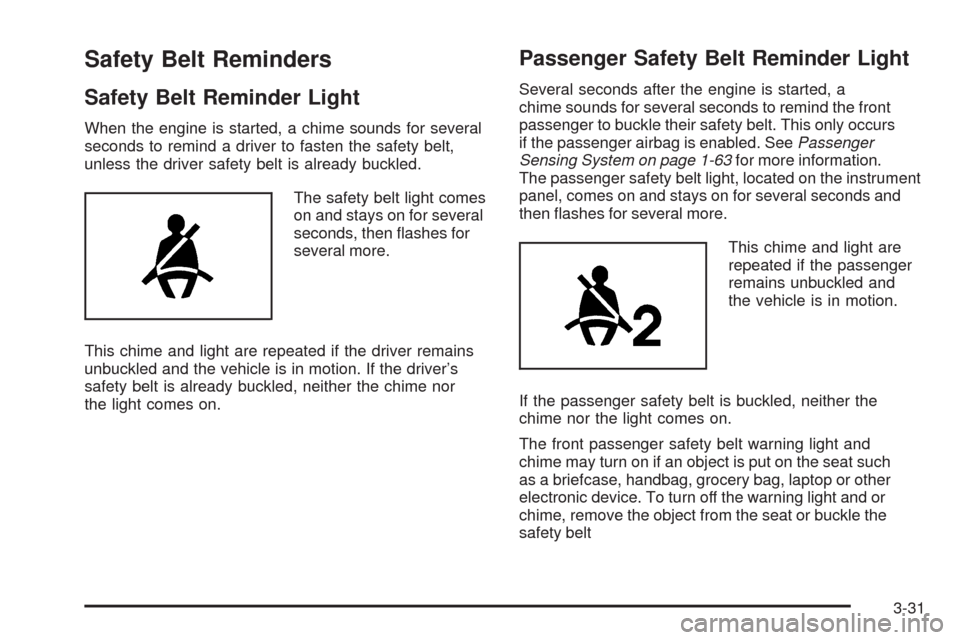
The safety belt light comes
on and stays on for several
seconds, then ashes for
several more.
This chime and light are repeated if the driver remains
unbuckled and the vehicle is in motion. If the driver’s
safety belt is already buckled, neither the chime nor
the light comes on.
Passenger Safety Belt Reminder Light
Several seconds after the engine is started, a
chime sounds for several seconds to remind the front
passenger to buckle their safety belt. This only occurs
if the passenger airbag is enabled. SeePassenger
Sensing System on page 1-63for more information.
The passenger safety belt light, located on the instrument
panel, comes on and stays on for several seconds and
then ashes for several more.
This chime and light are
repeated if the passenger
remains unbuckled and
the vehicle is in motion.
If the passenger safety belt is buckled, neither the
chime nor the light comes on.
The front passenger safety belt warning light and
chime may turn on if an object is put on the seat such
as a briefcase, handbag, grocery bag, laptop or other
electronic device. To turn off the warning light and or
chime, remove the object from the seat or buckle the
safety belt
3-31