Page 477 of 574
Make certain that all wheel nuts are properly
tightened. See “Wheel Nut Torque” under
Capacities and Specifications on page 5-121.
{CAUTION:
Rust or dirt on a wheel, or on the parts to
which it is fastened, can make wheel nuts
become loose after time. The wheel could
come off and cause an accident. When you
change a wheel, remove any rust or dirt from
places where the wheel attaches to the
vehicle. In an emergency, you can use a
cloth or a paper towel to do this; but be sure
to use a scraper or wire brush later, if
needed, to get all the rust or dirt off. See
Changing a Flat Tire on page 5-86.
Make sure the spare tire is stored securely. Push,
pull, and then try to rotate or turn the tire. If it
moves, tighten the cable. SeeStoring a Flat or
Spare Tire and Tools on page 5-101.
When It Is Time for New Tires
Various factors, such as maintenance, temperatures,
driving speeds, vehicle loading, and road conditions,
inuence when you need new tires.
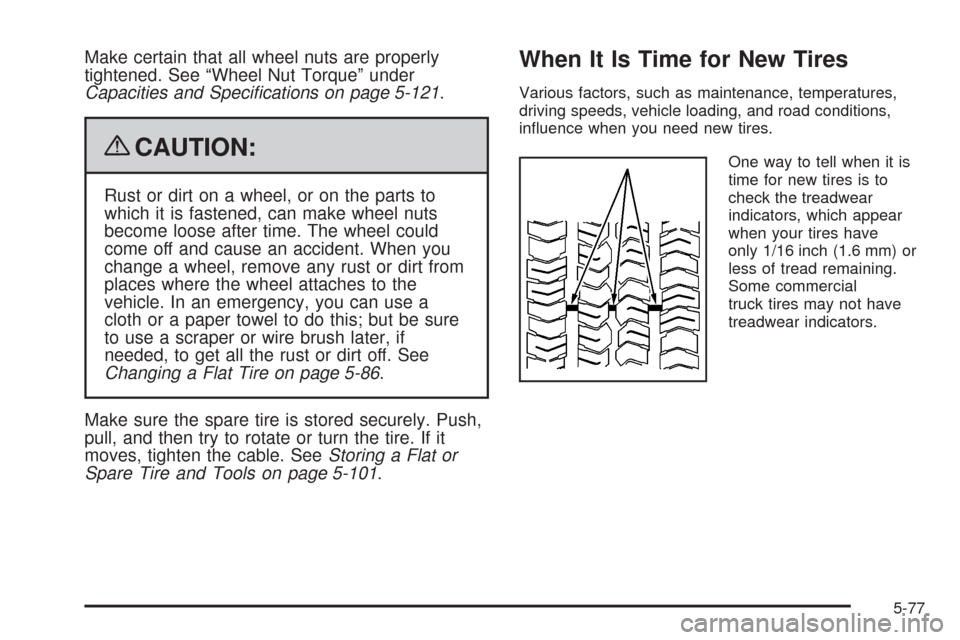
One way to tell when it is
time for new tires is to
check the treadwear
indicators, which appear
when your tires have
only 1/16 inch (1.6 mm) or
less of tread remaining.
Some commercial
truck tires may not have
treadwear indicators.
5-77
Page 485 of 574
If a Tire Goes Flat
It is unusual for a tire to blowout while you are driving,
especially if you maintain your vehicle’s tires properly.
If air goes out of a tire, it is much more likely to leak out
slowly. But if you should ever have a blowout, here
are a few tips about what to expect and what to do:
If a front tire fails, the at tire creates a drag that pulls
the vehicle toward that side. Take your foot off the
accelerator pedal and grip the steering wheel rmly.
Steer to maintain lane position, and then gently brake to
a stop well out of the traffic lane.
A rear blowout, particularly on a curve, acts much like a
skid and may require the same correction you would
use in a skid. In any rear blowout remove your foot from
the accelerator pedal. Get the vehicle under control
by steering the way you want the vehicle to go. It may
be very bumpy and noisy, but you can still steer.
Gently brake to a stop, well off the road if possible.{CAUTION:
Lifting a vehicle and getting under it to do
maintenance or repairs is dangerous without the
appropriate safety equipment and training. If a jack
is provided with the vehicle, it is designed only for
changing a at tire. If it is used for anything else,
you or others could be badly injured or killed if the
vehicle slips off the jack. If a jack is provided with
the vehicle, only use it for changing a at tire.
If a tire goes at, the next part shows how to use the
jacking equipment to change a at tire safely.
5-85
Page 486 of 574
Changing a Flat Tire
If your vehicle is a Two-mode Hybrid, see the Two-mode
Hybrid manual for more information.
If a tire goes at, avoid further tire and wheel damage
by driving slowly to a level place. Turn on the hazard
warning ashers. SeeHazard Warning Flashers on
page 3-6.
{CAUTION:
Changing a tire can be dangerous. The vehicle
can slip off the jack and roll over or fall on you or
other people. You and they could be badly injured
or even killed. Find a level place to change your
tire. To help prevent the vehicle from moving:
1. Set the parking brake rmly.
2. Put the shift lever in P (Park).
3. If you have a four-wheel-drive vehicle,
be sure the transfer case is in a drive
gear — not in Neutral.
CAUTION: (Continued)
CAUTION: (Continued)
4. Turn off the engine and do not restart while
the vehicle is raised.
5. Do not allow passengers to remain in the
vehicle.
6. Put the wheel blocks at the front and rear of
the tire farthest away from the one being
changed. That would be the tire on the other
side, at the opposite end of the vehicle.
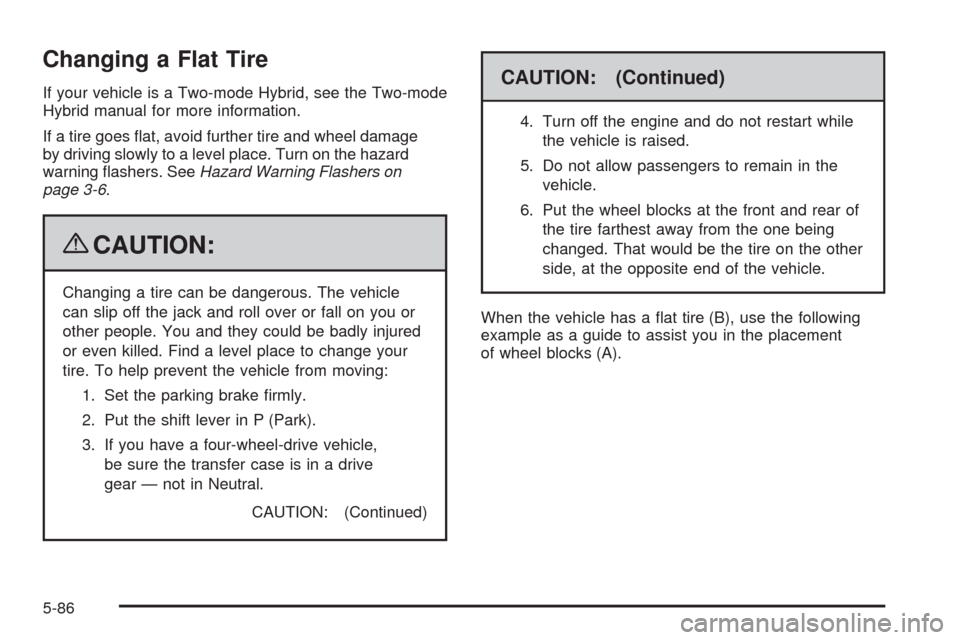
When the vehicle has a at tire (B), use the following
example as a guide to assist you in the placement
of wheel blocks (A).
5-86
Page 487 of 574
A. Wheel Block
B. Flat Tire
The following information explains how to use the jack
and change a tire.
Removing the Spare Tire and Tools
The equipment you will need to change a at tire is
stored under the storage tray, which is located on the
driver side trim panel (over the rear wheelhouse).
1. Remove the tray to access the tools by pulling up
on the nger depression under the jack symbol.
Regular Wheelbase shown, Extended Wheelbase
similar
5-87
Page 522 of 574
ApplicationCapacities
English Metric
Transfer Case Fluid 1.6 qt 1.5 L
Wheel Nut Torque 140 lb ft 190Y
†Oil lter should be changed at every oil change.
All capacities are approximate. When adding, be sure to ll to the approximate level, as recommended in this
manual. Recheck uid level after lling.
Engine Specications
Engine VIN Code Transmission Spark Plug Gap
4.8L V8 C Automatic 0.040 in (1.01 mm)
5.3L V8 Flexible Fuel with
Active Fuel Management™
(Iron Block)0 Automatic 0.040 in (1.01 mm)
5.3L V8 Flexible Fuel with
Active Fuel Management™
(Aluminum Block)3 Automatic 0.040 in (1.01 mm)
5.3L V8 with Active Fuel
Management™ (Iron Block)J Automatic 0.040 in (1.01 mm)
6.0L V8 (Iron Block) K Automatic 0.040 in (1.01 mm)
6.0L V8 with Active
Fuel Management™
(Aluminum Block)Y Automatic 0.040 in (1.01 mm)
6.2L V8 Flexible Fuel
(Aluminum Block)2 Automatic 0.040 in (1.01 mm)
5-122
Page 528 of 574
Additional Required Services
The following services should be performed at the rst maintenance service (IorII) after the indicated
miles (kilometers) shown for each item.
Additional Required Services
Service and Miles (Kilometers)25,000
(40 000)50,000
(80 000)75,000
(120 000)100,000
(160 000)125,000
(200 000)150,000
(240 000)
Inspect fuel system for damage or leaks.• •••••
Inspect exhaust system for loose or
damaged components.• •••••
Vehicles without a lter restriction
indicator: Replace engine air cleaner
lter. SeeEngine Air Cleaner/Filter on
page 5-20.•••
Change automatic transmission uid and
lter (severe service).See footnote (h).•••
Change automatic transmission uid and
lter (normal service).•
Four-wheel drive: Change transfer case
uid (severe service).See footnotes (g)
and (n).•••
6-6
Page 529 of 574
Additional Required Services (cont’d)
Service and Miles (Kilometers)25,000
(40 000)50,000
(80 000)75,000
(120 000)100,000
(160 000)125,000
(200 000)150,000
(240 000)
Four-wheel drive: Change transfer case
uid (normal service).See footnote (g).•
Inspect evaporative control system.
An Emission Control Service.
See footnotes † and (k).•••
Replace spark plugs and inspect spark
plug wires.An Emission Control
Service.•
Engine cooling system service (or every
ve years, whichever occurs rst).
An Emission Control Service.
See footnote (i).•
Inspect engine accessory drive belt.
An Emission Control Service.
See footnote (m).•
6-7
Page 572 of 574

Service, Scheduling Appointments.....................7-10
Servicing Your Airbag-Equipped Vehicle..............1-96
Setting the Clock............................................3-83
Sheet Metal Damage.....................................5-112
Shifting Into Park............................................2-47
Shifting Out of Park........................................2-49
Side Blind Zone Alert......................................2-58
Signals, Turn and Lane-Change.......................... 3-7
Snow Plow....................................................4-39
Spare Tire....................................................5-105
Installing....................................................5-92
Removing...................................................5-87
Storing.....................................................5-101
Specications, Capacities...............................5-121
Speedometer..................................................3-36
Split Bench Seat (60/40)..................................1-14
StabiliTrak
®Indicator Light...............................3-42
StabiliTrak®System.......................................... 4-6
Start Vehicle, Remote....................................... 2-7
Starting the Engine.........................................2-28
Steering.......................................................... 4-9
Steering Wheel Controls, Audio.......................3-137
Steering Wheel, Tilt Wheel................................. 3-6
Steps
Power Assist...............................................2-18
Storage Areas
Center Console Storage Area........................2-78
Cupholders.................................................2-78
Glove Box..................................................2-78Storage Areas (cont.)
Luggage Carrier..........................................2-79
Rear Seat Armrest.......................................2-80
Rear Storage Area.......................................2-79
Stuck in Sand, Mud, Ice, or Snow.....................4-31
Sun Visors.....................................................2-21
Sunroof.........................................................2-81
T
Tachometer....................................................3-36
Taillamps
Turn Signal, Stoplamps and Back-up Lamps....5-58
Theft-Deterrent, Radio....................................3-137
Theft-Deterrent Systems...................................2-22
Content Theft-Deterrent................................2-22
PASS-Key
®III+ Electronic Immobilizer............2-24
PASS-Key®III+ Electronic Immobilizer
Operation................................................2-24
Third Row Seat..............................................1-27
Tilt Wheel........................................................ 3-6
Time, Setting..................................................3-83
Tire
Pressure Light.............................................3-43
Tires.............................................................5-62
Aluminum or Chrome-Plated Wheels,
Cleaning...............................................5-111
Buying New Tires........................................5-78
Chains.......................................................5-84
12


