Page 376 of 600
Dolly Towing
Front Towing (Front Wheels Off the
Ground)
Two-Wheel-Drive Vehicles
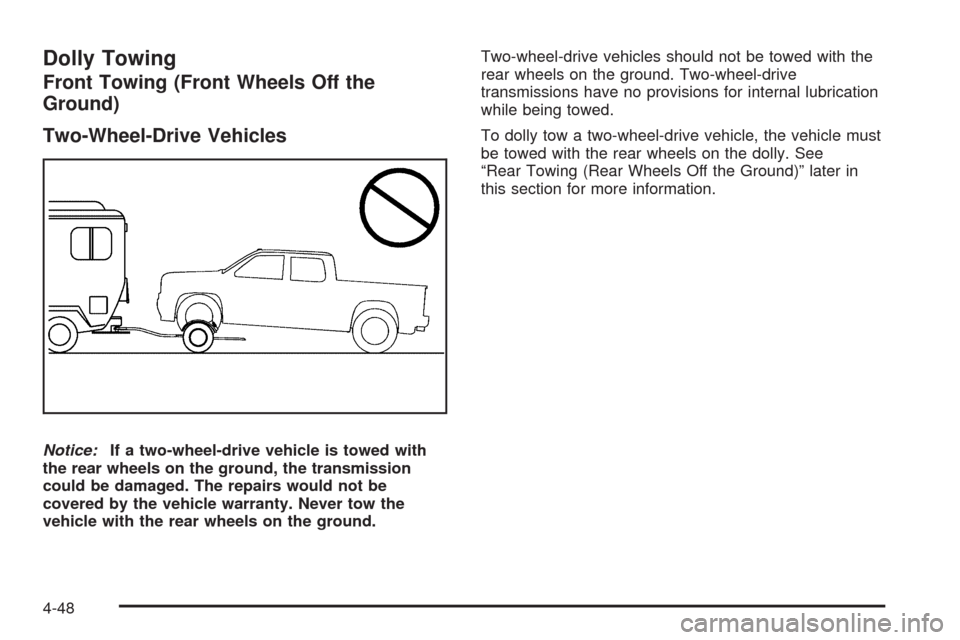
Notice:If a two-wheel-drive vehicle is towed with
the rear wheels on the ground, the transmission
could be damaged. The repairs would not be
covered by the vehicle warranty. Never tow the
vehicle with the rear wheels on the ground.Two-wheel-drive vehicles should not be towed with the
rear wheels on the ground. Two-wheel-drive
transmissions have no provisions for internal lubrication
while being towed.
To dolly tow a two-wheel-drive vehicle, the vehicle must
be towed with the rear wheels on the dolly. See
“Rear Towing (Rear Wheels Off the Ground)” later in
this section for more information.
4-48
Page 377 of 600
Four-Wheel-Drive Vehicles
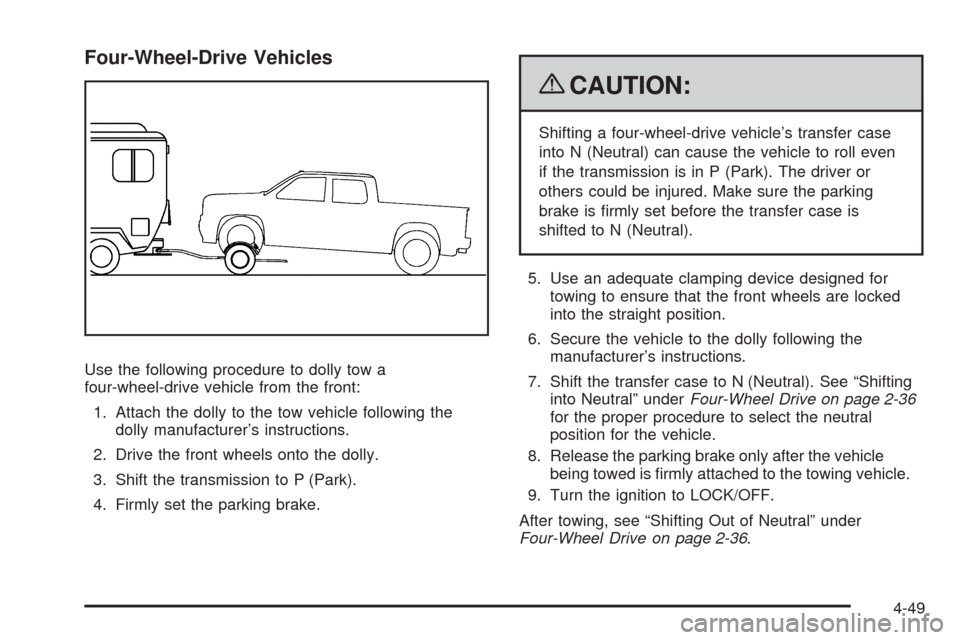
Use the following procedure to dolly tow a
four-wheel-drive vehicle from the front:
1. Attach the dolly to the tow vehicle following the
dolly manufacturer’s instructions.
2. Drive the front wheels onto the dolly.
3. Shift the transmission to P (Park).
4. Firmly set the parking brake.
{CAUTION:
Shifting a four-wheel-drive vehicle’s transfer case
into N (Neutral) can cause the vehicle to roll even
if the transmission is in P (Park). The driver or
others could be injured. Make sure the parking
brake is rmly set before the transfer case is
shifted to N (Neutral).
5. Use an adequate clamping device designed for
towing to ensure that the front wheels are locked
into the straight position.
6. Secure the vehicle to the dolly following the
manufacturer’s instructions.
7. Shift the transfer case to N (Neutral). See “Shifting
into Neutral” underFour-Wheel Drive on page 2-36
for the proper procedure to select the neutral
position for the vehicle.
8. Release the parking brake only after the vehicle
being towed is rmly attached to the towing vehicle.
9. Turn the ignition to LOCK/OFF.
After towing, see “Shifting Out of Neutral” under
Four-Wheel Drive on page 2-36.
4-49
Page 378 of 600
Rear Towing (Rear Wheels Off the
Ground)
Two-Wheel-Drive Vehicles
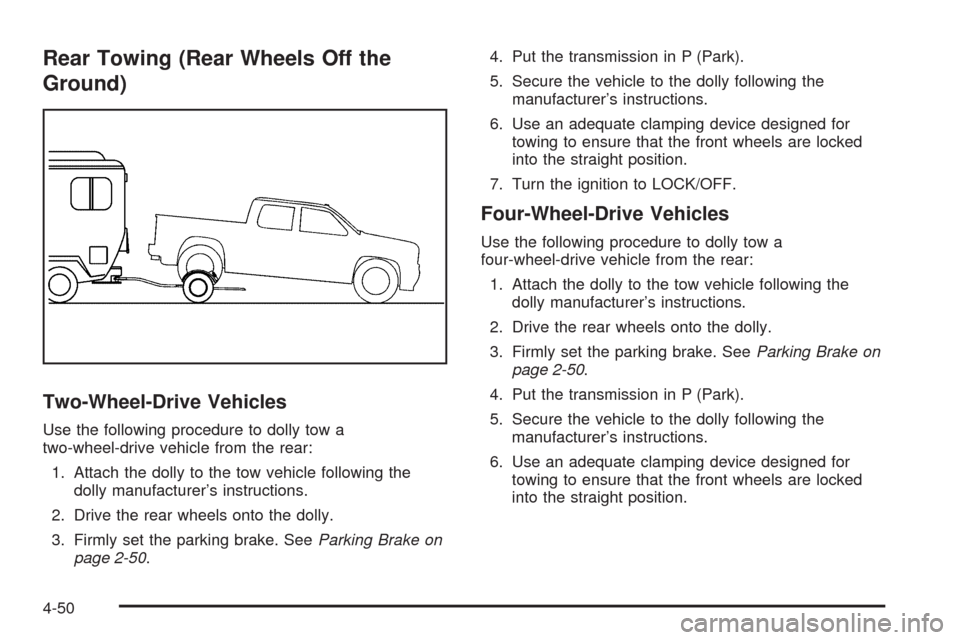
Use the following procedure to dolly tow a
two-wheel-drive vehicle from the rear:
1. Attach the dolly to the tow vehicle following the
dolly manufacturer’s instructions.
2. Drive the rear wheels onto the dolly.
3. Firmly set the parking brake. SeeParking Brake on
page 2-50.4. Put the transmission in P (Park).
5. Secure the vehicle to the dolly following the
manufacturer’s instructions.
6. Use an adequate clamping device designed for
towing to ensure that the front wheels are locked
into the straight position.
7. Turn the ignition to LOCK/OFF.
Four-Wheel-Drive Vehicles
Use the following procedure to dolly tow a
four-wheel-drive vehicle from the rear:
1. Attach the dolly to the tow vehicle following the
dolly manufacturer’s instructions.
2. Drive the rear wheels onto the dolly.
3. Firmly set the parking brake. SeeParking Brake on
page 2-50.
4. Put the transmission in P (Park).
5. Secure the vehicle to the dolly following the
manufacturer’s instructions.
6. Use an adequate clamping device designed for
towing to ensure that the front wheels are locked
into the straight position.
4-50
Page 379 of 600
{CAUTION:
Shifting a four-wheel-drive vehicle’s transfer case
into N (Neutral) can cause the vehicle to roll even
if the transmission is in P (Park). The driver or
others could be injured. Make sure the parking
brake is rmly set before the transfer case is
shifted to N (Neutral).
7. Shift the transfer case to N (Neutral). See “Shifting
into Neutral” underFour-Wheel Drive on page 2-36
for the proper procedure to select the neutral
position for the vehicle.
8. Turn the ignition to LOCK/OFF.
After towing, see “Shifting Out of Neutral” under
Four-Wheel Drive on page 2-36.
Towing a Trailer
If the vehicle has a diesel engine, see the DURAMAX®
Diesel manual for more information.
Do not tow a trailer during break-in. SeeNew Vehicle
Break-In on page 2-21for more information.
{CAUTION:
The driver can lose control when pulling a trailer if
the correct equipment is not used or the vehicle is
not driven properly. For example, if the trailer is
too heavy, the brakes may not work well or even
at all. The driver and passengers could be
seriously injured. The vehicle may also be
damaged; the resulting repairs would not be
covered by the vehicle warranty. Pull a trailer only
if all the steps in this section have been followed.
Ask your dealer/retailer for advice and information
about towing a trailer with the vehicle.
Notice:Pulling a trailer improperly can damage the
vehicle and result in costly repairs not covered
by the vehicle warranty. To pull a trailer correctly,
follow the advice in this section and see your
dealer/retailer for important information about
towing a trailer with the vehicle.
To identify the trailering capacity of the vehicle, read the
information in “Weight of the Trailer” that appears
later in this section.
4-51
Page 381 of 600
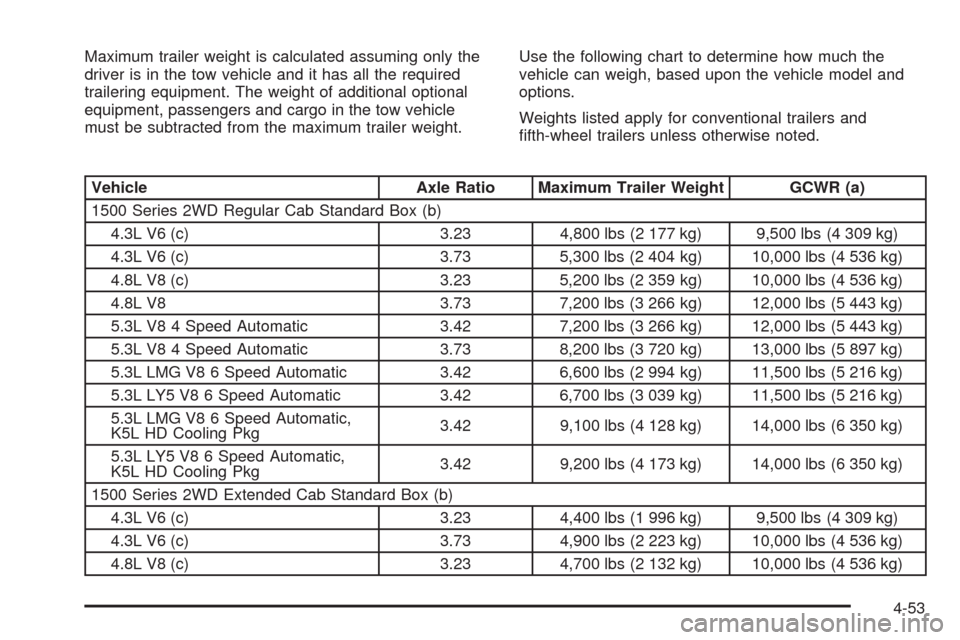
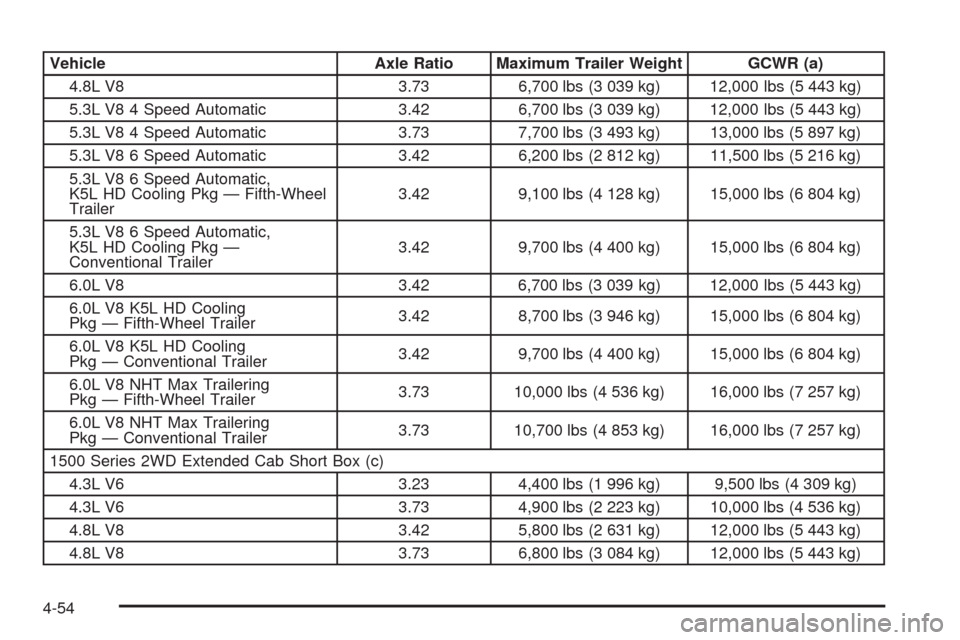
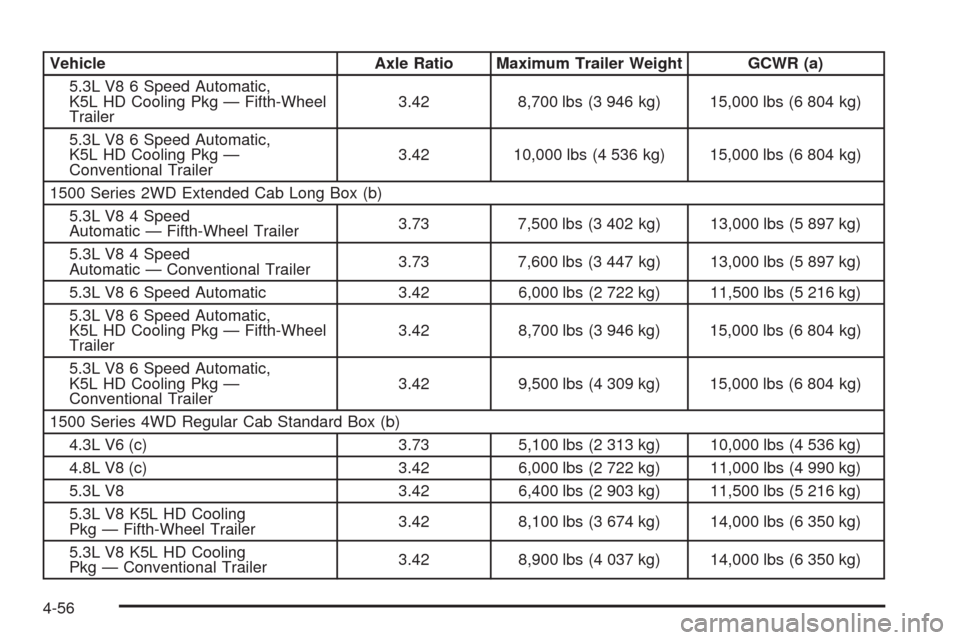
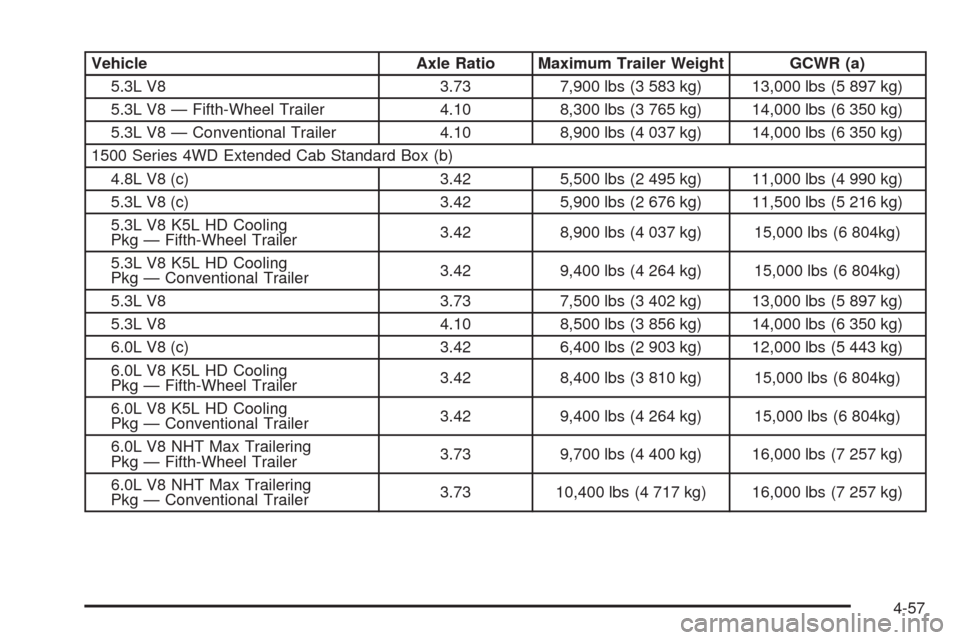
Maximum trailer weight is calculated assuming only the
driver is in the tow vehicle and it has all the required
trailering equipment. The weight of additional optional
equipment, passengers and cargo in the tow vehicle
must be subtracted from the maximum trailer weight.Use the following chart to determine how much the
vehicle can weigh, based upon the vehicle model and
options.
Weights listed apply for conventional trailers and
fth-wheel trailers unless otherwise noted.
Vehicle Axle Ratio Maximum Trailer Weight GCWR (a)
1500 Series 2WD Regular Cab Standard Box (b)
4.3L V6 (c) 3.23 4,800 lbs (2 177 kg) 9,500 lbs (4 309 kg)
4.3L V6 (c) 3.73 5,300 lbs (2 404 kg) 10,000 lbs (4 536 kg)
4.8L V8 (c) 3.23 5,200 lbs (2 359 kg) 10,000 lbs (4 536 kg)
4.8L V8 3.73 7,200 lbs (3 266 kg) 12,000 lbs (5 443 kg)
5.3L V8 4 Speed Automatic 3.42 7,200 lbs (3 266 kg) 12,000 lbs (5 443 kg)
5.3L V8 4 Speed Automatic 3.73 8,200 lbs (3 720 kg) 13,000 lbs (5 897 kg)
5.3L LMG V8 6 Speed Automatic 3.42 6,600 lbs (2 994 kg) 11,500 lbs (5 216 kg)
5.3L LY5 V8 6 Speed Automatic 3.42 6,700 lbs (3 039 kg) 11,500 lbs (5 216 kg)
5.3L LMG V8 6 Speed Automatic,
K5L HD Cooling Pkg3.42 9,100 lbs (4 128 kg) 14,000 lbs (6 350 kg)
5.3L LY5 V8 6 Speed Automatic,
K5L HD Cooling Pkg3.42 9,200 lbs (4 173 kg) 14,000 lbs (6 350 kg)
1500 Series 2WD Extended Cab Standard Box (b)
4.3L V6 (c) 3.23 4,400 lbs (1 996 kg) 9,500 lbs (4 309 kg)
4.3L V6 (c) 3.73 4,900 lbs (2 223 kg) 10,000 lbs (4 536 kg)
4.8L V8 (c) 3.23 4,700 lbs (2 132 kg) 10,000 lbs (4 536 kg)
4-53
Page 382 of 600
Vehicle Axle Ratio Maximum Trailer Weight GCWR (a)
4.8L V8 3.73 6,700 lbs (3 039 kg) 12,000 lbs (5 443 kg)
5.3L V8 4 Speed Automatic 3.42 6,700 lbs (3 039 kg) 12,000 lbs (5 443 kg)
5.3L V8 4 Speed Automatic 3.73 7,700 lbs (3 493 kg) 13,000 lbs (5 897 kg)
5.3L V8 6 Speed Automatic 3.42 6,200 lbs (2 812 kg) 11,500 lbs (5 216 kg)
5.3L V8 6 Speed Automatic,
K5L HD Cooling Pkg — Fifth-Wheel
Trailer3.42 9,100 lbs (4 128 kg) 15,000 lbs (6 804 kg)
5.3L V8 6 Speed Automatic,
K5L HD Cooling Pkg —
Conventional Trailer3.42 9,700 lbs (4 400 kg) 15,000 lbs (6 804 kg)
6.0L V8 3.42 6,700 lbs (3 039 kg) 12,000 lbs (5 443 kg)
6.0L V8 K5L HD Cooling
Pkg — Fifth-Wheel Trailer3.42 8,700 lbs (3 946 kg) 15,000 lbs (6 804 kg)
6.0L V8 K5L HD Cooling
Pkg — Conventional Trailer3.42 9,700 lbs (4 400 kg) 15,000 lbs (6 804 kg)
6.0L V8 NHT Max Trailering
Pkg — Fifth-Wheel Trailer3.73 10,000 lbs (4 536 kg) 16,000 lbs (7 257 kg)
6.0L V8 NHT Max Trailering
Pkg — Conventional Trailer3.73 10,700 lbs (4 853 kg) 16,000 lbs (7 257 kg)
1500 Series 2WD Extended Cab Short Box (c)
4.3L V6 3.23 4,400 lbs (1 996 kg) 9,500 lbs (4 309 kg)
4.3L V6 3.73 4,900 lbs (2 223 kg) 10,000 lbs (4 536 kg)
4.8L V8 3.42 5,800 lbs (2 631 kg) 12,000 lbs (5 443 kg)
4.8L V8 3.73 6,800 lbs (3 084 kg) 12,000 lbs (5 443 kg)
4-54
Page 384 of 600
Vehicle Axle Ratio Maximum Trailer Weight GCWR (a)
5.3L V8 6 Speed Automatic,
K5L HD Cooling Pkg — Fifth-Wheel
Trailer3.42 8,700 lbs (3 946 kg) 15,000 lbs (6 804 kg)
5.3L V8 6 Speed Automatic,
K5L HD Cooling Pkg —
Conventional Trailer3.42 10,000 lbs (4 536 kg) 15,000 lbs (6 804 kg)
1500 Series 2WD Extended Cab Long Box (b)
5.3L V8 4 Speed
Automatic — Fifth-Wheel Trailer3.73 7,500 lbs (3 402 kg) 13,000 lbs (5 897 kg)
5.3L V8 4 Speed
Automatic — Conventional Trailer3.73 7,600 lbs (3 447 kg) 13,000 lbs (5 897 kg)
5.3L V8 6 Speed Automatic 3.42 6,000 lbs (2 722 kg) 11,500 lbs (5 216 kg)
5.3L V8 6 Speed Automatic,
K5L HD Cooling Pkg — Fifth-Wheel
Trailer3.42 8,700 lbs (3 946 kg) 15,000 lbs (6 804 kg)
5.3L V8 6 Speed Automatic,
K5L HD Cooling Pkg —
Conventional Trailer3.42 9,500 lbs (4 309 kg) 15,000 lbs (6 804 kg)
1500 Series 4WD Regular Cab Standard Box (b)
4.3L V6 (c) 3.73 5,100 lbs (2 313 kg) 10,000 lbs (4 536 kg)
4.8L V8 (c) 3.42 6,000 lbs (2 722 kg) 11,000 lbs (4 990 kg)
5.3L V8 3.42 6,400 lbs (2 903 kg) 11,500 lbs (5 216 kg)
5.3L V8 K5L HD Cooling
Pkg — Fifth-Wheel Trailer3.42 8,100 lbs (3 674 kg) 14,000 lbs (6 350 kg)
5.3L V8 K5L HD Cooling
Pkg — Conventional Trailer3.42 8,900 lbs (4 037 kg) 14,000 lbs (6 350 kg)
4-56
Page 385 of 600
Vehicle Axle Ratio Maximum Trailer Weight GCWR (a)
5.3L V8 3.73 7,900 lbs (3 583 kg) 13,000 lbs (5 897 kg)
5.3L V8 — Fifth-Wheel Trailer 4.10 8,300 lbs (3 765 kg) 14,000 lbs (6 350 kg)
5.3L V8 — Conventional Trailer 4.10 8,900 lbs (4 037 kg) 14,000 lbs (6 350 kg)
1500 Series 4WD Extended Cab Standard Box (b)
4.8L V8 (c) 3.42 5,500 lbs (2 495 kg) 11,000 lbs (4 990 kg)
5.3L V8 (c) 3.42 5,900 lbs (2 676 kg) 11,500 lbs (5 216 kg)
5.3L V8 K5L HD Cooling
Pkg — Fifth-Wheel Trailer3.42 8,900 lbs (4 037 kg) 15,000 lbs (6 804kg)
5.3L V8 K5L HD Cooling
Pkg — Conventional Trailer3.42 9,400 lbs (4 264 kg) 15,000 lbs (6 804kg)
5.3L V8 3.73 7,500 lbs (3 402 kg) 13,000 lbs (5 897 kg)
5.3L V8 4.10 8,500 lbs (3 856 kg) 14,000 lbs (6 350 kg)
6.0L V8 (c) 3.42 6,400 lbs (2 903 kg) 12,000 lbs (5 443 kg)
6.0L V8 K5L HD Cooling
Pkg — Fifth-Wheel Trailer3.42 8,400 lbs (3 810 kg) 15,000 lbs (6 804kg)
6.0L V8 K5L HD Cooling
Pkg — Conventional Trailer3.42 9,400 lbs (4 264 kg) 15,000 lbs (6 804kg)
6.0L V8 NHT Max Trailering
Pkg — Fifth-Wheel Trailer3.73 9,700 lbs (4 400 kg) 16,000 lbs (7 257 kg)
6.0L V8 NHT Max Trailering
Pkg — Conventional Trailer3.73 10,400 lbs (4 717 kg) 16,000 lbs (7 257 kg)
4-57