Page 106 of 420
I (Intermediate):This position is also used for normal
driving. However, it reduces vehicle speed without using
the brakes for slight downgrades where the vehicle
would otherwise accelerate. If constant upshifting or
downshifting occurs while driving up steep hills, this
position can be used to prevent repetitive types of shifts.
You might choose I (Intermediate) instead of D (Drive)
when driving on hilly, winding roads and when towing a
trailer, so that there is less shifting between gears.
L (Low):This position gives you access to 4 (Fourth),
3 (Third), 2 (Second) and 1 (First) gear ranges.
This provides more engine braking but lower fuel
economy than D (Drive). You can use it on very steep
hills, or in deep snow or mud. If the electronic range
select is put in L (Low), the transmission will not shift
into lower gears until the vehicle is going slow enough.Automatic Transmission Operation
(Six Speed Transmission)
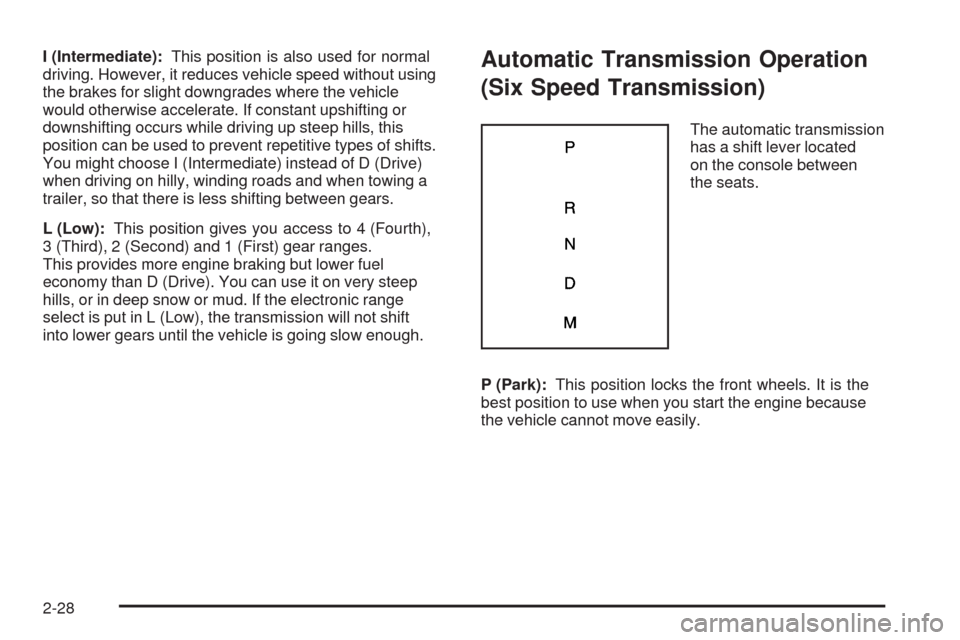
The automatic transmission
has a shift lever located
on the console between
the seats.
P (Park):This position locks the front wheels. It is the
best position to use when you start the engine because
the vehicle cannot move easily.
2-28
Page 248 of 420
Towing
Towing Your Vehicle
To avoid damage, the disabled vehicle should be towed
with all four wheels off the ground. Consult your
dealer/retailer or a professional towing service if the
disabled vehicle must be towed. SeeRoadside
Assistance Program on page 7-7.
To tow the vehicle behind another vehicle for
recreational purposes, such as behind a motorhome,
see “Recreational Vehicle Towing” following.
Recreational Vehicle Towing
Recreational vehicle towing means towing the vehicle
behind another vehicle – such as behind a motorhome.
The two most common types of recreational vehicle
towing are known as dinghy towing and dolly towing.
Dinghy towing is towing the vehicle with all four wheels
on the ground. Dolly towing is towing the vehicle with
two wheels on the ground and two wheels up on a
device known as a dolly.Here are some important things to consider before
recreational vehicle towing:
What’s the towing capacity of the towing vehicle?
Be sure to read the tow vehicle manufacturer’s
recommendations.
How far will the vehicle be towed? Some vehicles
have restrictions on how far and how long they
can tow.
Does the vehicle have the proper towing
equipment? See your dealer/retailer or trailering
professional for additional advice and equipment
recommendations.
Is the vehicle ready to be towed? Just as preparing
the vehicle for a long trip, make sure the vehicle is
prepared to be towed. SeeBefore Leaving on a
Long Trip on page 4-15.
Dinghy Towing
When dinghy towing, the vehicle should be run at the
beginning of each day and at each RV fuel stop for
about ve minutes. This will ensure proper lubrication of
transmission components.
4-26
Page 264 of 420
Gasoline Octane
If the vehicle has the 2.4L L4 engine (VIN Code B),
the 3.5L V6 engine (VIN Code K), or the 3.5L V6 engine
(VIN Code N), use regular unleaded gasoline with a
posted octane rating of 87 or higher. If the octane rating is
less than 87, you might notice an audible knocking noise
when you drive, commonly referred to as spark knock.
If this occurs, use a gasoline rated at 87 octane or higher
as soon as possible. If you are using gasoline rated at
87 octane or higher and you hear heavy knocking, the
engine needs service.
If the vehicle has the 3.6L V6 engine (VIN Code 7),
use regular unleaded gasoline with a posted octane
rating of 87 or higher. For best performance or trailer
towing, you could choose to use middle grade 89 octane
unleaded gasoline. If the octane rating is less than 87,
you might notice an audible knocking noise when you
drive, commonly referred to as spark knock. If this occurs,
use a gasoline rated at 87 octane or higher as soon as
possible. If you are using gasoline rated at 87 octane or
higher and you hear heavy knocking, the engine needs
service.
Gasoline Specications
At a minimum, gasoline should meet ASTM specication
D 4814 in the United States or CAN/CGSB-3.5 or 3.511 in
Canada. Some gasolines contain an octane-enhancing
additive called methylcyclopentadienyl manganese
tricarbonyl (MMT). We recommend against the use of
gasolines containing MMT. SeeAdditives on page 5-7
for additional information.
California Fuel
If the vehicle is certied to meet California Emissions
Standards, it is designed to operate on fuels that meet
California specications. See the underhood emission
control label. If this fuel is not available in states adopting
California emissions standards, the vehicle will operate
satisfactorily on fuels meeting federal specications, but
emission control system performance might be affected.
The malfunction indicator lamp could turn on and the
vehicle might fail a smog-check test. SeeMalfunction
Indicator Lamp on page 3-38. If this occurs, return to your
authorized dealer/retailer for diagnosis. If it is determined
that the condition is caused by the type of fuel used,
repairs might not be covered by the vehicle warranty.
5-6
Page 270 of 420
While refueling, hang the tethered fuel cap from the
hook on the fuel door.
{CAUTION:
Fuel can spray out on you if you open the fuel cap
too quickly. If you spill fuel and then something
ignites it, you could be badly burned. This spray
can happen if the tank is nearly full, and is more
likely in hot weather. Open the fuel cap slowly and
wait for any hiss noise to stop. Then unscrew the
cap all the way.
Be careful not to spill fuel. Do not top off or overll the
tank and wait a few seconds after you have nished
pumping the fuel before removing the nozzle. Clean
fuel from painted surfaces as soon as possible.
SeeWashing Your Vehicle on page 5-93.
When replacing the fuel cap, turn it to the clockwise
until it clicks. Make sure the cap is fully installed.
The diagnostic system can determine if the fuel cap
has been left off or improperly installed. This would allow
fuel to evaporate into the atmosphere. SeeMalfunction
Indicator Lamp on page 3-38.If the vehicle has a Driver Information Center (DIC),
the CHECK GAS CAP message displays if the fuel cap
is not properly installed.
{CAUTION:
If a re starts while you are refueling, do not
remove the nozzle. Shut off the ow of fuel by
shutting off the pump or by notifying the station
attendant. Leave the area immediately.
Notice:If you need a new fuel cap, be sure to get
the right type. Your dealer/ retailer can get one
for you. If you get the wrong type, it might not t
properly. This can cause the malfunction indicator
lamp to light and can damage the fuel tank and
emissions system. SeeMalfunction Indicator Lamp
on page 3-38.
5-12