Page 287 of 420
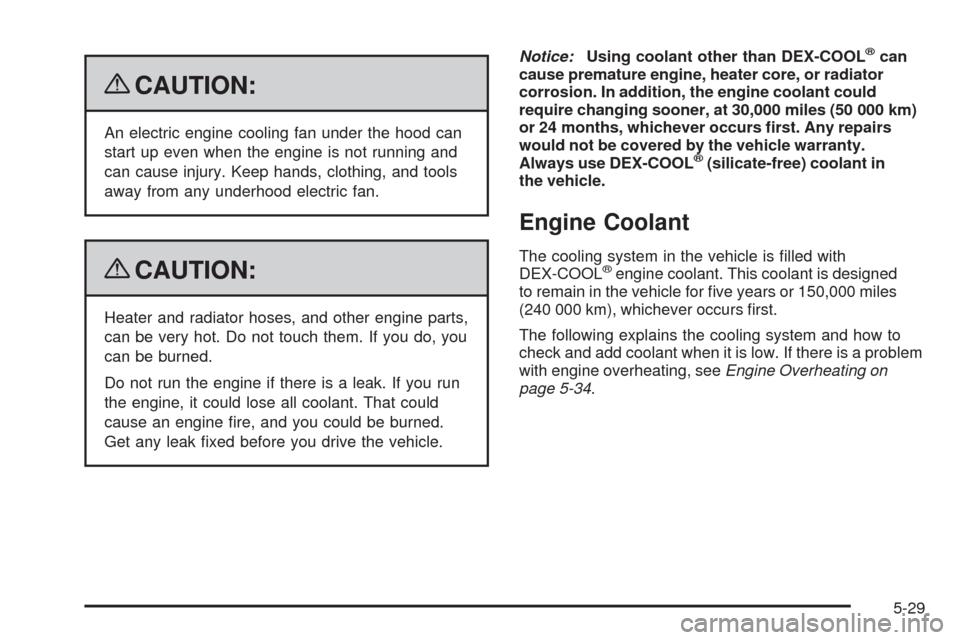
{CAUTION:
An electric engine cooling fan under the hood can
start up even when the engine is not running and
can cause injury. Keep hands, clothing, and tools
away from any underhood electric fan.
{CAUTION:
Heater and radiator hoses, and other engine parts,
can be very hot. Do not touch them. If you do, you
can be burned.
Do not run the engine if there is a leak. If you run
the engine, it could lose all coolant. That could
cause an engine re, and you could be burned.
Get any leak xed before you drive the vehicle.Notice:Using coolant other than DEX-COOL
®can
cause premature engine, heater core, or radiator
corrosion. In addition, the engine coolant could
require changing sooner, at 30,000 miles (50 000 km)
or 24 months, whichever occurs rst. Any repairs
would not be covered by the vehicle warranty.
Always use DEX-COOL
®(silicate-free) coolant in
the vehicle.
Engine Coolant
The cooling system in the vehicle is lled with
DEX-COOL®engine coolant. This coolant is designed
to remain in the vehicle for ve years or 150,000 miles
(240 000 km), whichever occurs rst.
The following explains the cooling system and how to
check and add coolant when it is low. If there is a problem
with engine overheating, seeEngine Overheating on
page 5-34.
5-29
Page 289 of 420
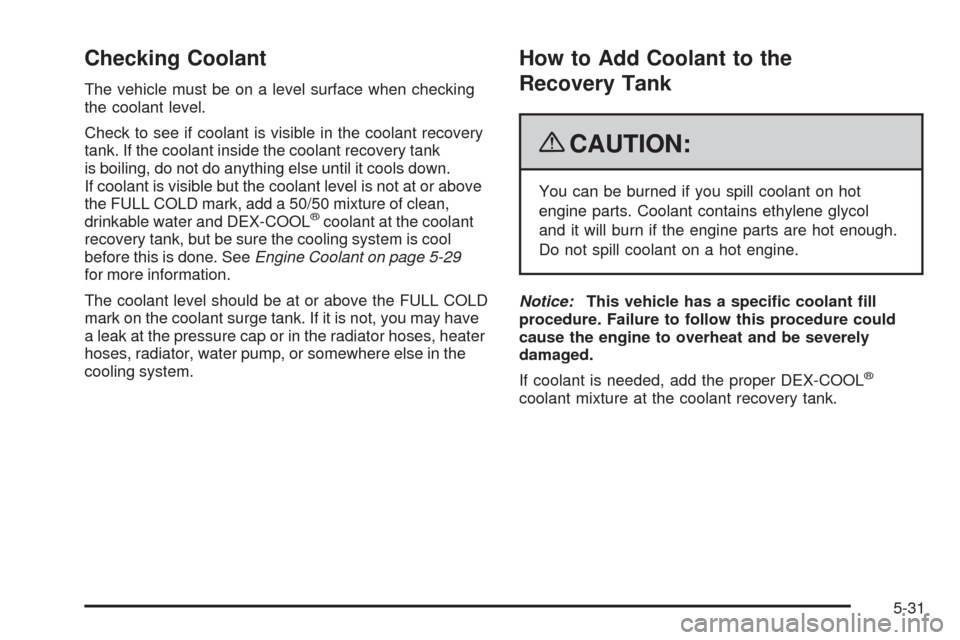
Checking Coolant
The vehicle must be on a level surface when checking
the coolant level.
Check to see if coolant is visible in the coolant recovery
tank. If the coolant inside the coolant recovery tank
is boiling, do not do anything else until it cools down.
If coolant is visible but the coolant level is not at or above
the FULL COLD mark, add a 50/50 mixture of clean,
drinkable water and DEX-COOL
®coolant at the coolant
recovery tank, but be sure the cooling system is cool
before this is done. SeeEngine Coolant on page 5-29
for more information.
The coolant level should be at or above the FULL COLD
mark on the coolant surge tank. If it is not, you may have
a leak at the pressure cap or in the radiator hoses, heater
hoses, radiator, water pump, or somewhere else in the
cooling system.
How to Add Coolant to the
Recovery Tank
{CAUTION:
You can be burned if you spill coolant on hot
engine parts. Coolant contains ethylene glycol
and it will burn if the engine parts are hot enough.
Do not spill coolant on a hot engine.
Notice:This vehicle has a specic coolant ll
procedure. Failure to follow this procedure could
cause the engine to overheat and be severely
damaged.
If coolant is needed, add the proper DEX-COOL
®
coolant mixture at the coolant recovery tank.
5-31
Page 291 of 420
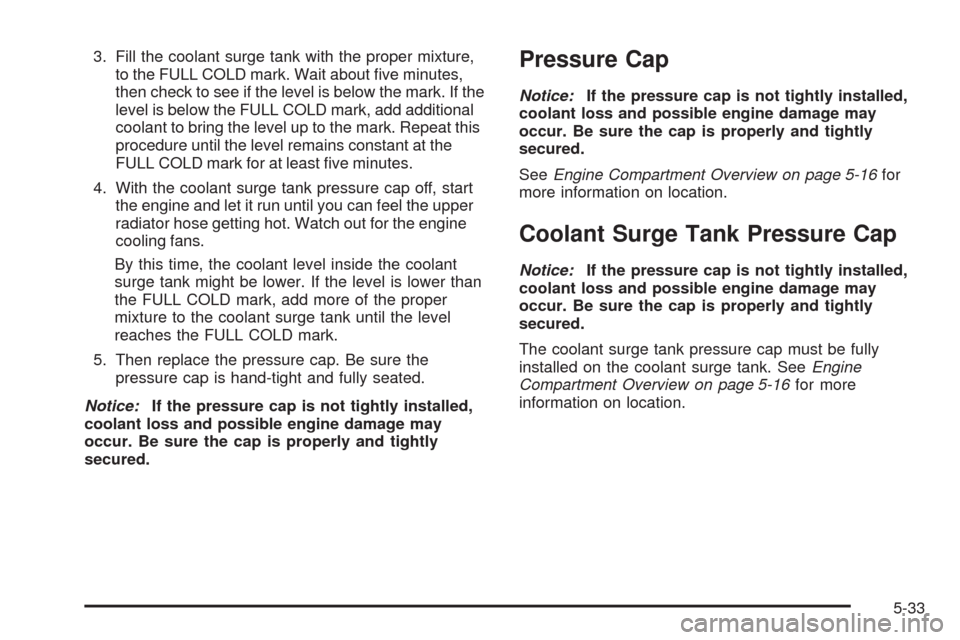
3. Fill the coolant surge tank with the proper mixture,
to the FULL COLD mark. Wait about ve minutes,
then check to see if the level is below the mark. If the
level is below the FULL COLD mark, add additional
coolant to bring the level up to the mark. Repeat this
procedure until the level remains constant at the
FULL COLD mark for at least ve minutes.
4. With the coolant surge tank pressure cap off, start
the engine and let it run until you can feel the upper
radiator hose getting hot. Watch out for the engine
cooling fans.
By this time, the coolant level inside the coolant
surge tank might be lower. If the level is lower than
the FULL COLD mark, add more of the proper
mixture to the coolant surge tank until the level
reaches the FULL COLD mark.
5. Then replace the pressure cap. Be sure the
pressure cap is hand-tight and fully seated.
Notice:If the pressure cap is not tightly installed,
coolant loss and possible engine damage may
occur. Be sure the cap is properly and tightly
secured.Pressure Cap
Notice:If the pressure cap is not tightly installed,
coolant loss and possible engine damage may
occur. Be sure the cap is properly and tightly
secured.
SeeEngine Compartment Overview on page 5-16for
more information on location.
Coolant Surge Tank Pressure Cap
Notice:If the pressure cap is not tightly installed,
coolant loss and possible engine damage may
occur. Be sure the cap is properly and tightly
secured.
The coolant surge tank pressure cap must be fully
installed on the coolant surge tank. SeeEngine
Compartment Overview on page 5-16for more
information on location.
5-33
Page 292 of 420
Engine Overheating
The vehicle has several indicators to warn of engine
overheating.
You will nd an engine coolant temperature gage as
well as an engine coolant temperature warning light
on your vehicle’s instrument panel cluster. SeeEngine
Coolant Temperature Gage on page 3-37andEngine
Coolant Temperature Warning Light on page 3-36.
You may decide not to lift the hood when this warning
appears, but instead get service help right away.
SeeRoadside Assistance Program on page 7-7.
If you do decide to lift the hood, make sure the vehicle
is parked on a level surface.
Then check to see if the engine cooling fans are
running. If the engine is overheating, both fans should
be running. If they are not, do not continue to run
the engine and have the vehicle serviced.
Notice:Engine damage from running the engine
without coolant is not covered by the warranty.
Notice:If the engine catches re while driving
with no coolant, the vehicle can be badly damaged.
The costly repairs would not be covered by the
vehicle warranty. SeeOverheated Engine Protection
Operating Mode on page 5-36for information on
driving to a safe place in an emergency.
If Steam Is Coming From The Engine
Compartment
{CAUTION:
Steam from an overheated engine can burn you
badly, even if you just open the hood. Stay away
from the engine if you see or hear steam coming
from it. Turn it off and get everyone away from the
vehicle until it cools down. Wait until there is no sign
of steam or coolant before you open the hood.
If you keep driving when the vehicles engine is
overheated, the liquids in it can catch re. You or
others could be badly burned. Stop the engine if
it overheats, and get out of the vehicle until the
engine is cool.
SeeOverheated Engine Protection Operating Mode
on page 5-36for information on driving to a safe
place in an emergency.
5-34
Page 294 of 420
Overheated Engine Protection
Operating Mode
This emergency operating mode allows your vehicle
to be driven to a safe place in an emergency situation.
If an overheated engine condition exists, an overheat
protection mode which alternates ring groups of
cylinders helps prevent engine damage. In this mode,
you will notice a signicant loss in power and engine
performance. The temperature gage will indicate an
overheat condition exists. Driving extended miles (km)
and/or towing a trailer in the overheat protection mode
should be avoided.
Notice:After driving in the overheated engine
protection operating mode, to avoid engine damage,
allow the engine to cool before attempting any
repair. The engine oil will be severely degraded.
Repair the cause of coolant loss, change the oil
and reset the oil life system. SeeEngine Oil
on page 5-21.
Power Steering Fluid
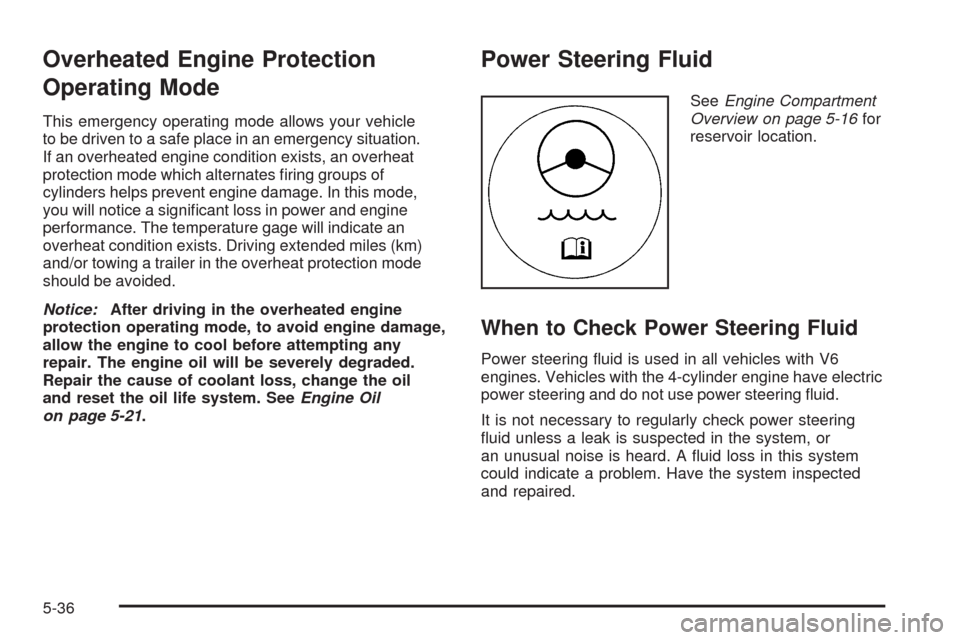
SeeEngine Compartment
Overview on page 5-16for
reservoir location.
When to Check Power Steering Fluid
Power steering uid is used in all vehicles with V6
engines. Vehicles with the 4-cylinder engine have electric
power steering and do not use power steering uid.
It is not necessary to regularly check power steering
uid unless a leak is suspected in the system, or
an unusual noise is heard. A uid loss in this system
could indicate a problem. Have the system inspected
and repaired.
5-36
Page 295 of 420
How to Check Power Steering Fluid
To check the power steering uid, do the following:
1. Turn the key off and let the engine compartment
cool down.
2. Wipe the cap and the top of the reservoir clean.
3. Unscrew the cap and wipe the dipstick with a
clean rag.
4. Replace the cap and completely tighten it.
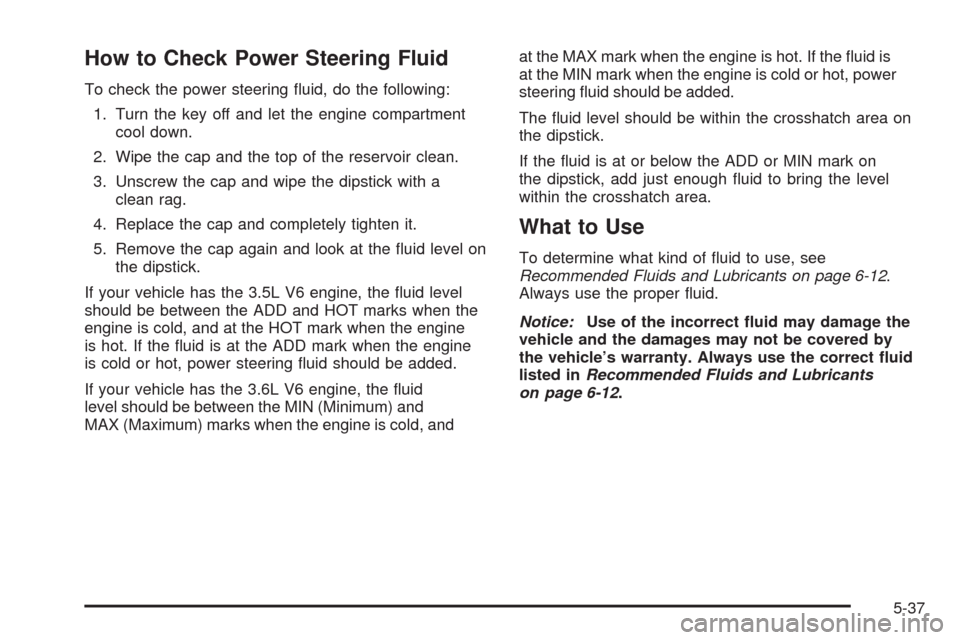
5. Remove the cap again and look at the uid level on
the dipstick.
If your vehicle has the 3.5L V6 engine, the uid level
should be between the ADD and HOT marks when the
engine is cold, and at the HOT mark when the engine
is hot. If the uid is at the ADD mark when the engine
is cold or hot, power steering uid should be added.
If your vehicle has the 3.6L V6 engine, the uid
level should be between the MIN (Minimum) and
MAX (Maximum) marks when the engine is cold, andat the MAX mark when the engine is hot. If the uid is
at the MIN mark when the engine is cold or hot, power
steering uid should be added.
The uid level should be within the crosshatch area on
the dipstick.
If the uid is at or below the ADD or MIN mark on
the dipstick, add just enough uid to bring the level
within the crosshatch area.
What to Use
To determine what kind of uid to use, see
Recommended Fluids and Lubricants on page 6-12.
Always use the proper uid.
Notice:Use of the incorrect uid may damage the
vehicle and the damages may not be covered by
the vehicle’s warranty. Always use the correct uid
listed inRecommended Fluids and Lubricants
on page 6-12.
5-37
Page 303 of 420
{CAUTION:
Fans or other moving engine parts can injure you
badly. Keep your hands away from moving parts
once the engine is running.
5. Check that the jumper cables do not have loose
or missing insulation. If they do, you could get a
shock. The vehicles could be damaged too.
Before you connect the cables, here are some
things you should know. Positive (+) will go to
positive (+) or to a remote positive (+) terminal if
the vehicle has one. Negative (−) will go to a
heavy, unpainted metal engine part or to a remote
negative (−) terminal if the vehicle has one.
Do not connect positive (+) to negative (−)oryou
will get a short that would damage the battery and
maybe other parts too. And do not connect the
negative (−) cable to the negative (−) terminal on
the dead battery because this can cause sparks.6. Connect the red positive (+) cable to the positive (+)
terminal of the dead battery. Use a remote
positive (+) terminal if the vehicle has one.
7. Do not let the other end touch metal. Connect it to
the positive (+) terminal of the good battery. Use a
remote positive (+) terminal if the vehicle has one.
8. Now connect the black negative (−) cable to the
negative (−) terminal of the good battery. Use a
remote negative (−) terminal if the vehicle has one.
Do not let the other end touch anything until the
next step. The other end of the negative (−) cable
does notgo to the dead battery. It goes to a heavy,
unpainted metal engine part or to a remote
negative (−) terminal on the vehicle with the
dead battery.
5-45
Page 367 of 420
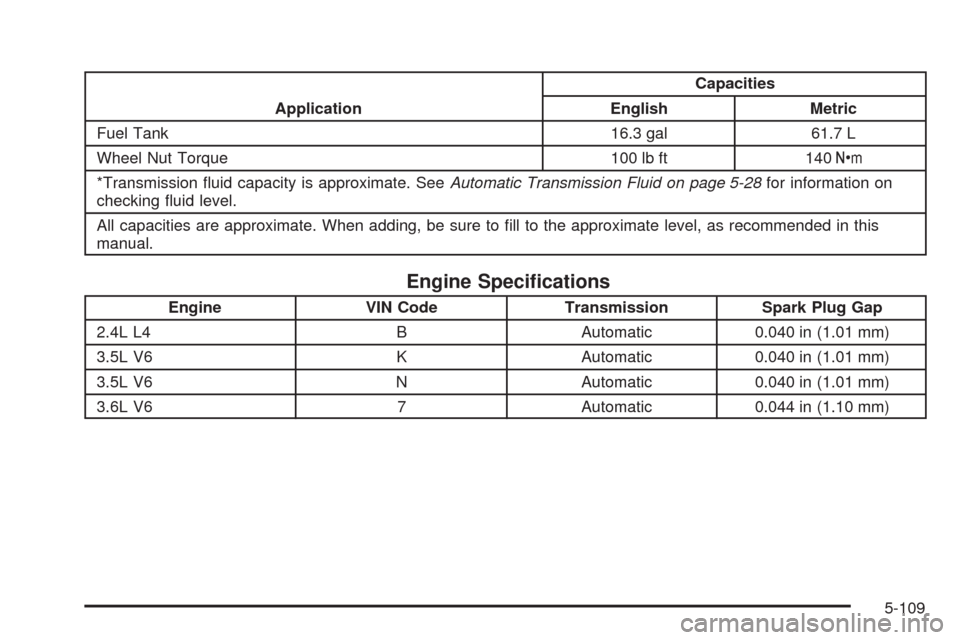
ApplicationCapacities
English Metric
Fuel Tank 16.3 gal 61.7 L
Wheel Nut Torque 100 lb ft 140Y
*Transmission uid capacity is approximate. SeeAutomatic Transmission Fluid on page 5-28for information on
checking uid level.
All capacities are approximate. When adding, be sure to ll to the approximate level, as recommended in this
manual.
Engine Specications
Engine VIN Code Transmission Spark Plug Gap
2.4L L4 B Automatic 0.040 in (1.01 mm)
3.5L V6 K Automatic 0.040 in (1.01 mm)
3.5L V6 N Automatic 0.040 in (1.01 mm)
3.6L V6 7 Automatic 0.044 in (1.10 mm)
5-109