2009 CHEVROLET MALIBU instrument panel
[x] Cancel search: instrument panelPage 80 of 420
OnStar®System.............................................2-40
Universal Home Remote System......................2-43
Universal Home Remote System Operation
(With Three Round LED)............................2-44
Storage Areas................................................2-50
Glove Box...................................................2-50
Cupholders..................................................2-50Instrument Panel Storage...............................2-50
Front Storage Area.......................................2-50
Center Console Storage.................................2-50
Driver Storage Compartment..........................2-51
Convenience Net..........................................2-51
Sunroof.........................................................2-51
Section 2 Features and Controls
2-2
Page 91 of 420
CAUTION: (Continued)
If the vehicle must be driven with the liftgate, or
trunk/hatch open:
Close all of the windows.
Fully open the air outlets on or under the
instrument panel.
Adjust the Climate Control system to a setting
that brings in only outside air and set the fan
speed to the highest setting. See Climate
Control System in the Index.
If the vehicle is equipped with a power liftgate,
disable the power liftgate function.
For more information about carbon monoxide, see
Engine Exhaust on page 2-35.
Remote Trunk Release
Press the button located
on the driver door near
the map pocket to open
the trunk.
The trunk can only be opened while the vehicle is in
P (Park) or when the ignition is off.
2-13
Page 96 of 420
Theft-Deterrent Systems
Vehicle theft is big business, especially in some cities.
This vehicle has theft-deterrent features, however,
they do not make it impossible to steal.
Content Theft-Deterrent
Your vehicle may have a
content theft-deterrent
alarm system.
Arming the System
With the ignition off, press the Remote Keyless
Entry (RKE) transmitter lock button to arm the system.
The system will arm 30 seconds after all the doors
are closed, or 60 seconds with any door open.
If you press the lock button on the transmitter a second
time while all the doors are closed, the system will arm
immediately. The system will still arm in 60 seconds if a
door is open. When the open door is closed, the system
will arm.The security light, located on the instrument panel
cluster, comes on to indicate that arming has been
initiated. Once the system is armed, the security light
ashes once every three seconds.
If the security light is ashing twice per second, this
means that a door is open.
If the system is armed and the key is used to unlock the
vehicle, the alarm will be activated.
If you do not want to arm the content theft system,
lock the vehicle with the manual lock knob on the doors
or with the inside power door lock switches.
The alarm will sound and the exterior lights will ash if
any door is opened while armed.
Disarming the System
To disarm the system, do one of the following:
Press the RKE transmitter unlock button.
Turn the ignition to ON/RUN.
Once the system is disarmed, the security light will stop
ashing.
2-18
Page 98 of 420
PASS-Key®III+ Electronic
Immobilizer Operation
Your vehicle has PASS-Key®III+ (Personalized
Automotive Security System) theft-deterrent system.
PASS-Key
®III+ is a passive theft-deterrent system.
The system is automatically armed when the key
is removed from the ignition.
You do not have to manually arm or disarm the system.
The security light will come on if there is a problem
with arming or disarming the theft-deterrent system.
When the PASS-Key
®III+ system senses that someone
is using the wrong key, it prevents the vehicle from
starting. Anyone using a trial-and-error method to start
the vehicle will be discouraged because of the high
number of electrical key codes.
When trying to start the vehicle if the engine does not
start and the security light on the instrument panel
cluster comes on, there may be a problem with your
theft-deterrent system. Turn the ignition off and try again.If the engine still does not start, and the key appears
to be not damaged, try another ignition key. At this time,
you may also want to check the fuse. SeeFuses on
page 5-99. If the engine still does not start with the other
key, your vehicle needs service. If your vehicle does start,
the rst key may be faulty. See your dealer/retailer who
can service the PASS-Key
®III+ to have a new key made.
In an emergency, contact Roadside Assistance.
SeeRoadside Assistance Program on page 7-7.
It may be possible for the PASS-Key
®III+ decoder to
“learn” the transponder value of a new or replacement
key. Up to 10 keys may be programmed for the vehicle.
The following procedure is for programming additional
keys only. If all the currently programmed keys are lost
or do not operate, you must see your dealer/retailer or a
locksmith who can service PASS-Key
®III+ to have keys
made and programmed to the system.
See your dealer/retailer or a locksmith who can service
PASS-Key
®III+ to get a new key blank that is cut
exactly as the ignition key that operates the system.
2-20
Page 101 of 420
R(ON/RUN):This position can be used to operate the
electrical accessories and to display some instrument
panel warning lights. The switch will stay in this position
while the engine is running.
If you leave the key in the ACC/ACCESSORY or
ON/RUN position with the engine off, the battery could
be drained. You may not be able to start the vehicle
if the battery is allowed to drain for an extended period
of time.
/(START):This position starts the engine. When the
engine starts, release the key. The ignition switch will
return to the ON/RUN position for driving.
A warning tone will sound when the driver door is opened,
the ignition is in ACC/ACCESSORY or LOCK/OFF and
the key is in the ignition.
Retained Accessory Power (RAP)
These vehicle accessories can be used for up to
10 minutes after the engine is turned off:
Audio System
Power Windows
Heated Seats (if equipped)
Sunroof (if equipped)
These features continue to work up to 10 minutes after
the ignition is turned to LOCK/OFF.
The power windows, heated seats, and sunroof will
work until any door is opened.
The radio continues to work until the driver door is
opened.
All these features operate when the key is in the
ON/RUN or ACC/ACCESSORY.
2-23
Page 128 of 420
Storage Areas
Glove Box
Pull the handle up to open.
Cupholders
Removable cupholders are located in front of the center
console. See “Center Console Storage Area” following
for how to access them. Press and hold the tab at
the rear of the cupholders and lift up and rearward to
remove the cupholders. This will disengage the two
forward tabs.
To reinstall them, place the two forward tabs into the
slots and push the rear of the cupholder down.
For vehicles with rear seat cupholders, pull down the
door on the back of the center console to access them.
Instrument Panel Storage
An instrument panel storage area, with a removable
liner, is located above the radio. Slide the latch toward
the back of the vehicle to open the storage area.
Front Storage Area
A storage area is located in front of the shift lever.
Push the bottom of the door and the storage will
automatically open.
Center Console Storage
The center console storage area has a storage tray
and a main storage. Pull up on the driver side latch to
access the storage tray. Pull up on the passenger side
latch to access the main storage. There is a removable
divider and may be a storage pocket located at the rear
of the center console.
The armrest on top of the center console can be
adjusted to a rearward, middle, and forward position.
Pull or push the front of the armrest to adjust to
the desired position.
Another storage area is located in front of the main
storage. Push down and then forward on the rear of the
cover to access. There is a storage tray and removable
cupholders.
2-50
Page 129 of 420
Driver Storage Compartment
A driver storage compartment is located near the
left side of the steering column on the bottom of
the instrument panel. Pull the cover down to open.
Pull out to remove for cleaning.
Convenience Net
Use the convenience net, located in the rear, to store
small loads as far forward as possible. The net should not
be used to store heavy loads.
Sunroof
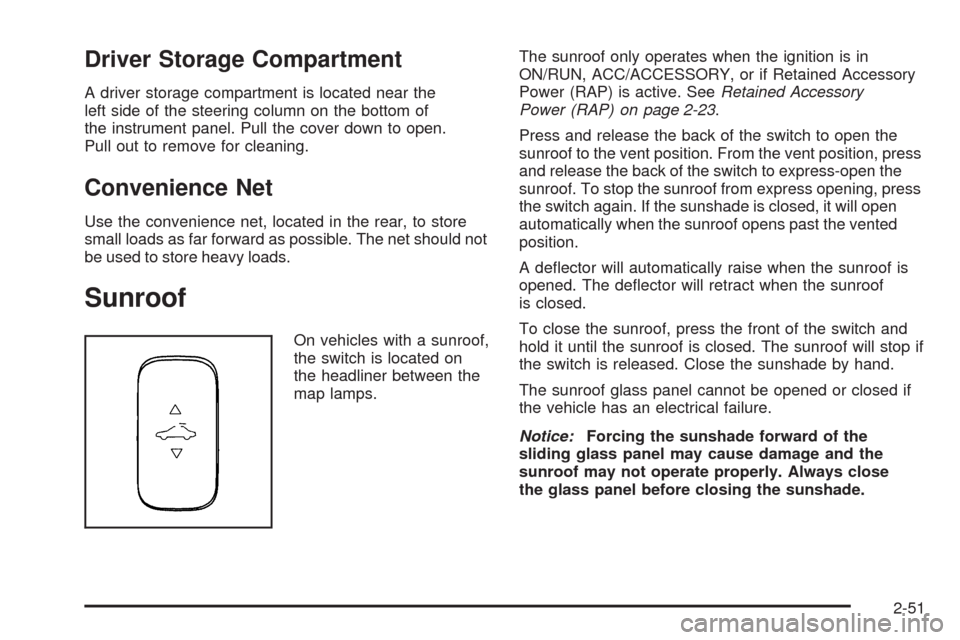
On vehicles with a sunroof,
the switch is located on
the headliner between the
map lamps.The sunroof only operates when the ignition is in
ON/RUN, ACC/ACCESSORY, or if Retained Accessory
Power (RAP) is active. SeeRetained Accessory
Power (RAP) on page 2-23.
Press and release the back of the switch to open the
sunroof to the vent position. From the vent position, press
and release the back of the switch to express-open the
sunroof. To stop the sunroof from express opening, press
the switch again. If the sunshade is closed, it will open
automatically when the sunroof opens past the vented
position.
A deector will automatically raise when the sunroof is
opened. The deector will retract when the sunroof
is closed.
To close the sunroof, press the front of the switch and
hold it until the sunroof is closed. The sunroof will stop if
the switch is released. Close the sunshade by hand.
The sunroof glass panel cannot be opened or closed if
the vehicle has an electrical failure.
Notice:Forcing the sunshade forward of the
sliding glass panel may cause damage and the
sunroof may not operate properly. Always close
the glass panel before closing the sunshade.
2-51
Page 131 of 420
Instrument Panel Overview...............................3-4
Hazard Warning Flashers................................3-6
Horn .............................................................3-6
Tilt and Telescopic Steering Wheel...................3-6
Turn Signal/Multifunction Lever.........................3-7
Turn and Lane-Change Signals........................3-7
Headlamp High/Low-Beam Changer..................3-8
Flash-to-Pass.................................................3-8
Windshield Wipers..........................................3-8
Windshield Washer.........................................3-9
Cruise Control..............................................3-10
Headlamps..................................................3-13
Headlamps on Reminder................................3-14
Headlamps Off in Park..................................3-14
Delayed Headlamps......................................3-14
Daytime Running Lamps (DRL).......................3-14
Automatic Headlamp System..........................3-15
Fog Lamps ..................................................3-15
Instrument Panel Brightness...........................3-16
Dome Lamps ...............................................3-16
Entry/Exit Lighting.........................................3-16
Parade Dimming...........................................3-16
Reading Lamps............................................3-16Electric Power Management...........................3-17
Battery Run-Down Protection..........................3-18
Accessory Power Outlet(s).............................3-18
Power Outlet 115 Volt Alternating Current........3-19
Climate Controls............................................3-20
Climate Control System.................................3-20
Automatic Climate Control System...................3-24
Outlet Adjustment.........................................3-27
Warning Lights, Gages, and Indicators............3-28
Instrument Panel Cluster................................3-29
Speedometer and Odometer...........................3-30
Trip Odometer.............................................
.3-30
Tachometer.................................................3-30
Safety Belt Reminders...................................3-30
Airbag Readiness Light..................................3-31
Passenger Airbag Status Indicator...................3-32
Charging System Light..................................3-33
Brake System Warning Light..........................3-34
Antilock Brake System (ABS) Warning Light.....3-35
Electronic Stability Control (ESC)/Traction
Control System (TCS) Indicator/Warning
Light........................................................3-35
Section 3 Instrument Panel
3-1