2009 CHEVROLET KODIAK engine coolant
[x] Cancel search: engine coolantPage 249 of 376
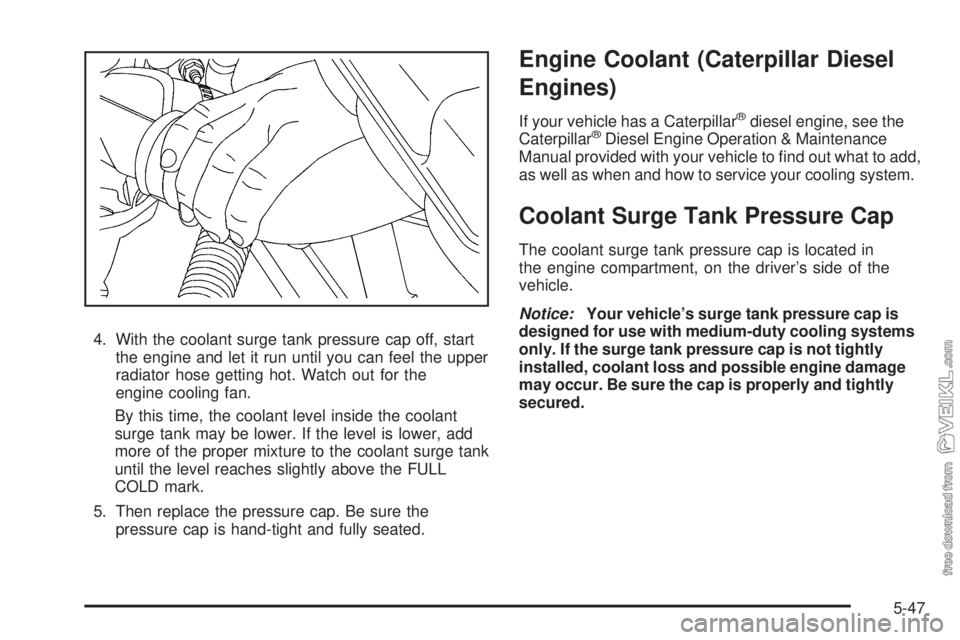
4. With the coolant surge tank pressure cap off, start
the engine and let it run until you can feel the upper
radiator hose getting hot. Watch out for the
engine cooling fan.
By this time, the coolant level inside the coolant
surge tank may be lower. If the level is lower, add
more of the proper mixture to the coolant surge tank
until the level reaches slightly above the FULL
COLD mark.
5. Then replace the pressure cap. Be sure the
pressure cap is hand-tight and fully seated.
Engine Coolant (Caterpillar Diesel
Engines)
If your vehicle has a Caterpillar®diesel engine, see the
Caterpillar®Diesel Engine Operation & Maintenance
Manual provided with your vehicle to find out what to add,
as well as when and how to service your cooling system.
Coolant Surge Tank Pressure Cap
The coolant surge tank pressure cap is located in
the engine compartment, on the driver’s side of the
vehicle.
Notice:Your vehicle’s surge tank pressure cap is
designed for use with medium-duty cooling systems
only. If the surge tank pressure cap is not tightly
installed, coolant loss and possible engine damage
may occur. Be sure the cap is properly and tightly
secured.
5-47
Page 250 of 376

Engine Overheating
You will find an engine coolant temperature gage, as
well as a low coolant warning light, on your vehicle’s
instrument panel. SeeEngine Coolant Temperature
Gage on page 3-34andLow Coolant Warning Light on
page 3-35for more information.
Your vehicle also has a check gages warning light on
the instrument panel. SeeCheck Gages Warning
Light on page 3-43for more information.
If Steam Is Coming From Your Engine
{CAUTION:
Steam from an overheated engine can burn you
badly, even if you just open the hood. Stay away
from the engine if you see or hear steam coming
from it. Just turn it off and get everyone away
from the vehicle until it cools down. Wait until
there is no sign of steam or coolant before you
open the hood.
CAUTION: (Continued)
CAUTION: (Continued)
If you keep driving when your engine is overheated,
the liquids in it can catch fire. You or others could
be badly burned. Stop your engine if it overheats,
and get out of the vehicle until the engine is cool.
Notice:If the engine catches fire because of being
driven with no coolant, your vehicle can be badly
damaged. The costly repairs would not be covered
by the vehicle warranty.
If No Steam Is Coming From Your
Engine
An overheat warning, along with a low coolant light, can
indicate a serious problem. SeeLow Coolant Warning
Light on page 3-35for more information.
If you get an engine overheat warning with no low
coolant light, but see or hear no steam, the problem may
not be too serious. Sometimes the engine can get a
little too hot when you:
•Climb a long hill on a hot day.
•Stop after high-speed driving.
•Idle for long periods in traffic.
5-48
Page 253 of 376

Adding Washer Fluid
Open the cap with the
washer symbol on it.
Add washer fluid until
the tank is full.
The windshield washer fluid reservoir is located in the
engine compartment on the driver’s side of the vehicle.Notice:•When using concentrated washer fluid, follow
the manufacturer’s instructions for adding
water.
•Do not mix water with ready-to-use washer fluid.
Water can cause the solution to freeze and
damage your washer fluid tank and other parts
of the washer system. Also, water does not
clean as well as washer fluid.
•Fill the washer fluid tank only three-quarters full
when it is very cold. This allows for fluid
expansion if freezing occurs, which could
damage the tank if it is completely full.
•Do not use engine coolant (antifreeze) in your
windshield washer. It can damage the vehicle’s
windshield washer system and paint.
5-51
Page 338 of 376

(24)= Evaporative Control System Service, if equipped:
Check all fuel and vapor lines and hoses for proper
connections and correct routing (or every 24 months,
whichever occurs first). Replace parts as needed.
(25)= Replace spark plugs. Inspect wires for damage.
Check the wire boot and boot heat shield fit at spark
plugs and coil. Replace parts as needed.
(26)= Check the fuel tank, fuel cap and fuel lines for
damage which could cause leakage. Inspect fuel cap for
correct sealing ability and any indications of damage.
Check fuel cap gasket for even filler neck imprint.
Replace parts as needed.
(27)= Check Exhaust Gas Recirculation (EGR) system
as described in the service manual. SeeService
Publications Ordering Information on page 7-10.
(28)= Inspect Electronic Vacuum Regulator Valve
(EVRV) filter for excessive contamination or plugging.
If needed, clean filter with solution of soap and water, let
dry and install.
(29)= Drain, flush, and refill cooling system. This service
can be complex; you should have your dealer/retailer
perform this service. SeePart C: Recommended Fluids
and Lubricants on page 6-31for what to use. Inspect
hoses. Clean radiator, condenser, pressure cap, and
neck. Pressure test cooling system and pressure cap.
For Caterpillar
®diesel engines, always refer to the
Caterpillar®Diesel Engine Operation & Maintenance
Manual for coolant recommendations and change
intervals.(30)= Change the lubricant. SeePart C: Recommended
Fluids and Lubricants on page 6-31.
(31)= Front axle service: Re-pack upper kingpin roller
bearing.
(32)= Air brake service:
•Inspect brake lines and hoses for proper hook-up,
binding, leaks, cracks, chafing, etc. Inspect drum
brake linings for wear or cracks. Inspect other brake
parts at each wheel, including drums and wheel
speed sensor wiring. Check brake pedal for
excessive free play or travel (or every 6 months,
whichever occurs first) and have serviced if needed.
Check brakes more often if driving habits and
conditions result in frequent braking. Replace air
dryer cartridge only if excessive oil or moisture is
present. A small amount of oil in the system is normal
and should not be considered as a reason to replace
the cartridge.
•Test air lines for leaks; tighten as needed. Replace
compressor filter.
•Inspect air parking brake chamber for leaks and
damage. Inspect lines and hoses for leaks, cracks,
chafing, etc. Also check all attachments for tightness,
wear, or damage. Note: The spring brake section of
the rear brake diaphragms are non-serviceable.
6-24
Page 340 of 376

Part B: Owner Checks and Services
These owner checks and services should be performed
at the intervals specified to help ensure vehicle
safety, dependability, and emission control performance.
For your safety and that of others, any of the
safety-related components that may have been
damaged in an accident should be checked and any
needed repairs made before operating the vehicle.
At the minimum, these routine checks should be made
every 6 months or 6,000 miles (10 000 km), whichever
occurs first. Whenever repairs are needed, have
them completed before operating the vehicle.
At Each Fuel Fill
It is important to perform these underhood checks at
each fuel fill.
Engine Oil Level Check
Notice:It is important to check the engine oil
regularly and keep it at the proper level. Failure to
keep the engine oil at the proper level can cause
damage to the engine not covered by the vehicle
warranty.Check the engine oil level and add the proper oil if
necessary. SeeEngine Oil (DURAMAX Diesel Engine)
on page 5-24orEngine Oil (Caterpillar Diesel Engine)
on page 5-27orEngine Oil (Isuzu Diesel Engine) on
page 5-28orEngine Oil (Gasoline Engine) on page 5-32.
Engine Coolant Level Check
Check the engine coolant level and add DEX-COOL®
coolant mixture if necessary. SeeEngine Coolant
(Caterpillar Diesel Engines) on page 5-47.
Windshield Washer Fluid Level Check
Check the windshield washer fluid level in the windshield
washer fluid reservoir and add the proper fluid if
necessary. SeeWindshield Washer Fluid on page 5-50.
Tire Inflation Check
Check tire inflation cold. Make sure the tires are inflated
to the correct pressures. SeeLoading the Vehicle on
page 4-20andInflation - Tire Pressure on page 5-77.
6-26
Page 344 of 376

Fluid Leaks Check
Check for fuel, coolant, oil, or other fluid leaks by
looking at the surface beneath the vehicle after it has
been parked for awhile.
Underbody Inspection
Corrosive materials used for ice, snow removal, and dust
control can collect on the underbody. If these materials
are not removed, accelerated corrosion (rust) can occur
on underbody parts such as fuel lines, frame, floor pan,
and exhaust system. At least every spring, flush these
materials from the underbody with plain water. Take care
to clean well any areas where mud and other debris can
collect. Sediment packed in closed areas of the frame
should be loosened before being flushed.
Engine Cover Check
Check that the cab’s engine cover and seal, if the
vehicle has one, are not torn or damaged. Be sure that
the cover is clamped down firmly to the floor.
At Least Once a Year
Key Lock Cylinders Service
Lubricate the key lock cylinders with the lubricant
specified in Part C.
Underbody Flushing Service
At least every spring, use plain water to flush any
corrosive materials from the underbody. Take care to
clean thoroughly any areas where mud and other debris
can collect.
Tractor Protection (Breakaway) Valve
Check
On air brake models, remove, disassemble, clean, and
inspect the tractor protection (breakaway) valve.
6-30
Page 345 of 376

Part C: Recommended Fluids and
Lubricants
Fluids and lubricants identified below by name, part
number, or specification can be obtained from your
dealer/retailer.
Usage Fluid/Lubricant
Engine Oil
(Gasoline
Engine)Engine oil which meets GM Standard
GM6094M and displays the
American Petroleum Institute (API)
Certified for Gasoline Engines
starburst symbol. To determine the
proper viscosity for your vehicle’s
engine, see “Engine Oil” in the Index.
Engine Oil
(DURAMAX
®/
Isuzu Diesel
Engines)Engine oils with the letters CJ-4 are
required for your vehicle. The CJ-4
designation can appear either alone
or in combination with other
American Petroleum Institute (API)
designations, such as API CJ-4/SL.
These letters show API levels of
quality. To determine the preferred
viscosity for your vehicle’s diesel
engine, see “Engine Oil” in the Index.
Engine Oil
(Caterpillar
®
Diesel Engine)See the Caterpillar
®Operation &
Maintenance Manual for engine oil
recommendations.
Usage Fluid/Lubricant
Engine Coolant
(Caterpillar
®
Diesel Engine)See the Caterpillar
®Operation &
Maintenance Manual for engine
coolant recommendations.
Engine Coolant
(Gasoline
Engine &
DURAMAX
®/
Isuzu Diesel
Engines)50/50 mixture of clean, drinkable
water and use only DEX-COOL
®
Coolant. SeeEngine Coolant
(Caterpillar Diesel Engines) on
page 5-47.
Hydraulic Brake
SystemDelco
®Supreme 11 Brake Fluid or
equivalent DOT-3 brake fluid.
Windshield
Washer SolventOptikleen
®Washer Solvent.
Clutch Bearing
LubricantClutch Bearing Lubricant (GM Part
No. 12378484 or equivalent NLGI
#3 consistency).
Exhaust Brake
Ball Joint Cap
LubricantHigh-Temperature Grease
(GM Part No. U.S. 1051344,
in Canada 903037) or NLGI #3
consistency.
Power Steering
SystemDEXRON
®-VI Automatic
Transmission Fluid.
Manual
TransmissionSynthetic Manual Transmission Fluid
(GM Part No. U.S. 88861952,
in Canada 88861953).
Automatic
TransmissionSee the Allison Transmission
®
Operator’s Manual for correct
transmission fluid.
6-31
Page 367 of 376

Child Restraints (cont.)
Securing a Child Restraint in the Center
Rear Seat Position...................................1-42
Securing a Child Restraint in the Right
Front Seat Position...................................1-44
Where to Put the Restraint...........................1-38
Chime Level Adjustment..................................3-58
Cigarette Lighter.............................................3-19
Cleaning
Aluminum or Chrome-Plated Wheels..............5-92
Exterior Lamps/Lenses.................................5-90
Fabric/Carpet..............................................5-88
Finish Care.................................................5-90
Instrument Panel, Vinyl, and Other
Plastic Surfaces.......................................5-89
Interior.......................................................5-87
Tires..........................................................5-92
Underbody Maintenance...............................5-93
Washing Your Vehicle...................................5-90
Weatherstrips..............................................5-89
Windshield and Wiper Blades........................5-91
Climate Control System...................................3-20
Outlet Adjustment........................................3-22
Rear Heating System...................................3-23
Clock, Setting.................................................3-48
Collision Damage Repair................................... 7-6
Control of a Vehicle.......................................... 4-3Coolant
Engine.......................................................5-47
Engine Temperature Gage............................3-34
Low Warning Light.......................................3-35
Surge Tank Pressure Cap.............................5-47
Cooling System..............................................5-43
Cruise Control................................................3-10
Customer Assistance Information
Customer Assistance for Text Telephone
(TTY) Users.............................................. 7-4
Customer Assistance Offices........................... 7-4
Customer Satisfaction Procedure..................... 7-2
GM Mobility Reimbursement Program............... 7-5
Reporting Safety Defects to General Motors........ 7-9
Reporting Safety Defects to the Canadian
Government.............................................. 7-9
Reporting Safety Defects to the
United States Government.......................... 7-9
Roadside Assistance Program......................... 7-5
Service Publications Ordering Information........7-10
D
Daytime Running Lamp...................................3-15
Daytime Running Lamps Indicator Light.............3-42
Defensive Driving............................................. 4-2
3