2009 CHEVROLET EXPRESS CARGO VAN tow
[x] Cancel search: towPage 62 of 408
7. If the vehicle does not have a rear seat and the
child restraint has a top tether, follow the child
restraint manufacturer’s instructions regarding the
use of the top tether. SeeLower Anchors and
Tethers for Children (LATCH) on page 1-41for
more information.
8. Push and pull the child restraint in different
directions to be sure it is secure.
To remove the child restraint, unbuckle the vehicle
safety belt and let it return to the stowed position.
If you turned the airbag off with the switch, turn on
the right front passenger airbag when you remove the
child restraint from the vehicle unless the person
who will be sitting there is a member of a passenger
airbag risk group. SeeAirbag Off Switch on page 1-67
for more information, including important safety
information.
Airbag System
The vehicle has the following airbag:
•A frontal airbag for the driver.
The vehicle may have the following airbags:
•A frontal airbag for the right front passenger.
•A roof-rail airbag for the driver (cargo van).
•A roof-rail airbag for the right front passenger
position (cargo or passenger van equipped
with a sliding door).
If you have a passenger van with a right front
passenger roof-rail airbag and a sliding door, you
will also have a separate roof-rail airbag for the
passenger seated directly behind the right front
passenger and the third row outboard passenger
position.
•A roof-rail airbag for the driver, passenger seated
directly behind the driver, and the third row
outboard passenger position (passenger van
equipped with a sliding or hinged door).
•A roof-rail airbag for the right front passenger,
passenger seated directly behind the right
front passenger, and the third row outboard
passenger position (passenger van equipped
with a hinged door).
All of the airbags in the vehicle will have the word
AIRBAG embossed in the trim or on an attached label
near the deployment opening.
For frontal airbags, the word AIRBAG will appear on the
middle part of the steering wheel for the driver and
on the instrument panel for the right front passenger.
With roof-rail airbags, the word AIRBAG will appear
along the headliner or trim.
1-58
Page 69 of 408
How Does an Airbag Restrain?
In moderate to severe frontal or near frontal collisions,
even belted occupants can contact the steering wheel
or the instrument panel. In moderate to severe side
collisions, even belted occupants can contact the inside
of the vehicle.
Airbags supplement the protection provided by safety
belts. Frontal airbags distribute the force of the
impact more evenly over the occupant’s upper body,
stopping the occupant more gradually. Roof-rail airbags
distribute the force of the impact more evenly over
the occupant’s upper body.
Rollover capable roof-rail airbags are designed to
help contain the head and chest of occupants in the
outboard seating positions in the first, second, and
third rows, if equipped. The rollover capable roof-rail
airbags are designed to help reduce the risk of full
or partial ejection in rollover events, although no system
can prevent all such ejections.But airbags would not help in many types of collisions,
primarily because the occupant’s motion is not
toward those airbags. SeeWhen Should an Airbag
Inflate? on page 1-63for more information.
Airbags should never be regarded as anything more
than a supplement to safety belts.
What Will You See After an Airbag
Inates?
After the frontal airbags inflate, they quickly deflate,
so quickly that some people may not even realize an
airbag inflated. Roof-rail airbags may still be at least
partially inflated for some time after they deploy.
Some components of the airbag module may be hot
for several minutes. For location of the airbag modules,
seeWhat Makes an Airbag Inflate? on page 1-64.
1-65
Page 79 of 408
Additional Factors Affecting System
Operation
Safety belts help keep the passenger in position on the
seat during vehicle maneuvers and braking, which helps
the passenger sensing system maintain the passenger
airbag status. See “Safety Belts” and “Child Restraints” in
the Index for additional information about the importance
of proper restraint use.
If you ever pull the shoulder portion of the belt out all
the way, you will engage the child restraint locking
feature. This may unintentionally cause the passenger
sensing system to turn the airbag(s) off for some
adult size occupants. If this happens, just let the
belt go back all the way and start again.A thick layer of additional material, such as a blanket or
cushion, or aftermarket equipment such as seat covers,
seat heaters, and seat massagers can affect how well the
passenger sensing system operates. We recommend
that you not use seat covers or other aftermarket
equipment except when approved by GM for your specific
vehicle. SeeAdding Equipment to Your Airbag-Equipped
Vehicle on page 1-76for more information about
modifications that can affect how the system operates.
{CAUTION:
Stowing of articles under the passenger seat or
between the passenger seat cushion and seatback
may interfere with the proper operation of the
passenger sensing system.
1-75
Page 85 of 408
Keys...............................................................2-2
Remote Keyless Entry (RKE) System................2-3
Remote Keyless Entry (RKE) System
Operation...................................................2-4
Doors and Locks.............................................2-6
Door Locks....................................................2-6
Power Door Locks..........................................2-6
Cargo Door Relocking.....................................2-7
Delayed Locking.............................................2-7
Programmable Automatic Door Locks................2-7
Automatic Door Lock.......................................2-8
Automatic Door Unlock....................................2-8
Rear Door Security Locks................................2-8
Lockout Protection..........................................2-9
Sliding Side Door...........................................2-9
60/40 Swing-Out Side Door............................2-10
Rear Doors..................................................2-12
Windows........................................................2-13
Manual Windows..........................................2-14
Power Windows............................................2-14
Swing-Out Windows......................................2-15
Enhanced Technology Glass..........................2-16
Sun Visors...................................................2-16Theft-Deterrent Systems..................................2-16
PASS-Key®III+ Electronic Immobilizer.............2-17
PASS-Key®III+ Electronic Immobilizer
Operation.................................................2-17
Starting and Operating Your Vehicle................2-19
New Vehicle Break-In....................................2-19
Ignition Positions..........................................2-19
Retained Accessory Power (RAP)...................2-20
Starting the Engine.......................................2-20
Engine Coolant Heater..................................2-22
Automatic Transmission Operation...................2-23
Tow/Haul Mode............................................2-25
Parking Brake..............................................2-26
Shifting Into Park..........................................2-27
Shifting Out of Park......................................2-29
Parking Over Things That Burn.......................2-29
Engine Exhaust............................................2-30
Running the Vehicle While Parked..................2-31
Mirrors...........................................................2-32
Manual Rearview Mirror.................................2-32
Outside Manual Mirrors..................................2-32
Outside Towing Mirrors..................................2-32
Outside Power Mirrors...................................2-33
Outside Convex Mirror...................................2-33
Outside Heated Mirrors..................................2-34
Storage Areas................................................2-34
Section 2 Features and Controls
2-1
Page 93 of 408
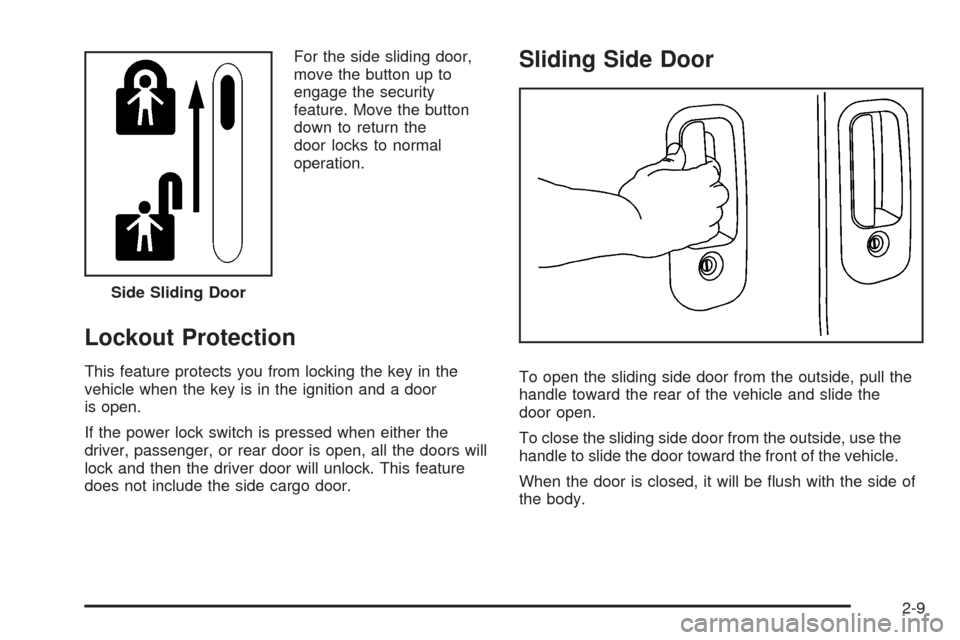
For the side sliding door,
move the button up to
engage the security
feature. Move the button
down to return the
door locks to normal
operation.
Lockout Protection
This feature protects you from locking the key in the
vehicle when the key is in the ignition and a door
is open.
If the power lock switch is pressed when either the
driver, passenger, or rear door is open, all the doors will
lock and then the driver door will unlock. This feature
does not include the side cargo door.
Sliding Side Door
To open the sliding side door from the outside, pull the
handle toward the rear of the vehicle and slide the
door open.
To close the sliding side door from the outside, use the
handle to slide the door toward the front of the vehicle.
When the door is closed, it will be flush with the side of
the body. Side Sliding Door
2-9
Page 94 of 408
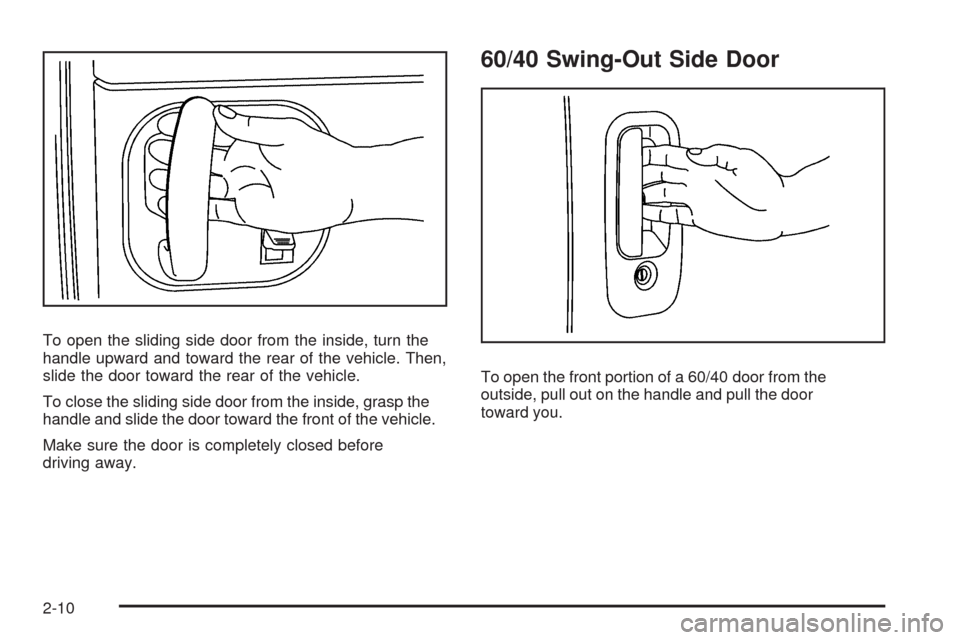
To open the sliding side door from the inside, turn the
handle upward and toward the rear of the vehicle. Then,
slide the door toward the rear of the vehicle.
To close the sliding side door from the inside, grasp the
handle and slide the door toward the front of the vehicle.
Make sure the door is completely closed before
driving away.
60/40 Swing-Out Side Door
To open the front portion of a 60/40 door from the
outside, pull out on the handle and pull the door
toward you.
2-10
Page 95 of 408
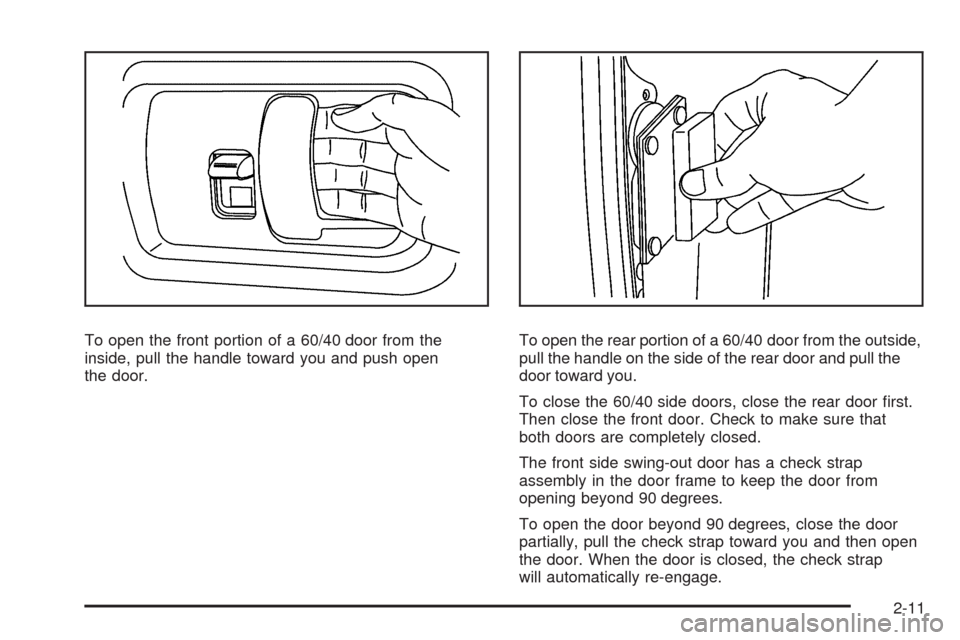
To open the front portion of a 60/40 door from the
inside, pull the handle toward you and push open
the door.To open the rear portion of a 60/40 door from the outside,
pull the handle on the side of the rear door and pull the
door toward you.
To close the 60/40 side doors, close the rear door first.
Then close the front door. Check to make sure that
both doors are completely closed.
The front side swing-out door has a check strap
assembly in the door frame to keep the door from
opening beyond 90 degrees.
To open the door beyond 90 degrees, close the door
partially, pull the check strap toward you and then open
the door. When the door is closed, the check strap
will automatically re-engage.
2-11
Page 96 of 408
Rear Doors
{CAUTION:
Unlocked doors can be dangerous.
•Passengers, especially children, can easily
open the doors and fall out of a moving
vehicle. When a door is locked, the handle
will not open it. You increase the chance of
being thrown out of the vehicle in a crash if
the doors are not locked. So, wear safety
belts properly and lock the doors whenever
you drive.
•Young children who get into unlocked vehicles
may be unable to get out. A child can be
overcome by extreme heat and can suffer
permanent injuries or even death from heat
stroke. Always lock your vehicle whenever
you leave it.
•Outsiders can easily enter through an
unlocked door when you slow down or stop
your vehicle. Locking your doors can help
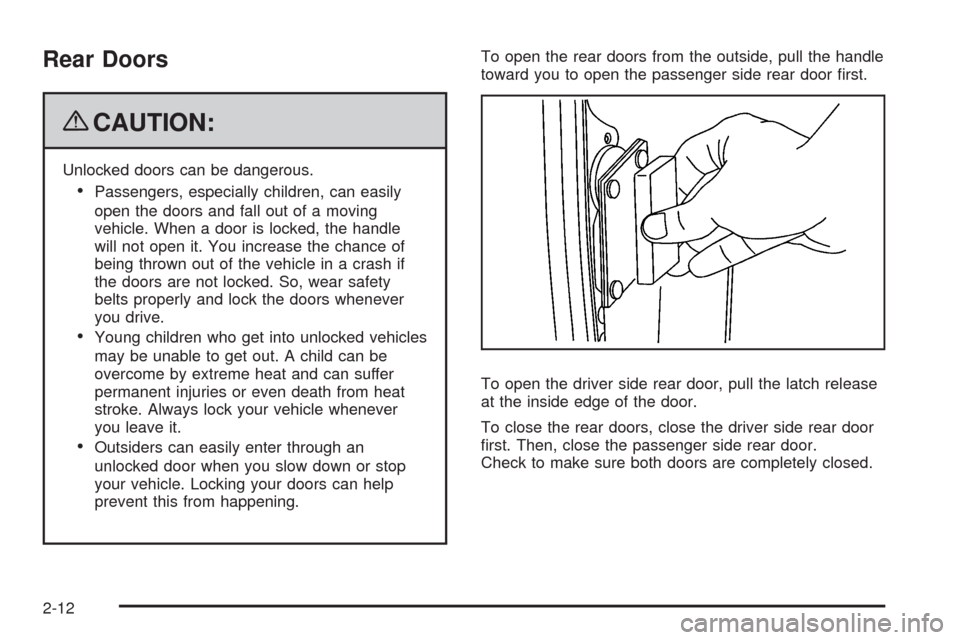
prevent this from happening.To open the rear doors from the outside, pull the handle
toward you to open the passenger side rear door first.
To open the driver side rear door, pull the latch release
at the inside edge of the door.
To close the rear doors, close the driver side rear door
first. Then, close the passenger side rear door.
Check to make sure both doors are completely closed.
2-12