2009 CHEVROLET EQUINOX climate control
[x] Cancel search: climate controlPage 1 of 442

Seats and Restraint System............................. 1-1
Front Seats
............................................... 1-2
Rear Seats
..............................................1-10
Safety Belts
.............................................1-12
Child Restraints
.......................................1-32
Airbag System
.........................................1-58
Restraint System Check
............................1-74
Features and Controls..................................... 2-1
Keys
........................................................ 2-3
Doors and Locks
......................................2-10
Windows
.................................................2-14
Theft-Deterrent Systems
............................2-16
Starting and Operating Your Vehicle
...........2-19
Mirrors
....................................................2-36
OnStar
®System
......................................2-37
Storage Areas
.........................................2-41
Sunroof
..................................................2-47
Instrument Panel............................................. 3-1
Instrument Panel Overview
.......................... 3-4
Climate Controls
......................................3-18
Warning Lights, Gages, and Indicators
........3-23
Driver Information Center (DIC)
..................3-42
Audio System(s)
.......................................3-64Driving Your Vehicle....................................... 4-1
Your Driving, the Road, and the Vehicle
....... 4-2
Towing
...................................................4-26
Service and Appearance Care.......................... 5-1
Service
..................................................... 5-3
Fuel
......................................................... 5-5
Checking Things Under the Hood
...............5-10
All-Wheel Drive
........................................5-42
Headlamp Aiming
.....................................5-44
Bulb Replacement
....................................5-45
Windshield Wiper Blade Replacement
.........5-51
Tires
......................................................5-52
Appearance Care
.....................................5-88
Vehicle Identication
.................................5-96
Electrical System
......................................5-97
Capacities and Specications
...................5-104
Maintenance Schedule..................................... 6-1
Maintenance Schedule
................................ 6-2
Customer Assistance Information.................... 7-1
Customer Assistance and Information
........... 7-2
Reporting Safety Defects
...........................7-14
Vehicle Data Recording and Privacy
...........7-16
Index................................................................ 1
2009 Chevrolet Equinox Owner ManualM
Page 8 of 442
Manual Lumbar
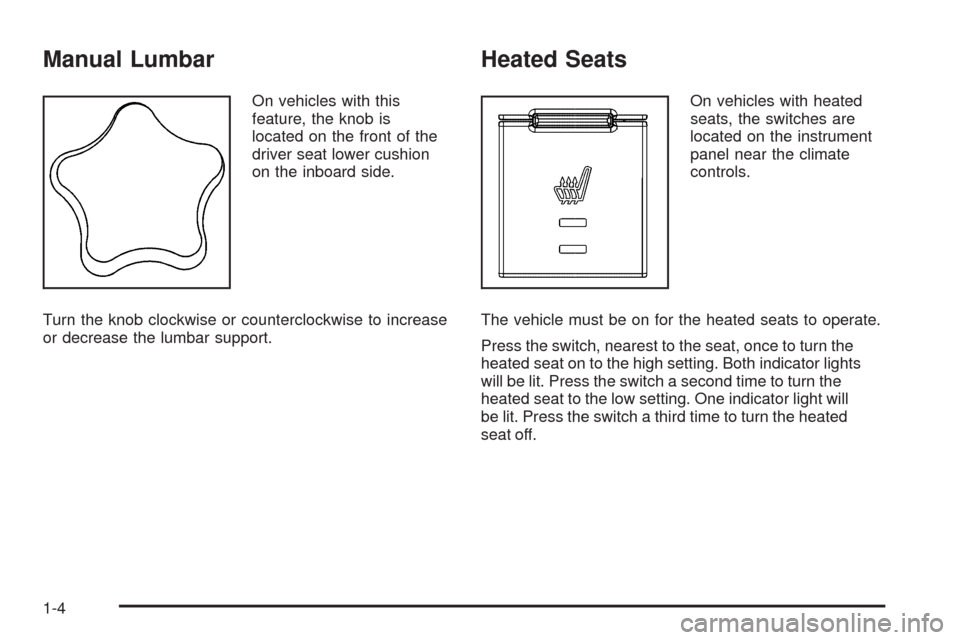
On vehicles with this
feature, the knob is
located on the front of the
driver seat lower cushion
on the inboard side.
Turn the knob clockwise or counterclockwise to increase
or decrease the lumbar support.
Heated Seats
On vehicles with heated
seats, the switches are
located on the instrument
panel near the climate
controls.
The vehicle must be on for the heated seats to operate.
Press the switch, nearest to the seat, once to turn the
heated seat on to the high setting. Both indicator lights
will be lit. Press the switch a second time to turn the
heated seat to the low setting. One indicator light will
be lit. Press the switch a third time to turn the heated
seat off.
1-4
Page 87 of 442
Remote Vehicle Start
Your vehicle may have the remote start feature. This
feature allows you to start the engine from outside
the vehicle. See “REMOTE START” underDIC Vehicle
Personalization on page 3-57for instructions on how
to enable and disable this feature.
During a remote start, the climate control system will
turn on at the fan, temperature, and mode settings the
vehicle was set to when the vehicle was last turned
off. The rear window defogger will also turn on.
If your vehicle has heated seats, they may turn on during
colder outside temperatures and will shut off when the
key is turned to ON/RUN. You may not notice an increase
in seat surface temperature until the seat is occupied for
a short period of time.
Laws in some local communities may restrict the use of
remote starters. For example, some laws may require a
person using remote start to have the vehicle in view
when doing so. Check local regulations for any
requirements on remote starting of vehicles.
If your vehicle is low on fuel, do not use the remote
start feature. The vehicle may run out of fuel.If your vehicle has the remote start feature, the RKE
transmitter functions will have an increased range
of operation. However, the range may be less while
the vehicle is running.
There are other conditions which can affect the
performance of the transmitter, seeRemote Keyless
Entry (RKE) System on page 2-4for additional
information.
/(Remote Vehicle Start):This button will be on the
RKE transmitter if you have remote start.
To start the engine using the remote start feature:
1. Aim the RKE transmitter, that has a remote vehicle
start button, at the vehicle.
2. Press and release the transmitter’s lock button,
then immediately press and hold the remote
vehicle start button. Hold the remote start button
until the vehicle’s turn signal lamps ash, or
for at least four seconds if the vehicle’s lights are
not visible. The vehicle’s doors will be locked.
Pressing the remote start button again after the
vehicle has started will turn off the ignition.
When the vehicle’s engine starts, the parking lamps
will turn on and remain on while the engine is
running.
2-7
Page 92 of 442
Lockout Protection
If you press the power door lock switch when the key is
in the ignition and any door is open, all the doors will
lock and only the driver’s door will unlock. Be sure
to remove the key from the ignition when locking your
vehicle.
If the keyless entry transmitter is used to lock the doors
and the key is in the ignition, a chime will sound
three times. All passenger doors will lock, but the
driver’s door will remain unlocked.
Liftgate
{CAUTION:
It can be dangerous to drive with the liftgate or
liftglass open because carbon monoxide (CO) gas
can come into your vehicle. You cannot see or
smell CO. It can cause unconsciousness and even
death. If you must drive with the liftgate open or if
CAUTION: (Continued)
CAUTION: (Continued)
electrical wiring or other cable connections must
pass through the seal between the body and the
liftgate or liftglass:
Make sure all other windows are shut.
Turn the fan on your climate control system to
its highest speed and select the control setting
that will force outside air into your vehicle.
See “Climate Control System” in the Index.
If you have air outlets on or under the
instrument panel, open them all the way.
SeeEngine Exhaust on page 2-34.
To unlock the liftgate, press the unlock button on the
Remote Keyless Entry (RKE) transmitter twice or use the
power door lock switch.
To lock the liftgate, press the lock button on the
RKE transmitter or use the power door lock switch.
The liftgate does not have a key lock cylinder.
To open the liftgate, press the touchpad centered on
the underside of the liftgate handle and pull up.
When closing the liftgate, use the molded handles to
pull the liftgate down. Push the liftgate closed until
it latches.
2-12
Page 129 of 442
Instrument Panel Overview...............................3-4
Hazard Warning Flashers................................3-6
Horn .............................................................3-6
Tilt Wheel.....................................................3-6
Turn Signal/Multifunction Lever.........................3-7
Turn and Lane-Change Signals........................3-7
Headlamp High/Low-Beam Changer..................3-8
Flash-to-Pass.................................................3-8
Windshield Wipers..........................................3-8
Windshield Washer.........................................3-9
Rear Window Wiper/Washer.............................3-9
Cruise Control..............................................3-10
Headlamps..................................................3-13
Headlamps on Reminder................................3-13
Daytime Running Lamps (DRL).......................3-13
Automatic Headlamp System..........................3-14
Fog Lamps ..................................................3-14
Instrument Panel Brightness...........................3-14
Dome Lamp .................................................3-15
Entry Lighting...............................................3-15
Map Lamps .................................................3-15
Cargo Lamp.................................................3-15
Electric Power Management...........................3-16
Battery Run-Down Protection..........................3-16
Accessory Power Outlet(s).............................3-17
Ashtray(s) and Cigarette Lighter......................3-17Climate Controls............................................3-18
Climate Control System.................................3-18
Outlet Adjustment.........................................3-21
Passenger Compartment Air Filter...................3-22
Warning Lights, Gages, and Indicators............3-23
Instrument Panel Cluster................................3-24
Speedometer and Odometer...........................3-25
Trip Odometer..............................................3-25
Tachometer.................................................3-25
Safety Belt Reminders...................................3-26
Airbag Readiness Light..................................3-27
Passenger Airbag Status Indicator...................3-28
Charging System Light..................................3-29
Brake System Warning Light..........................3-29
Antilock Brake System (ABS) Warning Light.....3-30
Traction Control System (TCS) Warning Light......3-31
Engine Coolant Temperature Warning Light......3-31
Engine Coolant Temperature Gage..................3-32
Tire Pressure Light.......................................3-32
Malfunction Indicator Lamp.............................3-33
Oil Pressure Light.........................................3-36
Change Engine Oil Light................................3-36
Security Light...............................................3-37
Fog Lamp Light............................................3-37
Cruise Control Light......................................3-37
Reduced Engine Power Light.........................3-38
Section 3 Instrument Panel
3-1
Page 133 of 442
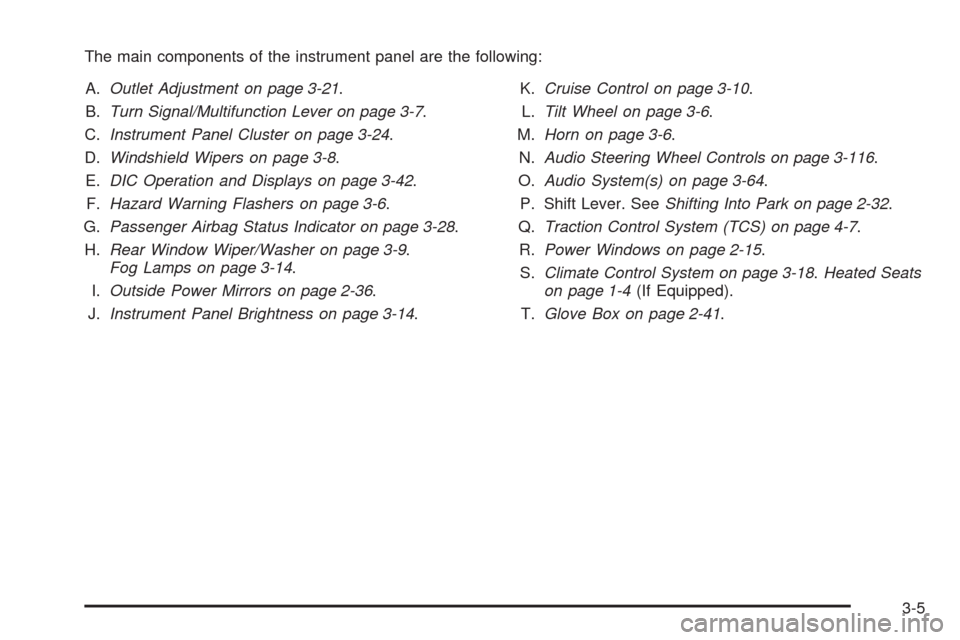
The main components of the instrument panel are the following:
A.Outlet Adjustment on page 3-21.
B.Turn Signal/Multifunction Lever on page 3-7.
C.Instrument Panel Cluster on page 3-24.
D.Windshield Wipers on page 3-8.
E.DIC Operation and Displays on page 3-42.
F.Hazard Warning Flashers on page 3-6.
G.Passenger Airbag Status Indicator on page 3-28.
H.Rear Window Wiper/Washer on page 3-9.
Fog Lamps on page 3-14.
I.Outside Power Mirrors on page 2-36.
J.Instrument Panel Brightness on page 3-14.K.Cruise Control on page 3-10.
L.Tilt Wheel on page 3-6.
M.Horn on page 3-6.
N.Audio Steering Wheel Controls on page 3-116.
O.Audio System(s) on page 3-64.
P. Shift Lever. SeeShifting Into Park on page 2-32.
Q.Traction Control System (TCS) on page 4-7.
R.Power Windows on page 2-15.
S.Climate Control System on page 3-18.Heated Seats
on page 1-4(If Equipped).
T.Glove Box on page 2-41.
3-5
Page 144 of 442
Electric Power Management
The vehicle has Electric Power Management (EPM) that
estimates the battery’s temperature and state of charge.
It then adjusts the voltage for best performance and
extended life of the battery.
When the battery’s state of charge is low, the voltage is
raised slightly to quickly bring the charge back up.
When the state of charge is high, the voltage is lowered
slightly to prevent overcharging. If the vehicle has a
voltmeter gage or a voltage display on the Driver
Information Center (DIC), you may see the voltage
move up or down. This is normal. If there is a problem,
an alert will be displayed.
The battery can be discharged at idle if the electrical
loads are very high. This is true for all vehicles.
This is because the generator (alternator) may not be
spinning fast enough at idle to produce all the power that
is needed for very high electrical loads.
A high electrical load occurs when several of the
following are on, such as: headlamps, high beams,
fog lamps, rear window defogger, climate control fan at
high speed, heated seats, engine cooling fans, trailer
loads, and loads plugged into accessory power outlets.
EPM works to prevent excessive discharge of the
battery. It does this by balancing the generator’s output
and the vehicle’s electrical needs. It can increaseengine idle speed to generate more power, whenever
needed. It can temporarily reduce the power demands of
some accessories.
Normally, these actions occur in steps or levels, without
being noticeable. In rare cases at the highest levels
of corrective action, this action may be noticeable to
the driver. If so, a Driver Information Center (DIC)
message might be displayed, such as BATTERY
SAVER ACTIVE, BATTERY VOLTAGE LOW, or
LOW BATTERY. If this message is displayed, it is
recommended that the driver reduce the electrical loads
as much as possible. SeeDIC Warnings and Messages
on page 3-49.
Battery Run-Down Protection
The vehicle has a battery saver feature designed to
protect the vehicle’s battery.
When any interior lamp is left on and the ignition is
turned off, the battery rundown protection system will
automatically turn the lamp off after 20 minutes. This will
avoid draining the battery. This vehicle also has a
retained accessory power feature. If the radio is on,
it will turn off after 10 minutes or if any door on
the vehicle is opened. SeeRetained Accessory Power
(RAP) on page 2-21.
3-16
Page 146 of 442
Climate Controls
Climate Control System
The heating, cooling, and ventilation for the vehicle can
be controlled with this system. For vehicles with the
remote start feature, the climate control system functions
as part of the remote start feature. SeeRemote
Keyless Entry (RKE) System Operation on page 2-5.
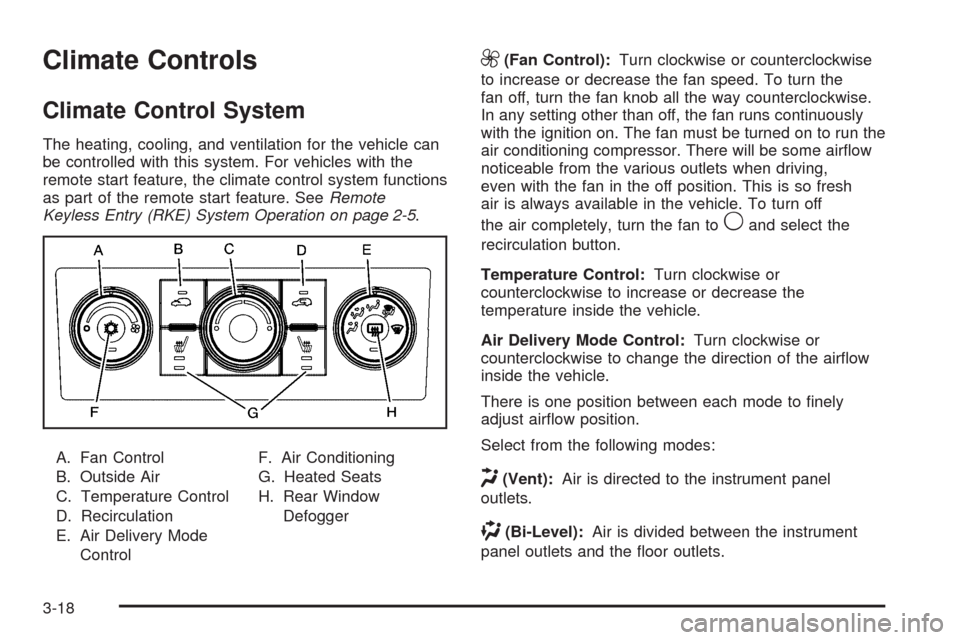
A. Fan Control
B. Outside Air
C. Temperature Control
D. Recirculation
E. Air Delivery Mode
ControlF. Air Conditioning
G. Heated Seats
H. Rear Window
Defogger
9(Fan Control):Turn clockwise or counterclockwise
to increase or decrease the fan speed. To turn the
fan off, turn the fan knob all the way counterclockwise.
In any setting other than off, the fan runs continuously
with the ignition on. The fan must be turned on to run the
air conditioning compressor. There will be some airow
noticeable from the various outlets when driving,
even with the fan in the off position. This is so fresh
air is always available in the vehicle. To turn off
the air completely, turn the fan to
9and select the
recirculation button.
Temperature Control:Turn clockwise or
counterclockwise to increase or decrease the
temperature inside the vehicle.
Air Delivery Mode Control:Turn clockwise or
counterclockwise to change the direction of the airow
inside the vehicle.
There is one position between each mode to nely
adjust airow position.
Select from the following modes:
H(Vent):Air is directed to the instrument panel
outlets.
)(Bi-Level):Air is divided between the instrument
panel outlets and the oor outlets.
3-18