2009 CHEVROLET CORVETTE instrument panel
[x] Cancel search: instrument panelPage 282 of 434
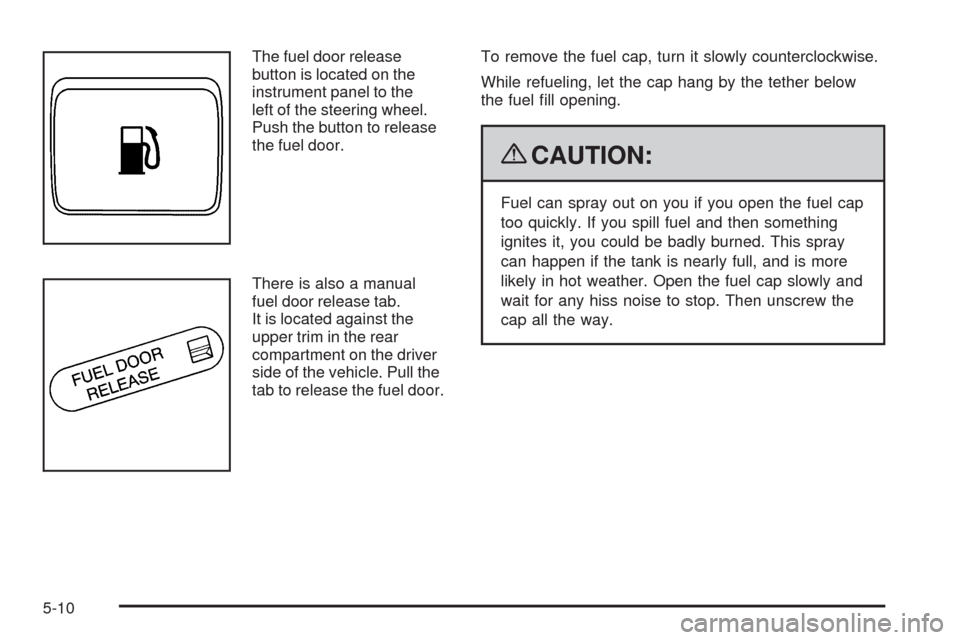
The fuel door release
button is located on the
instrument panel to the
left of the steering wheel.
Push the button to release
the fuel door.
There is also a manual
fuel door release tab.
It is located against the
upper trim in the rear
compartment on the driver
side of the vehicle. Pull the
tab to release the fuel door.To remove the fuel cap, turn it slowly counterclockwise.
While refueling, let the cap hang by the tether below
the fuel ll opening.
{CAUTION:
Fuel can spray out on you if you open the fuel cap
too quickly. If you spill fuel and then something
ignites it, you could be badly burned. This spray
can happen if the tank is nearly full, and is more
likely in hot weather. Open the fuel cap slowly and
wait for any hiss noise to stop. Then unscrew the
cap all the way.
5-10
Page 285 of 434
Hood Release
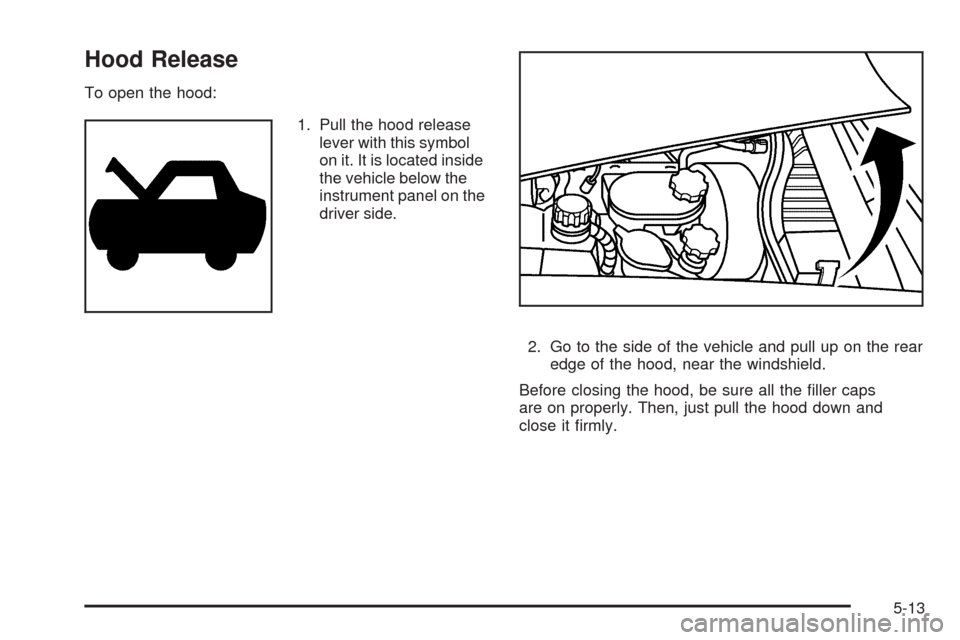
To open the hood:
1. Pull the hood release
lever with this symbol
on it. It is located inside
the vehicle below the
instrument panel on the
driver side.
2. Go to the side of the vehicle and pull up on the rear
edge of the hood, near the windshield.
Before closing the hood, be sure all the ller caps
are on properly. Then, just pull the hood down and
close it rmly.
5-13
Page 311 of 434
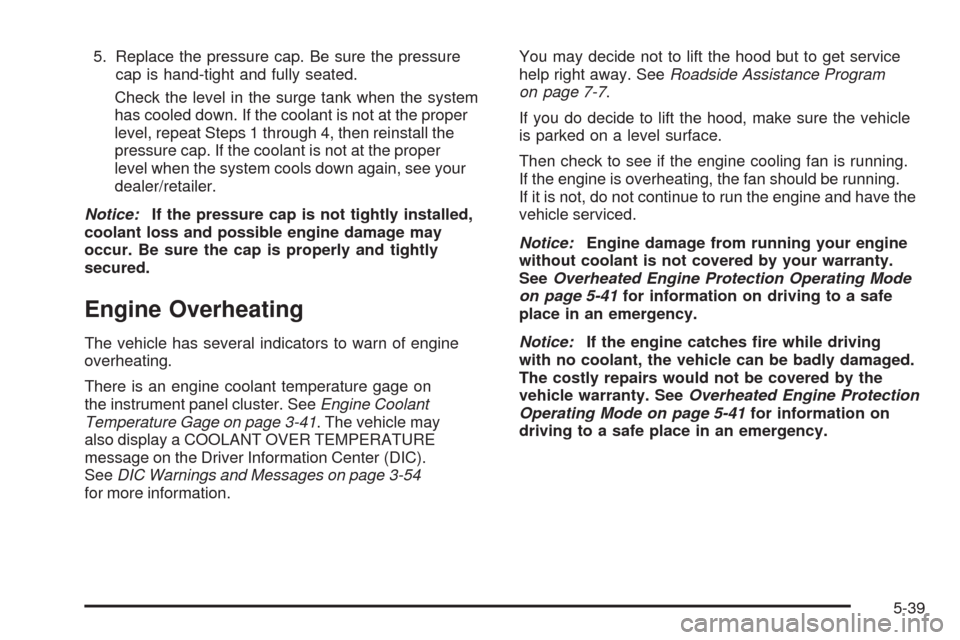
5. Replace the pressure cap. Be sure the pressure
cap is hand-tight and fully seated.
Check the level in the surge tank when the system
has cooled down. If the coolant is not at the proper
level, repeat Steps 1 through 4, then reinstall the
pressure cap. If the coolant is not at the proper
level when the system cools down again, see your
dealer/retailer.
Notice:If the pressure cap is not tightly installed,
coolant loss and possible engine damage may
occur. Be sure the cap is properly and tightly
secured.
Engine Overheating
The vehicle has several indicators to warn of engine
overheating.
There is an engine coolant temperature gage on
the instrument panel cluster. SeeEngine Coolant
Temperature Gage on page 3-41. The vehicle may
also display a COOLANT OVER TEMPERATURE
message on the Driver Information Center (DIC).
SeeDIC Warnings and Messages on page 3-54
for more information.You may decide not to lift the hood but to get service
help right away. SeeRoadside Assistance Program
on page 7-7.
If you do decide to lift the hood, make sure the vehicle
is parked on a level surface.
Then check to see if the engine cooling fan is running.
If the engine is overheating, the fan should be running.
If it is not, do not continue to run the engine and have the
vehicle serviced.
Notice:Engine damage from running your engine
without coolant is not covered by your warranty.
SeeOverheated Engine Protection Operating Mode
on page 5-41for information on driving to a safe
place in an emergency.
Notice:If the engine catches re while driving
with no coolant, the vehicle can be badly damaged.
The costly repairs would not be covered by the
vehicle warranty. SeeOverheated Engine Protection
Operating Mode on page 5-41for information on
driving to a safe place in an emergency.
5-39
Page 341 of 434

Run-Flat Tires
This vehicle, when new, had run-at tires. There is no
spare tire, no tire changing equipment, and no place
to store a tire in the vehicle. Run-at tires perform
so well without any air that a Tire Pressure Monitor
System (TPMS) is used to alert you if a tire has
lost pressure.
{CAUTION:
When the low tire warning light is displayed on
the instrument panel cluster, your vehicle’s handling
capabilities will be reduced during severe
maneuvers. If you drive too fast, you could lose
control of your vehicle. You or others could be
injured. Do not drive over 55 mph (90 km/h)
when the low tire warning light is displayed.
Drive cautiously and check your tire pressures
as soon as you can.
If a tire goes at, you will not need to stop on the side of
the road to change the tire. You can just keep on driving.
The shorter the distance you drive and the slower thespeed, the greater the chance that the tire will not have
to be replaced. If you drive on a deated run-at tire
for 25 miles (40 km) or less and at speeds of 55 mph
(90 km/h) or less, there is a good chance that the tire
can be repaired. The tires on coupe, convertible and
Z06 models can operate effectively with no air pressure
for up to 100 miles (160 km) at speeds up to 55 mph
(90 km/h), but the tire would then have to be replaced.
The tires on ZR1 models can operate effectively with no
air pressure for up to 50 miles (80 km) at speeds up to
55 mph (90 km/h), but the tire would then have to be
replaced. When a tire is lled with air, it provides a
cushion between the road and the wheel. Because you
will not have this cushion when driving on a deated tire,
try to avoid potholes that could damage your wheel and
require replacement of it.
Some road hazards can damage a tire beyond repair.
This damage could occur even before you have driven
on the tire in a deated condition. When a tire has
been damaged, or if you have driven any distance
on a run-at tire, check with an authorized run-at tire
service center to determine whether the tire can be
repaired or should be replaced. To maintain your
vehicle’s run-at feature, all replacement tires must
be self-supporting tires. As soon as possible, contact
the nearest authorized GM or run-at servicing
facility for inspection and repair or replacement.
5-69
Page 346 of 434

Federal Communications
Commission (FCC) and Industry
and Science Canada
The Tire Pressure Monitor System (TPMS) operates
on a radio frequency and complies with Part 15 of the
FCC Rules. Operation is subject to the following two
conditions:
1. This device may not cause harmful interference.
2. This device must accept any interference received,
including interference that may cause undesired
operation.
The TPMS operates on a radio frequency and complies
with RSS-210 of Industry and Science Canada.
Operation is subject to the following two conditions:
1. This device may not cause interference.
2. This device must accept any interference received,
including interference that may cause undesired
operation of the device.
Changes or modications to this system by other than
an authorized service facility could void authorization to
use this equipment.
Tire Pressure Monitor Operation
This vehicle may have a Tire Pressure Monitor
System (TPMS). The TPMS is designed to warn the
driver when a low tire pressure condition exists. TPMS
sensors are mounted onto each tire and wheel assembly
on your vehicle. The TPMS sensors monitor the air
pressure in the vehicle’s tires and transmits the tire
pressure readings to a receiver located in the vehicle.
When a low tire pressure
condition is detected, the
TPMS illuminates the low
tire pressure warning light,
located in the instrument
panel cluster.
At the same time a message to check the pressure in
a specic tire appears on the Driver Information Center
(DIC) display. The low tire pressure warning light and the
DIC warning message appear at each ignition cycle until
the tires are inated to the correct ination pressure.
Using the DIC, tire pressure levels can be viewed by
the driver. For additional information and details about
the DIC operation and displays seeDIC Operation and
Displays on page 3-49andDIC Warnings and Messages
on page 3-54.
5-74
Page 366 of 434
Leather
A soft cloth dampened with water can be used to
remove dust. If a more thorough cleaning is necessary,
a soft cloth dampened with a mild soap solution can
be used. Allow the leather to dry naturally. Do not use
heat to dry. Never use steam to clean leather. Never
use spot lifters or spot removers on leather. Many
commercial leather cleaners and coatings that are
sold to preserve and protect leather may permanently
change the appearance and feel of the leather and
are not recommended. Do not use silicone or wax-based
products, or those containing organic solvents to
clean the vehicle’s interior because they can alter the
appearance by increasing the gloss in a non-uniform
manner. Never use shoe polish on leather.
Instrument Panel, Vinyl, and Other
Plastic Surfaces
A soft cloth dampened with water may be used to
remove dust. If a more thorough cleaning is necessary,
a clean soft cloth dampened with a mild soap solution can
be used to gently remove dust and dirt. Never use spot
lifters or removers on plastic surfaces. Many commercial
cleaners and coatings that are sold to preserve and
protect soft plastic surfaces may permanently change
the appearance and feel of the interior and are not
recommended. Do not use silicone or wax-based
products, or those containing organic solvents to
clean the vehicle’s interior because they can alter the
appearance by increasing the gloss in a non-uniform
manner.
Some commercial products may increase gloss on the
instrument panel. The increase in gloss may cause
annoying reections in the windshield and even make
it difficult to see through the windshield under certain
conditions.
5-94
Page 373 of 434
Vehicle Identication
Vehicle Identication Number (VIN)
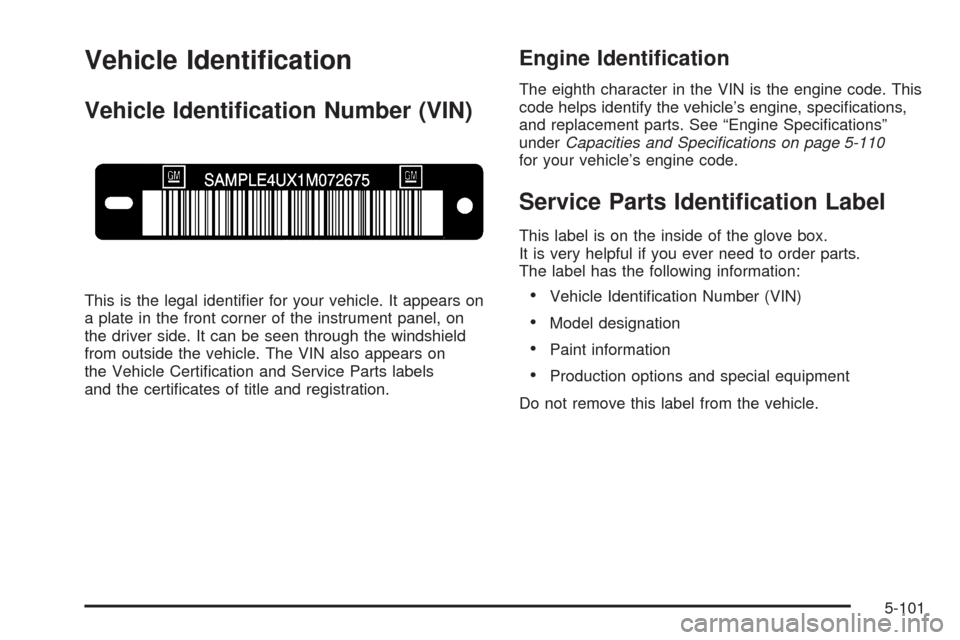
This is the legal identier for your vehicle. It appears on
a plate in the front corner of the instrument panel, on
the driver side. It can be seen through the windshield
from outside the vehicle. The VIN also appears on
the Vehicle Certication and Service Parts labels
and the certicates of title and registration.
Engine Identication
The eighth character in the VIN is the engine code. This
code helps identify the vehicle’s engine, specications,
and replacement parts. See “Engine Specications”
underCapacities and Specifications on page 5-110
for your vehicle’s engine code.
Service Parts Identication Label
This label is on the inside of the glove box.
It is very helpful if you ever need to order parts.
The label has the following information:
Vehicle Identication Number (VIN)
Model designation
Paint information
Production options and special equipment
Do not remove this label from the vehicle.
5-101
Page 375 of 434
Fuses and Circuit Breakers
The wiring circuits in the vehicle are protected
from short circuits by a combination of J-Case fuses,
mini-fuses and circuit breakers. This greatly reduces
the chance of res caused by electrical problems.
Look at the silver-colored band inside the fuse. If the
band is broken or melted, replace the fuse. Be sure
you replace a bad fuse with a new one of the identical
size and rating.
If you ever have a problem on the road and do not have
a spare fuse, you can borrow one that has the same
amperage. Just pick some feature of the vehicle that
you can get along without – like the radio or cigarette
lighter – and use its fuse, if it is the correct amperage.
Replace it as soon as you can.Vehicles with the ZR–1 package have an intercooler
relay located on the fan shroud. See your dealer/retailer.
Vehicles with the ZR–1 package also have a fuel
system mini-fuse. It is located near the battery in the
battery storage compartment in the rear of the vehicle.
Instrument Panel Fuse Block
The instrument panel fuse block is located on the
passenger side of the vehicle, under the instrument
panel and under the toe-board.
Remove the carpet and toe-board covering to access
the fuse block by pulling at the top of each corner of the
panel. Open the fuse block cover to access the fuses.
You can remove fuses using the fuse puller.
5-103