Page 181 of 354

Your Driving, the Road, and the Vehicle............4-2
Driving for Better Fuel Economy.......................4-2
Defensive Driving...........................................4-2
Drunk Driving.................................................4-3
Control of a Vehicle........................................4-3
Braking.........................................................4-4
Antilock Brake System (ABS)...........................4-5
Braking in Emergencies...................................4-6
Steering........................................................4-6
Off-Road Recovery.........................................4-8
Passing........................................................4-8
Loss of Control..............................................4-8
Driving at Night............................................4-10
Driving in Rain and on Wet Roads..................4-10Before Leaving on a Long Trip.......................4-11
Highway Hypnosis........................................4-12
Hill and Mountain Roads................................4-12
Winter Driving..............................................4-13
If Your Vehicle is Stuck in Sand, Mud, Ice,
or Snow...................................................4-15
Rocking Your Vehicle to Get It Out.................4-16
Loading the Vehicle......................................4-16
Towing..........................................................4-24
Towing Your Vehicle.....................................4-24
Recreational Vehicle Towing...........................4-24
Towing a Trailer...........................................4-27
Section 4 Driving Your Vehicle
4-1
Page 196 of 354

Rocking Your Vehicle to Get It Out
Turn the steering wheel left and right to clear the
area around the front wheels. Shift back and forth
between R (Reverse) and a forward gear, or with
a manual transmission, between 1 (First) or 2 (Second)
and R (Reverse), spinning the wheels as little as
possible. To prevent transmission wear, wait until the
wheels stop spinning before shifting gears. Release the
accelerator pedal while shifting, and press lightly on
the accelerator pedal when the transmission is in gear.
Slowly spinning the wheels in the forward and reverse
directions causes a rocking motion that could free
the vehicle. If that does not get the vehicle out after a
few tries, it might need to be towed out. If the vehicle
does need to be towed out, seeTowing Your Vehicle
on page 4-24.
Loading the Vehicle
It is very important to know how much weight
your vehicle can carry. This weight is called the
vehicle capacity weight or maximum load amount
and includes the weight of all occupants, cargo,
and all nonfactory-installed options. Two labels on
your vehicle show how much weight it may
properly carry, the Tire and Loading Information
label and the Certication label.
{CAUTION:
Do not load the vehicle any heavier than the
Gross Vehicle Weight Rating (GVWR), or
either the maximum front or rear Gross Axle
Weight Rating (GAWR). If you do, parts on
the vehicle can break, and it can change
the way your vehicle handles. These could
cause you to lose control and crash.
Also, overloading can shorten the life of
the vehicle.
4-16
Page 198 of 354
4.The resulting gure equals the available
amount of cargo and luggage load capacity.
For example, if the “XXX” amount equals
1400 lbs and there will be ve 150 lb
passengers in your vehicle, the amount of
available cargo and luggage load capacity is
650 lbs (1400 - 750 (5 x 150) = 650 lbs).
5.Determine the combined weight of luggage
and cargo being loaded on the vehicle. That
weight may not safely exceed the available
cargo and luggage load capacity calculated
in Step 4.
6.If your vehicle will be towing a trailer, the load
from your trailer will be transferred to your
vehicle. Consult this manual to determine how
this reduces the available cargo and luggage
load capacity of your vehicle.
Your vehicle is neither designed nor intended to
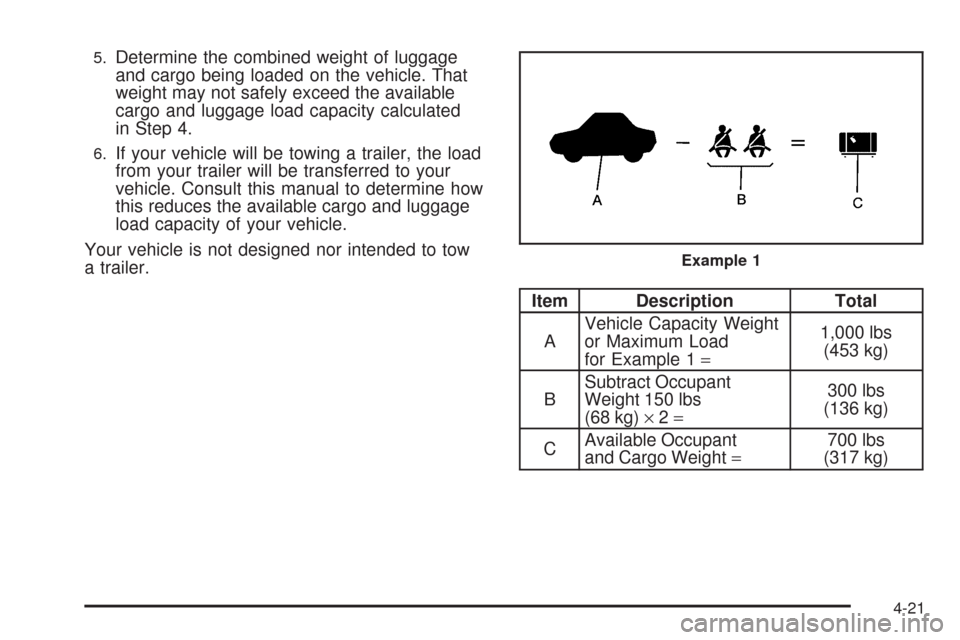
tow a trailer.Item Description Total
AVehicle Capacity Weight
for Example 1=1,000 lbs
(453 kg)
BSubtract Occupant
Weight 150 lbs
(68 kg)×2=300 lbs
(136 kg)
CAvailable Occupant
and Cargo Weight=700 lbs
(317 kg)
Example 1
4-18
Page 201 of 354
5.Determine the combined weight of luggage
and cargo being loaded on the vehicle. That
weight may not safely exceed the available
cargo and luggage load capacity calculated
in Step 4.
6.If your vehicle will be towing a trailer, the load
from your trailer will be transferred to your
vehicle. Consult this manual to determine how
this reduces the available cargo and luggage
load capacity of your vehicle.
Your vehicle is not designed nor intended to tow
a trailer.
Item Description Total
AVehicle Capacity Weight
or Maximum Load
for Example 1=1,000 lbs
(453 kg)
BSubtract Occupant
Weight 150 lbs
(68 kg)×2=300 lbs
(136 kg)
CAvailable Occupant
and Cargo Weight=700 lbs
(317 kg)
Example 1
4-21
Page 204 of 354

If you put things inside your vehicle — like
suitcases, tools, packages, or anything else — they
will go as fast as the vehicle goes. If you have to
stop or turn quickly, or if there is a crash, they will
keep going.
{CAUTION:
Things you put inside your vehicle can strike
and injure people in a sudden stop or turn, or
in a crash.
Put things in the cargo area of your
vehicle. Try to spread the weight evenly.
Never stack heavier things, like suitcases,
inside the vehicle so that some of them
are above the tops of the seats.
Do not leave an unsecured child restraint
in your vehicle.
When you carry something inside the
vehicle, secure it whenever you can.
Do not leave a seat folded down unless
you need to.
Towing
Towing Your Vehicle
To avoid damage, the disabled vehicle should be towed
with all four wheels off the ground. Consult your
dealer/retailer or a professional towing service if the
disabled vehicle must be towed. SeeRoadside
Assistance Program on page 7-7.
To tow the vehicle behind another vehicle for
recreational purposes, such as behind a motorhome,
see “Recreational Vehicle Towing” following.
Recreational Vehicle Towing
Recreational vehicle towing means towing the vehicle
behind another vehicle – such as behind a motorhome.
The two most common types of recreational vehicle
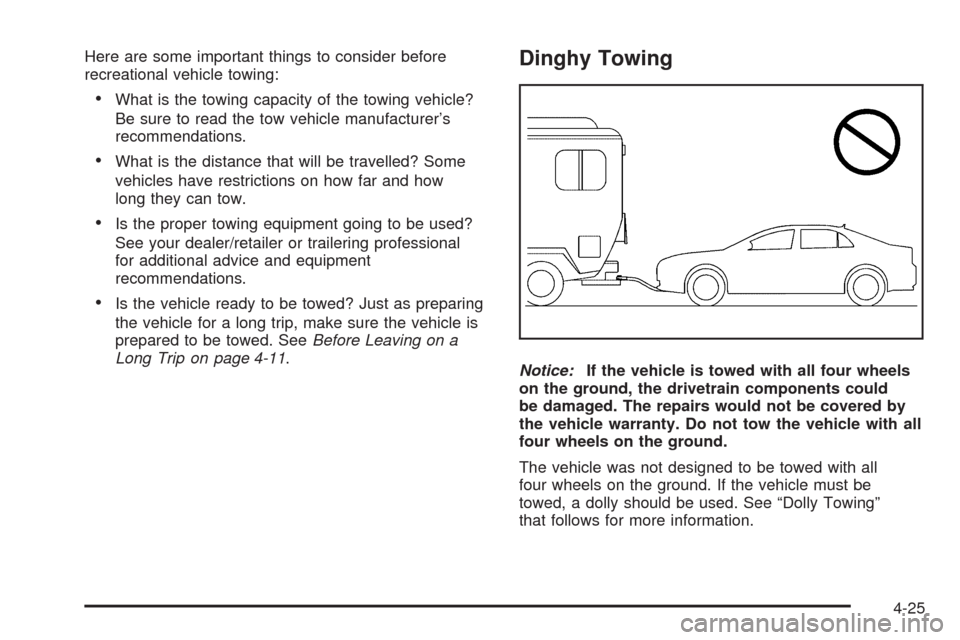
towing are known as dinghy towing and dolly towing.
Dinghy towing is towing the vehicle with all four wheels
on the ground. Dolly towing is towing the vehicle
with two wheels on the ground and two wheels up on a
device known as a dolly.
4-24
Page 205 of 354
Here are some important things to consider before
recreational vehicle towing:
What is the towing capacity of the towing vehicle?
Be sure to read the tow vehicle manufacturer’s
recommendations.
What is the distance that will be travelled? Some
vehicles have restrictions on how far and how
long they can tow.
Is the proper towing equipment going to be used?
See your dealer/retailer or trailering professional
for additional advice and equipment
recommendations.
Is the vehicle ready to be towed? Just as preparing
the vehicle for a long trip, make sure the vehicle is
prepared to be towed. SeeBefore Leaving on a
Long Trip on page 4-11.
Dinghy Towing
Notice:If the vehicle is towed with all four wheels
on the ground, the drivetrain components could
be damaged. The repairs would not be covered by
the vehicle warranty. Do not tow the vehicle with all
four wheels on the ground.
The vehicle was not designed to be towed with all
four wheels on the ground. If the vehicle must be
towed, a dolly should be used. See “Dolly Towing”
that follows for more information.
4-25
Page 206 of 354
Dolly Towing From the Front
The vehicle can be towed from the front using a dolly.
To tow the vehicle using a dolly, follow these steps:
1. Attach the dolly to the tow vehicle following the
dolly manufacturer’s instructions.
2. Drive the front wheels onto the dolly.3. Put an automatic transmission in P (Park) or a
manual transmission in N (Neutral).
4. Set the parking brake and remove the key.
5. For an automatic transmission, insert the key into
the shift-lock release slot and shift to N (Neutral).
SeeShifting Out of Park on page 2-30.
6. Clamp the steering wheel in a straight-ahead
position with a clamping device designed for
towing.
7. Release the parking brake.
4-26
Page 207 of 354
Dolly Towing From the Rear
Notice:Towing the vehicle from the rear with
the front wheels on the ground could cause
transmission damage. Do not tow the vehicle from
the rear with the front wheels on the ground.
Towing a Trailer
The vehicle is neither designed nor intended to tow
a trailer.
4-27