2009 CHEVROLET AVALANCHE weight
[x] Cancel search: weightPage 359 of 550
Autoride®
With this feature, improved vehicle ride and handling is
provided under a variety of passenger and loading
conditions.
The system is fully automatic and uses a computer
controller to continuously monitor vehicle speed, wheel
to body position, lift/dive and steering position of the
vehicle. The controller then sends signals to each shock
absorber to independently adjust the damping level to
provide the optimum vehicle ride.
Autoride also interacts with the tow/haul mode that,
when activated, will provide additional control of
the shock absorbers. This additional control results in
better ride and handling characteristics when the vehicle
is loaded or towing a trailer. See “Tow/Haul Mode”
underTowing a Trailer on page 4-47for more
information.
Towing a Trailer
Do not tow a trailer during break-in. SeeNew Vehicle
Break-In on page 2-32for more information.
{CAUTION:
The driver can lose control when pulling a trailer if
the correct equipment is not used or the vehicle is
not driven properly. For example, if the trailer is
too heavy, the brakes may not work well — or
even at all. The driver and passengers could be
seriously injured. The vehicle may also be
damaged; the resulting repairs would not be
covered by the vehicle warranty. Pull a trailer only
if all the steps in this section have been followed.
Ask your dealer/retailer for advice and information
about towing a trailer with the vehicle.
Notice:Pulling a trailer improperly can damage the
vehicle and result in costly repairs not covered
by the vehicle warranty. To pull a trailer correctly,
follow the advice in this section and see your
dealer/retailer for important information about
towing a trailer with the vehicle.
To identify the trailering capacity of the vehicle, read the
information in “Weight of the Trailer” that appears
later in this section.
4-47
Page 360 of 550
Trailering is different than just driving the vehicle by itself.
Trailering means changes in handling, acceleration,
braking, durability and fuel economy. Successful, safe
trailering takes correct equipment, and it has to be used
properly.
The following information has many time-tested,
important trailering tips and safety rules. Many of these
are important for your safety and that of your passengers.
So please read this section carefully before pulling a
trailer.
Pulling A Trailer
Here are some important points:
There are many different laws, including speed limit
restrictions, having to do with trailering. Make sure
the rig will be legal, not only where you live but
also where you will be driving. A good source for
this information can be state or provincial police.
Consider using a sway control. See “Hitches” later
in this section.
Do not tow a trailer at all during the rst 500 miles
(800 km) the new vehicle is driven. The engine,
axle or other parts could be damaged.
Then, during the rst 500 miles (800 km) that a trailer
is towed, do not drive over 50 mph (80 km/h) and do
not make starts at full throttle. This helps the engine
and other parts of the vehicle wear in at the heavier
loads.
Vehicles can tow in D (Drive). Shift the transmission
to a lower gear if the transmission shifts too often
under heavy loads and/or hilly conditions.
Three important considerations have to do with weight:
The weight of the trailer
The weight of the trailer tongue
And the weight on the vehicle’s tires
Weight of the Trailer
How heavy can a trailer safely be?
It depends on how the rig is used. For example, speed,
altitude, road grades, outside temperature and how
much the vehicle is used to pull a trailer are all
important. It can depend on any special equipment on
the vehicle, and the amount of tongue weight the vehicle
can carry. See “Weight of the Trailer Tongue” later in
this section for more information.
Maximum trailer weight is calculated assuming only the
driver is in the tow vehicle and it has all the required
trailering equipment. The weight of additional optional
equipment, passengers and cargo in the tow vehicle
must be subtracted from the maximum trailer weight.
Use the following chart to determine how much the
vehicle can weigh, based upon the vehicle model and
options.
4-48
Page 361 of 550
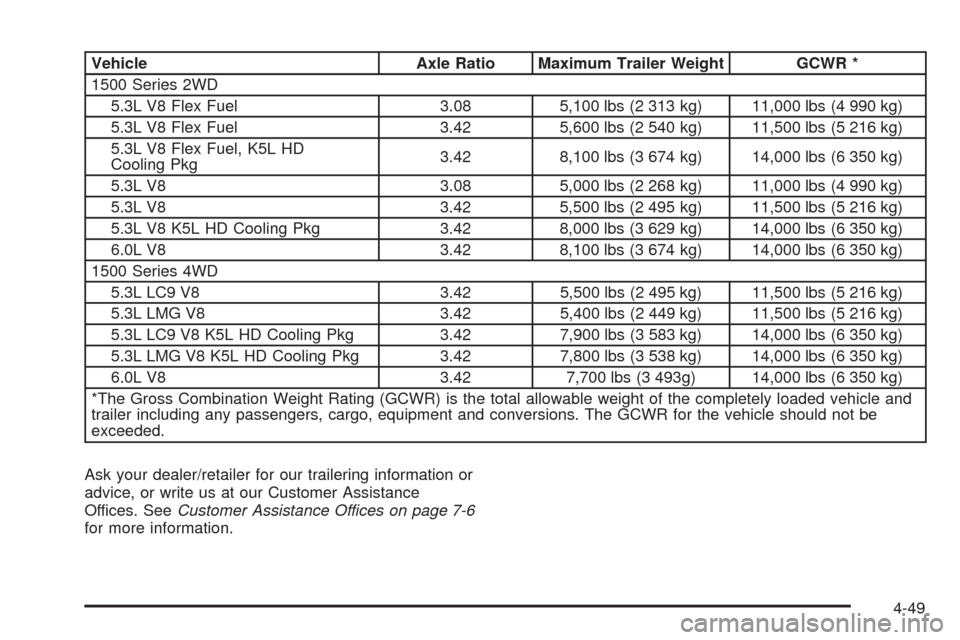
Vehicle Axle Ratio Maximum Trailer Weight GCWR *
1500 Series 2WD
5.3L V8 Flex Fuel 3.08 5,100 lbs (2 313 kg) 11,000 lbs (4 990 kg)
5.3L V8 Flex Fuel 3.42 5,600 lbs (2 540 kg) 11,500 lbs (5 216 kg)
5.3L V8 Flex Fuel, K5L HD
Cooling Pkg3.42 8,100 lbs (3 674 kg) 14,000 lbs (6 350 kg)
5.3L V8 3.08 5,000 lbs (2 268 kg) 11,000 lbs (4 990 kg)
5.3L V8 3.42 5,500 lbs (2 495 kg) 11,500 lbs (5 216 kg)
5.3L V8 K5L HD Cooling Pkg 3.42 8,000 lbs (3 629 kg) 14,000 lbs (6 350 kg)
6.0L V8 3.42 8,100 lbs (3 674 kg) 14,000 lbs (6 350 kg)
1500 Series 4WD
5.3L LC9 V8 3.42 5,500 lbs (2 495 kg) 11,500 lbs (5 216 kg)
5.3L LMG V8 3.42 5,400 lbs (2 449 kg) 11,500 lbs (5 216 kg)
5.3L LC9 V8 K5L HD Cooling Pkg 3.42 7,900 lbs (3 583 kg) 14,000 lbs (6 350 kg)
5.3L LMG V8 K5L HD Cooling Pkg 3.42 7,800 lbs (3 538 kg) 14,000 lbs (6 350 kg)
6.0L V8 3.42 7,700 lbs (3 493g) 14,000 lbs (6 350 kg)
*The Gross Combination Weight Rating (GCWR) is the total allowable weight of the completely loaded vehicle and
trailer including any passengers, cargo, equipment and conversions. The GCWR for the vehicle should not be
exceeded.
Ask your dealer/retailer for our trailering information or
advice, or write us at our Customer Assistance
Offices. SeeCustomer Assistance Offices on page 7-6
for more information.
4-49
Page 362 of 550
Weight of the Trailer Tongue
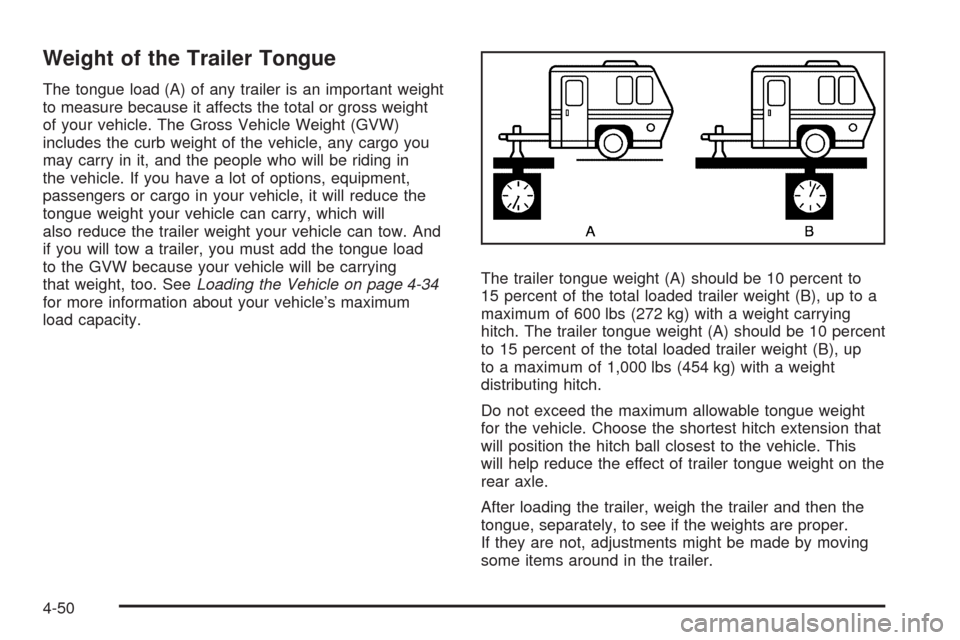
The tongue load (A) of any trailer is an important weight
to measure because it affects the total or gross weight
of your vehicle. The Gross Vehicle Weight (GVW)
includes the curb weight of the vehicle, any cargo you
may carry in it, and the people who will be riding in
the vehicle. If you have a lot of options, equipment,
passengers or cargo in your vehicle, it will reduce the
tongue weight your vehicle can carry, which will
also reduce the trailer weight your vehicle can tow. And
if you will tow a trailer, you must add the tongue load
to the GVW because your vehicle will be carrying
that weight, too. SeeLoading the Vehicle on page 4-34
for more information about your vehicle’s maximum
load capacity.The trailer tongue weight (A) should be 10 percent to
15 percent of the total loaded trailer weight (B), up to a
maximum of 600 lbs (272 kg) with a weight carrying
hitch. The trailer tongue weight (A) should be 10 percent
to 15 percent of the total loaded trailer weight (B), up
to a maximum of 1,000 lbs (454 kg) with a weight
distributing hitch.
Do not exceed the maximum allowable tongue weight
for the vehicle. Choose the shortest hitch extension that
will position the hitch ball closest to the vehicle. This
will help reduce the effect of trailer tongue weight on the
rear axle.
After loading the trailer, weigh the trailer and then the
tongue, separately, to see if the weights are proper.
If they are not, adjustments might be made by moving
some items around in the trailer.
4-50
Page 363 of 550
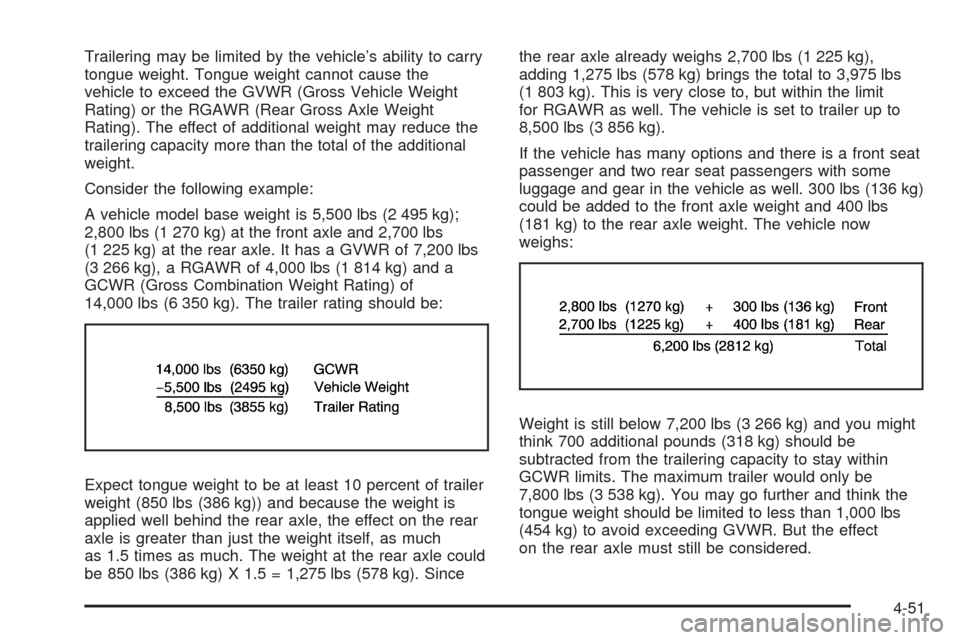
Trailering may be limited by the vehicle’s ability to carry
tongue weight. Tongue weight cannot cause the
vehicle to exceed the GVWR (Gross Vehicle Weight
Rating) or the RGAWR (Rear Gross Axle Weight
Rating). The effect of additional weight may reduce the
trailering capacity more than the total of the additional
weight.
Consider the following example:
A vehicle model base weight is 5,500 lbs (2 495 kg);
2,800 lbs (1 270 kg) at the front axle and 2,700 lbs
(1 225 kg) at the rear axle. It has a GVWR of 7,200 lbs
(3 266 kg), a RGAWR of 4,000 lbs (1 814 kg) and a
GCWR (Gross Combination Weight Rating) of
14,000 lbs (6 350 kg). The trailer rating should be:
Expect tongue weight to be at least 10 percent of trailer
weight (850 lbs (386 kg)) and because the weight is
applied well behind the rear axle, the effect on the rear
axle is greater than just the weight itself, as much
as 1.5 times as much. The weight at the rear axle could
be 850 lbs (386 kg) X 1.5 = 1,275 lbs (578 kg). Sincethe rear axle already weighs 2,700 lbs (1 225 kg),
adding 1,275 lbs (578 kg) brings the total to 3,975 lbs
(1 803 kg). This is very close to, but within the limit
for RGAWR as well. The vehicle is set to trailer up to
8,500 lbs (3 856 kg).
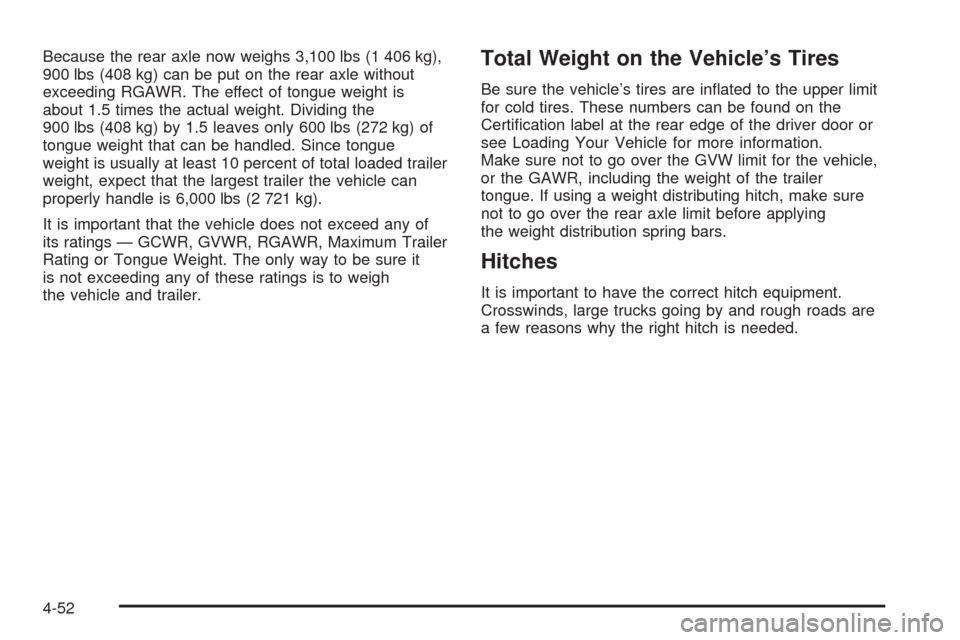
If the vehicle has many options and there is a front seat
passenger and two rear seat passengers with some
luggage and gear in the vehicle as well. 300 lbs (136 kg)
could be added to the front axle weight and 400 lbs
(181 kg) to the rear axle weight. The vehicle now
weighs:
Weight is still below 7,200 lbs (3 266 kg) and you might
think 700 additional pounds (318 kg) should be
subtracted from the trailering capacity to stay within
GCWR limits. The maximum trailer would only be
7,800 lbs (3 538 kg). You may go further and think the
tongue weight should be limited to less than 1,000 lbs
(454 kg) to avoid exceeding GVWR. But the effect
on the rear axle must still be considered.
4-51
Page 364 of 550
Because the rear axle now weighs 3,100 lbs (1 406 kg),
900 lbs (408 kg) can be put on the rear axle without
exceeding RGAWR. The effect of tongue weight is
about 1.5 times the actual weight. Dividing the
900 lbs (408 kg) by 1.5 leaves only 600 lbs (272 kg) of
tongue weight that can be handled. Since tongue
weight is usually at least 10 percent of total loaded trailer
weight, expect that the largest trailer the vehicle can
properly handle is 6,000 lbs (2 721 kg).
It is important that the vehicle does not exceed any of
its ratings — GCWR, GVWR, RGAWR, Maximum Trailer
Rating or Tongue Weight. The only way to be sure it
is not exceeding any of these ratings is to weigh
the vehicle and trailer.Total Weight on the Vehicle’s Tires
Be sure the vehicle’s tires are inated to the upper limit
for cold tires. These numbers can be found on the
Certication label at the rear edge of the driver door or
see Loading Your Vehicle for more information.
Make sure not to go over the GVW limit for the vehicle,
or the GAWR, including the weight of the trailer
tongue. If using a weight distributing hitch, make sure
not to go over the rear axle limit before applying
the weight distribution spring bars.
Hitches
It is important to have the correct hitch equipment.
Crosswinds, large trucks going by and rough roads are
a few reasons why the right hitch is needed.
4-52
Page 365 of 550
Weight-Distributing Hitches and Weight
Carrying Hitches
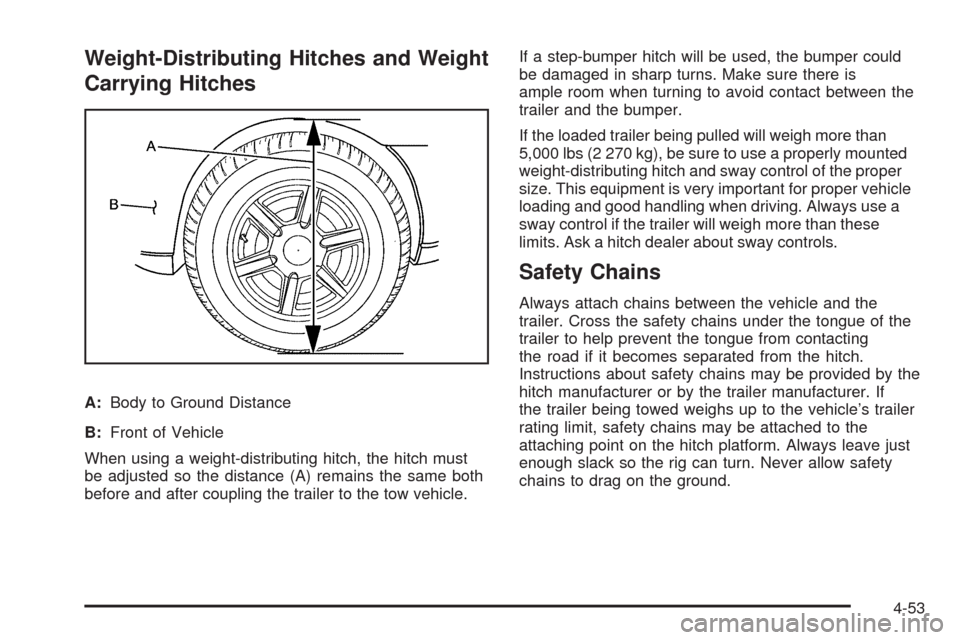
A:Body to Ground Distance
B:Front of Vehicle
When using a weight-distributing hitch, the hitch must
be adjusted so the distance (A) remains the same both
before and after coupling the trailer to the tow vehicle.If a step-bumper hitch will be used, the bumper could
be damaged in sharp turns. Make sure there is
ample room when turning to avoid contact between the
trailer and the bumper.
If the loaded trailer being pulled will weigh more than
5,000 lbs (2 270 kg), be sure to use a properly mounted
weight-distributing hitch and sway control of the proper
size. This equipment is very important for proper vehicle
loading and good handling when driving. Always use a
sway control if the trailer will weigh more than these
limits. Ask a hitch dealer about sway controls.
Safety Chains
Always attach chains between the vehicle and the
trailer. Cross the safety chains under the tongue of the
trailer to help prevent the tongue from contacting
the road if it becomes separated from the hitch.
Instructions about safety chains may be provided by the
hitch manufacturer or by the trailer manufacturer. If
the trailer being towed weighs up to the vehicle’s trailer
rating limit, safety chains may be attached to the
attaching point on the hitch platform. Always leave just
enough slack so the rig can turn. Never allow safety
chains to drag on the ground.
4-53
Page 366 of 550
Tow/Haul Mode
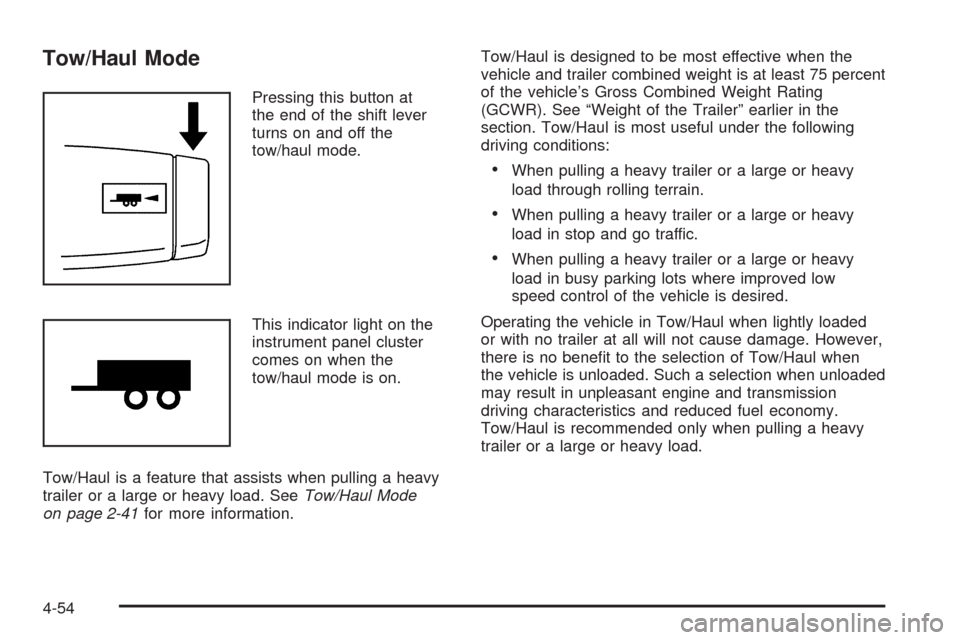
Pressing this button at
the end of the shift lever
turns on and off the
tow/haul mode.
This indicator light on the
instrument panel cluster
comes on when the
tow/haul mode is on.
Tow/Haul is a feature that assists when pulling a heavy
trailer or a large or heavy load. SeeTow/Haul Mode
on page 2-41for more information.Tow/Haul is designed to be most effective when the
vehicle and trailer combined weight is at least 75 percent
of the vehicle’s Gross Combined Weight Rating
(GCWR). See “Weight of the Trailer” earlier in the
section. Tow/Haul is most useful under the following
driving conditions:
When pulling a heavy trailer or a large or heavy
load through rolling terrain.
When pulling a heavy trailer or a large or heavy
load in stop and go traffic.
When pulling a heavy trailer or a large or heavy
load in busy parking lots where improved low
speed control of the vehicle is desired.
Operating the vehicle in Tow/Haul when lightly loaded
or with no trailer at all will not cause damage. However,
there is no benet to the selection of Tow/Haul when
the vehicle is unloaded. Such a selection when unloaded
may result in unpleasant engine and transmission
driving characteristics and reduced fuel economy.
Tow/Haul is recommended only when pulling a heavy
trailer or a large or heavy load.
4-54