2009 CADILLAC ESCALADE ESV brake
[x] Cancel search: brakePage 133 of 602

M (Manual Mode): This position lets drivers select the
range of gears appropriate for current driving conditions.
See Driver Shift Control (DSC) later in this section.
Notice: Spinning the tires or holding the vehicle in
one place on a hill using only the accelerator pedal
may damage the transmission. The repair will not be
covered by the vehicle warranty. If you are stuck, do
not spin the tires. When stopping on a hill, use the
brakes to hold the vehicle in place.
The vehicle has a shift stabilization feature that adjusts
the transmission shifting to the current driving conditions
in order to reduce rapid upshifts and downshifts. This shift
stabilization feature is designed to determine, before
making an upshift, if the engine will be able to maintain
vehicle speed by analyzing things such as vehicle speed,
throttle position and vehicle load. If the shift stabilization
feature determines that a current vehicle speed cannot be
maintained, the transmission does not upshift and instead
holds the current gear. In some cases, this may appear to
be a delayed shift, however the transmission is operating
normally. The vehicle’s transmission uses adaptive shift controls
that compares key shift parameters to pre-programmed
ideal shifts stored in the transmissions computer.
The transmission constantly makes adjustments to
improve vehicle performance according to how the
vehicle is being used, such as with a heavy load or when
temperature changes. During this adaptive shift controls
process, shifting may feel different as the transmission
determines the best settings.
When temperatures are very cold, the Hydra-Matic ®
6L80 automatic transmission’s gear shifting may
be delayed providing more stable shifts until the engine
warms up. Shifts may be more noticeable with a cold
transmission. This difference in shifting is normal.
2-31
Page 135 of 602

Tow/Haul Mode
The vehicle has a tow/haul mode. The tow/haul mode
adjusts the transmission shift pattern to reduce shift
cycling, providing increased performance, vehicle control,
and transmission cooling when towing or hauling heavy
loads.
Press the button located on the end of the shift lever to
turn the tow/haul on or off. When the tow/haul is on,
a light on the instrument panel cluster will come on.
See Tow/Haul Mode Light on page 3-46 for more
information.
Also see “Tow Haul Mode” under Towing a Trailer on
page 5-44 for more information. The tow/haul mode works with the Autoride ®
feature, if
the vehicle has this, to enhance the ride when trailering or
with a loaded vehicle. See Autoride ®
on page 5-44 .
Grade Braking The Grade Braking shift modes can be activated by
pressing the button on the end of the shift control lever.
While in Range Selection Mode, Grade Braking is
deactivated allowing the driver to select a desired range
of gears.
Grade Braking is only active while the Tow/Haul Mode is
selected and you are not in the Range Selection Mode.
See “Tow/Haul Mode listed previously and Automatic
Transmission Operation on page 2-29 for more
information on the Range Selection Mode. Grade Braking
assists in maintaining desired vehicle speeds when
driving on downhill grades by automatically implementing
a shift schedule that utilizes the engine and transmission
to slow the vehicle. This reduces wear on the braking
system and increases control of the vehicle. Grade
Braking monitors vehicle speed, acceleration, engine
torque and brake pedal usage. Using this information, it
detects when the vehicle is on a downhill grade and the
driver desires to slow the vehicle by pressing the brake.
Also see Towing a Trailer on page 5-44 for more
information.
2-33
Page 136 of 602
Cruise Grade Braking Cruise Grade Braking assists when driving on a downhill
grade. It maintains vehicle speed by automatically
implementing a shift schedule that uses the engine and
the transmission to slow the vehicle. Cruise Grade
Braking operates while Cruise Control is engaged in
Tow/Haul mode to assist in maintaining vehicle speed
under loaded vehicle conditions. It utilizes vehicle
acceleration and deviation from desired speed to
determine the correct gear for the operating condition.
If vehicle speed is above the desired speed the
transmission will downshift to slow the vehicle.
If vehicle speed is near or below desired speed the
trans will upshift, allowing vehicle speed to increase.
While in the Range Select Mode (RSM) mode, cruise
grade braking is not available.
See Automatic Transmission Operation on page 2-29 .Parking Brake
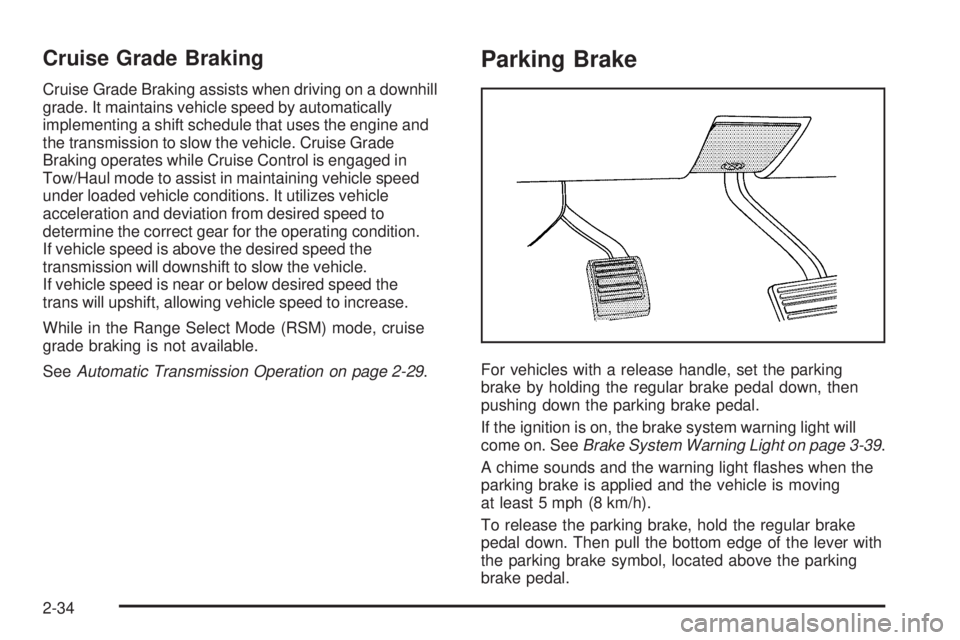
For vehicles with a release handle, set the parking
brake by holding the regular brake pedal down, then
pushing down the parking brake pedal.
If the ignition is on, the brake system warning light will
come on. See Brake System Warning Light on page 3-39 .
A chime sounds and the warning light ashes when the
parking brake is applied and the vehicle is moving
at least 5 mph (8 km/h).
To release the parking brake, hold the regular brake
pedal down. Then pull the bottom edge of the lever with
the parking brake symbol, located above the parking
brake pedal.
2-34
Page 137 of 602

If the ignition is on when the parking brake is released,
the brake system warning light goes off.
Notice: Driving with the parking brake on can
overheat the brake system and cause premature
wear or damage to brake system parts. Make sure
that the parking brake is fully released and the brake
warning light is off before driving.
If you are towing a trailer and are parking on any hill,
see Towing a Trailer on page 5-44 .
For vehicles without a release handle, set the parking
brake by holding the regular brake pedal down,
then pushing down the parking brake pedal. If the ignition is on, the brake system warning light will
come on. See Brake System Warning Light on
page 3-39 .
Notice: Driving with the parking brake on can
overheat the brake system and cause premature
wear or damage to brake system parts. Make sure
that the parking brake is fully released and the brake
warning light is off before driving.
To release the parking brake, hold the regular brake
pedal down, then push down momentarily on the parking
brake pedal until you feel the pedal release. Slowly
pull your foot up off the park brake pedal. If the parking
brake is not released when you begin to drive, the
brake system warning light will ash and a chime will
sound warning you that the parking brake is still on.
If you are towing a trailer and are parking on a hill, see
Towing a Trailer on page 5-44 .
2-35
Page 138 of 602

Shifting Into Park
{ CAUTION: It can be dangerous to get out of the vehicle if the
shift lever is not fully in P (Park) with the parking
brake rmly set. The vehicle can roll. If you have
left the engine running, the vehicle can move
suddenly. You or others could be injured. To be
sure the vehicle will not move, even when you are
on fairly level ground, use the steps that follow.
If you are pulling a trailer, see Towing a Trailer on
page 5-44 .
1. Hold the brake pedal down, then set the parking
brake.
2. Move the shift lever into the P (Park) position by
pulling the shift lever toward you and moving it up
as far as it will go.
3. Turn the ignition key to LOCK/OFF.
4. Remove the key and take it with you. If you can
leave the vehicle with the ignition key in your
hand, the vehicle is in P (Park). Leaving the Vehicle With the Engine
Running
{ CAUTION: It can be dangerous to leave the vehicle with the
engine running. The vehicle could move suddenly if
the shift lever is not fully in P (Park) with the parking
brake rmly set. And, if you leave the vehicle with
the engine running, it could overheat and even
catch re. You or others could be injured. Do not
leave the vehicle with the engine running.
If you have to leave the vehicle with the engine running,
be sure the vehicle is in P (Park) and the parking
brake is rmly set. After the shift lever is moved into
P (Park), hold the regular brake pedal down. Then, see
if you can move the shift lever away from P (Park)
without rst pulling it toward you. If you can, it means
that the shift lever was not fully locked into P (Park).
2-36
Page 139 of 602

Torque Lock If you are parking on a hill and you do not shift the
transmission into P (Park) properly, the weight of the
vehicle can put too much force on the parking pawl in the
transmission. It might be difficult to pull the shift lever out
of P (Park). This is called torque lock. To prevent torque
lock, set the parking brake and then shift into P (Park)
properly before you leave the driver seat. To nd out how,
see Shifting Into Park on page 2-36 .
When you are ready to drive, move the shift lever out of
P (Park) before releasing the parking brake.
If torque lock does occur, you might need to have another
vehicle push yours a little uphill to take some of the
pressure from the parking pawl in the transmission. Then
you should be able to pull the shift lever out of P (Park).
Shifting Out of Park This vehicle is equipped with an electronic shift lock
release system. The shift lock release is designed to:
Prevent ignition key removal unless the shift
lever is in P (Park) with the shift lever button fully
released, and
Prevent movement of the shift lever out of
P (Park), unless the ignition is in ON/RUN or ACC/
ACCESSORY and the regular brake pedal is applied. The shift lock release is always functional except in the
case of an uncharged or low voltage (less than 9 volt)
battery.
If the vehicle has an uncharged battery or a battery with
low voltage, try charging or jump starting the battery.
See Jump Starting on page 6-40 for more information.
To shift out of P (Park) use the following:
1. Apply the brake pedal.
2. Move the shift lever to the desired position.
If you still are unable to shift out of P (Park):
1. Ease the pressure on the shift lever.
2. While holding down the brake pedal, press the shift
lever all the way into P (Park).
3. Move the shift lever to the desired position.
If you are still having a problem shifting, then have the
vehicle serviced soon.
2-37
Page 141 of 602

Running the Vehicle While Parked It is better not to park with the engine running. But if you
ever have to, here are some things to know.
{ CAUTION: Idling a vehicle in an enclosed area with poor
ventilation is dangerous. Engine exhaust may
enter the vehicle. Engine exhaust contains Carbon
Monoxide (CO) which cannot be seen or smelled.
It can cause unconsciousness and even death.
Never run the engine in an enclosed area that has
no fresh air ventilation. For more information, see
Engine Exhaust on page 2-38 .{ CAUTION: It can be dangerous to get out of the vehicle
if the automatic transmission shift lever is not
fully in P (Park) with the parking brake rmly set.
The vehicle can roll. Do not leave the vehicle
when the engine is running unless you have to.
If you have left the engine running, the vehicle can
move suddenly. You or others could be injured.
To be sure the vehicle will not move, even when
you are on fairly level ground, always set the
parking brake and move the shift lever to P (Park).
Follow the proper steps to be sure the vehicle will not
move. See Shifting Into Park on page 2-36 .
If parking on a hill and pulling a trailer, see Towing a
Trailer on page 5-44 .
2-39
Page 146 of 602

When the System Does Not Seem to
Work Properly If the URPA system will not activate due to a temporary
condition, the message PARK ASSIST OFF will be
displayed on the DIC and a red light will be shown on
the rear URPA display when the shift lever is moved into
R (Reverse). This occurs under the following conditions:
The driver disables the system.
The ultrasonic sensors are not clean. Keep the
vehicle’s rear bumper free of mud, dirt, snow,
ice and slush. For cleaning instructions, see
Washing Your Vehicle on page 6-100 .
A trailer was attached to the vehicle, or a bicycle or
an object was hanging out of the liftgate during the
last drive cycle, the red light may illuminate in the
rear display. Once the attached object is removed,
URPA will return to normal operation.
A tow bar is attached to the vehicle.
The vehicle’s bumper is damaged. Take the vehicle
to your dealer/retailer to repair the system.
Other conditions may affect system performance,
such as vibrations from a jackhammer or the
compression of air brakes on a very large truck.
If the system is still disabled, after driving forward at least
15 mph (25 km/h), take the vehicle to your dealer/retailer. Side Blind Zone Alert (SBZA) The vehicle may have a Side Blind Zone Alert (SBZA)
system. Read this entire section before using the system.
The SBZA system operates on a radio frequency
subject to Federal Communications Commission (FCC)
Rules and with Industry Canada.
This device complies with Part 15 of the FCC Rules.
Operation is subject to the following two conditions:
1. This device may not cause harmful interference.
2. This device must accept any interference received,
including interference that may cause undesired
operation.
This device complies with RSS-310 of Industry Canada.
Operation is subject to the following two conditions:
1. This device may not cause harmful interference.
2. This device must accept any interference received,
including interference that may cause undesired
operation.
Frequency of operation: 24.05GHz – 24.25GHz
Field Strength: Not greater than 2.5V/m peak (0.25V/m
average) at a distance of 3m
2-44