2009 CADILLAC CTS brake
[x] Cancel search: brakePage 123 of 490

2 (Second):Press the clutch pedal as you let up
on the accelerator pedal and shift into 2 (Second).
Then, slowly let up on the clutch pedal as you press
the accelerator pedal.
3 (Third), 4 (Fourth), 5 (Fifth) and 6 (Sixth):Shift into
3 (Third), 4 (Fourth), 5 (Fifth) and 6 (Sixth) the same
way you do for 2 (Second). Slowly let up on the clutch
pedal as you press the accelerator pedal.
To stop, let up on the accelerator pedal and press the
brake pedal. Just before the vehicle stops, press the
clutch pedal and the brake pedal, and shift to Neutral.
Neutral:Use this position when you start or idle your
engine. Your shift lever is in Neutral when it is centered
in the shift pattern, not in any gear.
R (Reverse):To back up, press down the clutch pedal,
completely stop the vehicle, and shift into R (Reverse).
Let up on the clutch pedal slowly while pressing the
accelerator pedal.
The CTS-V transmission prevents you from easily
shifting into R (Reverse) using normal shifting force while
the vehicle is moving at more than 3 mph (5 km/h), or
when the ignition is in LOCK/OFF.Shift Speeds (Manual Transmission)
{CAUTION:
If you skip a gear when you downshift, you could
lose control of the vehicle. You could injure
yourself or others. Do not shift down more than
one gear at a time when you downshift.
Notice:If you skip more than one gear when you
downshift, or if you race the engine when you release
the clutch pedal while downshifting, you could
damage the engine, clutch, driveshaft or the
transmission. Do not skip gears or race the engine
when downshifting.
If the vehicle speed drops below 20 mph (32 km/h), or if
the engine is not running smoothly, you should downshift
to the next lower gear. You may have to downshift two or
more gears to keep the engine running smoothly or for
good performance.
2-41
Page 124 of 490

Up-Shift Light
CTS vehicles with a manual
transmission have an
economy up-shift light on
the instrument panel. This
light shows when to shift to
the next higher gear for the
best fuel economy.
When this light comes on, you can shift to the next
higher gear if weather, road, and traffic conditions allow.
For the best fuel economy, accelerate slowly and
shift when the light comes on.
While you accelerate, it is normal for the light to go on
and off if you quickly change the position of the
accelerator. Ignore the light when you downshift.
CTS-V vehicles use tracer lights around the outside of
the tachometer as a performance up-shift light.
These tracers ash to indicate when to shift to the next
higher gear to avoid the engine speed limit. See
Tachometer on page 3-34for more information.
Skip Shift (CTS-V)
Under light acceleration, the transmission will only
allow you to shift from 1 (First) to 4 (Fourth). Shifts from
1 (First) to 2 (Second) or 3 (Third) are not allowed.
This helps improve fuel mileage.
Under harder acceleration, Skip Shift is disabled, and
the driver has all gears available.
Parking Brake
The parking brake pedal is
located on the lower portion
of the instrument panel to
the left of the steering
wheel.
To set the parking brake, hold the brake pedal down,
then push the parking brake pedal down.
2-42
Page 125 of 490
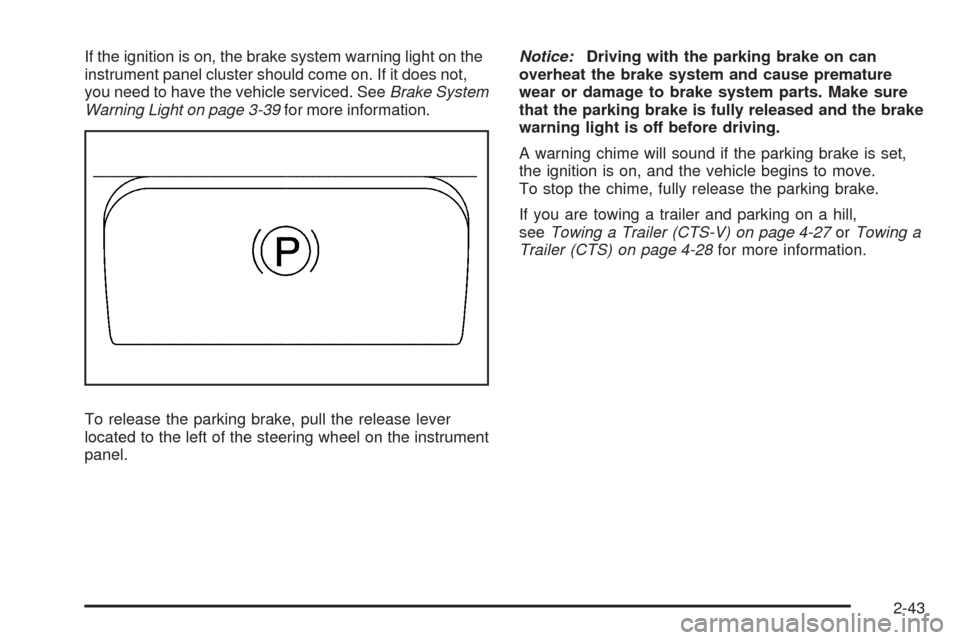
If the ignition is on, the brake system warning light on the
instrument panel cluster should come on. If it does not,
you need to have the vehicle serviced. SeeBrake System
Warning Light on page 3-39for more information.
To release the parking brake, pull the release lever
located to the left of the steering wheel on the instrument
panel.Notice:Driving with the parking brake on can
overheat the brake system and cause premature
wear or damage to brake system parts. Make sure
that the parking brake is fully released and the brake
warning light is off before driving.
A warning chime will sound if the parking brake is set,
the ignition is on, and the vehicle begins to move.
To stop the chime, fully release the parking brake.
If you are towing a trailer and parking on a hill,
seeTowing a Trailer (CTS-V) on page 4-27orTowing a
Trailer (CTS) on page 4-28for more information.
2-43
Page 126 of 490

Electric Parking Brake
{CAUTION:
On vehicles with a manual transmission, releasing
the clutch and pressing the accelerator will release
the Electric Parking Brake. If the vehicle is not in a
gear, the vehicle could move, and you or others
could be injured. Make sure the vehicle is in a
gear before attempting to drive away. To avoid
unexpected vehicle movement, do not partially
release the clutch or press the accelerator pedal
until you are ready to release the parking brake
and drive away.Vehicles with
the Electric
Parking Brake
(EPB) have
a switch in the
center console.
The EPB takes the place of the manual parking brake
system, the foot pedal and release handle. The system
has two warning lights and ve Driver Information Center
(DIC) messages. SeeBrake System Warning Light on
page 3-39andDIC Warnings and Messages on
page 3-58for more information. In case of insufficient
electrical power, the EPB cannot be applied or released.
2-44
Page 127 of 490

EPB Apply
The EPB can be applied any time the vehicle is stopped.
The EPB is applied by momentarily lifting up on the EPB
switch. Once fully applied, the BRAKE light will be on,
and the DIC message “Park Brake Set” will be displayed.
If the light does not come on, or is ashing, you need to
have the vehicle serviced. Do not drive the vehicle if
the BRAKE light is ashing. See your dealer/retailer.
SeeBrake System Warning Light on page 3-39for more
information.
If the EPB is applied while the vehicle is in motion,
a chime will sound, and the DIC message “Release
Park Brake Switch” will be displayed. The vehicle
will decelerate as long as the switch is held in the
up position. Releasing the EPB switch during the
deceleration will release the parking brake. If the
switch is held in the up position until the vehicle
comes to a stop, the EPB will remain applied.
If the BRAKE light is on, either the EPB is applied, or
there is a failure in the hydraulic brake system.If this light is ashing, the EPB is only partially applied
or released, or there is a problem with the EPB.
The DIC message “Service Park Brake” will be
displayed. If this light is ashing, release the EPB, and
attempt to apply it again. If this light continues to
ash, do not drive the vehicle. See your dealer/retailer.
If the
Ylight is on, the EPB has detected an error
in another system and is operating with reduced
functionality. To apply the EPB when this light is on, lift up
on the EPB switch and hold it in the up position. Full
application of the parking brake by the EPB system may
take a longer period of time than normal when this light is
on. Continue to hold the switch until the BRAKE light
remains on. If the
Ylight is on, see your dealer/retailer.
If the EPB fails to apply, the rear wheels should be
blocked to prevent vehicle movement.
2-45
Page 128 of 490

EPB Release
To release the EPB, turn the ignition switch to the
ON/RUN position, apply and hold the brake pedal, and
push down momentarily on the EPB switch. If you attempt
to release the EPB without the brake pedal applied, a
chime will sound, and the DIC message “Press Brake
Pedal to Release Park Brake” will be displayed. The EPB
is released when the BRAKE light is off and the DIC
message “Park Brake Released” is displayed.
If the
Ylight is on, the EPB has detected an error
in another system and is operating with reduced
functionality. To release the EPB when this light is on,
push down on the EPB switch and hold it in the down
position. EPB release may take a longer period of time
than normal when this light is on. Continue to hold the
switch until the BRAKE light is off. If the
Ylight is on,
see your dealer/retailer.
Notice:Driving with the parking brake on can
overheat the brake system and cause premature
wear or damage to brake system parts. Make sure
that the parking brake is fully released and the brake
warning light is off before driving.
Automatic EPB Release
The EPB will automatically release if the vehicle is
running, placed into gear and an attempt is made to
drive away. Avoid rapid acceleration when the EPB
is applied, to preserve park brake lining life.
The EPB can also be used to prevent roll back for
vehicles with a manual transmission taking off on a hill.
In a situation where no roll back is desired, an applied
EPB will allow both feet to be used for the clutch
and accelerator pedals in preparation for starting the
vehicle moving in the intended direction.
In this situation, perform the normal clutch and
accelerator actions required to begin moving the vehicle.
There is no need to push the switch to release the EPB.
If you are towing a trailer and parking on a hill, see
Towing a Trailer (CTS-V) on page 4-27orTowing
a Trailer (CTS) on page 4-28for more information.
2-46
Page 129 of 490

Shifting Into Park
(Automatic Transmission)
{CAUTION:
It can be dangerous to get out of the vehicle if the
shift lever is not fully in P (Park) with the parking
brake rmly set. The vehicle can roll. If you have left
the engine running, the vehicle can move suddenly.
You or others could be injured. To be sure the
vehicle will not move, even when you are on fairly
level ground, use the steps that follow. If you are
pulling a trailer, seeTowing a Trailer (CTS-V) on
page 4-27orTowing a Trailer (CTS) on page 4-28.Use this procedure to shift into P (Park):
1. Hold the brake pedal down and set the parking
brake.
SeeParking Brake on page 2-42for more
information.
2. Move the shift lever into P (Park) by holding in the
button on the shift lever and pushing the lever all
the way toward the front of the vehicle.
3. Turn the ignition key to LOCK/OFF.
4. For vehicles with key access, remove the key and
take it with you. If you can leave the vehicle with
the ignition key in your hand, the vehicle is in
P (Park). Vehicles with the keyless access system,
take the keyless access transmitter with you.
2-47
Page 130 of 490

Leaving the Vehicle With the Engine
Running (Automatic Transmission)
{CAUTION:
It can be dangerous to leave the vehicle with the
engine running. The vehicle could move suddenly if
the shift lever is not fully in P (Park) with the parking
brake rmly set. And, if you leave the vehicle with
the engine running, it could overheat and even
catch re. You or others could be injured. Do not
leave the vehicle with the engine running.
If you have to leave the vehicle with the engine running,
the vehicle must be in P (Park) and the parking brake
set. After shifting into P (Park), try to move the shift lever
out without rst pushing the button on the shift lever.
If you can, the shift lever was not fully locked into
P (Park).
Torque Lock (Automatic Transmission)
Torque lock is when the weight of the vehicle puts too
much force on the parking pawl in the transmission.
This happens when parking on a hill and shifting the
transmission into P (Park) is not done properly and then it
is difficult to shift out of P (Park). To prevent torque lock,
set the parking brake and then shift into P (Park). To nd
out how, see″Shifting Into P (Park)″listed previously.
If torque lock does occur, your vehicle may need to be
pushed uphill by another vehicle to relieve the parking
pawl pressure, so you can shift out of P (Park).
Shifting Out of Park
This vehicle is equipped with an electronic shift lock
release system. The shift lock release is designed to:
Prevent ignition key removal unless the shift
lever is in P (Park) with the shift lever button fully
released, for vehicles with key access.
Prevent movement of the shift lever out of P (Park),
unless the ignition is in ON/RUN or
ACC/ACCESSORY and the brake pedal is applied.
The shift lock release is always functional except in the
case of an uncharged or low voltage (less than 9 volt)
battery.
2-48