2009 CADILLAC CTS radio
[x] Cancel search: radioPage 150 of 490

Malfunction Indicator Lamp.............................3-43
Oil Pressure Light.........................................3-46
Engine Oil Pressure Gage.............................3-47
Security Light...............................................3-48
Fog Lamp Light............................................3-48
Lights On Reminder......................................3-48
Cruise Control Light......................................3-48
Highbeam On Light.......................................3-49
Fuel Gage...................................................3-49
Boost Gage.................................................3-50
Driver Information Center (DIC).......................3-50
DIC Operation and Displays...........................3-51
DIC Compass..............................................3-56DIC Warnings and Messages.........................3-58
DIC Vehicle Customization.............................3-72
Audio System(s).............................................3-85
Radio(s)......................................................3-86
Using an MP3............................................3-108
XM Radio Messages...................................3-112
Navigation/Radio System..............................3-113
Bluetooth
®.................................................3-113
Theft-Deterrent Feature................................3-126
Audio Steering Wheel Controls......................3-126
Radio Reception.........................................3-127
Backglass Antenna......................................3-128
XM™ Satellite Radio Antenna System..............3-128
Section 3 Instrument Panel
3-2
Page 153 of 490
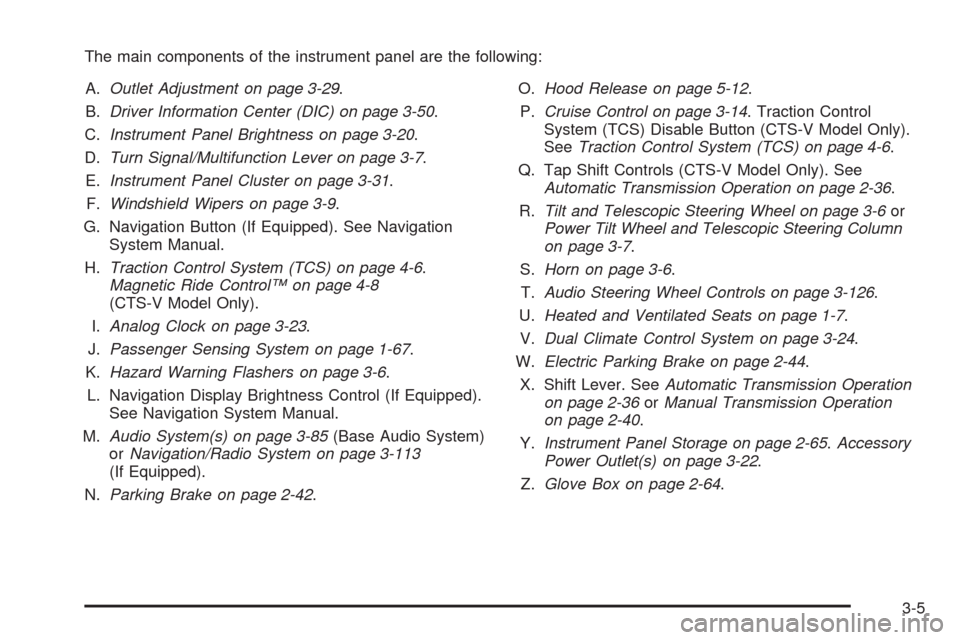
The main components of the instrument panel are the following:
A.Outlet Adjustment on page 3-29.
B.Driver Information Center (DIC) on page 3-50.
C.Instrument Panel Brightness on page 3-20.
D.Turn Signal/Multifunction Lever on page 3-7.
E.Instrument Panel Cluster on page 3-31.
F.Windshield Wipers on page 3-9.
G. Navigation Button (If Equipped). See Navigation
System Manual.
H.Traction Control System (TCS) on page 4-6.
Magnetic Ride Control™ on page 4-8
(CTS-V Model Only).
I.Analog Clock on page 3-23.
J.Passenger Sensing System on page 1-67.
K.Hazard Warning Flashers on page 3-6.
L. Navigation Display Brightness Control (If Equipped).
See Navigation System Manual.
M.Audio System(s) on page 3-85(Base Audio System)
orNavigation/Radio System on page 3-113
(If Equipped).
N.Parking Brake on page 2-42.O.Hood Release on page 5-12.
P.Cruise Control on page 3-14. Traction Control
System (TCS) Disable Button (CTS-V Model Only).
SeeTraction Control System (TCS) on page 4-6.
Q. Tap Shift Controls (CTS-V Model Only). See
Automatic Transmission Operation on page 2-36.
R.Tilt and Telescopic Steering Wheel on page 3-6or
Power Tilt Wheel and Telescopic Steering Column
on page 3-7.
S.Horn on page 3-6.
T.Audio Steering Wheel Controls on page 3-126.
U.Heated and Ventilated Seats on page 1-7.
V.Dual Climate Control System on page 3-24.
W.Electric Parking Brake on page 2-44.
X. Shift Lever. SeeAutomatic Transmission Operation
on page 2-36orManual Transmission Operation
on page 2-40.
Y.Instrument Panel Storage on page 2-65.Accessory
Power Outlet(s) on page 3-22.
Z.Glove Box on page 2-64.
3-5
Page 171 of 490
Ashtray(s) and Cigarette Lighter
The vehicle may have two removable ashtrays and
cigarette lighters. One ashtray can be placed into the
instrument panel storage compartment and the other
into the center console rear compartment. To use
the lighter, push it in all the way and let go. When it is
ready, it will pop back out by itself.
To empty the ashtrays, hold on to the edges of the bin
and pull straight out. To reinstall, push the tray back
into place.
Notice:Holding a cigarette lighter in while it is
heating does not let the lighter back away from the
heating element when it is hot. Damage from
overheating can occur to the lighter or heating
element, or a fuse could be blown. Do not hold a
cigarette lighter in while it is heating.
Notice:If papers, pins, or other ammable items
are put in the ashtray, hot cigarettes or other
smoking materials could ignite them and possibly
damage the vehicle. Never put ammable items
in the ashtray.
Analog Clock
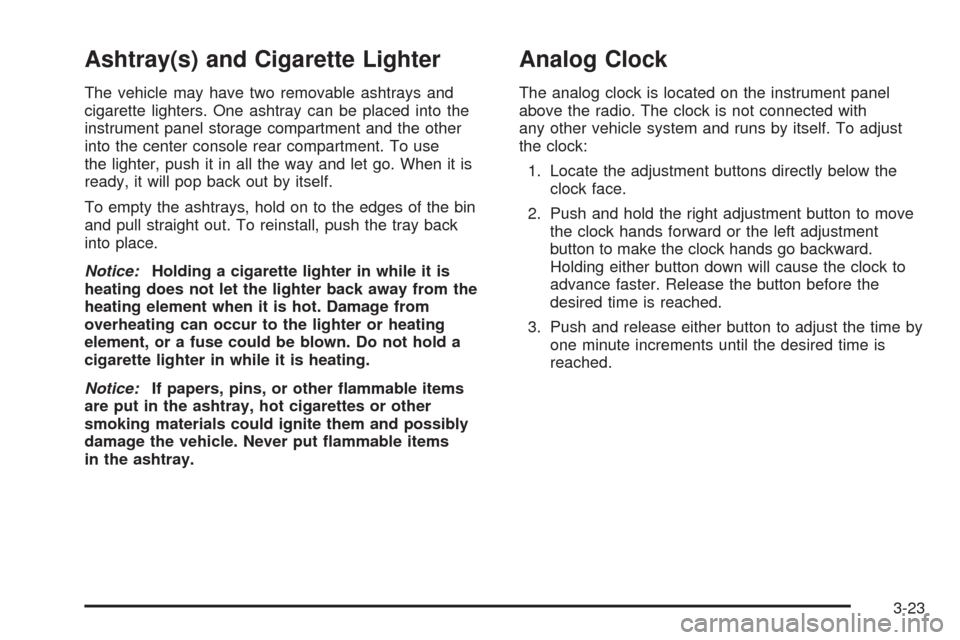
The analog clock is located on the instrument panel
above the radio. The clock is not connected with
any other vehicle system and runs by itself. To adjust
the clock:
1. Locate the adjustment buttons directly below the
clock face.
2. Push and hold the right adjustment button to move
the clock hands forward or the left adjustment
button to make the clock hands go backward.
Holding either button down will cause the clock to
advance faster. Release the button before the
desired time is reached.
3. Push and release either button to adjust the time by
one minute increments until the desired time is
reached.
3-23
Page 175 of 490

M/F(Recirculation/Outside Air):Press this
button to switch between recirculation and outside
air modes. The indicator light comes on to show which
mode is being used. The recirculation mode recirculates
and helps to quickly cool the air inside the vehicle.
It can be used to prevent outside air and odors from
entering the vehicle. Press the auto button to have
the system select the best air delivery mode for
the temperature setting.
Recirculation is not available in the defrost mode and
automatically turns off 10 minutes after defog is selected.
This helps to limit window fogging in the vehicle.
Using recirculation for long periods of time could cause
the air inside the vehicle to become too dry or stuffy.
To prevent this from happening, after the air in the vehicle
has cooled, select outside air or press the auto button.
The outside air mode pulls fresh air from outside the
vehicle. Outside air is always selected in defrost mode to
prevent fogging.Rear Window Defogger
The rear window defogger uses a warming grid to
remove fog or frost from the rear window. It only works
when the ignition is in ON/RUN.
=(Rear Window Defogger):Press to turn the rear
window defogger on or off.
The rear window defogger stays on for about 15 minutes,
before turning off if the vehicle is moving at a slower
speed. At higher speeds, the rear window defogger may
stay on continuously. With each additional press, the
defogger runs for about 10 minutes. The defogger can
also be turned off by turning off the engine.
The heated outside rearview mirrors turn on when the
rear window defogger button is on and helps to clear
fog or frost from the surface of the mirror. SeeOutside
Heated Mirrors on page 2-53.
Notice:Do not try to clear frost or other material
from the inside of the front windshield and rear
window with a razor blade or anything else that is
sharp. This may damage the rear window defogger
grid and affect your radio’s ability to pick up
stations clearly. The repairs wouldn’t be covered
by your warranty.
3-27
Page 186 of 490

Charging System Light
This light comes on briey
when the ignition key is
turned to START, but
the engine is not running,
as a check to show it
is working.
If it does not, have the vehicle serviced by your
dealer/retailer.
The light should go out once the engine starts. If it
stays on, or comes on while driving, there could be a
problem with the charging system. A charging system
message in the Driver Information Center (DIC) can also
appear. SeeDIC Warnings and Messages on page 3-58
for more information. This light could indicate that
there are problems with a generator drive belt, or that
there is an electrical problem. Have it checked right
away. If the vehicle must be driven a short distance with
the light on, turn off accessories, such as the radio
and air conditioner.
Up-Shift Light
The vehicle may have an
up-shift light, it shows
when to shift to the next
higher gear for best
fuel economy.
SeeManual Transmission Operation on page 2-40
for more information.
For the CTS-V, the tracer lights function as a
performance up-shift light.
These tracers ash to indicate when to shift to the
next higher gear to avoid the engine speed limit.
SeeAutomatic Transmission Operation on page 2-36
orManual Transmission Operation on page 2-40
for more information.
3-38
Page 209 of 490

Differential Hot, Reduce Speed
(CTS-V Only)
This message displays and a chime sounds if the
differential uid temperature exceeds 300°F (150°C).
Driving aggressively or at high speeds can cause
the differential uid temperature to be higher than
normal. If this message appears, you may continue to
drive at a slower speed. If you have been operating the
vehicle under normal driving conditions, the vehicle
may need service. See your dealer/retailer for an
inspection.
To acknowledge the message, press
V. The message
reappears and a chime sounds every two minutes until
this condition changes. If you do not clear the message,
it will remain on until the condition changes.
Driver Door Open
This message displays when the driver door is not
closed completely. Close the door completely.
Electronic Key Already Known
If the vehicle has the keyless access system, this
message displays if you try to match a transmitter that
has already been learned. SeeKeyless Access
System Operation on page 2-8for more information.
Electronic Key Not Detected
If the vehicle has the keyless access system, this
message displays if the vehicle does not detect the
presence of a transmitter when you have attempted to
start the vehicle or a vehicle door has just closed.
The following conditions may cause this message to
appear:
Driver-added equipment plugged into the accessory
power outlet on the center console is causing
interference. Examples of these devices are cell
phones and cell phone chargers, two-way radios,
power inverters, or similar items. Try moving
the keyless access transmitter away from these
devices when starting the vehicle. In addition,
PDA devices and remote garage and gate openers
may also generate Electromagnetic Interference
(EMI) that may interfere with the keyless access
transmitter. Do not carry the keyless access
transmitter in the same pocket or bag as these
devices.
The vehicle is experiencing Electromagnetic
Interference (EMI). Some locations, such as
airports, automatic toll booths, and some gas
stations have EMI elds which may interfere with
the keyless access transmitter.
3-61
Page 210 of 490

If moving the transmitter to different locations within
the vehicle does not help, place the transmitter in the
center console transmitter pocket with the buttons facing
the front of the vehicle and then start the vehicle.
The vehicle’s battery voltage is low. The battery
voltage must be above 10 volts for the keyless
access transmitter to be detected properly.
Electronic Key Not Detected Restart
Allowed
If the vehicle has the keyless access system, this
message displays when the keyless access transmitter is
not detected inside the vehicle while you are trying to turn
the ignition off. The vehicle may be near a strong radio
antenna signal causing the keyless access system to be
jammed. If you have the keyless access transmitter with
you, get out of the vehicle and lock the doors. If you do
not have the keyless access transmitter with you, you will
be able to start the vehicle again within ve minutes, or
until the vehicle’s content theft deterrent system is armed.
SeeStarting the Engine on page 2-33for more
information.
Engine Hot A/C (Air Conditioning) Off
This message displays when the engine coolant
becomes hotter than the normal operating temperature.
SeeEngine Coolant Temperature Gage on page 3-42.
To avoid added strain on a hot engine, the air
conditioning compressor automatically turns off. When
the coolant temperature returns to normal, the air
conditioning compressor turns back on. You can
continue to drive the vehicle.
If this message continues to appear, have the system
repaired by your dealer/retailer as soon as possible
to avoid damage to the engine.
3-62
Page 233 of 490

Audio System(s)
Determine which radio the vehicle has and read the
following pages to become familiar with its features.
{CAUTION:
Taking your eyes off the road for extended periods
could cause a crash resulting in injury or death to
you or others. Do not give extended attention to
entertainment tasks while driving.
This system provides access to many audio and non
audio listings.To minimize taking your eyes off the road while driving,
do the following while the vehicle is parked:
Become familiar with the operation and controls of
the audio system.
Set up the tone, speaker adjustments, and preset
radio stations.
For more information, seeDefensive Driving on page 4-2.
Notice:Contact your dealer/retailer before adding
any equipment.
Adding audio or communication equipment could
interfere with the operation of the vehicle’s engine,
radio, or other systems, and could damage them.
Follow federal rules covering mobile radio and
telephone equipment.
The vehicle has Retained Accessory Power (RAP).
With RAP, the audio system can be played even after
the ignition is turned off. SeeRetained Accessory
Power (RAP) on page 2-33for more information.
3-85