2009 AUDI TT COUPE lock
[x] Cancel search: lockPage 173 of 316

Child Safety -
--------------------''---
If the convertible locking retractor should be activated inadvert
ently, the safety belt must be unfastened and gu ided co mple te ly
back into its stowed position to deactivate this feature. If the
convertible lock ing retractor is not deactivated, the safe ty be lt will
gradually become tighter and uncomfortab le to wear.
& WARNING
Improper ly in stalled child safet y seat s in crea se the risk of seri ous
personal injury and death in a colli sion.
• Never unfasten t he safety belt to d eactivate the c onvertible
locking retractor for child re straint s while the vehicle is moving .
You would not be re strained and could be seriou sly injured in an
accid ent.
• Alway s re ad and heed all WARNINGS whenever us ing a child
restrained in a vehicle is being used=:>
page 15 7. Spec ial precau
tion s app ly when in stalling a child safety se at on the fr ont
p assen ger seat =:>
pag e 13 7, "Child re straint s on the front seat -
s ome important thing s to know ".•
Additional Information
What types of child restraint anchors are
available and how are they related to child
safety?
For years, child restraints have been installed using the safety belts
a lready present i n every vehicle.
Since September 1, 1999, chi ld restraint manufacturers have been
providing tether straps that attach the top of the child restraint to
the vehicles structure, on most of their forward -facing systems in
order to comply with U.S. Federa l regu lations for child restraint
performance in a crash. Vehicle manufacture rs are required to
Controls and equip
ment Safety first Vehicle operation
phase-in tether anchorages for attachment of the tether strap in
t heir U.S. vehic les beg inn ing September 1, 1999 .
The combination of the tether anchorages and the lower anchor
ages is now genera lly called the
LATCH system for " Lower Anchors
and Tether for C hildren".
( T he term "ISOFIX" regarding lower anchorages had been used by
Audi and other manufacturers in t he pas t, but LATCH is now the
standard name for the new child restraint anchorage system.)
Some child restraint system manufacturers have been providing
tether straps on certain models o f their child restraint systems,
either as standard equipment or as a retrofit, for severa l years.
Check w ith the manufacturer of the child restraint sys te m f or tether
strap availabi lity.
To provide a simpler and more practicable way to attach the child restraint system on the vehicle seat, U.S . Federal regu lations require
t he phase -in of lower anchorages in veh icles an d devices on new
child restraint systems to attach to the veh ic le ancho rages .
Child restraint system manufacturers will probably offer two kinds
of lower anchorages on their child safety seats
They cou ld come with:
• hook-on or push-on connectors attached to adjustable straps or
• rigid latches on bars that extend out the back of the child
restraint and are released with re lease buttons at the bottom of the
child restraint.
I n addition to the LATCH lower anchorages, both of these child
restra int systems use tether straps to help keep the chi ld restraint
system firmly in p lace. •
Where can I get additional information about
child restraint application and usage?
There are a numbe r of sources of additional information about child
restra int select ion, installation and usage: _.,
Vehicle care Do-it-yourself service Technical data
Page 178 of 316
___ C_h_ i_ld _ S_ a_ f_ e_ t-= y'------------------------------------------------
& WARNING (continued)
fly forward and hit the interior of the vehicle, or be ejected from
the vehicle.
& WARNING
Improper installation of child restraints will increase the risk of
injury in an accident.
• Always follow the child restraint system manufacturer's
instructions for proper installation of the child restraint system
and proper use of tether straps as well as the lower anchorages or
safety belts in your vehicle.
• Always read and heed the important information and WARN
INGS about child safety and the installation of child restraint
systems =>
page 157, "Child Safety" .•
Mounting and releasing the anchorage hook
If you use a child restraint system with hooks or other
latches attached to adjustable straps.
Mounting
Press the anchorage hook with the spring catch release
onto the lower anchorage so that the anchorage hook
locks into place.
Pull on the anchorage hook to make sure that it has
securely engaged the lower anchorage .
Tighten the strap following the child restraint manufac
turer's instructions.
Releasing
- Loosen the tension on the strap following the child
restraint manufacturer's instructions. -
Depress the spring catch on the hook.
- Hold the spring catch in depressed posit ion .
- Move the hook in the direction of the vehicle floor so that
there is enough space to release the anchorage hook
from the lower anchorage.
& WARNING
• Improper installation of child restraints will increase the risk of
injuries in a crash.
• Always refer to the child restraints manufacturer's instructions
for proper installation of the child restraint and proper use of the
lower anchorages or safety belts in your vehicle.
ti
Tether strap
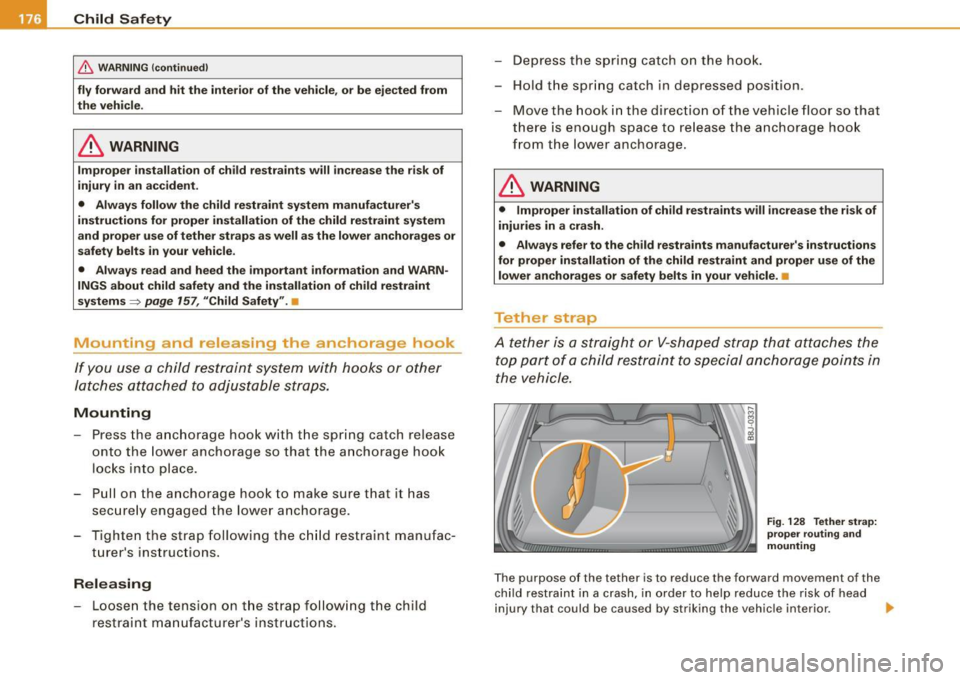
A tether is a straight or V-shaped strap that attaches the
top part of a child restraint to special anchorage points in
the vehicle.
Fig. 128 Tether strap:
proper routing and
mounting
Th e purpose of the tether is to reduce the forward movement of the
child restraint in a crash, in order to help reduce the risk of head
injury that could be caused by striking the vehicle int eri or. .,
Page 184 of 316
___ ln_ t _e_ ll_,ig ..,_ e_ n_t _t_ e_ c_ h_ n_o _ l_o ..:-g"'-' y'- -------------------------------------------
Intelligent technology
Notice about data recorded by
vehicle control modules
Your vehicle is not equipped with an Event Data Recorder (EDR),
installed by some manufacturers for the express purpose of
capturing data for retrieval after an accident or crash event . EDR's
are sometimes called "crash recorders".
Some state laws restrict the retrieval or downloading of data stored
by EDR's that were installed in a vehicle for the express purpose of
retrieving data after an accident or crash event w ithout the owner's
consent.
Although your vehicle is not equipped with an EDR, it is equipped
with a number of electronic control modules for various vehicle systems such as, for example, engine function, emission control, as
well as for the airbags and safety belts.
These electronic control modules also record vehic le-related data
during norma l vehicle opera tion for diagnostic and repair purposes .
The recording capacity of the electronic control modules is limited
to data (no sound is recorded) and only a small amount of data is
actually recorded over a very limited period of time and stored when
a system fault or other condition is sensed by a control unit. Some
of the data then stored may relate to vehic le speed, direction,
braking as well as restraint system use and performance in the
even t of a crash or other condition . Stored data can only be read and
downloaded with special equipment.
Electronic Stabilization Program (ESP)
Genel'61
The Electronic Stability Program increases driving
sta bility.
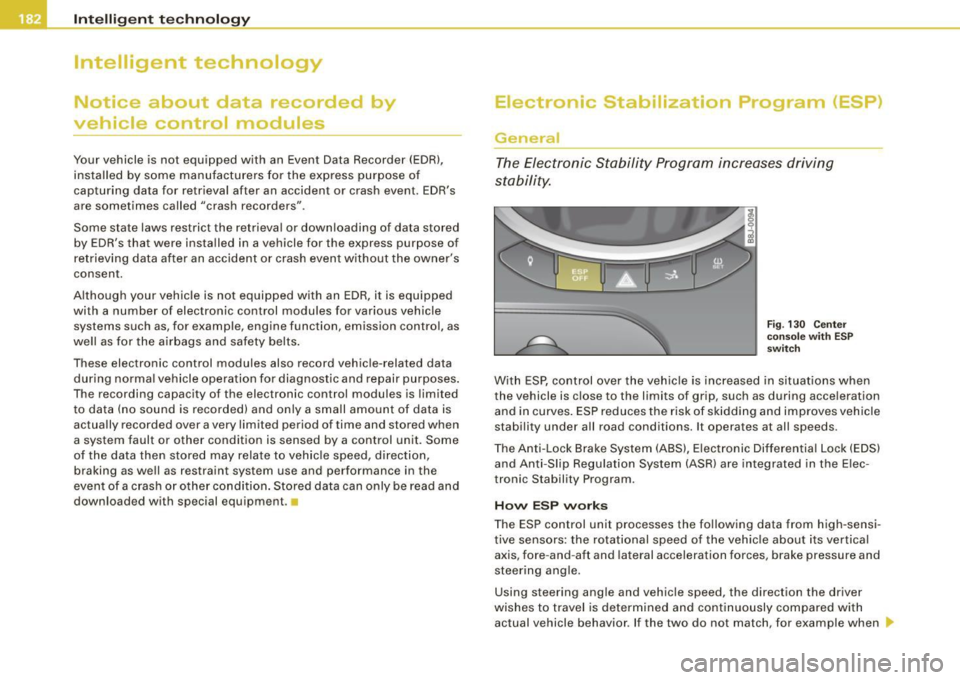
Fig . 13 0 Cente r
cons ole with ESP
sw itch
With ESP, control over the veh icle is increased in situations when
the vehicle is close to the limits of grip, such as during acce leration
and in curves. ESP reduces the risk of skidding a nd improves vehicle
stability under all road conditions . It operates at all speeds .
The Anti-Lock Brake System (ABS), E lec tronic Differentia l Lock (EDS)
and Anti-Slip Regulation System (ASR) are integrated in the Elec
tronic Stability Program .
H ow ESP work s
The ESP control unit processes the following data from high-sensi
tive sensors: the rotational speed of the vehicle about its vertica l
axis, fore -and -aft and lateral acceleration forces, brake pressure and
steering angle.
Using steering ang le and vehicle speed, the direction the driver
wishes to travel is determined and continuously compared with
actual vehicle behavior . If the two do not match, for example when
Page 186 of 316

___ ln_ t _e_ ll-'"ig ...,_ e_ n_t _t_ e_ c_ h _ n_o _ l_o _,.g= y,_ __________________________________________ _
Electronic differential lock (EOL)
The electronic differential lock monitors the rotational
speed of the drive wheels.
General notes
The electronic differential lock (EDU helps the car to start moving,
accelerate and climb a gradient on surfaces providing poor or
almost no grip. Without EDL, this would be difficult, if not impos
sible.
How the system works
Th e EDL operates automatically. It monitors the rotational speed of
the drive wheels on an axle with the help of the ABS sensors
=> page 187. If a noticeable difference in rotational speed between
the drive wheels on one axle is detected (e.g. on slippery ground on
one side), the spinning wheel is braked, thereby transferring power
to the other drive wheel or wheels (all-wheel drivel. This is done up
to a speed of about 60 mph (100 km/hl. Noises from the brake
system signal that wheel spin is being controlled.
Driving off
When driving off, always be sure to keep road conditions in mind as
you accelerate . If one drive wheel spins because it is on a surface
with less grip, gradually increase the pressure on the accelerator
pedal until the car starts to move. The wheel less able to transfer
power spins.
Overheating of brakes
To prevent the disc brake of the braked wheel from overheating if
subjected to excessive loads, the EDL cuts out temporarily . The
vehicle remains operational and behaves in the same way as a
vehicle without EDL.
As soon as the brake has cooled down, EDL switches on again auto
matically.
& WARNING
• When accelerating on slippery surfaces, such as on ice or snow,
always be careful when depressing the accelerator pedal. Even
with the EDL working, the drive wheels can spin and reduce your ability to control your car. -Risk of crash!
• The increased safety afforded by EDL does not mean that you
can take safety risks. Always adapt your driving style to the road
conditions and traffic situation.
[ i] Tips
If a fault occurs in the ABS, the EDL is also not functioning . This is
indicated by the ABS warning light=> page 20. •
Anti-Slip Regulation System (ASR)
The Anti-Slip Regulation System prevents the driven
wheels from spinning when the car is accelerating.
General notes
The Anti-Slip Regulation System (ASR) is integrated in the electronic
stabilization program (ESP). When the vehicle starts up and acceler
ates , the wheels are prevented from spinning by adjusting the
engine power to match the amount of grip available from the road
surface .
How the system works
ASR performs automatically, i.e. without the driver's intervention .
With the aid of the ABS sensors => page
187, ASR monitors the
speed of the driven wheels. If the wheels start to spin, the engine
torque is reduced automatically until the tires find enough grip to
lock onto the road surface . The system is active across the entire
speed range.
The ASR works in conjunction with the ABS. If a malfunction should
occur in the ABS, the ASR will also be out of action .
~
Page 189 of 316

If t he brakes ar e not used frequently , or if corrosion has for med on
th e d iscs, i t is adv isa ble to cl ean off the pads a nd disc s by braki ng
firm ly a f ew times from a moderate ly high speed=:> &.
Faults in the brake system
I f yo u shou ld notice a
sudden i ncrease in bra ke pedal trave l, then
o ne of th e two b rake c ircui ts may hav e fa iled =:>& .
Low brake fluid level
M alf unc tions ca n occu r in the br ake system if th e b ra ke flu id leve l is
too low . Th e brake fluid level is monitored e lectronica lly.
Brake lining wear status
B ra ke l inin g wea r may be c hec ked by v is u al inspection of the condi
tion o f the b rake pads t hrou gh the ope ning s in th e wheel. If neces
sary, the wheel may be removed for this inspection=:> page 268,
' 'W hat s hou ld I be aw are o f wh en ch ang ing a ti re ?".
Brake power assist unit
T he bra ke po wer assist unit increas es the pressure that you
generate with the b ra ke peda l. It work s only when the engine is
r u n nin g.
& WARNING
• You should perform braking maneuvers for the purpose of
cleaning the brake system only if road conditions permit . Other
road users must not be put at risk -you may cause an accident!
• Before descending a steep grade , reduce speed and shift trans
mission into a lower gear or lower driving position . Do not ride the
brakes or hold the pedal down too long or too often. This could
cause the brakes to get hot and diminish braking efficiency .
• Do not "ride the brakes " by resting your foot on the pedal when
you do not intend to brake . This may cause the brakes to overheat ,
premature wear and increased stopping distance .
• Under certain climatic and operating conditions such as
passing through water , driving in heavy rain or after washing the
Controls and equip ment Safety first Vehicle operation
Intelligent technology
& WARNING
(continued )
vehicle, the effectiveness of the brakes can be reduced . In winter ,
ice can accumulate on the brake pads , linings , discs and drums .
Cautiously apply brakes for a test. Brakes will dry and ice coatings
will be cleaned off after a few cautious brake applications.
• Driving for an extended period of time on salt-covered roads
without using your brakes can also affect braking efficiency. Clean off accumulated salt coating from brake discs and pads with a few
cautious brake applications.
• If you damage the front spoiler , or if you install a different
spoiler, be sure the air flow to the front brakes is not obstructed.
Otherwise the brake system could overheat reducing the effective
ness of the entire brake system.
• Failure of one brake circuit will impair the braking capability
resulting in an increased stopping distance. Avoid driving the
vehicle and have it towed to the nearest Audi dealer or qualified
workshop.
• Never let the veh icle roll to a stop with the engine shut off .
• If the brake booster is not working, for example when towing
your vehicle , or because the brake booster has somehow been
damaged , the brake pedal must be pre ssed considerably harder to
make up for the lack of booster assistance . •
Anti- lock brake system CABS)
ABS preve nts th e wheels from lo cking under br aking.
The anti -loc k brake syste m (ABS) makes a major contribution to
i nc reas ing active d rivi ng sa fety . You s ho ul d not e xp e ct that braki ng
distances wi ll be
shortened und er all circumstances with ABS .
B ra kin g dis tance may even become s omewhat lon ger, for exa mple,
on gravel or in new snow on s lippery ground, even if you are driving
c aref ully a nd s lowly .
Vehicle care Do-it-yourself service Technical data
Page 190 of 316

___ ln_ t _e_ ll-'"ig ...,_ e_ n_t _t_ e_ c_ h _ n_o _ l_o _,.g= y,_ __________________________________________ _
ABS operation
When a vehicle speed of about 10 mph (20 km/h) is reached, an au to
matic test sequence is run. Some noise from the pump may be
audible .
I f the speed of a whee l slows down too much relative to vehic le
speed and it starts to lock, brake pressure to this wheel is reduced.
This adj ustment process can be felt as a
pulsing motion of the brake
pedal ,
accompanied by some no ises. You as the driver are intention
a lly being given the infor mation tha t the wheels are tending t o lock
(ABS control range). In order for ABS to be ab le to operate optima lly
in this range, you must keep the b rake pedal depressed -do not
"pump the brakes".
Brake assistant
The brake power assist un it increases the pressure that you
genera te wi th the brake pedal. I t wo rks only when the e ngine is
running.
Automatic full braking
T his function al lows fu ll bra king in spite of high brake pedal forces
(e .g. whe n the brakes are seve rely s tressed beca use the veh ic le is
fully loaded) . T he driver not ices this function through a reduction of
pedal force a nd increased pedal t ravel. When the brake peda l is
re leased, fu ll braking assist switches off again automatically .
If there is an ABS failure, the brake assistant and automatic fu ll
brak in g ass ist are not available.
& WARNING
• ABS cannot suspend the la ws of physic s. You should keep this
in mind in parti cular on an icy or wet road . If ABS control of braking
intervenes , you should adjust your speed immediately to road and
traffic condit ions . Do not be tempted by the increased safety
provided to take risks -danger of an accident.
• Please keep in mind that the risk of an accident is increased by
driving too fast , particularly in bends and on icy or wet roads , and
& WARNING (continued )
by driving too close to the vehicle ahead . The increased risk of an
accident cannot be redu ced by the brake a ssistant -danger of an
accident .
[ i ] Tips
If a ma lfunction occurs in the ABS, this is signalled by an indicator
l ight, se e =>
pag e 20.
E ectro-mechan-;cal power assist
The electro -me chanical po wer assist helps the driver
w hen steering.
The degree o f pow er assis t is electronically matched t o ve h ic le
speed .
The power stee ring system as sists the driver so that he can steer the
vehic le with reduced physica l effort.
P ower steering wil l not work if the engine is off. As a result, the
s te eri ng wheel wi ll be hard to turn .
& WARNING
If the system develops a problem , you must seek qualified profes
s ional assist ance .
0 Note
If there is an electronic ma lfunction, servotronic wi ll st ill function
li ke a conve ntio nal power stee rin g system, prov iding a constant
steering support force that is no longer proportionate to the vehicle
speed. This is most no ticeable when turni ng the s teering wheel at
l ow speeds (for examp le when parking), -more effort will be
r e q uired than usual. ._
Page 191 of 316

• Be aware of the different than usual steering response and
adjust your steering force accordingly.
• Have the problem checked and set right by an authorized Audi
dealer as soon as possible.
• If a steering malfunction occurs, this is signaled with the or.
~ indicator lights and a warning tone, see.
[ i] Tips
• If the power steering system should fail, or if the engine is not
running (for example, while being towed} , you will still be able to
steer the vehicle. However, more effort will be required to do so.
• If the power steering system is not functioning properly, contact
your authorized Audi dealer immediately.
Ap plies to vehicles : w ith A ll Wheel Drive
0 iving w i h your quattro®
With All Wheel Drive, all four wheels are driven.
General information
With All Wheel Drive, power is distributed to all four wheels. This
happens automatically depending on your driving style and the
road conditions at the time. See also=> page
184, "Electronic differ
ential lock (EDU".
Winter tires
When driving in the winter , your vehicle with All Wheel Drive has an
advantage, even with regular tires. In winter road conditions it may
be advisable to mount winter tires (or all-season tires} for improved
driveability and braking : these tires must be mounted on all four
wheels. See also=> page 250, "Winter tires".
Controls and equip ment Safety first Vehicle operation
Intelligent technology
Snow
chains
Where tire chains are mandatory on certain roads, this normally
also applies to vehicles with All Wheel Drive=> page 251, "Snow
chains".
Replacing wheels/tires
Vehicles with All Wheel Drive must always have tires of the same
size. Also avoid tires with different tread depths . For details see
page => page 246, "New tires and replacing tires and wheels".
Off-Road driving?
Your Audi does not have enough ground clearance to be used as an
off-road vehicle. It is therefore best to avoid rough tracks and
uneven terrain as much as possible. Also refer to=> page 192.
& WARNING
Always adjust your driving to road and traffic conditions. Do not
let the extra safety afforded by All Wheel Drive tempt you into
taking extra risks.
• Although the All Wheel Drive is very effective, always
remember that braking capacity is limited by tire traction. You
should therefore not drive at excessive speeds on icy or slippery
road surfaces.
• On wet road surfaces, be careful not to drive too fast because
the front wheels could begin to slide on top of the water (aqua planing}.
If this should occur, you will have no warning from a
sudden increase in engine speed as with a front-wheel drive
vehicle . Always drive at speeds which are suited to the road condi
tions. -risk of crash. •
Vehicle care Do-it-yourself service Technical data
Page 202 of 316

___ C_ le_ a _ n_i_n ~g _ a_ n_ d __ p_r _o _t _e _c_ t_ i_o _n ___________________________________________ _
0 Note
• Never try to remove d irt, mud or dust if the surface of the vehicle
is dry . Never use a dry cloth or sponge, since this cou ld scratch your
vehic le's paint or w indows.
• Never wash your car in bright sunlight. Drops of water act as
magnify ing lenses and may damage your paint.
• When you wash your car in the winter : if you rinse your vehicle
with a hose, be careful not to aim the stream of water directly at
locks, or at door or hatch openings -they can freeze shut.
• Never use sponges designed to remove insects, or any kitchen
scouring sponges or similar products. They can damage your paint
finish .
• Never use a dry cloth or sponge to c lean the head ligh ts. Only use
wet cloths or sponges to prevent scratches . It is best to use soapy
water.
For the sake of the environment
In the interest of the environment, the vehicle should on ly be
washed in specia l wash bays. •
Washing your vehicle with a power washer
Cleaning the exterior of your car with a high -p ressure
power washer is safe as l ong as y ou observe a few simple
rules .
-Before using the power washer, make s ure you have read
and understood the WAR NINGS=::;,
& in "General infor
mati on" o n
page 198.
-Always follow the operating instructions for the power
washer. - Make sure that the jet o
n the spray hose pro duces a "fan
sha ped sp ray".
D o
not hold the spray nozzle too close to soft materials.
When cleaning the vehicle with a power washer always follow the
operating instructions. This applies particula rly to the
operating
pre ssure
and the spraying di stance . Maintain a sufficient distance
to soft materia ls such as rubber hoses and sound/vibration dead
ening materia ls (part icularly on the underside of the engine hood).
Do not use a jet which sprays water in a
direct stream or one that
has a
rotating jet.
Water temperature should not exceed 140 °F (60 °Cl.
& WARNING
Never wash tire s with a jet that sp ra ys water in a dir e ct stream .
Thi s could cau se invisible damage to the tire s and we ake n them ,
eve n if th e spra y is from a re lativel y lo ng dis tanc e an d f or a sh o rt
time . Damaged and weakened tire s can f ail and cau se ac cident s
a nd per sona l injur y.
0 Note
To avoid damaging your vehicle, always make sure that there is
suffic ient distance between the spray head and soft materia ls like
rubber hoses, plastic parts and sound -deadening materials . Never
aim the spray head at the same p oint for a long time . This also
applies to cleaning headlights and painted bumpers . Remember :
the c loser the nozzle is to the surface of the material, the greater the
stress on the mater ial. •