2009 AUDI TT COUPE airbag off
[x] Cancel search: airbag offPage 165 of 316

& WARNING
Not using a child safety seat, using the wrong child safety seat or
improperly installing a child restraint increases the risk of serious
personal injury and death in a crash.
• Never install rear-facing child safety seats or infant carriers on
the front passenger seat -even with an Advanced Airbag System .
A child will be seriously injured and can be killed when the
inflating airbag hits the child safety seat or infant carrier with
great force and smashes the child safety seat and child against the
backrest, or door=>
page 137, "Child restraints on the front seat -
some important things to know" .
• Always install rear-facing child safety seats or infant carriers on
the rear seat.
• Never install a rear-facing child restraint in the forward-facing
direction. Such restraints are designed for the special needs of
infants and very small children and cannot protect them properly
if the seat is forward-facing.
• If you must install a rearward facing child safety seat on the
front passenger seat because of exceptional circumstances and
the PASSENGER AIR BAG OFF light does not come on and stay on, immediately install the rear-facing child safety seat in a rear
seating position and have the airbag system inspected by your
Audi dealer .
• Always read and heed all WARNINGS whenever using a child
restrained in a vehicle is being used=>
page 125 , "Safety belts",
=> page 135, "Airbag system" and=> page 157, "Important things
to know". •
Safety first
Child Safety
Convertible child safety seats
Properly used convertible child safety seats can help
protect toddlers and children over age one who weigh
between 20 and 40 lbs. (10 and 20 kg) in a crash.
Fig. 119 Rear seat:
smalle r child in a prop
erly installed forward
facing convertible child
safety seat
When using the vehicle safety belt to install a child safety
seat, you must first activate the convertible locking
feature on the safety belt to prevent the child safety seat
from moving :::;,
page 168 or install the seat using the
LATCH attachment .
Push the child safety seat down with your full weight to
get the safety belt really tight so that the seat cannot
move forward or sideways more than one inch (2.5 cm)
:::;, page 168 .
A toddler or child is usually too large for an infant restraint if it is
more than one year old and weighs more than 22 lbs. (10 kg).
Toddlers and children who are older than one year up to about 4
years old and weigh more than 22 lbs (10 kg) up to 40 lbs . (18 kg)
should be properly res trained in a child safety seat certified for their
size and weight=> fig. 119 .
The airbag on the passenger side makes the front seat a potentially
dangerous place for a child to ride . The front seat is not the safest •
Vehicle care I I Technical data
Page 166 of 316

-Child Safety -------=--------------------------------------------
place for a chi ld in a forward -facing ch ild safety seat . It is a very
da ngerous p lace fo r an i nfan t or a large r ch ild in a re arw ard -f ac ing
s e at .
& WARNING
Not using a child safety seat , using the wrong child safety seat or
improperly installing a child restraint increases the risk of seriou s
personal injury and death in a collision or other emergency situa
tion.
• Children on the front seat of any car, even with Advanced
Airbags, can be seriously injured or even killed when an airbag inflates. A child in a rearward -facing child safety seat installed on
the front passenger seat will be seriously injured and can be killed if the front airbag inflates -even w ith an Advan ced Airbag System .
• The inflating airbag will hit the child safety seat or infant
carrier with great for ce and will smash the child safety seat and
child against the backrest or door.
• Always install rea r-facing child safety seats on the rear seat .
• If you must install a rearward facing child safety seat on the
front passenger seat because of exceptional circumstances and
the PASSENGER AIR BAG OFF light does not come on and stay on ,
immediately install the rear-facing child safety seat in a rear
seating position and have the airbag system inspected by your
Audi dealer .
• Always read and heed all WARNINGS whenever using a child
restrained in a vehicle is being used=>
page 125 , "Safety belts ",
=>
page 135 , "Airbag sy stem" and=> page 157 , "Important things
to know ".
& WARNING
If exceptional circumstances require the use of a forward-facing
child restraint on the front pas senger's seat , the child's safety and
well-being require that the following special precautions be taken :
& WARNING (continued )
• Make sure the forward-facing seat ha s been designed and certi
fied by its manufacturer for use on a front seat with a pa ssenger
front and side airbag .
• Always follow the manufacturer's inst ructions prov ided with
the child safety seat or carrier.
• Always move the front passenger seat into the rearmost posi
tion of the passenger seat's fore and aft adjustment range , and as
far away from the airbag as possible before installing the child restraint.
• Always make sure that nothing prevents the front passenger's
seat from being moved to the rearmost position in its fore and aft
adjustment range .
• Always make sure the backrest is in an upright position.
• Make sure that the PASSENGER AIR BAG OFF light comes on
and stays on all the time whenever the ignition i s switched on.
• If the light does not stay on , perform the checks=>
page 146,
"Monitoring the Advanced Airbag System" .
• Take the child restraint off the front passenger seat and install
it properly at one of the rear seat positions if the PASSENGER AIR
BAG OFF light does not stay on whenever the ignition is switched
on .a
Page 167 of 316

Booster seats
Properly used booster seats can help protect children
weighing between about 40 lbs. and 80 lbs. (18 kg and 36
kg) who are less than
4 ft. 9 in. tall.
Fig. 120 Rear seat :
child properly
restrained in a booster
seat
The vehicle's safety belts alone will not fit most children
until they are at least 4 ft. 9 in. tall and weigh about 80 lbs.
(36 kg). Booster seats raise these children up so that the
safety belt will pass properly over the stronger parts of their
bodies and the safety belt can help protect them in a crash.
- Do not use the convertible locking retractor when using
the vehicle's safety belt to restrain a child on a booster
seat.
- Always position the shoulder portion of the safety belt
midway over the child's shoulder.
- Always make sure that the shoulder portion of the safety
belt never rests against or across the child's neck.
- Always make sure that the child can properly wear the
lap portion of the belt low across the thighs or pelvis and
never over the stomach or abdomen.
Safety first
Child Safety
Children up to about 40 lbs (18 kg) are best protected in child safety
seats designed for their age and weight. Experts say that the skel
etal structure, particularly the pelvis, of these children is not fully
developed, and they should not use the vehicle safety belts
=> page 165, fig. 120.
Children who weigh more than 40 lbs. (18 kg) may generally use the
available three point combination lap and shoulder belts when they
sit on an appropriate booster seat . Be sure the booster seat meets
all applicable safety standards.
Booster seats raise the seating position of the child and reposition
both the lap and shoulder parts of the safety belt so that they pass
across the child's body in the right places. The routing of the belt
over the child's body is very important for the child's protection.
This applies whenever a child uses the vehicle's safety belts, even
when the child is big enough to use them without a booster seat.
Children age 12 and under should
always ride in the rear seat .
Children should not ride in the front seat unless no other seating
position is available because crash statistics show that children are
better protected in the rear seat.
In a crash, airbags must inflate within a blink of an eye and with
considerable force . In order to do its job, the airbag needs room to
inflate so that it will be there to protect the occupant as the occu
pant moves forward into the airbag.
A vehicle occupant including a child who is out of position and too
close to the airbag gets in the way of an inflating airbag. When an
occupant is too close, he or she will be struck violently and will
receive serious or possibly even fatal injury.
In order for the airbag to offer protection, it is important that all
vehicle occupants, especially any children, who must be in the front
seat in exceptional circumstances, be properly restrained and as far
away from the airbag as possible. By keeping room between the
child's or other occupant's body and the front of the passenger
compartment, the airbag can inflate fully and completely and
provide supplemental protection in certain frontal crashes. _.,
Vehicle care I I irechnical data
Page 168 of 316

___ C_h_ i_ ld _ S_ a_ f_ e_ t_y ____________________________________________ _
& WARNING
Not using a booster seat, using the booster seat improperly , in cor
rectly installing a booster seat or using the vehicle safety belt
improperly in creases the risk of serious personal injury and death
in a collision or other emergency situation. To help reduce the risk
of serious personal injury and /or death:
• Always make sure to position the shoulder portion of the three
po int belt over the m iddle of ch ild's shoulder .
• Never let the shoulder portion of the belt rest against or across
the neck , face , chin, or throat of the child .
• Always make sure the lap belt portion of the three-point belt is
worn snug and passes as low as possible across the child 's pelvis.
Never let the belt pass over the soft abdomen.
• Failure to properly route safety belts over a child's body will
cause severe injuries in an accident or other emergency situation
=>
page 125 .
• Children on the front seat of any car, even with Advanced
Airbags , can be seriously injured or even killed when an airbag
inflates . A child in a rearward -facing child safety seat installed on
the front passenger seat will be seriously injured and can be killed
if the front airbag inflates.
• Never let a ch ild stand or kneel on any seat , for example the
front seat.
• Never let a child ride in the cargo area of your vehicle.
• Always remember that a child leaning forward , sitting s ide
ways or out of position in any way during an accident can be
struck by a deploying airbag . This will result in serious personal
injury or death .
• If you must install a rearward facing child safety seat on the
front passenger seat because of exceptional circumstances the
PASSENGER AIR BAG OFF light must come on and stay on, when
ever the ignition is switched on .
& WARNING (continued)
• If the PASSENGER AIR BAG OFF light does not come on and stay
on, perform the checks described=>
page 146, "Monitoring the
Advanced Airbag System ".
• Take the child restraint off the front passenger seat and in stall
it properly at one of the rear seat positions if the PASSENGER AIR
BAG OFF light does not stay on whenever the ignition is switched
on .
• Always read and heed all WARNINGS whenever using a child
restrained in a vehicle is being used =>
page 125, "Safety belts",
=>
page 135, " Airbag system " and => page 157, "Important things
to know" .•
Booster seats on the rear seat
Ch ildr en who are a bo ut 7 years and older, wh o weigh mor e tha n 55
l b ( 25 kg ) and ar e not taller than 4'1 1" (1.5 m) are best protected
when pro per ly restrained on the rea r seat.
D ue t o limite d re ar s eat he ad cleara nce chil dren 4'3" (1.3 m) a nd
tal ler must not use booster seats on the rear seat of your Audi TT
Co upe . T he rear sea t of yo ur A udi TT C oupe has been spec ially
designed to permit c hildr en who are b etween 4'3" (1. 3 m) and 4'11"
( 1. 5 m ) ta ll (a bout 7 to 1 2 years old) to u se the a vai lab le thr ee -point
l ap and shoulder safety belts.
& WARNING
• The rear seat area is too small to safely transport passengers
taller than 4'11" (1.5 ml.
• Persons taller than 4'11 " (1 .5 m) as well as children in booster
seats who are too close to the rear window and roof can suffer
severe head and neck injuries when the rear lid is closed or in a
crash .
Page 169 of 316
& WARNING !continued )
• The minimum clearance between the passengers ' heads and
the rear window must never -under any circumstances -be less
than
1 inch ( 2 .5 cm .) when the passengers sits fully upright.
• Always make sure that the rear seat passengers cannot be
struck when the rear lid is closed. •
Booster seats on the front seat
Children aged ab out 7 yea rs and older an d weig hing more than 55
lbs 125 kg) who are between 4'3" (1.3 m) and 4'11" (1.5 m ) ta ll may in
e xceptional c ircumstances ride on the fr ont pas senge r's sea t. Chil
d ren l ess t han
4' 9" 1 1.4 m) tall must sit on a certified boos te r seat
and properly wear the vehicle's three -p o int la p and shoulder safety
belt.
A lways securely latch the passenger seat at the very rear of its fore
a nd a ft ad justment ra nge . T he b ackr est mu st b e ad juste d to an
upr ight position .
& WARNING
If you must install a booster seat child restraint on the front
passenger seat:
• Make sure the booster seat has been designed and certified by
its manufacturer for use on a front seat with a passenger front and
side airbag .
• Always follow the manufacturer's instructions provided with
the booster seat .
• Always move the passenger seat to the very rear of its fore and
aft adjustment range , as far away from the airbag as possible .
• Always make sure that the passenger seat is securely latched
in place before installing the booster seat. The backrest must be
adjusted to an upright position .
Safety first
Child Safety
& WARNING !continued )
• If the passenger seat cannot be securely latched in the very
rear of its fore and aft adjustment range, then the passenger front
airbag must be turned off with the ON / OFF sw itch .•
Safety belts and o lder children
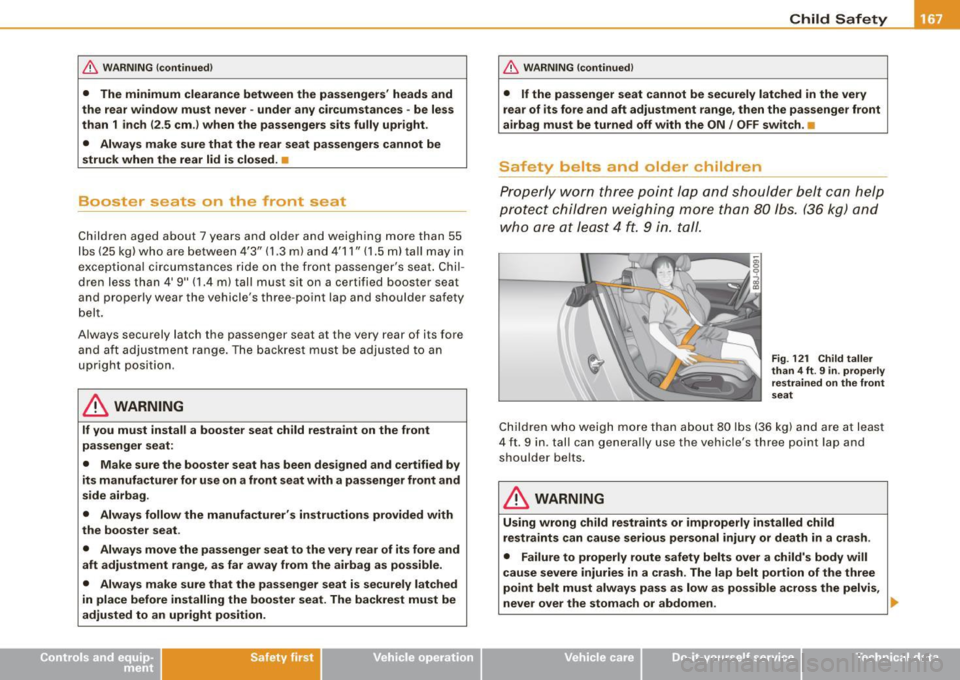
Prope rly worn th ree point la p an d sh oul der belt can hel p
p rotect ch ild ren weighi ng mor e th an 8 0 lbs. (3 6 kg) and
w ho are at lea st 4
ft. 9 in . tall .
Fig . 121 Child taller
th an 4
ft . 9 in . properly
restrained
on the front
seat
C hil dren who weigh mor e tha n about 80 lb s (36 kg) a nd are a t lea st
4 ft. 9 in. ta ll can gene ra lly use the vehicle's three point lap and
shou lder belts .
& WARNING
Using wrong child restraints or improperly installed child
restraints can cause serious personal injury or death in a crash .
• Failure to properly route safety belts over a child's body will
cause severe injuries in a crash . The lap belt portion of the three
point belt must always pass as low as possible across the pelvis ,
never over the stomach or abdomen .
~
Vehicle care I I irechnical data
Page 171 of 316
____________________________________________ __:C:::. h :....:..:..:. il.:::d ~S :::.:::a.:.:fe :::. t:.! y~ _ffllll
& WARNING
Always take special precautions if you must install a forward or
rearward -facing child restraint on the front passenger's seat in
exceptional situations:
• Whenever a forward or rearward -facing child restraint is
installed on the front passenger seat , the PASSENGER AIR BAG
OFF light must come on and stay on whenever the ignition is
switched on.
• If the PASSENGER AIR BAG OFF light does not come on and stay
on , perform the checks described
=> page 146, "Monitoring the
Advanced Airbag System".
• Take the child restraint off the front passenger seat and install
it properly at one of the rear seat positions if the PASSENGER AIR
BAG OFF light does not stay on whenever the ignition is switched
on .
• Improper installation of child restraints can reduce the ir effec
tiveness or even prevent them from providing any protection .
• An improperly installed ch ild restraint can interfere with the
airbag as it deploys and seriously injure or even kill the child.
• Always carefully follow the manufacturer's instructions
provided with the child safety seat or carrier.
• Never place additional items on the seat that can increase the
total weight registered by the weight-sensing mat and can cause
injury in a crash .
& WARNING
Forward-facing child restraints:
• Always make sure the forward -facing seat has been designed
and certified by its manufacturer for use on a front seat with a
passenger front and side airbag .
• Never put the forward -facing child restraint up , against or very
near the instrument panel .
Controls and equip ment Safety first
Vehicle operation
& WARNING (continued )
• Always move the passenger seat into its rearmost position in
the seat's fore and aft adjustment range, as far away from the airbag as possible before installing the forward-facing child
restraint. The backrest must be adjusted to an upright position .
• Make sure that the PASSENGER AIR BAG OFF light comes on
and stays on all the time whenever the ignition is switched on.
& WARNING
Rearward -facing child restraints :
• A child in a rearward -facing child safety seat installed on the
front passenger seat will be seriously injured and can be killed if
the front airbag inflates -even with an Advanced Airbag System .
• The inflating airbag will hit the child safety seat or infant
carrier with great force and will smash the child safety seat and
child against the backrest , door or roof .
• Always be especially careful if you must install a rearward
fac ing child safety seat on the front passenger seat in e xceptional
circumstances .
• A tight tether strap on a rearward-facing child restraint
attached to the front passenger seat can put too much pressure
on the weight-mat in the seat and register a heavier weight in the
Advanced Airbag System. The heavier weight registered can make
the system work as though an adult were on the seat and deploy
the Advanced Airbag when it must be suppressed causing serious or even fatal injury to the child .
• Make sure that the PASSENGER AIR BAG OFF light comes on
and stays on all the time whenever the ignition is sw itched on .
• If the PASSENGER AIR BAG OFF light does not come on and stay
on , immediately install the rear-fac ing child safety seat in a rear
seating position and have the airbag system inspected by your
Audi dealer. •
Vehicle care Do-it-yourself service Technical data
Page 179 of 316

Fo rw ard facing child r estra ints manufactu red after September 1,
1 999, a re requ ired by U .S. f edera l r eg ulations to com ply wi th child
head movement pe rformance requ irements. These new perfo r
m ance req uir e m ent s m ake a tethe r neces sary on mos t new child
safety seats.
& WARNING
Improper installation of child restraints will increase the risk of
injury in a crash .
• Never attach a child safety seat tether strap to a tie-down hook
in the luggage compartment.
• Never secure or attach any luggage or other items to the LATCH
lower anchorages or to the tether.
• If a tether or other strap is used to attach a child restraint to the
front passenger seat , make sure that it is not so tight , that it
causes the weight-sensing mat to measure more weight than is
actually on the seat.
• The heavier weight registered can make the system work as
though an adult were on the seat and deploy the Advanced Airbag
when it must be suppressed causing serious or even fatal injury to
the child .•
Using tethers on rear-facing child restraint
systems
Curr ently, few r ear -facing chi ld restraint systems come with a tether.
P lease read and heed the c hild restrai nt s ystem manufac tu re r's
instructions careful ly to determine how to proper ly instal l the
tethe r.
Safety first
Child Safety
& WARNING
A child in a rearward -facing child safety seat installed on the front
passenger seat will be seriously injured and can be killed if the
front airbag inflates -even with an Advanced Airbag System .
• The inflating airbag will hit the child safety seat or infant
carrier with great force and will smash the ch ild safety seat and
child against the backrest , or door .
• A tight tether or other strap on a rearward-facing child restraint
attached to the front passenger seat can put too much pressure
on the weight-mat in the seat and register a heavier weight in the
Advanced Airbag System. The heavier weight registered can make
the system work as though an adult were on the seat and deploy
the Advanced Airbag when it must be suppressed causing serious or even fatal injury to the child.
• If you must install a rearward facing child safety seat on the
front passenger seat because of exceptional circumstances and
the PASSENGER AIR BAG OFF light does not come on and stay on ,
immediately install the rear-facing child safety seat in a rear
seating posit ion and have the airbag system inspected by your
Audi dealer . •
Securing the upper tether strap to the anchor
bracket
Vehicle care I I
Fig . 129 Tether strap:
prope r routing and
mounting ..
irechnical data
Page 208 of 316
-~_C_ l_ e _a _n_ in_g=- a _n_d__, p,__ ro_ t_e _c_ t_ i_o _n _____________________________________________ _
In the case of general soiling of the upho lstery and cover material,
we recommend hiring a s pecialis t tha t has the equ ip m ent to c lean
the seat covers and other fabric surfaces by shampooing and spray
e xtraction .
& WARNING
Always read and heed all WARNINGS and the information
~ page 198 .
[ i ] Tip s
Open Ve lcro fasteners on your clothing can damage the seat cover.
Please make sure that Velc ro fas tene rs a re c losed. •
Plastic parts and instrument panel
Always us e a clea n clo th mo isten ed in cl ear wa ter t o clean thes e
areas . For persistent dirt use an Audi approved
solvent -free plastic
cleane r/ p rotec tan t.
& WARNING
Solvent s can change the propertie s of some plastic s and make it
h arder for the airbag to deploy .
• Never clean the instrument panel or the surface of Airbag
modules with cleaning produ cts that contain solvents .
• Products containing so lvents will make the surface of this part
porous.
• Serious injur ies can re sult if plastic part s come loose when the
airbag is deployed.
• Always read and heed all WARNINGS and the infor mation
~ page 198 .
0 Note
Cleaning agents co ntaini ng so lvents wil l attack t he ma ter ial and can
change the way it behaves .•
Instrument cluster glass
- Clea n the glass w it h a soft, damp clot h.
In order to preserve the anti -glare properties of the instrument
clus ter g lass, it sho uld only be clea ned w ith a soft , dam p clo th .•
Ap plies to vehicl es: w ith n atu ra l le ath er
Natural leather
A udi make s gr eat effo rts to maintai n the pro perti es ,
n at ura l look an d feel of int erior leather.
General
We offer many different types of lea ther on our veh icles . M ost are
different types of nappa leather, which has a smooth surface and
comes in va rious co lors .
Th e intensity o f the color de termi nes the visua l character istics a nd
appearance . If the surface of the leather has a typica l natural look,
t hen the leat her is a nappa leather tha t has been left in a re la tively
natural condition. This leather offers particu lar ly good comfort and
b rea thes well. Fi ne veins, closed grains, insect bi tes, skin fol ds, and
subt le variations in color remain visible. These characteristics
dem onstra te that the mater ial is natura l.
Natura l nappa leather is not covered by a color fin is h . It is therefo re
more sensitive to soiling and wear, which is something you need to
conside r if c hild ren, a nimals o r other factors migh t prove to be
particularly hard on the leather.
By c ontrast, lea ther types that a re covere d by a colo red fini sh layer
are more durable . This has a positive effect on the leather's resis -
~