2009 AUDI TT COUPE transmission
[x] Cancel search: transmissionPage 220 of 316

___ C_ h_ e _ c_k _in--= g'-- a_n _d_ f_il _li _n --=g==-- --------------------------------------------
& WARNING (continued )
-First, fully apply the park ing brake, move selector lever of
automatic transmission to "P " (Park ); put manual transmission
in Neutral.
- Alway s use extreme c aution to prevent clothing , jewel ry , or
long hair from gettin g caught in the radiator fan , V-belts or
other moving parts , or from contacting hot parts. Tie back hair
before starting , and wear no clothing that will hang or droop
into the engine.
• Minimize exposure to emission and chemi cal hazard s
=> &.
& WARNING
Californ ia Proposition 65 Warning :
• Engine exhaust , some of its constituents , and certa in vehicle
component s contain or emit chemical s known to the State of Cali
fornia to cause cancer and birth defe cts and reproductive h arm . In
addition, certain fluid s contained in vehicles and certain products
of component wear contain or emit chem icals known to the State
of California to cause cancer and birth defects or other reproduc
tive harm.
• Battery po sts , terminal s and related ac cessories contain lead
and lead compounds , chem icals known to the State of California
to cause cancer and reproductive harms. Wash hand s after
handling .
0 Note
When adding fluids, always make sure that the y are poured into the
proper container or filler opening, otherwise serious damage to
vehicle systems will occur .
<£' For the sake of the environment
To detect leaks in t ime, inspect the veh icle floor pan from unde r
neath regularly. If you see spots from oil or other vehic le fluids, have
you r ve hicle i nsp ected by a n authori zed Audi dealer .•
Engine compartment
Ap plies to veh ic les: with 1. 8I180-h p eng ine
2 .01 200-hp engine
Th ese a re th e mo st imp ortan t items that you can check.
F ig . 137 Engine comp artment : 2 .01 200 -hp engine
G) Coolan t expansion tank (J _) ... ........ ..• ..•. ....
0 Engine oil f iller cap ("t:::r.) . .. ... .• .. .... .... ... ...
© En gine oil d ipstick ( orange) .. ...... ... .. .. .. .... .
© B ra ke fluid reservoir ( ) . ... ...... .... .... ... .. .
225
222
2 21
2 27 ..
Page 237 of 316

Tires and wheels -
----------------
•
& WARNING (continu ed )
crashes and serious personal in jur ies . Have worn or da maged t ires
replaced immediately .
• Tires age even if they are not being u sed and can fail suddenly ,
especially at high speeds. T ires that are more than 6 years old can
only be used in an emergency and then w ith special care and at
low speed.
Glossary of tire and loading terminology
Accessory weight
means the co mbined we ig ht ( in excess o f those sta nda rd items
which may be rep laced) of automatic transmission, power steering,
power brakes, power w indows, powe r seats, rad io, a nd heater, to
the extent that these items are avai lab le as factory-installed equip
m ent (w hether insta lled or not).
Aspect ratio
means t he ratio o f th e height to t he w idt h of the tire in perce nt.
N umbers of 55 or lower indicate a low sidewa ll for improved
steer ing respo nse and b ette r overall ha ndl ing on dry pave ment.
Bead
means the part of the tire that is made of stee l wires, wrapped or
reinforced by ply cords and that is shaped to fit the rim.
Bead separation
means a breakdow n of the bond be tween co mponents i n the bead.
Cord
means the strands fo rmi ng the plies in the ti re.
& W ARNING (continued )
• Never mount used tires on your vehicle if you are not sure of
their "previous history. " Old used t ire s may ha ve been damaged
even though the damage cannot be seen that can lead to sudden
tire failure and lo ss of vehicle control.
• If you noti ce unusual vibration or if the vehicle pulls to one side
when driving , always stop as soon as it is safe to do so and check
the wheels and tires for damage . •
Cold tire inflation pressure
mea ns t he ti re pressure reco mm ended by the ve hicle ma nufacturer
for a tire of a designated size that has not been d riven for more tha n
a cou ple o f miles (k ilometers) at low speeds in t he t hre e ho ur per iod
before the tire pressure is measured or ad justed .
Curb weight
means the weight of a moto r vehic le with standard equipment
i nc lud ing the max imu m capac ity o f fue l, o il, and coola nt, a ir c ond i
tioning and additiona l weight of optional equipment.
Extra load tire
means a tire designed to ope rate at higher loads and at higher infla
tion pressures than the corresponding standard tire. Extra load tires
my be identified as "XL",
"xi", "EX TRA LOAD", or "RF" on the side
wa ll.
Gross Axle Weight Rating ("GAWR ")
means the load -carrying capacity of a sing le ax le system, measured
at the ti re -ground interfaces.
Gross Vehicle Weight Rating ("GVWR "l
means the ma ximum tot al l oade d weigh t of the vehicle.
Vehicle care I t •
Page 268 of 316

1111...__W_ h_ a _ t_d_ o_ l _d _o_ n_ o_ vv_ ? ______________________________________________ _
[ i J Tips
• If sealant has run out, allow it to dry. Then you can peel it off .
• Have the tire sealant replaced every 4 years at a d ealership. •
Applie s to ve hicles: with T ire Mob ilit y Sy stem
Preliminary steps
Some preliminary steps ore necessary for tire repair.
Fig . 158 Tire Mobility
System under luggage
compartment floor
- If you have a flat tire, park the vehicle as far as possible
from moving t raffic.
- Apply the
parking brake firmly.
- On vehicles w ith manual transmission, engage
1st gear,
or move the selector lever to the P position on vehicles
w ith automat ic transmission.
- Check whether a repair using the Tire Mob ility System is
possible ~
page 264, "General and safety po inters".
Have all passengers
leave the vehicle and stay away from
the danger zone~& .
- Take the
sealant bottle and the electric air pump from the
luggage compartment under the floor~ fig. 158. - Remove the "max. 50 mph"
(80 km/h) sticker from the
sealant bottle and affix it to the instrument cluster in the
driver's view.
& WARNING
• Turn the hazard flashers on and set up the warning triangle if
you have a flat tire in moving traffic. In this way you protect your
self and other road users.
• Make sure that all passengers are in a safe place, out of the
danger zone (for example, behind a guard raill.
(D Note
Particular care is necessary if you are making a tire repair on a steep
inc line .
[ i J Tips
Obey all laws. •
App lies to ve hicles: w ith T ire Mob ility System
Mak ing a tire repa ir
Tire repair consists of the following sections.
Fig. 159 Parts of the
Tire Mobility System ..
Page 278 of 316

ffl.___F_ u_ s _ e_s _ a_n _ d_ b_ u_lb _ s _______________________________________________ _
Equipment No.
II Equipment
Amps I
Engine relay, fuel tank control unit, Airbag Off 16 A/C system (control unit) 10
1 light, light switch (switch illumination), diagnos-10
tic connector
17 Tire pressure monitoring system (control unit) 5
18 Not used
2 ABS, ASR, ESP, brake light switch 5
19
Not used
3 AFS headlight (left) 5 20
Not used
Oil level sensor (extended maintenance interval)
(WIVl, tire pressure monitoring system, switch
21 Fuel injectors (gasoline engine) 10
4 for Electronic Stability Program (ESP), AFS head-5 22 Wind deflector (Roadster) 30
lights (control unit), A/C system (pressure sen-23 Horn 20 llsorl, backup light switch
Automatic headlight range control, AFS head -
24 Transmission (control unit) 15
5
light (right)/ manual headlight range control, 5/10 25 Heater rear window Coupe/heated rear window 30/20
halogen headlights Roadster
Control unit for CAN data transfer (gateway),
26 Driver's side power window 30
6 electromechanical steering, automatic transmis-5 27 Passenger's side power window 30
sion shift gate
28 Not used
Acoustic Park Assist, automatic dipping interior
rear view mirror, garage door opener, heatable
29 Washer pump 15
7
windshield washer nozzles, washer pump, wind 5
30 Cigarette lighter 20
deflector relay (Roadster)
31 Starter 40
8
Haldex clutch 5 32 Steering column module 5
9
Control unit Audi magnetic ride 5 33
Instrument cluster 5
Airbag control unit 5 34 Radio navigation system, radio 15
1 1 Mass airflow sensor, crankcase heating 5/10
35
Audio amplifier 30
Door control unit (central locking driver/passen-12 10
36 Engine (control unit) 10 gerl
13 Diagnostic connector 10 37 CAN (Gateway) 5
Rain sensor, automatic transmission shift gate 5 38 Not used
15 Roof light (interior lighting) 5 39 Not
used
Page 282 of 316

IIII...__E_ m _ e _r.;:g '-e_ n_ c-=y _ s_ i_t _u _a _t_ i_o _n_ s _______________________________________________ _
& WARNING (continued)
• Before you check anything in the engine compartment, always
read and heed all WARNINGS=>
page 209, "Engine compartment".
0 Note
• Applying a highe r voltage booste r battery will cause expensive
damage to sens itiv e electron ic components, such as control units,
relays , radio, etc.
• There must be no electrical contact between the vehicles as
otherwise current could already start to flow as soon as the positive
( + ) terminals are connected .
[ i ] Tips
The d ischarged battery must b e properly connected to the vehicle's
electrical system. •
Use of jumper cables
Make sure to connect the jumper cable clamps in exactly
the order described below!
Fig. 172 For jump
starting or charging
the battery, there is a
jump start connection
on the left side of the
engine compartment . Fig
. 173 Jump start
using the battery in
another vehicle: A -
Discharge, B- Female
socket
The procedure described below for connecting jumper
cables is intended to provide a jump start for your vehicle.
Preparatory measures
1. Do not jump start a frozen battery! Replace such a
battery!
2. Otherwise apply the hand brake and sh ift into idle gear if
your vehicle has manual transmission, and put the selector lever into P posit ion if your vehicle has auto
matic transmission.
3. For both vehicles switch off all consumers and the igni
tion.
Connecting/disconnecting the jumper cable.
4. Connect one end of the red jumper cable on the jump
start bolt G) => fig. 173 (Bolts under red cover= "posi
tive") of the vehicle to be started
@.
5. Connect the other end of the red jumper cable to the
positive terminal @ of the booster battery @.
6. Connect one end of the black jumper cable to the nega -
tive terminal @ of the booster battery @. _,,,
Page 284 of 316

IIIII...__E_ m _ e _r.;:g '-e_ n_ c-=y _ s_ i_t _u _a _t_ i_o _n_ s _______________________________________________ _
Emergency towing with commercial
tow truck
General hints
Your Audi requires special handling for towing.
The following information is to be used by commercial tow truck
operators who know how to operate their equipment safely.
• Never tow your Audi, towing will cause damage to the engine
and transmission.
• Never wrap the safety chains or winch cables around the brake
lines.
• To prevent unnecessary damage , your Audi must be transported
with a car carrier (flatbed truck).
• To load the vehicle on to the flat bed, use the towing loop found
in the vehicle tools and attach to the front or rear anchorage
~ page 282 and~ page 283.
& WARNING
A vehicle being towed is not safe for passengers. Never allow
anyone to ride in a vehicle being towed, for any reason. •
Front towing loop
Do not install the front towing loop until it is needed.
Fig. 174 Front
bumper: removing the
grill
Fig . 175 Front
bumper: screwing in
the towing loop
The towline eye fits into the threaded hole located on the
right side of the front bumper behind the grill.
- Remove the screwdriver and towing loop from the
vehicle toolkit =>
page 264.
-Insert the screwdriver into the slot as shown and press
toward the center of the vehicle=> fig. 174. At the same
time, pull the grill forward and out.
- Screw the towing loop tightly into the threaded hole as
far as it will go=> fig. 175. ..,
Page 287 of 316

________________________________________________ E _m_ e_r.:g :;,. e_ n_c ...: y:.- s_ i_ t _u _a_ t_ i_ o _ n_ s __ ffllll
•
& WARNING
• To reduce the risk of serious injury and vehicle damage.
-Always lift the vehicle only at the special workshop hoist and
floor jack lift points illustrated=> page
284, fig. 178 and
=> page 284, fig. 179.
- Failure to lift the vehicle at these points could cause the
vehicle to tilt or fall from a lift if there is a change in vehicle
weight distribution and balance. This might happen, for
example, when heavy components such as the engine block or
transmission are removed.
• When removing heavy components like these, anchor vehicle
to hoist or add corresponding weights to maintain the center of
gravity. Otherwise, the vehicle might tilt or slip off the hoist,
causing serious personal injury.
0 Note
• Be aware of the following points before lifting the vehicle:
- The vehicle should never be lifted or jacked up from under
neath the engine oil pan, the transmission housing, the front or
rear axle or the body side members . This could lead to serious
damage.
- To avoid damage to the underbody or chassis frame, a rubber
pad must be inserted between the floor jack and the lift points.
- Before driving over a workshop hoist, check that the vehicle
weight does not exceed the permissible lifting capacity of the hoist .
- Before driving over a workshop hoist, ensure that there is
sufficient clearance between the hoist and low parts of the
vehicle. •
Do-it-yourself service
Page 290 of 316
___ G_ e_ n_ e_r_ a _ l_ in_ f_ o _r_m _ a_ t_ i_ o _ n __________________________________________________ _
General information
Explanation of technical data
Some of the technical data listed in this manual require
further explanation .
The tecical data for your vehicle are listed in the charts starting on
~ page 291 . This chapter provides general information, notes and
restrictions which apply to these data.•
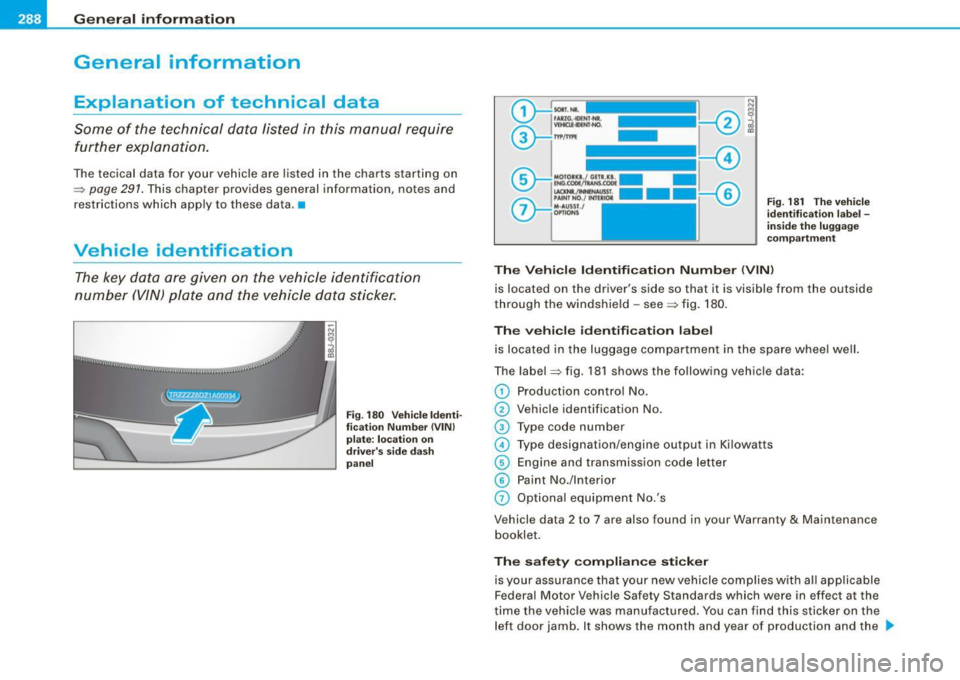
Vehicle identification
The key data are given on the vehicle identification
number (VIN) plate an d the vehicle d ata sticker.
Fig. 18 0 Vehicl e Identi
fi ca tion N umber (V IN)
pl ate : lo cation on
dri ver 's s ide d ash
pan el F
ig . 181 The vehi cle
i d e ntifi catio n la bel -
i n sid e th e luggag e
com partm ent
The Vehicle Id ent ification Numb er (V IN)
is located on the driver's side so that it is visible from the outside
through the winds hie ld -see ~ fig. 180 .
The veh icle identifi cat ion lab el
is located in the luggage compar tment in the spare whee l well .
The label~ fig. 181 shows the following vehic le data :
0 Production contro l No.
0 Vehicle identification No .
G) Type code number
© Type designation/engine output in Ki lowatts
@ Engine and transmission code letter
© Paint No./lnterior
0 Optiona l equipment No.'s
Vehicle data 2 to 7 are also found in your Warranty
& Maintenance
booklet.
Th e s afety c ompliance sticker
is your assurance that your new vehicle complies with a ll app licable
Federa l Motor Vehicle Safety Standards which were in effect at the
time the vehicle was manu factured. You can find this sticker on the
left door jamb . It shows the month and year of production and the .._