2009 AUDI TT COUPE child lock
[x] Cancel search: child lockPage 173 of 316

Child Safety -
--------------------''---
If the convertible locking retractor should be activated inadvert
ently, the safety belt must be unfastened and gu ided co mple te ly
back into its stowed position to deactivate this feature. If the
convertible lock ing retractor is not deactivated, the safe ty be lt will
gradually become tighter and uncomfortab le to wear.
& WARNING
Improper ly in stalled child safet y seat s in crea se the risk of seri ous
personal injury and death in a colli sion.
• Never unfasten t he safety belt to d eactivate the c onvertible
locking retractor for child re straint s while the vehicle is moving .
You would not be re strained and could be seriou sly injured in an
accid ent.
• Alway s re ad and heed all WARNINGS whenever us ing a child
restrained in a vehicle is being used=:>
page 15 7. Spec ial precau
tion s app ly when in stalling a child safety se at on the fr ont
p assen ger seat =:>
pag e 13 7, "Child re straint s on the front seat -
s ome important thing s to know ".•
Additional Information
What types of child restraint anchors are
available and how are they related to child
safety?
For years, child restraints have been installed using the safety belts
a lready present i n every vehicle.
Since September 1, 1999, chi ld restraint manufacturers have been
providing tether straps that attach the top of the child restraint to
the vehicles structure, on most of their forward -facing systems in
order to comply with U.S. Federa l regu lations for child restraint
performance in a crash. Vehicle manufacture rs are required to
Controls and equip
ment Safety first Vehicle operation
phase-in tether anchorages for attachment of the tether strap in
t heir U.S. vehic les beg inn ing September 1, 1999 .
The combination of the tether anchorages and the lower anchor
ages is now genera lly called the
LATCH system for " Lower Anchors
and Tether for C hildren".
( T he term "ISOFIX" regarding lower anchorages had been used by
Audi and other manufacturers in t he pas t, but LATCH is now the
standard name for the new child restraint anchorage system.)
Some child restraint system manufacturers have been providing
tether straps on certain models o f their child restraint systems,
either as standard equipment or as a retrofit, for severa l years.
Check w ith the manufacturer of the child restraint sys te m f or tether
strap availabi lity.
To provide a simpler and more practicable way to attach the child restraint system on the vehicle seat, U.S . Federal regu lations require
t he phase -in of lower anchorages in veh icles an d devices on new
child restraint systems to attach to the veh ic le ancho rages .
Child restraint system manufacturers will probably offer two kinds
of lower anchorages on their child safety seats
They cou ld come with:
• hook-on or push-on connectors attached to adjustable straps or
• rigid latches on bars that extend out the back of the child
restraint and are released with re lease buttons at the bottom of the
child restraint.
I n addition to the LATCH lower anchorages, both of these child
restra int systems use tether straps to help keep the chi ld restraint
system firmly in p lace. •
Where can I get additional information about
child restraint application and usage?
There are a numbe r of sources of additional information about child
restra int select ion, installation and usage: _.,
Vehicle care Do-it-yourself service Technical data
Page 178 of 316
___ C_h_ i_ld _ S_ a_ f_ e_ t-= y'------------------------------------------------
& WARNING (continued)
fly forward and hit the interior of the vehicle, or be ejected from
the vehicle.
& WARNING
Improper installation of child restraints will increase the risk of
injury in an accident.
• Always follow the child restraint system manufacturer's
instructions for proper installation of the child restraint system
and proper use of tether straps as well as the lower anchorages or
safety belts in your vehicle.
• Always read and heed the important information and WARN
INGS about child safety and the installation of child restraint
systems =>
page 157, "Child Safety" .•
Mounting and releasing the anchorage hook
If you use a child restraint system with hooks or other
latches attached to adjustable straps.
Mounting
Press the anchorage hook with the spring catch release
onto the lower anchorage so that the anchorage hook
locks into place.
Pull on the anchorage hook to make sure that it has
securely engaged the lower anchorage .
Tighten the strap following the child restraint manufac
turer's instructions.
Releasing
- Loosen the tension on the strap following the child
restraint manufacturer's instructions. -
Depress the spring catch on the hook.
- Hold the spring catch in depressed posit ion .
- Move the hook in the direction of the vehicle floor so that
there is enough space to release the anchorage hook
from the lower anchorage.
& WARNING
• Improper installation of child restraints will increase the risk of
injuries in a crash.
• Always refer to the child restraints manufacturer's instructions
for proper installation of the child restraint and proper use of the
lower anchorages or safety belts in your vehicle.
ti
Tether strap
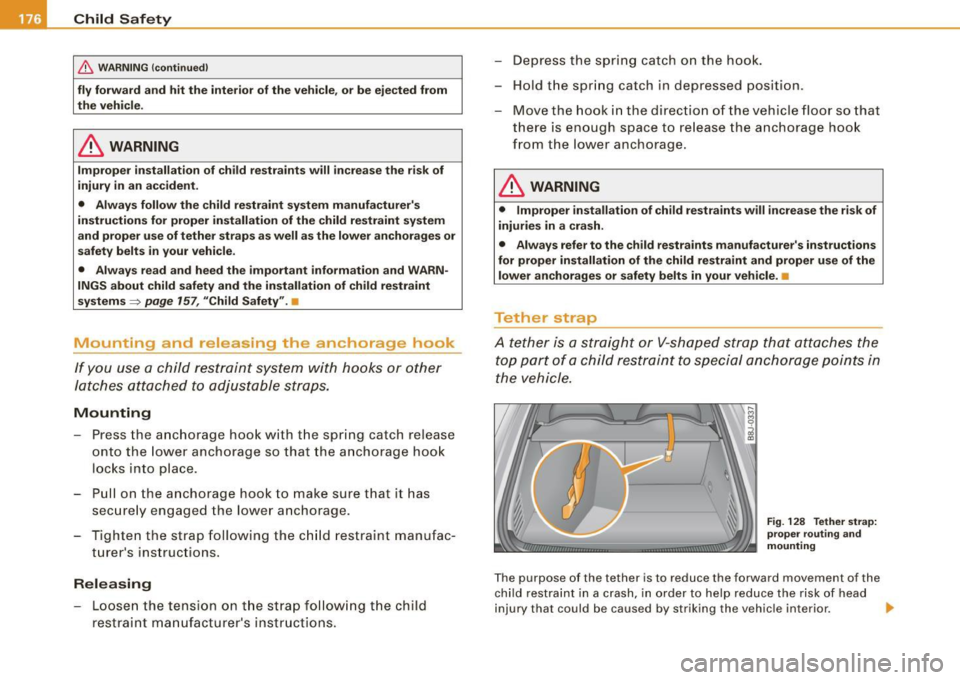
A tether is a straight or V-shaped strap that attaches the
top part of a child restraint to special anchorage points in
the vehicle.
Fig. 128 Tether strap:
proper routing and
mounting
Th e purpose of the tether is to reduce the forward movement of the
child restraint in a crash, in order to help reduce the risk of head
injury that could be caused by striking the vehicle int eri or. .,
Page 219 of 316

___________________________________________ C_ h_e _c_ k_ i_n _g _ a_n _d_ f_il _li _n _g __ fflllll
•
Closing the engine hood
- Pull the hood down until the pressure from the struts is
reduced .
- Let the hood
drop down and latch in place. Do not try to
push it shut;
it may fail to engage => &.
& WARNING
A hood that is not completely latched could fly up and block your
view while driving.
• When you close the engine hood, check it to make sure the
safety catch has properly engaged. The hood should be flush with
the surrounding vehicle body parts.
• If you notice while driving that the hood is not secured prop
erly, stop at once and close it. •
Working in the engine compartment
Be especially careful whenever you work in the engine
compartment!
Whenever you must perform any work in the engine compartment,
for example checking and filling the different fluids, there is a risk of injury, burns and accidents. To prevent personal injury always
observe the following WARNINGS. The engine compartment of any
vehicle is a hazardous area!
~ &
& WARNING
To help avoid injury, before you check anything under the hood :
• Switch off the engine.
• Remove the ignition key.
• Apply the parking brake .
& WARNING (continued)
• Move selector lever of automatic transmission to "P" (Park);
put manual transmission in Neutral .
• Always let the engine cool down. Hot components will burn
skin on contact.
• To reduce the risk of being burned, never open the hood if you
see or hear steam or coolant escaping from the engine compart
ment. Wait until no steam or coolant can be seen or heard before
carefully opening the hood .
• Keep children away from the engine compartment.
• Never spill fluids on hot engine components . They can cause a
fire.
• Never touch the radiator fan. The auxiliary electric fan is
temperature controlled and can switch on suddenly.
• Never open the coolant reservoir cap when the engine is still
warm. The coolant system is pressurized and hot coolant could
spray out.
• Protect your face, hands and arm from steam or hot engine
coolant by placing a thick rag over the cap when you open the
coolant reservoir.
• If work on the fuel system or the electrical system is necessary:
- Always disconnect the battery.
- Never smoke or work near heaters or open flames. Fluids in
the engine compartment could start a fire .
- Keep an approved fire extinguisher immediately available.
• To avoid electrical shock and personal injury while the engine
is running or being started, never touch :
- Ignition cables
- Other components of the high voltage electronic ignition
system.
• If you must perform a check or repair with the engine running: ..,
Vehicle care
I t •
Page 228 of 316

-~_C_ h_e _c _ k_ i_n ...:::g::;...._ a_n_ d_ f_ i_ll _in -'g:::;.._ ___________________________________________ _
-Pla ce a t hick ra g o ver the coola nt e xpansion tank
=>
page 225, fi g. 142 an d carefully tw ist the c ap counter
cl ockw ise=> &.
- Add coo lan t.
- Twist the cap on again
tightly .
Replacement engine coolant must conform to exact specifications
=>
page 224, "C oolant" . Even in an emerge ncy, if coo lant add it ive
G 12+ +, G 12+ or G12 is not availab le, do
not use a different additive.
Use p lain water instead until you ca n get the c orrec t addit ive and
can restore the correct ratio. This should be done as soon as possible.
If you have lost a considerable amount o f coo lant, then you should
add co ld antifreeze and cold water only when the engine is cold.
A lways use
new e ngine c oolan t when refil ling .
Do not fill coolant above the "MAX" mark. Excess coolant will be
forced ou t through the pressure relief va lve in the cap when the
engine becomes hot.
& WARNING
• The cooling sy stem is under pre ssure and can get very hot .
Reduce the risk of scalding from hot coolant by following these
s teps.
- Turn off the engine and allo w it to cool down .
- Protect your face, hands and arms from esc aping fluid and
steam by covering the cap with a large , thick rag .
- Turn the cap slo wly and very carefully in a counter -clockwise
dire ction while applying light , downward pressure on the top
of the cap .
- To avoid being burned, do not spill antifreeze or coolant on
the e xhaust system or hot engine parts . Under certain condi
tions, the ethylene glycol in engine coolant can catch fire .
& WARNING (continued )
• Antifreeze is poi sonous. Always store antifreeze in its original
container and well out of the re ach of children .
• If you drain the coolant , it must be caught and safely stored in
a proper container clearly marked "poison ".
0 Note
• Coo lant po llutes the environment and could cause an engine
fire. Excess coolant will be forced out through the pressure re lief
va lve in the cap when the engine becomes hot.
• If , in an eme rgency, o nly wa te r can be added, the correct rat io
between water and antifreeze=>
page 224 must be restored as soon
as possib le .
ffi For the sake of the environment
Drained coolant should not be reused. Always dispose of used
coo lant whi le observ ing all environmen tal regulat io n s. •
Radiator fan
The radi ator f an s witches on au tomati cally by itself.
T he e lectric radiator fan is control led bythe rmoswitches that switch
on and off depending on coolant and engine compartment temper
atures.
An auxiliary electric radiator fan* switches on and off depending on
coo la nt tempe rature a nd other veh ic le operati on cond itio ns.
After you switch the engine off, the aux iliary fan can continue
running for up to 10 m inutes -even with the ignition off. It can even
sw itch o n again later by itself=> & , if
• the temperature of the engine coo lant rises due to the heat
b ui ld-up fro m the eng ine in the eng ine co m partment, or
Page 230 of 316

-~_C_ h_e _c _ k_ i_n ...:::g::;...._ a_n_d _ f_ i_ll _in -'g:::;.._ ___________________________________________ _
& WARNING
• Bra ke fluid i s poiso nou s. It must be stor ed only in the clo se d
original container out of the rea ch of children!
• Bra ke failure can re sult from old or inappropri ate br ake fluid .
Ob serve the se pre cauti ons:
- Use o nly br ake fluid th at m eets S AE spe cific ation
J 1703 and
co nform s to Fed era l Mo tor Vehic le Standard 11 6. Alway s check
w ith your authori zed Aud i de aler to mak e sure y ou are usi ng
the correc t brake fluid. The corre ct type of brake flu id i s also
indica ted on the br ake fl uid re se rvoi r.
- The brake fluid mu st be new . Heavy u se of the brake s can
ca use a vapor lock if th e bra ke fluid is left in the system too
long. Thi s can seriou sly affect the effic iency of the brake s as
w ell as y our safet y. T his c ould re s u lt in an a ccident .
0 Note
Brake fluid wil l damage the paint of your vehicle .
~ For the sake of the environment
Because of the problem of proper disposal of brake fluid as well as
the special tools required and the necessary expertise, we recom
mend that you have the brake fluid changed by your authorized Audi
dea ler. •
Battery
General information
Your vehicle is equipped with a specia l battery, an AGM battery. This
ba ttery is loca ted in the luggage compar tment and must be
replaced with an original equipment battery. Under normal oper
ating conditions, the battery is
ma inten anc e-free .
Have the battery checked when you take your vehicle in for service .
You a re well advised to replace a battery that is o lder than 5 years .
Disconn ecting th e batt ery te rmin als
Some vehicle functions (power w indow regulators, for example) are
lost if the battery terminals are disconnected. These functions have
to be relearned after the battery terminals are connected again. To prevent this, the battery should only be disconnected from the
vehic le electrical sys tem when abso lutely necessary for repairs .
Vehi cles not dri ven for lo ng p eriods
If you are going to let your vehic le stand for a long time and n ot
drive it, you should remember there are e lectrica l components
whic h are still functioning and they will draw energy from the
battery and drain it, for example, the engine immobilizer. To prevent
t his, you can eithe r charge the batte ry occasionally to keep it in
good working condition or you can disconnect the negative cable
on the battery.
W int er op erati on
During the winter months, batte ry capacity tends to decrease as
temperatures drop . This is because more power is also consumed
whi le starting, and the headlights, rear window defogger, etc ., are
used more often.
Avoid unnecessary power consumption, particularly in city traffic or
when trave ling o nly short distances . Let your authorized Audi dealer
check the capacity of the vehicle battery before winter sets in
~ page 232. A we ll charged battery will not only preven t starting
problems when the weather is cold, but will also last longer.
Repla cing batter y
The new battery must hav e the same capacity, voltage ( 12 volts),
amperage, construction and p lug sea ling, as the orig inal battery .
Specifications are listed on the battery housing. Batteries specia lly
developed by Aud i fulfill the main tenance, output, and safe ty
requirements. ...,
Page 302 of 316
___ A---" lp_ h_ a_b_ e_ t_ i_ c _ a_ l_ in_ d_ e_x ______________________________________________ _
A
A/C operation
Climate control ............ ....... 89
ABS See Anti -Lock Brake System . . . . . . . . 187
Accessories . . . . . . . . . . . . . . . . . . . . . . . . 295
Acoustic park assist rear . . . . . . . . . . . . . . . . . . . . . . . . . . . . . 95
Acoustic parking system .. .... ... .... . 95
Adaptive Light defective . . . . . . . . . . . . . . . . . . . . . . . . 37
Adaptive light . . . . . . . . . . . . . . . . . . . . . . . 54
Adding Engine coolant .. ... .... .... .... . 225
Engine oil ....................... 222
Windshield washer fluid . . . . . . . . . . 233
Additiona l accessories .. ........ .... . 295
Additives Engine oil ... ..... .... ... ... ... .. 222
Adjustable steering column .... .... ... 91
Adjusting front seats . ...... .... .... .. 69
Adjusting steering column ...... .. ... . 91
Adjusting the seats .... .... .... .... .. 71
Advanced Airbag System
Children ........................ 158
Components .. .... .... ......... . 142 Air distribution
Climate control ..... .. .... .... .... 87
Air recirculation mode Climate control ...... .... ... .. .... 88
Airbag Warning/indicator lights ......... .. 18
Airbag system .................. 135, 155
Care ............................ 149
Child restraints .... .... .... .... .. 159
Components (front airbags) .. ...... 142
Danger of fitting a chi ld safety seat on the
front passenger seat . . . . . . . . . . . . 137
Disposa I . . . . . . . . . . . . . . . . . . . . . . . . 149
Front airbags . . . . . . . . . . . . . . . . . . . . 139
How do the front airbags work? . . . . 144
How many airbags does my vehicle have?
142
Important safety instructions on the knee
airbag system . . . . . . . . . . . . . . . . . . 153
Important things to know . ... .. ... 135
Indicator light ....... .... ... .. ... 146
Knee airbags .... .... .... ... .... . 151
Monitoring . . . . . . . . . . . . . . . . . . . . . . 146
PASSENGER AIR BAG OFF light ... .. 147
Repairs . . . . . . . . . . . . . . . . . . . . . . . . . 149
Side airbags ... ...... ....... ..... 154
When must the system be inspected? ...
146 Anti-free
ze
See Engine coolant system ...... .. 224
Anti -glare inside day-night mirror .... .. 64
Anti-Lock Brake System .............. 187
Anti- lock brake system
Warning/indicator lights ............ 20
Anti -Slip Regulation System (ASR)
How the system works . . . . . . . . . . . . 184
Anti-theft systems Anti-Theft A larm System ...... ..... 47
Electronic immobilizer . .... .... .... 40
Ashtray ................... .......... 81
ASR How the Anti -S lip Regu lation System
works ... .... .... .... ... .... ... 184
Asterisk What does it mean when something is
marked with an asterisk? . .... ...... 6
Audi magnetic ride ......... .... ... 16, 98
Description ....................... 98
Indicator light ...... ..... ..... ... . 16
Audi Service Repair Manuals and Literature . 293
Auto Safety Hotline ... ..... .. ... ..... 123
Automatic belt retractor 129
Automatic car wash
See Washing .. ........ .... ...... 199
Front airbags ....... .... .... .... .
140 All Wheel Drive
......... ....... ..... 189 Automatic headlight control ........... 52
How the components work together 143 Alloy wheels ... .. ...... .... ... .. ... 204 Automatic headlights
Monitoring .. .... .... .... ... .... . 146 All-whee l drive defective .
.... ... .... .... .... ..... 37
Weight -sensing mat . ... .. .... .... 158 Winter tires ..................... 250 Automatic Transmission
air conditioning Alternator Automatic Transmission
.......... 103
Temperature . . . . . . . . . . . . . . . . . . . . . 86 See Generator . . . . . . . . . . . . . . . . . . . . 18
Page 303 of 316

______________________________________________ A_ l.:.. p _h_ a_ b_e _t_ic _ a _ l _in _ d_e _ x __ _
Automatic transmission ..... ... .. .... . 99
Driving Notes ... .. .... ... .... .... 102
Emergency program .. .... ... .... . 105
Emergency release . . . . . . . . . . . . . . . 106
Ignition key safety lock ....... .... .. 92
Kick-down .. ... .. .... .... ...... .. 105
Launch Control Program ........... 105
Selector lever lock .. ...... ...... .. 101
Selector lever positions ........... 100
Tiptronic ... .. .... .... ........... 103
Tiptronic controls on the steering wheel
104
Average fuel mileage ... .... .... .... .. 26
Average speed . ... .. .... .... .... .... . 26
Avoid damaging the vehicle ......... . 192
B
Battery . ...... ..... ... .... .... . 228, 231
Battery location inside the engine compartment ... .... .... .... 218,219
Charging . .... .... .... ... .... .... 232
Checking battery acid level .... 231, 232
Connecting ... ... ..... ... .... ... . 228
Disconnecting ....... ....... .... . 228
Important warnings when working on the
battery ..... .... ....... ...... .. 229
Replacing the battery . ....... .... . 228
Winter operation . .... .... ... .... . 228
Working on the battery ... .... .... . 229
Battery voltage ......... .... ......... 36
Before driving .. ...... .. ....... ..... 114
Bi -Xenon headlights ........... .. .... . 57
Blended gasoline ... .... .... ... .... . 211
Controls and equip
ment Safety first
Body
cavity sealing .... .. ..... ... ... . 204
Booster seats .... .... .... .... .... ... 165
How do I properly install a booster seat in
my vehicle? . ... ... ....... .. .... 165
Safety instructions ..... .... ... .... 165
Brake fluid Changing the brake fluid .. .... .... 227
Checking the brake fluid level ...... 227
What is the correct brake f luid level? 227
What should I do if the brake fluid warning
light comes on? . ........ ... ..... 227
Brake fluid reservoir ..... .... .... .... 227
Brake system . ... ...... ......... .... 227
Anti-lock brake system ... .... ... .. . 20
Brake Assistan t .... . .. .. .. . ... ... 187
Brake fluid .... ... .... ...... ...... 227
Brake fluid specifications for refi ll and
replacement . ... ..... ... .... .... 227
Brake light defective . .... .... .... .. 37
Brake pads ... ... ..... ... .... ... . 191
General information . .... .. .. .. ... 186
How does the moisture or road salt affect
the brakes? ............... ...... 1 86
Malfunction .... ........... ...... . 33
Warning/indicator lights .. ..... .... . 19
Worn brake pads symbo l .... ...... . 36
Break -in period ........ ............. 190
Brake pads ...... ..... ....... .... 191
Tires .... . ... ... ... ... .... .... ... 190
Bulbs ..... .. .... ..... .. ... ... ...... 278 C
California Proposition 65 Warning . .... 218
Battery specific .... ... .... .... .... 231
Capacities ... .... .... .... ... .... .... 291
Car care ... ..... .. .. .... .... .... .. . . 198
Interior .... ... .. .. .... ........ ... 205
Plastic and vinyl .. ............... . 202
Weatherstrips ... .. .... .. . .... ... . 203
Care of exterior . ..... ....... ....... . 198
Cargo area
See Luggage compartment . ... .... . 121
Cargo net .. .... .. .. .... .... .... .... . 78
Catalytic converter .. .... .... .... ... . 191
CD changer .... ... .. .... .... .... .. .. . 84
Certification .. ....... ....... ..... ... 296
Changing a flat tire ......... .... ... .. 268
Changing engine oi l .. .... ... .... .. .. 223
Chassis Undercoating . ... .... .... .... ... . 205
See also Audi magnetic ride .... .... . 98
Checking Battery acid level .. ....... .... 231, 232
Engine coolant level ...... .... .... 225
Checking tire pressure ..... .... ...... 241
Child restraint Danger of using ch ild restraints in the
front seat ... .... .... .... ... ... . 137
Child restraints What types of child restraint anchors are
avai lable? ... .... .... .... ...... . 171
Where can I get additional information
about child restraints? ........... 171
Vehicle operation Vehicle care Do-it-yourself service Technical data
Page 304 of 316

___ A_l.:. p _h_ a_ b_e _t _ic _ a_l _in _ d_e _x ____________________________________________ _
Child safety ...... ... .... ...... . 157,162
Booster seats . . . . . . . . . . . . . . . . . . . . 165
Convertible child safety seats . . . . . . 163
Convertible locking retractor . . . . . . . 168
Guidance fixtures for lower anchorages
173
Important safety instructions for using child safety seats .... ....... .... 160
Important things to know when driving
with children ................... 157
Infant seats ..................... 162
Insta lling a child restraint using the
LATCH system . . . . . . . . . . . . . . . . . . 175
Lower anchorages . . . . . . . . . . . . . . . 173
Mounting and releasing the anchorage hook .. ...... .... ....... ....... 176
Older children and safety belts . . . . . 167
Safety belts and older children . . . . . 167
Tether strap . . . . . . . . . . . . . . . . . . . . . 176
Which restraint system should my older child wear? ................. ... 167
Child safety seat .. ........... ....... 162
Convertible locking retractor . . . . . . . 168
Installing . .... ... ..... ..... .. ... 168
child safety seat LATCH system . . . . . . . . . . . . . . . . . . . 175
Child safety seats How do I properly insta ll a chi ld safety
seat in my vehicle? ... .... ....... 160
Safety instructions . . . . . . . . . . . . . . . 160
Cigarette lighter ..................... 82
Cleaning Alcantara (synthetic suede) . . . . . . . . 208
Engine compartment ... .. .... .... 209 Fabrics and fabric c
,overings ....... 205
Instrument panel ... .... .... .... .. 206
Interior ......................... 205
Leather ......................... 207
Plast ic and vinyl ....... .... ...... 202
P lastic parts ............... ... ... 206
Safety belts . . . . . . . . . . . . . . . . . . . . . 209
Trim strips ... .... ... .. .... .. 201,202
Cleaning and protection .. ........ ... 198
Climate control A/C operation . . . . . . . . . . . . . . . . . . . . . 89
Air distribution .... ........ ....... 87
Automatic mode . . . . . . . . . . . . . . . . . . 88
Defrost ............. ...... ....... 88
Economical use ... ...... ..... ... .. 89
Fan ............................. 87
Heated seats . . . . . . . . . . . . . . . . . . . . . 90
Rear window defogger . . . . . . . . . . . . . 89
Switching on and o ff ...... .... .... 87
Climate controls ........ ........... .. 85
Air recirculation mode . ...... ...... 88
Controls . . . . . . . . . . . . . . . . . . . . . . . . . 85
Dust filter ..... ....... ............ 85
Heating .. .... .... ... .. .... .... ... 85
Pollen fi lter ... ....... ...... .... ... 85
Venti lation ... ... .. .... .... ....... 85
Clock ....... ....... ... .............. 13
Coat hooks ............... .... ... .... 84
Co ld tire inflation pressure ........... 238
Coming -home -function ... .... ....... . 55
Compass mirror ............... ...... 67
Compliance .. .... ... .... ... ... .. ... 296
Consumer Information .... ....... 123, 293 Contacting NHTSA
... .. .. .... .... ... 123
Controls and disp lays ...... ...... .... . 11
Convenience close/open feature Windows ... ... .... .... ... .... .... 49
Convertible child seats How do I properly install a convertible chi ld seat in my vehicle? ......... 163
Safety instructions .... .... .... ... 163
Convertible locking retractor Activating ............. .... ...... 170
Deactivating ... .... ....... .... ... 170
Using to secure a child safety seat .. 168,
170
Coolant System Expansion tank ... .... .... .... ... 225
Coolant system .. .... .... .... ....... 224
Cornering light ...................... 54
Cruise contro l ........ ... .... .... .... 96
Changing speed . ...... .... .... ... 97
Presetting your speed .......... .... 97
Switching off ... .. .... .... .... .... 97
Switching on ...... .... ... .... .... 96
Warning/indicator lights .... ....... . 18
Cup holder ... .... .... ....... .... .... 81
Current fuel mileage .................. 26
D
Damping
See Audi magnetic ride .... ... .. .... 98
Data .............................. 291
Data recorder ...................... 182
Datedisplay . ......... .... ... .... .... 13