2009 AUDI TT COUPE warning
[x] Cancel search: warningPage 266 of 316

-L~W~h~a~t:_:d~o~I ~d~o~n~o~vv~? __________________________________________ _
What do I do now?
Vehicle tool kit
The tools are stored underneath the floor panel in the
luggage compartment.
-5
i
Fig. 156 Luggage
compartment: vehicle
tool kit
Swing the luggage compartment floor upwards.
- Remove the vehicle tool kit.
The onboard tool kit includes:
• Hook for removing wheel covers*
• Plastic clip to remove wheel bolt covers*
• Wheel bolt wrench
• Alignment pin for changing wheels
• Screwdriver with reversible blade
• Replacement bit (reversible Torx bit for changing lamps)
• Open ended wrench 10 x 13
• Towing eye
Note: some of the on board items listed above are provided on
certain models only or are optional extras.
& WARNING
• Using a bumper jack to raise the vehicle will damage the
bumper system. The jack may slip, causing injury .
• Never support your vehicle on cinder blocks, bricks or other
objects. These may not be able to support the load and could
cause injury when they fail.
• Never start or run the engine while the vehicle is supported by
the jack.
• If you must work under the vehicle, always use safety stands
specifically designed for this purpose .
• Never use the hexagonal socket in the handle of the screw
driver to loosen or tighten the wheel bolts . •
Tire repair
Appl ies to vehicles: with T ire Mob ili ty System
Gen eral and safety pointers
Tire repair is intended only for temporary, short-term use.
®
Fig. 157 Tire damage
for which the Tire
Mobility System is not
suited ...
Page 267 of 316
_____________________________________________ w __ h_a _t _ d_ o_ l _d _o :.....:. n,;_ o::.. w..:....:,_ ?,;_· __ Ill
•
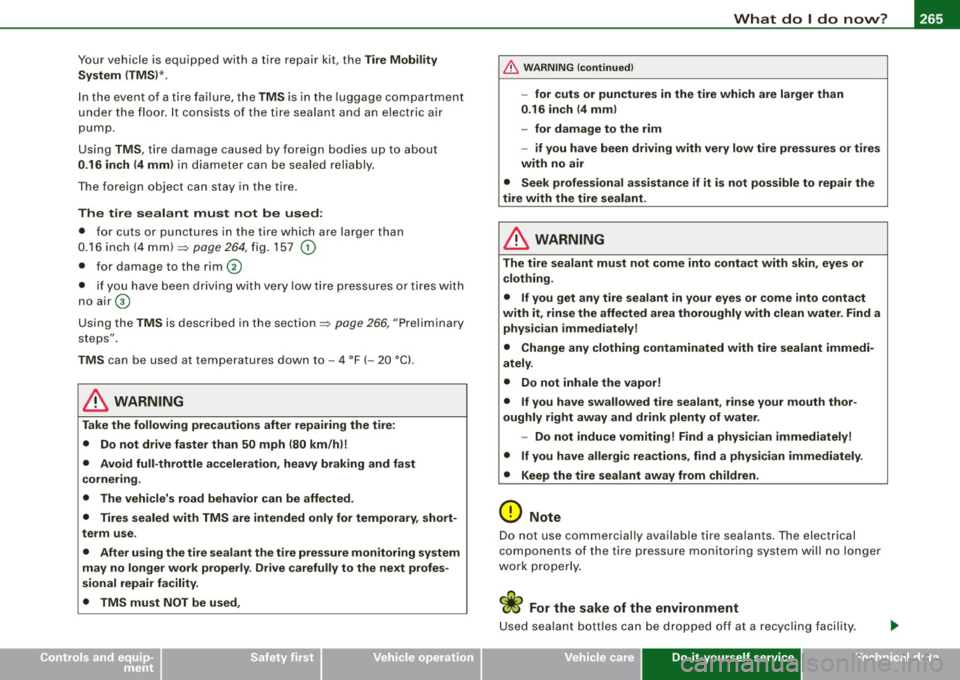
Your vehicle is equipped with a t ire repair kit, the Tire Mobility
System (TMSl *.
In the event of a tire fai lure, the TMS is in the luggage compartment
under the floor . It consists of the tire sealant and an e lectric ai r
pump.
Using
TMS , tire damage caused by foreign bodies up to about
0.16 inch (4 mm) in d iam ete r can be sea le d reli abl y.
T he foreign object can stay i n the tire .
The tire sealant mu st not be used :
• for cuts or punctures in the tire which are larger than
0.16 inch
(4 mm )=> page 264, fig . 157 G)
• for damage to the rim@
• if you have bee n drivin g wi th very lo w tir e pr essures o r tire s w it h
no air@
Usi ng th e
TMS is de scrib ed in th e se ction=> page 2 66, "Prel imina ry
steps" .
TMS can be used at temperat ures down to -4 °F ( -20 °C).
& WARNING
Take the following precautions after repairing the tire :
• Do not drive faster than 50 mph (80 km/h)!
• Avoid full -throttle acceleration , heavy braking and fast
cornering.
• The vehicle's road behavior can be affected.
• Tires sealed with TMS are intended only for temporary , short
term use .
• After using the tire sealant the tire pressure monitoring system
may no longer work properly . Drive carefully to the next profes
sional repair facility .
• TMS must NOT be used ,
& WARNING (continued )
-for cuts or punctures in the tire which are larger than
0 .16 inch (4 mm)
- for damage to the rim
- if you have been driving with very low tire pressures or tires
with no air
• Seek professional assistance if it is not possible to repair the
tire with the tire sealant.
& WARNING
The tire sealant must not come into contact with skin , eyes or
clothing.
• If you get any tire sealant in your eyes or come into conta ct
with it , rinse the affected area thoroughly with clean water. Find a
physician immediately!
• Change any clothing contaminated with tire sealant immedi
ately.
• Do not inhale the vapor!
• If you have swallowed tire sealant , rinse your mouth thor
oughly right away and drink plenty of water .
- Do not induce vomiting! Find a physician immediately!
• If you have allergic reactions, find a physician immediately .
• Keep the tire sealant away from children.
0 Note
Do not u se co mm ercially ava ilable tire sealants . The elec trical
components of the tire pressure monitoring system wi ll no lo nger
wo rk p roperly.
~ For the sake of the environment
U sed sealant bottles ca n be dropped off at a recycling faci lity .
Do-it -yourself service
Page 268 of 316

1111...__W_ h_ a _ t_d_ o_ l _d _o_ n_ o_ vv_ ? ______________________________________________ _
[ i J Tips
• If sealant has run out, allow it to dry. Then you can peel it off .
• Have the tire sealant replaced every 4 years at a d ealership. •
Applie s to ve hicles: with T ire Mob ilit y Sy stem
Preliminary steps
Some preliminary steps ore necessary for tire repair.
Fig . 158 Tire Mobility
System under luggage
compartment floor
- If you have a flat tire, park the vehicle as far as possible
from moving t raffic.
- Apply the
parking brake firmly.
- On vehicles w ith manual transmission, engage
1st gear,
or move the selector lever to the P position on vehicles
w ith automat ic transmission.
- Check whether a repair using the Tire Mob ility System is
possible ~
page 264, "General and safety po inters".
Have all passengers
leave the vehicle and stay away from
the danger zone~& .
- Take the
sealant bottle and the electric air pump from the
luggage compartment under the floor~ fig. 158. - Remove the "max. 50 mph"
(80 km/h) sticker from the
sealant bottle and affix it to the instrument cluster in the
driver's view.
& WARNING
• Turn the hazard flashers on and set up the warning triangle if
you have a flat tire in moving traffic. In this way you protect your
self and other road users.
• Make sure that all passengers are in a safe place, out of the
danger zone (for example, behind a guard raill.
(D Note
Particular care is necessary if you are making a tire repair on a steep
inc line .
[ i J Tips
Obey all laws. •
App lies to ve hicles: w ith T ire Mob ility System
Mak ing a tire repa ir
Tire repair consists of the following sections.
Fig. 159 Parts of the
Tire Mobility System ..
Page 270 of 316

11111.___W_ h_ a _ t_d_ o_ l _d _o_ n_ o_ w_ ? ______________________________________________ _
-Place the electric air pump in the luggage compartment
for the time being.
- Start driving right away so that the sealant is dist ributed
in the tire.
& WARNING
• Follow the manufacturer's safety instructions on the decal for
the air pump and the sealant bottle.
• If a tire pressure of 1.8 bar cannot be achieved after pumping
for 5 minutes, the tire is too severely damaged. Do not continue to
drive.
• Seek professional assistance if it is not possible to repair the
tire with the tire sealant.
[ i] Tips
• Do not operate the electric air pump for more than 8 minutes
without stopping, otherwise it can overheat. When the air pump has
cooled down, you can continue to use it.
• If sealant has escaped, allow it to dry, then you can peel it off. •
Applies to veh icles: with Tire Mob ili ty Sys tem
Final check
After driving for a short distance, tire pressure
must be checked
- After driving for about 10 minutes, stop and check the
tire pressure.
- If tire pressure is still at least 1.3 bar, inflate the tire to
specified pressure (see driveas side B-pillarl, drive to the
next repair shop and have the tire and the sealant bottle
replaced. -
If tire pressure is less than 1.3 bar, the tire is too severely
damaged. Do not continue to drive. Seek professional
assistance.
& WARNING
If tire pressure is less than 1.3 bar after driving for 10 minutes, the
tire is too severely damaged. Do not continue to drive. Seek profes
sional assistance.
[ i] Tips
After a tire repair, have the sealant bottle replaced at a dealership.
This restores full functionality to the Tire Mobility System. •
What should I be aware of when
changing a tire?
General information
The following sections will provide you with important information
on how to change a tire using the vehicle tool kit.
However, we recommend that you have a qualified service center
change the tire and perform all work associated with changing it. •
Page 272 of 316

1111...__W_ h_ a _ t_d_ o_ l _d _o_ n_ o_ vv_ ? ______________________________________________ _
Loosening and tightening the wheel bolts
The wheel bolts must be loosened before raising the
vehicle.
Loosening
Fig . 163 Wheel
change: loosening the
wheel bolts
- Fit the wheel bolt wrench over the wheel bolt and push it
down as far as it will go .
- Close your grip around the
end of the wrench handle for
maximum torque and turn the wheel bolts
counter-clock
wise
about one single turn in the direction of arrow
~ fig. 163.
Tightening
Fit the wheel bolt wrench over the wheel bolt and push it
down as far as it will go.
- Close your grip around the
end of the wrench handle for
maximum torque and turn each wheel bolt
clockwise
until it sits tight.
& WARNING
• Using force without control to speed the wheel change up can
cause the vehicle to slip off the jack and cause serious personal
injuries.
• Do not loosen the wheel bolts more than one turn before you
raise the vehicle with the jack. -Risk of injury!
[ i] Tips
• Never try and use the hexagonal socket in the handle of the
screwdriver to loosen or tighten the wheel bolts.
• If a wheel bolt sits very tight, you may find it easier to loosen by
carefully pushing down on the end of the wheel bolt wrench with
one foot only . As you do, hold on to the car to keep yourself stable
and take care not to slip.•
Raising the vehicle
The vehicle must be lifted with the jack first before the
wheel can be removed.
Fig. 164 Wheel
change: mounting
points
for the lifting
jack ..
Page 273 of 316

What do I do now? -
------------------
Fig. 165 Close-up:
proper positioning of
lifting jack
- Find the mounting point on the rocker panel which is
closest to the flat tire =>
page 270, fig. 164 -arrows-.
- Crank the jack up until it can be positioned under the lift
point on the vehicle.
- Align the jack so the claw=> fig. 165@ grips the
mounting point on the rocker panel and the flexible base
plate ® is flat on the ground.
- Continue to crank the jack until the wheel is lifted just
clear of the ground.
Recesses at the front and rear of the underbody rib mark the proper
mounting locations for the jack=>
page 270 , fig. 164. There is only
one
designated jack mounting point for each wheel. Do not apply
the jack anywhere else=>&.
The jack should be positioned approximately 6 in. (15 cm) behind
the front wheel or 10 in. (25 cm) in front of the rear wheel.
An
unstable surface under the jack can cause the vehicle to slip off
the jack. Always provide a firm base for the jack on the ground. If
necessary place a sturdy board or similar support under the jack. On
hard, slippery surfaces (such as tiles) use a rubber mat or similar to
prevent the jack from slipping=> &.
& WARNING
• You or your passengers could be injured while changing a
wheel if you do not follow safety precautions:
-Mounting the jack under the vehicle at any other place than
indicated above may damage the vehicle or may result in
personal injuries.
- A soft or unstable surface under the jack may cause the
vehicle to slip off the jack. Always provide a firm base for the
jack on the ground. If necessary, use a sturdy board under the
jack.
- On hard, slippery surface (such as tiles) use a rubber mat or
similar to prevent the jack from slipping.
• To help prevent injury to yourself and your passengers:
-Do not raise the vehicle until you are sure the jack is securely
engaged.
- Passengers must not remain in the vehicle when it is jacked
up.
- Make sure that passengers wait
in a safe place away from
the vehicle and well away from the roadway and traffic.
- Make sure jack position is correct, adjust as necessary and
then continue to raise the jack.
0 Note
A floor jack or the pads on the hoist arms must not be positioned at
the points shown
=> page 270 , fig. 164 -arrows -. •
Vehicle care Do-it-yourself service irechnical data
Page 275 of 316

What do I do now? -
----------------
•
• The whe el bo lts should be cl ean and easy to turn . C heck for dirt
an d corro sion on the mati ng s urfaces o f both th e wheel a nd the
hub. Remove a ll dirt fro m these surfaces before remountin g the
whee l.•
Notes on wheel change
Ple as e rea d th e informati on => pag e 246 , "New tir es an d r ep laci ng
tir es and whee ls", if you ar e goin g to us e a spar e tire which is
d ifferent from th e tir es on y our v ehic le .
After you ch ange a tire :
• Check the tire pressure on the spare immediately after
mounting.
• Have the wheel bolt tightening torque checked with a torque
wrench as soon as possible by your authorized Audi dealer or a qualified service station .
• With steel and alloy wheel rims, the wheel bolts are correctly
tightened at a torque of 90 ft lb (120 Nm l.
• If you notice while changing a tire that the wheel bolts are
corroded and difficult to turn , then they should be replaced before
you check the tightening torque.
• Replace the flat tire with a new one and have it installed on your
vehicle as soon as possible . Remount the wheel cover.
Until then , drive with extra care and at reduced speeds .
& WARNING
• If you are going to equip your vehicle with tires or rims which
differ from those which were factory installed , then be sure to read
the information
=> page 246, "New tires and replacing tires and
wheels ".
• Always store the tools securely in luggage compartment .
Otherwise, in an accident or sudden maneuver they could fly
forward, causing injury to passengers in the vehicle.
0 Note
D o not us e comme rc ia lly av ai labl e tire sea lants. Otherw ise, t he elec
trical components of the ti re pressure monitor ing system* will no
l o nger wor k properly a nd the se ns or fo r the tire pr essure moni
to ring system will have to be rep laced b y a qualified workshop. •
Tires with unidirectional tread design
T ires w ith unid ire ction al tread design must be m ounted
w ith their tread patte rn po inted t he r ight dire ction.
A un id irectiona l tir e ca n be iden tified by arrows on the sidewall ,
w hi ch point in th e dir ec tion of the r otation. You mus t follow th e
specified direction of rotati on. T his is necessa ry in o rder fo r these
t ire s to de ve lop their optimum ch arac ter ist ics rega rdin g grip, r oad
noise, wear, and h ydroplaning .•
Do-it -yourself service
Page 277 of 316

Fuses and bulbs -
------------------
The various electrical circuits are protected by fuses. The fuses are
clustered in a centralized unit. The unit is located behind the face
panel at the end of the instrument panel.
Two spare fuses and a sticker identifying the fuses are located on
the inside of the fuse box cover.
You are well advised to keep a supply of spare fuses in your vehicle.
Fuses with the proper ampere ratings are available at your autho
rized Audi dealer.
& WARNING
Never replace a fuse with one that has a higher amperage rating .
• A fuse with a too high amperage could damage the electrical
part and cause a fire.
0 Note
• On no account should fuses be repaired (e.g. patched up with tin
foil or wire) as this may cause serious damage elsewhere in the elec
trical circuit or cause fire.
• If a fuse blows repeatedly, do not keep replacing it. Instead, have
the cause for the repeated short circuit or overload tracked and
fixed. •
Fuse Location , Instrument Panel left
Fig . 170 Fuse carrier
behind the instrument
panelendface,cover
removed
Some of the equipment items listed are optional or only available on
certain model configurations.
Note that the following table is accurate at the time of going to
press and is subject to change. In the event of discrepancies, the
label on the inside of the cover always takes precedence.
The power seats are protected by circuit breakers, which automati
cally reset after a few seconds after the overload has been reme-
died. .,_
Vehicle care Do-it-yourself service irechnical data