2009 AUDI TT COUPE ABS
[x] Cancel search: ABSPage 130 of 316

___ S_a_ f_ e_ t-= y_ b_e_ l_ t _s _______________________________________________ _
supposed to deploy in all kinds of accidents. Although your Audi is
equipped with airbags, all vehicle occupants, including the driver, must wear safety belts correctly in order to minimize the risk of
severe injury or death in a crash.
Remember too, that airbags will deploy only once and that your
safety belts are always there to offer protection in those accidents
in which airbags are not supposed to deploy or when they have
already deployed. Unbelted occupants can also be thrown out of the
vehicle where even more severe or fatal injuries can occur.
It is also important for the rear passengers to wear safety belts
correctly. Unbelted passengers in the rear seats endanger not only
themselves but also the driver and other passengers:::::,
page 127,
fig. 104. In a frontal collision they will be thrown forward violently,
where they can hit and injure the driver and/or front seat passenger. •
Safety belts protect
People think it's possible to use the hands to brace the
body in a minor collision. It's simply not true!
Fig . 105 Driver is prop
er ly restrained in a
sudden braking
maneuver.
Safety belts used properly can make a big difference . Safety belts
help to keep passengers in their seats, gradually reduce energy
levels applied to the body in an accident, and help prevent the uncontrolled movement that
can cause serious injuries. In addition,
safety belts reduce the danger of being thrown out of the vehicle.
Safety belts attach passengers to the car and give them the benefit
of being slowed down more gently or "softly" through the "give" in
the safety belts, crush zones and other safety features engineered
into today's vehicles. By "absorbing" the kinetic energy over a
longer period of time, the safety belts make the forces on the body
more "tolerable" and less likely to cause injury.
Although these examples are based on a frontal collision, safety belts can also substantially reduce the risk of injury in other kinds
of crashes. So, whether you're on a long trip or just going to the
corner store, always buckle up and make sure others do, too . Acci
dent statistics show that vehicle occupants properly wearing safety
belts have a lower risk of being injured and a much better chance of
surviving an accident. Properly using safety belts also greatly
increases the ability of the supplemental airbags to do their job in a
collision . For this reason, wearing a safety belt is legally required in
most countries including much of the United States and Canada.
Although your Audi is equipped with airbags, you still have to wear
the safety belts provided. Front airbags, for example, are activated
only in some frontal collisions. The front airbags are not activated in
all frontal collisions, in side and rear collisions, in roll overs or in
cases where there is not enough deceleration through impact to the
front of the vehicle. The same goes for the other airbag systems in
your Audi. So, always wear your safety belt and make sure every body in your vehicle is properly restrained! •
Important safety instruct~ons about safety
belts
Safety belts must always be properly positioned across
the strongest bones of your body.
Always wear safety belts as illustrated and described in
this chapter. _,
Page 142 of 316

___ A_ i_r _b _a _ g~ s_ y_ s_t _e _m ___________________________________________________ _
& WARNING (continued)
• Airbag work most effectively when used with properly worn
safety belts .
• Therefore, always wear your safety belts and make sure that
everybody in your vehicle is properly restrained .
& WARNING
A person on the front passenger seat, especially infants and small
children, will receive serious injuries and can even be killed by
being too close to the airbag when it inflates .
• Although the Advanced Airbag System in your vehicle is
designed to turn off the front passenger airbag if an infant or a
small child is on the front passenger seat, nobody can absolutely
guarantee that deployment under these special conditions is
impossible in all conceivable situations that may happen during
the useful life of your vehicle.
• The Advanced Airbag System can deploy in accordance with
the "low risk" option under the U.S. Federal Standard if a child that
is heavier than the typical one-year old child is on the front
passenger seat and the other conditions for airbag deployment
are met.
• Accident statistics have shown that children are generally safer
in the rear seat area than in the front seating position.
• For their own safety, all children, especially 12 years and
younger, should always ride in the back properly restrained for
their age and size . •
Advanced front airbag system
Your vehicle is equipped with a front Advanced Airbag System in
compliance with United States Federal Motor Vehicle Safety Stan
dard 208 as applicable at the time your vehicle was manufactured. The
front Advanced Airbag System supplements the safety belts to
provide additional protection for the driver's and front passenger's
heads and upper bodies in frontal crashes . The airbags inflate only
in frontal impacts when the vehicle deceleration is high enough.
The front Advanced Airbag System for the front seat occupants is
not a substitute for your safety belts . Rather, it is part of the overall
occupant restraint system in your vehicle. Always remember that
the airbag system can only help to protect you, if you are sitting
upright, wearing your safety belt and wearing it properly. This is why
you and your passengers must always be properly restrained, not
just because the law requires you to be.
The Advanced Airbag System in your vehicle has been certified to
meet the "low risk" requirements for 3 and 6 year -old children on the
passenger side and very small adults on the driver side. The low risk
deployment criteria are intended to help reduce the risk of injury
through interaction with the front airbag that can occur, for
example, by being too close to the steering wheel and instrument
panel when the airbag inflates.
In addition, the system has been certified to comply with the
"suppression" requirements of the Safety Standard, to turn off the
front airbag for infants 12 months old and younger who are
restrained on the front passenger seat in child restraints that are
listed in the Standard=>
page 159, "Child restraints and Advanced
Airbags" .
"Suppression" requires the front airbag on the passenger side to be
turned off if:
• a child up to about one year of age is restrained on the front
passenger seat in one of the rear-facing or forward-facing infant
restraints listed in Federal Motor Vehicle Safety Standard 208 with
which the Advanced Airbag System in your vehicle was certified. For
a listing of the child restraints that were used to certify your
vehicle's compliance with the US Safety Standard=>
page 159,
• weight less than a threshold level stored in the control unit is
detected on the front passenger seat. .,
Page 152 of 316

-L~A:::..:,: ir:....: b:!..::: a~g L.:: s:1y :...:s::..: t~ e:.: m:...:...:.. ________________________________________________ _
& WARN ING (continued )
• Always make sure that the side airbag can inflate without inter
fe rence :
- Never install seat covers or replacement upholstery over the
front seatback s that have not been spe cifically approved by
Audi.
- Never use additional seat cushions that cover the areas
where the side airbags inflate .
- Damage to the original seat covers or to the seam
in the area
of the side airbag module must always be repaired immedi
ately by an authorized Audi dealer .
• The airbag system can be activated only once. After an airbag
ha s inflated , it must be replaced by an authorized Audi de aler or
qualified technician who has the technical information , training
and special equipment necessary .
• The airbag system can be deployed only once. After an airbag
has been deployed , it must be repla ced with new repla cement
parts designed and approved especially for your Audi model
version . Replacement of complete airbag systems or airbag
components must be performed by qualified workshops only .
Make sure that any airbag service action is entered in your Audi
Warranty
& Maintenance booklet under AIRBAG REPLACEMENT
RECORD .
• For safety reasons in severe accidents , the alternator and
starter are separated from the vehicle battery with a pyrotechn ic
circuit interrupter.
-Work on the pyrotechni c circuit interrupter must only be
performed by a qualified dealer -risk of an accident!
- If the vehi cle or the circuit inte rrupter is scrapped , all appli
cable safety precautions must be followed. •
Other things that can affect Advanced Airbag
performance
Changing the vehic le 's suspens ion system can change the way that
th e Adva nced Air bag Syste m performs in a c rash. Fo r example,
using tire -ri m co mbinations not approved by Audi, lowering the
veh ic le, c hang in g the st if f ness o f th e suspe nsio n, incl uding th e
spr ings, suspension struts, shock absorbers etc. can change the
f o rces t hat a re m easured by the a irba g se nsors and se nt to the elec
tronic control unit. Some suspension changes can, for example,
i ncrease the fo rce level s meas ure d by the senso rs and make the
a irbag system dep loy in crashes in which it wou ld not d ep loy if the
changes ha d no t been made . O th er ki nds of changes may red uce
th e force levels measured by the sensors and preve nt the airbag
fro m deploying w hen it sh ould.
Th e senso rs in th e sa fety belt buc kle fo r the dr iver a nd fro nt
passenger seat te ll the e lectronic control modu le if the safety belt is
l a tc h ed or not. If th e sa fe ty belt is being use d, th e front airbag wi ll
deploy at a slightly higher rate of vehic le dece leration than if the
sa fe ty be lt is n ot b ein g use d. Th ere fore, i n a partic ula r co llisi on, i t is
possible that an airbag wi ll not deploy at a seating position where
th e sa fe ty be lt is bei ng us ed bu t wi ll infl ate at the position w here the
safety be lt is not being used. It is important that nothi ng interfere
with the safety belt buc kles so that the sensors can send the co rrect
i nformatio n about safety belt use to t he electronic control unit.
& WARNING
Changing the vehicle's suspension including use of unapproved
tire -rim combinations can change Advanced Airbag performance
and increase the risk of serious personal injury in a crash.
• Never install suspension components that do not have the
same pe rformance characteristics as the components originally
installed on your vehicle.
• Never use tire -rim combinations that have not been approved
by Audi. ..
Page 184 of 316
___ ln_ t _e_ ll_,ig ..,_ e_ n_t _t_ e_ c_ h_ n_o _ l_o ..:-g"'-' y'- -------------------------------------------
Intelligent technology
Notice about data recorded by
vehicle control modules
Your vehicle is not equipped with an Event Data Recorder (EDR),
installed by some manufacturers for the express purpose of
capturing data for retrieval after an accident or crash event . EDR's
are sometimes called "crash recorders".
Some state laws restrict the retrieval or downloading of data stored
by EDR's that were installed in a vehicle for the express purpose of
retrieving data after an accident or crash event w ithout the owner's
consent.
Although your vehicle is not equipped with an EDR, it is equipped
with a number of electronic control modules for various vehicle systems such as, for example, engine function, emission control, as
well as for the airbags and safety belts.
These electronic control modules also record vehic le-related data
during norma l vehicle opera tion for diagnostic and repair purposes .
The recording capacity of the electronic control modules is limited
to data (no sound is recorded) and only a small amount of data is
actually recorded over a very limited period of time and stored when
a system fault or other condition is sensed by a control unit. Some
of the data then stored may relate to vehic le speed, direction,
braking as well as restraint system use and performance in the
even t of a crash or other condition . Stored data can only be read and
downloaded with special equipment.
Electronic Stabilization Program (ESP)
Genel'61
The Electronic Stability Program increases driving
sta bility.
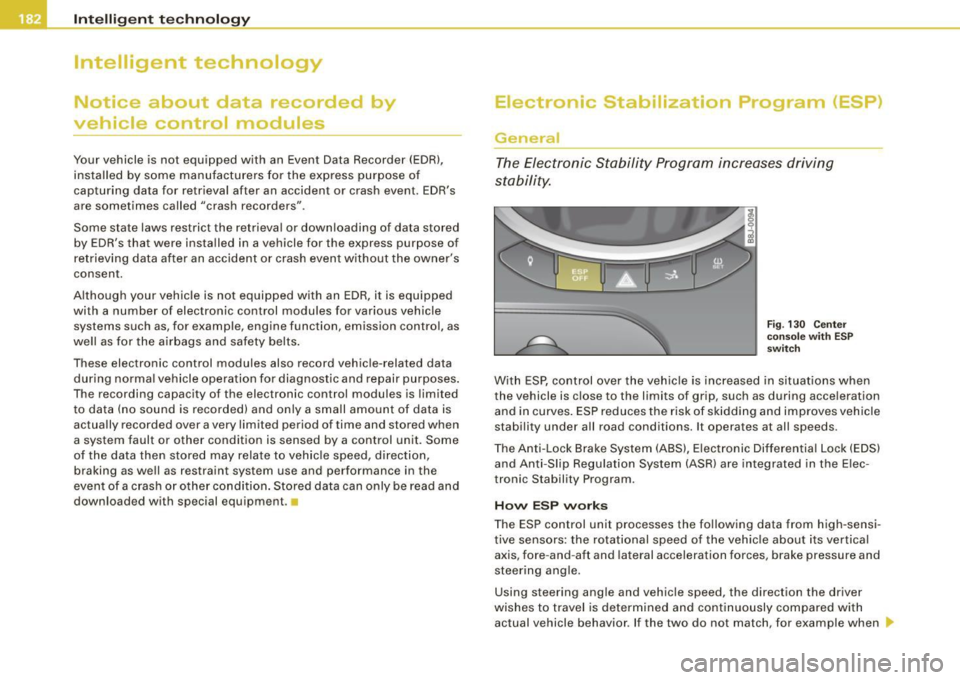
Fig . 13 0 Cente r
cons ole with ESP
sw itch
With ESP, control over the veh icle is increased in situations when
the vehicle is close to the limits of grip, such as during acce leration
and in curves. ESP reduces the risk of skidding a nd improves vehicle
stability under all road conditions . It operates at all speeds .
The Anti-Lock Brake System (ABS), E lec tronic Differentia l Lock (EDS)
and Anti-Slip Regulation System (ASR) are integrated in the Elec
tronic Stability Program .
H ow ESP work s
The ESP control unit processes the following data from high-sensi
tive sensors: the rotational speed of the vehicle about its vertica l
axis, fore -and -aft and lateral acceleration forces, brake pressure and
steering angle.
Using steering ang le and vehicle speed, the direction the driver
wishes to travel is determined and continuously compared with
actual vehicle behavior . If the two do not match, for example when
Page 185 of 316

the vehicle begins to skid, ESP brakes the appropriate wheel automatical ly .
The vehicle is stabilized again by the forces acting on the wheel during braking. With an oversteering vehicle (tendency for the rear
end to skid out of the curve), the brake application is mainly at the
front wheel on the outside of the curve, with an understeering
vehicle (tendency to run wide in the curve) at the rear wheel on the
inside of the curve or additionally at the other wheels as needed .
This brake application is accompanied by noises.
ESP works in conjunction with ABS=:>
page 187. If there is ma lfunc
tion in the ABS, ESP is also inoperative .
Activa ting
The ESP is automatica lly activated when the engine is started, and
it performs a self-test. As soon as the test is completed, the system
is in normal operating mode . With ASR deactivated, or with ESP/ASR
deactivated, pressing the button=>
page 182, fig. 130 returns the
system to normal operation.
D eac tiva ting
ESP should norma lly be activated at all times because this ensures
optimum vehicle stability . Only in certain exceptional cases it does
make sense to deactivate Anti -Slip Regulation (ASR) or the Elec
tronic Stability Program !ESP) by pressing the button =:>
page 182,
fig. 130. Both deactivation stages can only be activated from normal
mode.
Dea cti vat ing ASR
Tap the switch . Deactivation is indicated by slow flashing of the ESP
lamp in the instrument c luster. In certain situations (e.g. driving
with snow chains, in deep snow or on loose ground, or when rocking the car free), it may be necessary to deactivate ASR. Deacti
vation is effective only up to a speed of about 45 mph (70 km/h). At higher speeds, ASR is switched on again automatical ly in front
whee l drive vehicles, deactivation is possible only up to about 30
mph (50 km/h). With all -whee l drive vehicles, ASR is active above
Controls and equip
ment Safety first Vehicle operation
In
te llig ent tec hn olo gy
about 45 mph (70 km/h) and deactivated automatical ly below this
speed.
D eac tiva tin g ES P/ASR
Press the button for more than 3 seconds . Deactivation is indicated
by the ESP lamp in the instrument c luster staying on permanently .
This deactivates the E lectronic Stabi lity Program (ESP) in addition to
ASR . No Electronic Stability System operation and no Anti-Slip
Regu lation is availab le across the entire speed range; ASR and ESP
are activated only when the brakes are used for the duration of the
braking action and remain active until a stab le vehicle condition has
been reached. There is no driving situation which requires ESP to be
deactivated, so this should only be done if the driver's skill and the
traff ic situation permit .
& WARNING
• The limi ts of ph ysics ca nnot be suspe nd ed by E SP. E ven in vehi
cles w ith ESP, you should always adapt your dr iving to road and
tr affi c co ndition s. Thi s is part icul ar ly tr ue on a s lippe ry and wet
road . Do not be te mpt ed b y th e incre as ed safet y prov ided t o ta ke
ri sks - dang er of an acc ide nt!
• Plea se not e that when ASR or ESP /ASR i s de activ ated , the drive
w heel s ca n spin on icy and slipper y ro ad s an d the vehi cle can
break away - da nger of skiddin g!
Ii ] Tip s
In the event of a defect in the rear spoiler system or in Audi
magnetic ride, it can happen that ASR and ASR/ESP cannot be deac
tivated, or they are activated automatica lly in the deactivated
state. •
Vehicle care Do-it-yourself service Technical data
Page 186 of 316

___ ln_ t _e_ ll-'"ig ...,_ e_ n_t _t_ e_ c_ h _ n_o _ l_o _,.g= y,_ __________________________________________ _
Electronic differential lock (EOL)
The electronic differential lock monitors the rotational
speed of the drive wheels.
General notes
The electronic differential lock (EDU helps the car to start moving,
accelerate and climb a gradient on surfaces providing poor or
almost no grip. Without EDL, this would be difficult, if not impos
sible.
How the system works
Th e EDL operates automatically. It monitors the rotational speed of
the drive wheels on an axle with the help of the ABS sensors
=> page 187. If a noticeable difference in rotational speed between
the drive wheels on one axle is detected (e.g. on slippery ground on
one side), the spinning wheel is braked, thereby transferring power
to the other drive wheel or wheels (all-wheel drivel. This is done up
to a speed of about 60 mph (100 km/hl. Noises from the brake
system signal that wheel spin is being controlled.
Driving off
When driving off, always be sure to keep road conditions in mind as
you accelerate . If one drive wheel spins because it is on a surface
with less grip, gradually increase the pressure on the accelerator
pedal until the car starts to move. The wheel less able to transfer
power spins.
Overheating of brakes
To prevent the disc brake of the braked wheel from overheating if
subjected to excessive loads, the EDL cuts out temporarily . The
vehicle remains operational and behaves in the same way as a
vehicle without EDL.
As soon as the brake has cooled down, EDL switches on again auto
matically.
& WARNING
• When accelerating on slippery surfaces, such as on ice or snow,
always be careful when depressing the accelerator pedal. Even
with the EDL working, the drive wheels can spin and reduce your ability to control your car. -Risk of crash!
• The increased safety afforded by EDL does not mean that you
can take safety risks. Always adapt your driving style to the road
conditions and traffic situation.
[ i] Tips
If a fault occurs in the ABS, the EDL is also not functioning . This is
indicated by the ABS warning light=> page 20. •
Anti-Slip Regulation System (ASR)
The Anti-Slip Regulation System prevents the driven
wheels from spinning when the car is accelerating.
General notes
The Anti-Slip Regulation System (ASR) is integrated in the electronic
stabilization program (ESP). When the vehicle starts up and acceler
ates , the wheels are prevented from spinning by adjusting the
engine power to match the amount of grip available from the road
surface .
How the system works
ASR performs automatically, i.e. without the driver's intervention .
With the aid of the ABS sensors => page
187, ASR monitors the
speed of the driven wheels. If the wheels start to spin, the engine
torque is reduced automatically until the tires find enough grip to
lock onto the road surface . The system is active across the entire
speed range.
The ASR works in conjunction with the ABS. If a malfunction should
occur in the ABS, the ASR will also be out of action .
~
Page 189 of 316

If t he brakes ar e not used frequently , or if corrosion has for med on
th e d iscs, i t is adv isa ble to cl ean off the pads a nd disc s by braki ng
firm ly a f ew times from a moderate ly high speed=:> &.
Faults in the brake system
I f yo u shou ld notice a
sudden i ncrease in bra ke pedal trave l, then
o ne of th e two b rake c ircui ts may hav e fa iled =:>& .
Low brake fluid level
M alf unc tions ca n occu r in the br ake system if th e b ra ke flu id leve l is
too low . Th e brake fluid level is monitored e lectronica lly.
Brake lining wear status
B ra ke l inin g wea r may be c hec ked by v is u al inspection of the condi
tion o f the b rake pads t hrou gh the ope ning s in th e wheel. If neces
sary, the wheel may be removed for this inspection=:> page 268,
' 'W hat s hou ld I be aw are o f wh en ch ang ing a ti re ?".
Brake power assist unit
T he bra ke po wer assist unit increas es the pressure that you
generate with the b ra ke peda l. It work s only when the engine is
r u n nin g.
& WARNING
• You should perform braking maneuvers for the purpose of
cleaning the brake system only if road conditions permit . Other
road users must not be put at risk -you may cause an accident!
• Before descending a steep grade , reduce speed and shift trans
mission into a lower gear or lower driving position . Do not ride the
brakes or hold the pedal down too long or too often. This could
cause the brakes to get hot and diminish braking efficiency .
• Do not "ride the brakes " by resting your foot on the pedal when
you do not intend to brake . This may cause the brakes to overheat ,
premature wear and increased stopping distance .
• Under certain climatic and operating conditions such as
passing through water , driving in heavy rain or after washing the
Controls and equip ment Safety first Vehicle operation
Intelligent technology
& WARNING
(continued )
vehicle, the effectiveness of the brakes can be reduced . In winter ,
ice can accumulate on the brake pads , linings , discs and drums .
Cautiously apply brakes for a test. Brakes will dry and ice coatings
will be cleaned off after a few cautious brake applications.
• Driving for an extended period of time on salt-covered roads
without using your brakes can also affect braking efficiency. Clean off accumulated salt coating from brake discs and pads with a few
cautious brake applications.
• If you damage the front spoiler , or if you install a different
spoiler, be sure the air flow to the front brakes is not obstructed.
Otherwise the brake system could overheat reducing the effective
ness of the entire brake system.
• Failure of one brake circuit will impair the braking capability
resulting in an increased stopping distance. Avoid driving the
vehicle and have it towed to the nearest Audi dealer or qualified
workshop.
• Never let the veh icle roll to a stop with the engine shut off .
• If the brake booster is not working, for example when towing
your vehicle , or because the brake booster has somehow been
damaged , the brake pedal must be pre ssed considerably harder to
make up for the lack of booster assistance . •
Anti- lock brake system CABS)
ABS preve nts th e wheels from lo cking under br aking.
The anti -loc k brake syste m (ABS) makes a major contribution to
i nc reas ing active d rivi ng sa fety . You s ho ul d not e xp e ct that braki ng
distances wi ll be
shortened und er all circumstances with ABS .
B ra kin g dis tance may even become s omewhat lon ger, for exa mple,
on gravel or in new snow on s lippery ground, even if you are driving
c aref ully a nd s lowly .
Vehicle care Do-it-yourself service Technical data
Page 190 of 316

___ ln_ t _e_ ll-'"ig ...,_ e_ n_t _t_ e_ c_ h _ n_o _ l_o _,.g= y,_ __________________________________________ _
ABS operation
When a vehicle speed of about 10 mph (20 km/h) is reached, an au to
matic test sequence is run. Some noise from the pump may be
audible .
I f the speed of a whee l slows down too much relative to vehic le
speed and it starts to lock, brake pressure to this wheel is reduced.
This adj ustment process can be felt as a
pulsing motion of the brake
pedal ,
accompanied by some no ises. You as the driver are intention
a lly being given the infor mation tha t the wheels are tending t o lock
(ABS control range). In order for ABS to be ab le to operate optima lly
in this range, you must keep the b rake pedal depressed -do not
"pump the brakes".
Brake assistant
The brake power assist un it increases the pressure that you
genera te wi th the brake pedal. I t wo rks only when the e ngine is
running.
Automatic full braking
T his function al lows fu ll bra king in spite of high brake pedal forces
(e .g. whe n the brakes are seve rely s tressed beca use the veh ic le is
fully loaded) . T he driver not ices this function through a reduction of
pedal force a nd increased pedal t ravel. When the brake peda l is
re leased, fu ll braking assist switches off again automatically .
If there is an ABS failure, the brake assistant and automatic fu ll
brak in g ass ist are not available.
& WARNING
• ABS cannot suspend the la ws of physic s. You should keep this
in mind in parti cular on an icy or wet road . If ABS control of braking
intervenes , you should adjust your speed immediately to road and
traffic condit ions . Do not be tempted by the increased safety
provided to take risks -danger of an accident.
• Please keep in mind that the risk of an accident is increased by
driving too fast , particularly in bends and on icy or wet roads , and
& WARNING (continued )
by driving too close to the vehicle ahead . The increased risk of an
accident cannot be redu ced by the brake a ssistant -danger of an
accident .
[ i ] Tips
If a ma lfunction occurs in the ABS, this is signalled by an indicator
l ight, se e =>
pag e 20.
E ectro-mechan-;cal power assist
The electro -me chanical po wer assist helps the driver
w hen steering.
The degree o f pow er assis t is electronically matched t o ve h ic le
speed .
The power stee ring system as sists the driver so that he can steer the
vehic le with reduced physica l effort.
P ower steering wil l not work if the engine is off. As a result, the
s te eri ng wheel wi ll be hard to turn .
& WARNING
If the system develops a problem , you must seek qualified profes
s ional assist ance .
0 Note
If there is an electronic ma lfunction, servotronic wi ll st ill function
li ke a conve ntio nal power stee rin g system, prov iding a constant
steering support force that is no longer proportionate to the vehicle
speed. This is most no ticeable when turni ng the s teering wheel at
l ow speeds (for examp le when parking), -more effort will be
r e q uired than usual. ._