2009 AUDI S6 instrument cluster
[x] Cancel search: instrument clusterPage 13 of 398

Instruments and controls
General illustration
G)
0
©
©
©
©
0
©
Power window switches ...... .... ..... .. ....... .
Door handle
Memory buttons (driver's seat)
Power locking switch .......................... .
Adjuster control for outside mirrors .. .... .... .... .
Air outlets ........ ... ...... .... ...... .... ... .. .
Light switch .... .... ........... .... .... .... ... .
Control lever for :
- Turn signal and high beam
- Lane assist .... .... ... .... .... .... .......... .
Control lever for:
- Cruise control
- Adaptive Cruise Contro l .......... ...... .... .. .
@ Multifunction steering wheel with:
- Horn
55
84
49
76
108
63
67
143
124
127
- Driver's airbag . . . . . . . . . . . . . . . . . . . . . . . . . . . . . . . 219
- Shift buttons ................................ 160, 167
@
@
@
@
-Button for steering wheel heating
Instrument cluster ... .... ... .... ...... ......... .
Switches for
- Windshield wiper/washer ..... ...... ..... .. ... .
- Trip computer ..... .. ..... ... .... ...... ... .. .
Steering lock/ignition/starter switch
Buttons for
- Reset button for trip odometer ... .. .... .... ... .
!CHECK] .. .... ....... .... .... ....... .... ... .
Instrument lighting .... ... .... .... ... ..... ... .
Controls and equip
ment
1 1 1
12
71
38
116
14
15
16
Instruments and controls
@ MMI Display, see separate manual
@ Depending on equipment, switches for:
- Electronic Stabilization Program (ESP)
- Side assist .. ... ..... .. .. .. .... .... .... ... ... .
- Emergency flashers .......................... .
- Power sunshade .... .... .... .... ... .... ..... . .
- Valet key function .... ....... ...... .... ...... .
@ Buttons for
- Switching MMI display on/off
- Unlocking glove compartment
@ Glove compartment ........... .... .... ......... .
@ Front passenger's airbag .. .... .... ... .. ...... .. .
@) Climate controls ......... .. .. .... .... .... .. . .. . .
@ Ashtray ..... .... .... ....... .... .... .... ... ... .
@ Shift lever for automatic transmission
- 6-speed automatic transmission .. .. .... .... ... .
I . .
® -
mu t1tron1c ... .... .... .... .... .... ... ...... .
@ MMI Terminal, see separate manual
@ Storage with cupholder . ........ ... .. .... .... ... .
@ Electromechanical parking brake ... .... .... .... .. .
@ ISTART ]-~STOP ] button .. ... ..... ... .... .... ... .
@ Adjustable steering wheel, depending on equipment:
- mechanica l .. .. .... .... ..... .. .... ..... ... .. .
- electrica l ... ...... .... ... .. .... .... ...... ... .
@) Data Link Connector for On Board Diagnostics (OBD II)
@ Hood release . .... .... ...... ... .. .... .... ... ... .
@) Switch for
unlocking the fuel filler door ..... ...... .... ... .
- unlocking the trunk lid . .... .... .... .... ... ... .
I • •
262
146 67
70
44
99
99
219
104
96
155
163
95
121
118
114
114
27
300
297
50 •
Page 14 of 398

Instruments and warning /indicator lights
Instruments and warning/indicator lights
Instruments
Instrument cluster and controls
The instrument cluster is your central source of informa
tion.
Fig. 2 Overview of the instrument cluster
G) Coolant temperature gauge ....... ........ ...... .
@ Tachometer with time and date display .. .... .... . .
G) Warning/indicator lights .. ............. ...... .. .
© Driver information system ...................... .
© Speedometer with odometer . .... ........ .... .. .
© Fuel gauge .... .... ... ...... .... ...... .... ... . .
0 Instrument cluster illumination ................ . .
12
13, 13
16
23
14
14 16
© I CH ECK] button ............. ..... .... ... ..... •.
® Reset button for trip odometer .................. .
[ i ] Tips
15
14
The illumination for the instrument cluster lights up whenever you
switch on the ignition with the
vehicle headlights off. As the
daylight fades, the instrument cluster illumination likewise dims
automatically and wil l go out complete ly when the outside light is
very low . This feature is meant to remind you to switch on the head
lights when outside light conditions become poor. •
Engine coolant temperature gauge
The engine coolant gauge~ fig. 2 G) only works when the ignition
is on. To prevent damage to your engine, please note the fo llowing
important points:
Engine cold
As long as the needle remains at or close to the bottom of the
gauge, the engine still has not reached its operating temperature .
Avoid high engine speeds, heavy engine loads and heavy throttle
applications .
Normal temperature
When the engine has reached its operating temperature, the needle
will move into the middle of the gauge and remain there. If the
engine is working hard at high outside temperatures, the needle
may rise up. This is no need to worry as long as the -~-warning light
in the instrument cluster does not illumina te. ..,.
Page 15 of 398

Warning light in the instrument cluster -L
When the _L warning light in the instrument cluster starts to flash,
this can mean one of two things: either the coolant
temperature is
too high, or the coolant
level is too low=> page 31.
If the needle is well in the upper area of the gauge, the coolant
temperature is too high. Stop the vehicle, switch the engine off and
allow the engine to cool. If the warning light comes on again after
driving a short distance, contact an authorized dealer.
& WARNING
• Always observe the warning in => page 293, "Engine compart
ment", before opening the hood and checking the engine coolant
level.
• Never open the engine hood if you see or hear steam, or if you
see engine coolant dripping from the engine compartment . You
could burn yourself. Let the engine cool off first so that you cannot
hear or see any steam or engine coolant.
0 Note
• Mount ing additional lights or accessories in front of the air inlets
reduces the cooling effect of the radiator. At high outside tempera
tures or high engine load, the engine could overheat .
• The front spoiler has been designed to properly distribute the
cooling air when the vehicle is moving. If the spoiler is damaged,
this could reduce the cooling effect and the engine could then over
heat. Ask your authorized Audi dealer for assistance. •
Tachometer (engine rev counter)
The tachometer indicates the engine RPM (revolutions per
minutes).
Th e tachometer 0 => page 12, fig. 2 is the left of the two large clock
type displays.
Controls and equip
ment
Instruments and warning/indicator lights
The engine turns at a speed 1,000 times the single digit in the
display, e.g. if the needle is pointing at the "2" the engine is turning
at
2,000 RPM.
If engine RPM drops below
1,500, you should downshift to the next
lower gear. The red area at the end of the scale indicates maximum
permissible engine RPM after the break -in period. Before reaching
this area, move the selector lever to position "D (Drivel" or ease your
foot off the accelerator pedal.
0 Note
The tachometer needle should not move into the red range. If it
does, then only for a very short period of time. You could damage
your engine by driving at high RPM.
'£> For the sake of the environment
Upshifting early saves fuel and reduces engine noise .•
Digital clock with date display
Dote and time of day con be set in the MM/.
Fig . 3 Instrument
cluster with digital
clock
The date, time of day, and time and date format can be set in the
MMI. You can find out more in the MMI manual. .,_
I • •
Page 16 of 398

Instruments and warning /indicator lights
[ i J Tips
• The digital clock and the odometer are turned on for about 30
seconds when the driver's door is opened.
• When the ignition is turned off, the odometer reading and the
digital clock with date display can be switched on for about
30 seconds by pressing the
I CHECK) button => page 15, fig. 5. •
Speedometer with odometer
The speedometer shows you the vehicle speed, and the
odometer shows you how many miles (kilometers) you
have driven.
Fig . 4 Instrument
c luster Odometer and
reset button
The odometer and trip odometer are located inside the speedom
eter.
• USA models -Miles
• Canada models -Kilometers
You can switch the display from miles to kilometers and vice versa
via the MMI.
Lower odometer
The lower odometer shows the total number of miles (kilometers)
driven. Upper
odometer (trip odometer )
The upper odometer shows the total number of mil·es (kilometers)
driven since you last reset the odometer to zero. You can use this
odometer when you wan t to keep track of how many miles (kilome
ters) you have driven for a single trip or errand. The last d igit indi
cates 1/10 of a mile (100 meters) .
You can reset the trip odometer to zero by pressing the Reset button
~0-
Malfunction message
If there is a malfunction somewhere in the instrument cluster,
dEF
wi ll appear in the trip odometer and will stay on. Contact your
authori zed Audi dealer to have the prob lem corrected .
Immobilizer
When the ignition is switched on, the data on the ignition key are scanned automatically.
If an unauthorized key was used,
SAFE is disp layed continuously in
the odometer display field . The vehicle cannot be operated
=>
page 44 .
[ i J Tips
• The digita l clock and the odometer are turned on for about 30
seconds when the driver's door is opened.
• When the ignition is turned off, the odometer reading and the
digital clock with date display can be switched on for about
30 seconds by pressing the
I CHECK) button=> page 15, fig. 5. •
Fuel gauge
The fuel gauge only works when the ignition is on.
When the needle reaches the reserve mark, the~
page 34 _,,,
symbo l appears in the instrument cluster display as well as the
message
Please refuel. There are approximately between 1.8 and 2.4 .,_
Page 17 of 398

gallons (7-9 liters) of fuel left. Th is message is meant to remind you
to
refuel.
The tota l tank capacity of your vehicle is listed in => page 369.
0 Note
Never run the tank completely dry . An irregular supp ly of fuel can
cause engine misfiring and fuel could enter the exhaust system . The
cata lytic converter could then overheat and be damaged. •
[ CHECK] button
You con perform different functions with this button.
Fig. 5 C HECK button in
the instrument cluster
The [ CHECK I button performs the following functions:
Switching on the clock and odometer
With the ignition turned o ff, the odometer reading and the digital
clock with date display can be switched on for about 30 seconds by
pressing the
(CHECK I button ~ fig. 5.
Starting the Auto-Check sequence
The Auto -Check system=> page 28 constantly monitors certain indi
vidual functions and components of the vehicle when the ignition is
turned on and when the vehicle is moving.
Contro ls and eq uip
ment
Instruments and warning /indicator lights
With the ignition turned on, you can start the "Auto-Check
sequence" by pressing the
[CHECK ] button. You can perform an
Auto-Check sequence when the vehicle is stationary and the ignition
is turned on or when the vehicle is moving not faster than 3 mph
(5 km/h).
The number of keys programmed to the vehicle is also displayed.
The display
3\3 indicates that three keys have been programmed.
This allows you to make sure you have received al l of the keys when
you purchase a used vehicle.
For example, if you only receive two keys, you should take those
keys to your authorized Audi dealer to have the missing key deacti
vated so it cannot be used. You should also report the missing key
to your insurance company .
Calling up the driver information
A yellow or red symbol appears in the instrument cluster display,
usually with a driver message . The driver message display disap
pears after about 5 seconds . The driver message can be displayed
again by briefly pressing the
I CHECK I button.
Setting the speed warning
By pressing the [ CHECK] button briefly, you can set threshold 1 of
the speed warning while you are driving=>
page 37. By maintaining
pressure on the [
CHECK] button, you delete the warning
threshold .•
Vehicle care I I irechnical data
Page 18 of 398
Inst rum ent s a nd warning /indi cato r li ghts
Instrument cluster illumination
The basic brightness of the illumination for the instru
ments, the center console and the display can be
adjusted .
Fig. 6 Instrume nt
c lu ster illu minat io n
Press the"+" button to increase the brightness during the
hours of darkness.
- Press the" -" button to decrease the brightness during the
hours of darkness.
A light sensor in the instrument cluster controls the illumination for
the instrument cluster, the center console and the displays. In a
bright environment, using the buttons to change the brightness has
no effect.
[ i J Tip s
The illumination for the instrument cluster lights up whenever you
switch on the ignition with the vehicle headlights off . As the
daylight fades, the instrument cluster illumination likewise dims
automatically and will go out completely when the ou ts ide light is
very low. This feature is meant to remind you to switch on the head
lights when outside light conditions become poor .•
Warning/indicator lights
Overview
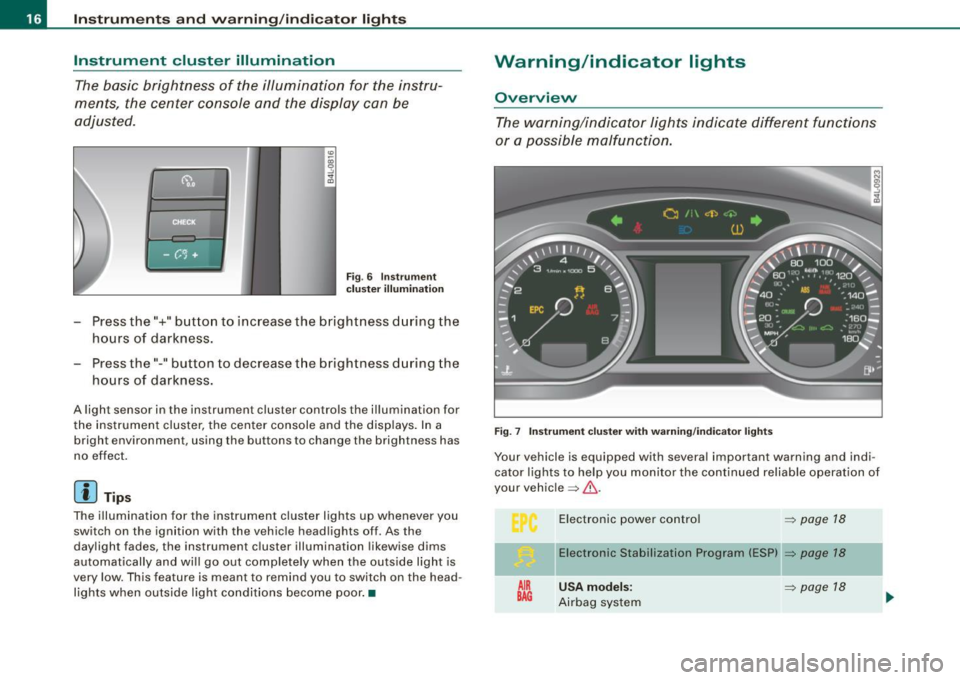
The warning/indicator lights indicate different functi ons
or a possible malfunction.
F ig. 7 Instr um ent clu ste r wi th w arnin g/indica tor lights
Your vehicle is equipped with several important warning and indi
cator lights to he lp you monitor the continued reliab le operation of
your vehic le => & .
AIR
BAG
E lectronic power contro l
=> page 18
Electronic Stabili zation Program (ES P) => page 18
U SA model s: => page 18
Airbag system
Page 25 of 398

Driver information display
Introduction
General notes
The driver information display inside the instrument
cluster provides you, the driver, with much useful infor
mation.
F ig. 8 Inst rume nt
c luster: ce nte r display
Information from the Driver Information System is shown in the
display in the center of the instrument cluster.
When you turn on the ignition and whi le you are driving, some func
tions and vehicle components are scanned for their operating status . Malfunctions or required service procedures are signa lled
audibly and shown by red and yellow lighted symbols and
reminders to the driver in the display .
The driver is also shown information about radio and CD operation and directions for the navigation system . You can find additional
information on these subjects in the MMI manual.
The Driver Information System provides the following functions:
Con tro ls and eq uip
ment
Dri ver inf orm atio n di spl ay
Sound system disp lay ~ page24
Outside air temperature ~ pa ge24
Digita l speedometer ~ page25
Door open in dicator ~ p age25
Defective light bulb ~ page25
Service interval display ~ page26
Auto Check system ~ page28
Driver inform ation ~ pa ge28
Speed limiter ~ page27
Tr ip computer ~ pag e38
Tire pressure monitoring ~ page336
~ page 156
[ i ] Tip s
In the event of a malfunction either a red or yellow icon appears in
the display. Red symbols indicate
D ange r~ page 29 . Yellow
symbols indicate a
W arning ~ page 33 . •
Vehicle care I I irechnical data
Page 29 of 398

On-Board Diagnostic system (08D)
Malfunction Indicator Lamp (MIL)
The Malfunction Indicator Lamp (MIU ~ in the instrument cluster
~ page 16, fig. 7 is part of the On-Board Diagnostic (OBD ID system.
The warning/indicator light illuminates when the ignition is
switched on and goes out after the engine starts and the idle has
stabi lized . This indicates that the MIL is working properly.
If the light does not go out after the engine is started, or illuminates
while you are driving, a malfunction may exist in the engine system.
If the light starts flashing, the catalytic converter could be damaged.
Continue driving
with reduced power (avoiding sustained high
speeds and/or rapid accelerations) and have the condition
corrected. Contact your authorized Audi dealer.
If the light illuminates, the electronic speed limiter may also be
malfunctioning . For more information~
page 27, "Electronic speed
limiter".
An improperly closed fuel filler cap may also cause the MIL light to
illuminate
~ page 297. •
On-Board Diagnostics
Con tro ls and eq uip
ment
Fig . 16 Location of
Data Link Connector
(D LC )
Driver information display
On-Board Diagnostics monitors the components of your emission
control system. Each monitored component in your engine sys tem
has been assigned a code. In case of a malfunction, the component
wil l be identified and the fault stored as a code in the control
module memory .
The M IL light may also illuminate if there is a leak in the on -board
fuel vapor recovery system. If the light illuminates after a refuelling,
stop the vehicle and make sure the fuel filler cap is properly closed
~ page 297.
In order to make an accurate diagnosis, the stored data can only be
d isplayed using special diagnostic equipment (generic scan tool for
OBDl.
In order to connect the special diagnostic equipment, push the plug
into the Data Link Connector (DLC). The DLC is located to the right of
the hood release~ fig. 16.
Your authorized Audi dealer or a qua lified service station can inter
pret the code and perform the necessary repair. •
Electronic speed limiter
Your vehicle may be factory equipped with tires that are rated for a
maximum speed of 130 mph (210 km/h). This is less than the
maximum speed of your vehicle. To reduce the risk of sudden tire
failure and loss of control if the vehicle is operated at excessive
speeds, your vehicle also has an electronic speed limiter. The elec
tronic speed limiter prevents your vehicle from going faster than the
tire speed rating. For more information~
page 329.
If the engine control unit receives faulty vehicle roadspeed signa ls,
the Malfunction Indicator Lamp (MIU will i lluminate . If this
occurs, contact the nearest authorized Audi dealer for assistance. .,.
Vehicle care I I Technical data