2009 AUDI S6 oil
[x] Cancel search: oilPage 310 of 398
lffl __ C _h_ e_ c_k _in --== g'-- a_n _d_ f_il _li _n ..:::g:::..- ___________________________________________ _
models; 60% for Canadian models). This mixture both assures the
necessary frost protection and protects metal components in the
engine's cooling system from corrosion and scaling. It also raises
the boiling point of the coolant.
Do not reduce the concentration of the coolant in the summer by
adding plain water.
Th e pro port io n of coo la nt additi ve mu st be at
lea st 50 % but n ot mor e th an 60 %
to maintai n ant ifreeze protection
and cooling efficiency. If the coolant frost protection is too low , the
coolant could free ze and damage the veh icle heating and engine
cooling system .
For year-round driving , antifreeze is added at the factory for temper
atures down to:
• -31 °F ( -35 °c1 usA
• - 40 °F ( - 40 °C) Canada.
You can mix the
Gl 2+ + coolant additive with other additives (G12+
or G12). Always check w ith your authorized Audi dealer.
& WARNING
B efo re you che ck anyt hing in th e eng ine compartmen t, alway s
re ad a nd he ed all WARN ING S~
& in " Working in the engine
c ompar tm ent " on
page 30 1.
0 Not e
• Before winter sets in, have the coolant checked to see if the
coo lant additive in your vehicle is sufficient to meet the climate
conditions. This is especia lly important if you live in a region where
the winter is extremely cold . If necessary, increase the proportion of
coolant additive to 60%.
• When adding coolan t additive to your coo ling system,
remember:
-We recommend using only coolant additive
G12+ + (check the
label) for your vehicle. This coolant additive is avai lable at autho
riz ed Audi dealers. Other types of antifreeze can significantly reduce corrosion protection. The resulting corrosion can cause a
loss of coolant and serious engine damage.
• Do not add any type of radiator leak sealant to your vehicle's
engine coolan t. Adding radiator repair fluid may adversely affect the
function and performance of your cooling system and could result
in damage not covered by your New Vehicle Limited Warranty. •
Checking the engine coolant level
The engine coolant level can be checked with a quick
glance.
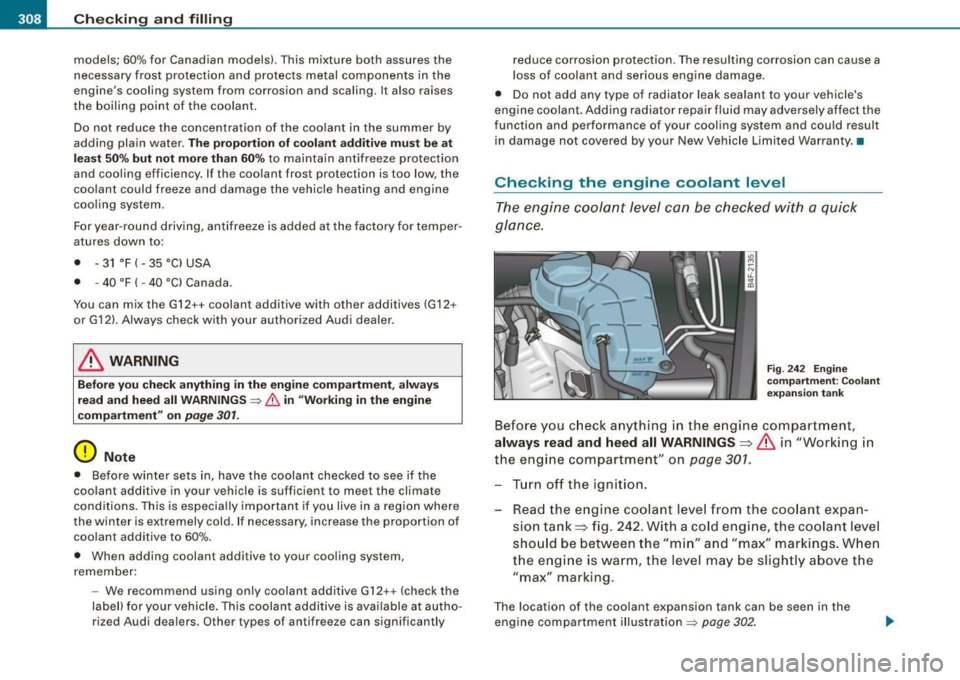
F ig . 2 42 E ngin e
com partm ent : Cool ant
ex pans io n tank
Before you check anything in the engine compartment,
alw ays read and h eed all WARNINGS ~ & in "Working in
the eng ine compartment" on page 301.
- Turn off the ignition.
- Read the e ngine coo lant level from the coo lant expan -
sion tank~ fig. 242. With a cold engi ne, the coolant level
sho uld be between the "min" and "max" markings. W hen
the engine is warm, the level may be slightly above the
"max" marking .
The location of the coolant expansion tank can be seen in the
engine compartment illustration~
page 302.
Page 311 of 398

_____________________________________________ C_h_ e_ c_k _in ~ g_ a_n _d_ f_il _li _n ~g __ lfflll
•
T o obtain an accurate reading, the engine must be switched off .
The expansion tank in your vehic le is equipped with an e lectric
coolant level sensor.
When the coolant level is too low, the warning light in the Auto
Check System ~
page 37 will blink until you add coo lant and the
level has been restored to normal. Even though there is an electric
coolant level sensor, we still recommend you check the coo lant level
from time to time .
Coolant loss
Coolant loss may indicate a leak in the cooling system. In the event
of coolant loss, the cooling system should be inspected immedi
ately by your authorized Audi dealer . It is not enough merely to add
coo la nt.
In a sealed system, losses can occur only if the boiling point of the
coolant is exceeded as a result of overheating .
0 Note
Do not add any type of radiator leak sealant to your vehicle's engine
coolant . Adding radiator repair fluid may adversely affect the func
tion and performance of your cooling system and could result in
damage not covered by your New Vehicle Limited Warranty. •
Adding coolant
Be very careful when adding engine coolant.
Before you check anything in the engine compartment,
always read and heed all WARNINGS~ & in "Working in
the engine compartment" on
page 301.
- Turn off the engine.
- Let the engine cool down. Place
a thick rag over the coolant expansion tank
~ page 308, fig. 242 and carefully twist the cap counter
clockwise ~& .
Add coolant.
- Twist the cap on again
tightly .
Replacement engine coolant must conform to exact specifications
~ page 307, "Coolant". Even in an emergency, if coolant additive
G12++ , G12 + or G12 is not availab le, do not use a different additive .
Use plain water instead until you can get the correct add itive and
can restore the correct ratio. This shou ld be done as soon as
possible.
If you have lost a considerab le amount of coolant, then you should
add cold antifreeze and cold water only when the engine is cold .
A lw ays use
new engine coolant when refilling.
Do not fill coolant above the "MAX" mark. Excess coolant will be
forced out through the pressure relief valve in the cap when the
eng ine becomes hot.
& WARNING
• The cooling system is under pressure and can get very hot.
Reduce the risk of scalding from hot coolant by following these
steps.
-Turn off the engine and allow it to cool down .
- Protect your face , hands and arms from escaping fluid and
steam by covering the cap with a large , thick rag.
- Turn the cap slowly and very carefully in a counter-clockwise
direction while applying light , downward pressure on the top
of the cap.
- To avoid being burned, do not spill antifreeze or coolant on
the exhaust system or hot engine parts. Under certain condi-
tions , the ethylene glycol in engine coolant can catch fire . ...
Vehicle care
I t •
Page 313 of 398

Checkin g and fillin g Ill
--------------~-
•
-Read the brake fluid level from the brake fluid reservoir
~ fig. 243. The brake fluid level must be between the
"MIN" and "MAX" markings.
The brake fluid reservoir is located at the rear partition of the engine
compartment on the left side=> page 302.
The fluid level may drop slightly after some time due to the auto
matic adjustment of the brake pads . This is not cause for alarm.
If the brake fluid level falls considerably below the "MIN" mark, the
brake warning/indicator l ight (U.S. models:
BRAKE , Canadian models:
CCD> l will come on=> page 22 and=> page 30. Do not continue to
operate the vehicle . The complete brake syste m shou ld be thor
oughly checked by an authorized Audi dealer or other qualified
facility and the cause corrected. If the brake fluid level is too low, the
brake warning/indicator light will illuminate . Contact an authorized
Audi dea ler
immedi ately. •
Changing brake fluid
Have the brake fluid changed by an experienced techni
cian.
Brake fluid absorbs moisture from the air. If the water content in the
brake fluid is too high, corrosion in the brake system may result
after a period of time . The boiling po int of the brake fluid will also
decrease considerably and decrease braking performance.
T herefore, the brake fluid must be changed
ever y two yea rs. Always
use new brake fluid which conforms to Federa l Motor Veh ic le Stan
dard "FMVSS 116 DO T 4".
The brake fluid reservoir can be difficult to reach, therefore, we recommend that you have the brake fluid changed by your autho
rized
Audi deal er. Your dealer has the co rrect tools, the right brake
fluid and the know-how to do this for you.
& WARNING
• Bra ke fluid i s poi sonou s. It m ust be stor ed only in the closed
or iginal container out of the reach of children!
• Brake f ailur e can result fr om old or in approp riat e bra ke fluid .
Ob serve the se pre cauti ons:
- Use o nly br ake fluid that me ets SAE specifi cation
J 1703 and
c onfo rm s t o Fed eral Mo to r V ehicle Standard 116 . Alway s check
w ith your auth oriz ed A udi de aler t o m ake sure you are usin g
the correct b rake flu id . The corre ct ty p e of brake flu id i s al so
indi cate d on the br ake fl uid r eservo ir .
- The brake f luid mu st be new . Heav y use of the brake s can
ca us e a va por lo ck if the brake fluid is left in the sy stem too
long. Thi s ca n seriou sly affect th e effic iency of the brake s as
well as your safe ty. T his co uld r esult i n an a ccide nt.
0 No te
Brake fluid wil l damage the paint of your vehicle .
'£> For the sake of the environm ent
Because of the problem of proper disposal of brake fluid as well as
the special too ls required and the necessary expertise, we recom
mend that you have the brake fluid changed by your authorized Audi
dea ler. •
Battery
General information
Under norm al operating conditions, the battery in your Audi does
not need any maintenance . With high outside temperatures or long
daily drives we recommend that you have the electrolyte level ._
Vehicle care I t •
Page 319 of 398

________________________________________________ T_ i _r_e _s_ a_n_ d_ w_ h_ e_e _ l_s __ lllll
•
Tires and wheels
Tires
General notes
Tires may be the least appreciated and most abused parts
of a motor vehicle.
Tires may be the least appreciated and most abused parts of a
motor vehicle. Tires are, however, one of the most important parts
of a vehicle, particularly considering the comparative ly sma ll patch
of rubber on each tire that assures that all- important contact
between you, your vehicle and the road .
Maintaining the correct tire pressure, making sure that your vehicle
and its tires do not have to carry more weight than they can safely
handle, avoiding damage from road hazards and regu lar ly
inspecting tires for damage inc luding cuts , slashes irregular wear
and overa ll condition are the most important things that you can do
to help avoid sudden tire failure including tread separation and
b lowouts .
Avoiding dama ge
If you have to drive over a curb or similar obstacle, drive very slow ly
and as close as possible at a right angle to the curb.
A lways keep chemica ls includ ing grease, oil, gasoline and brake
f luid off the tires.
I nspec t the tires regularly for damage (cuts, cracks or blis ters, etc.l.
Remove any foreign bodies embedded in the treads.
Storing tires
Mark tires when you remove them to indicate the direction of rota
tion . This ensu res you to be ab le to mount them correctly when you
reinstal l them. When removed, the wheels or tires shou
ld be stored in a coo l, dry
and preferably dark place.
St ore t ires in a vertical posit ion if they a re not mounted on rims, in
a horizontal position if they are mounted on rims.
New tire s
New tires have to be broken in~&.
The tread dep th of new tires may va ry, according to the type and
make of tire and the tread pattern.
Hidden d ama ge
Damage to tires and rims is often not readily visible. If you notice
unusua l vibration or the vehicle pul ls to one side, this may indicate
that one of the tires has been damaged . The tires must be checked
immed iately by an authorized Audi dealer or qualified workshop .
Unidire ction al tir es
A unidirectio nal tire can be iden tif ied by arrows on the s idewa ll, that
point in the direction the tire is designed to rotate. You must follow
the specified direction of ro tation . This is necessary so that these
tires can deve lop their optimum characteristics regarding grip, road
noise, wear and hydroplaning resistance . For more information
~ page 349.
in. WARNING
Ne w tire s or tire s that are old , worn or damaged cann ot pro vide
m aximum cont rol and braking ability.
• New tire s tend to be slippe ry and m ust be broken in . To redu ce
the risk of losing control, a colli sion and seriou s per sonal injurie s,
drive with speci al care for t he fi rst 350 m ile s ( 560 km l.
• Driving with worn or damaged t ire s can lead to lo ss of co ntrol ,
s udd en tire failure , in clu ding a blowout a nd sudden deflation , .,,_
Vehicle care
I t •
Page 320 of 398
-~_T_ ir_e_ s_ a_ n_d _ w_ h_ e_e _l_s _________________________________________________ _
& WARNING (continued)
crashes and serious personal injuries . Have worn or damaged tires
replaced immediately.
• Tires age even if they are not being used and can fail suddenly,
especially at high speeds. Tires that are more than 6 years old can
only be used in an emergency and then with special care and at
low speed.
Glossary of tire and loading terminology
Accessory weight
means the combined weight (in excess of those standard items
which may be replaced) of automatic transmission, power steering,
power brakes, power windows, power seats, radio, and heater, to
the extent that these items are available as factory-installed equip
ment (whether installed or not).
Aspect ratio means the ratio of the height to the width of the tire in percent.
Numb ers of 55 or lower indicate a low sidewall for improved
steering response and better overall handling on dry pavement.
Bead
means the part of the tire that is made of steel wires, wrapped or reinforced by ply cords and that is shaped to fit the rim.
Bead separation means a breakdown of the bond between components in the bead.
Cord
means the strands forming the plies in the tire.
& WARNING (continued)
• Never mount used tires on your vehicle if you are not sure of
their "previous history." Old used tires may have been damaged
even though the damage cannot be seen that can lead to sudden
tire failure and loss of vehicle control.
• If you notice unusual vibration or if the vehicle pulls to one side
when driving, always stop as soon as it is safe to do so and check
the wheels and tires for damage . •
Cold tire inflation pressure
means the tire pressure recommended by the vehicle manufacturer
for a tire of a designated size that has not been driven for more than
a couple of miles (kilometers) at low speeds in the three hour period
before the tire pressure is measured or adjusted .
Curb weight means the weight of a motor vehicle with standard equipment
including the maximum capacity of fuel, oil, and coolant, air condi
tioning and additional weight of optional equipment.
Extra load tire
means a tire designed to operate at higher loads and at higher infla
tion pressures than the corresponding standard tire . Extra load tires
my be identified as "XL",
"xi", "EXTRA LOAD", or "RF" on the side
wall.
Gross Axle Weight Rating ("GAWR")
means the load-carrying capacity of a single axle system, measured
at the tire -ground interfaces .
Gross Vehicle Weight Rating ("GVWR"l
means the maximum total loaded weight of the vehicle.
Page 327 of 398
Tires and wheels -
----------------
•
& WARNING (continu ed )
• The driver is respon sible for the correct tire pres sures for all
tire s on the vehicle . The applicable pre ssure values are located on
a sticker on the driver 's side B-pillar .
• Only when all tires on the veh icle are filled to the correct pre s
sure , the tire pressure monitoring system can work correctly .
• The use of incorre ct t ire pressure values can lead to a ccidents
or other damage. Therefore it is essential that the driver observe
the specified tire pressure values for the tires and the correct pre s
sures for the function of the tire pressure monitor ing system.
• Always inflate tires to the recommended and corre ct tire pres
sure before driving off.
• Driving with underinflated tires bend more , letting them get
too hot resulting in tread separation, sudden tire failure and loss
of control.
• Excessive speed and /overloading can cause heat build-up ,
sudden tire failure and loss of control.
• If the tire pre ssure is too low or too high, the tires will wear
prematurely and the vehicle will not handle well .
• If the tire is not flat and you do not have to change a wheel
immed iately , drive at reduced speed to the nearest service stat ion
to check the tire pres sure and add air as required.
0 Note
Dr iving w ithout valve s tem caps can cause damage to the t ire
valves . To prevent this, a lways make sure that factory installed valve
stem caps on a ll whee ls are securely mounted o n the va lve.
For the sake of the environment
Unde rin fla ted tires will a lso increase the f uel c onsump tion .•
Tires and vehicle load limits
There are limits to the amount of load or weight that any vehic le and
any t ir e can carry. A veh icle that is overloaded w il l not handle wel l
and is more difficu lt to stop. Overloading can not only lead to loss
o f veh ic le control, but ca n also damage impor ta nt parts of the
vehic le and can lead to sudden tire failure, inc luding a blowout and
sudde n defla tion that can cause the vehic le to crash .
Your sa fety and that o f your passen gers also depends on mak ing
sure that load limits are not e xceeded. Vehicle load includes every
body and everythi ng in and on the veh ic le. T hese load lim its a re
technica lly referred to as the vehicle's
Gross Vehi cle We ight Rating
(" GVWR") .
T he "GVWR" includes the weight of the basic vehic le, all factory
insta lled acces so ries, a ful l ta nk of fuel, oil, coolant an d othe r flui ds
p lus maximum load. The maximum load inc ludes the number o f
p asse ngers that the vehicle is inte nded t o carry ("sea ting capacity")
w ith an assu med we ight o f 150 l bs (68 kg) fo r each passe nger at a
designated seating position and the total weight of any luggage in
t he vehicle. If you tow a trailer, the we ig ht o f the tra iler h itch an d th e
tongue weight of the loaded trailer must be included as part of the
ve hicle l oad.
The
Gross Axle Weight Rating !"GAWR") is t he maximum load that
can be applied a t each of the vehicle's two ax les.
The Gross Veh icle Weig ht Rating and t he G ross Axle Weig ht Rat ing
are listed on the safety comp liance sticker labe l located on the
d river 's s ide B -pi llar . Y o ur Au di h as 5 s eating positi ons, 2 i n the fro nt
and 3 in the rear for total seating capacity of 5 . Each seating position
has a safe ty bel t~
page 205, "Safe ty belts".
The fact that th ere is an upper limit to your vehicle's Gross Vehicle
Weight Rating means that the total weight of whatever is being
carried in the vehic le (includ ing the we ight of a trai ler hitch and the
tong ue weight of the loaded trai ler) is limited. The more passengers
i n the v ehicle or pass engers wh o are heavie r than t he sta nd ard
we ights assumed mean that less weight can be ca rried as luggage . .,_
Vehicle care I t •
Page 330 of 398

-~_T_ ir_e_ s_ a_ n_d _ w_ h_ e_e _l_s _________________________________________________ _
Tire pr essure
Inco rrect tire pressure causes prematu re wear and can cau se
sudden tire blow-out. For this reason, tire pressure must be checked
at least once a month
~ page 323 .
Driving style
Dr iv ing fa st around curves, heavy acceleration and hard brak ing
increase tire wear.
Rotating tire s for more even wear
For all four t ires on your vehic le to have the same service life, we
recommend that the front and rea r tires are rotat ed acc ord ing to the
tire manufacturer 's suggested tire rotation intervals. Please
remembe r the f ollo wi ng :
• Tire rotat ion i nterva ls m ay d iffer from the vehic le serv ice inte r
vals outl ined in your Maintenance and Warranty Book let.
• The longer one tire is used in one location on the vehicle, t he
more it wears at certain points; the refo re, we recommend that you
f ollow the tire manu facturer's sug ges ted t ire rotat ion i nte rvals.
• Vehicles with fro nt-w hee l dr ive e xper ience more tread wear on
the front wheels compared to all -wheel drive (quattro®l .
• Please rotate tires as sh ow n~
page 32 7, fig. 250 .
• Extra care must be taken when rotating direction -specific tires
~ pag e 349 .
Wheel balancing
T he w hee ls o n new v ehic les are balanced. However, various s itua
tions during everyday driving can cause them to become unba l
anc ed, resu lti ng in vib rati ons yo u ca n us ually feel thro ugh t he
steer ing whee l.
U nba la nce d w heels must b e re ba lance d to avoid e xcessive wea r on
steering, suspension and tires. A whee l must a lso be reba lanced
when a new tire is installed.
Incorrect wheel alignment
Incorrect w hee l al ig nm ent ca n cau se e xcess ive ti re wea r, impa iring
t h e s afety of th e veh ic le. If t ires s how excessive w ear, have the
w hee l a lig nme nt checke d by a n autho rize d Aud i deale r or qualifie d
wo rkshop.
All Wheel Drive
Vehic les with quattro® must always have tires of the same size,
co nstruct ion an d tread ty pe. For deta ils see ~
page 268.
& WARNING
Sudden tire failure can lead to loss of control , a crash and serious
personal injury !
• Never drive a vehicle when the tread on any tire is worn down
to the wear indicators.
• Worn tires are a safety hazard , they do not grip well on wet
roads and increase your risk of "hydroplaning " and loss of control.
• Always keep chemicals that can cause tire damage , such as
grease, oil, gasoline and brake fluid away from tires .
• Tires age even if they are not being used and can fail suddenly ,
especially at high speeds. Tires that are more than 6 years old can
only be used in an emergency and then with special care and at
lower speeds .
• Never mount used tires on your vehicle if you are not sure of
their "previous history. " Old used tires may have been damaged
even though the damage cannot be seen that can lead to sudden
tire failure and loss of vehicle control . •
Page 337 of 398
Tires and wheels -_______________________ ..::...:..:..-=::.......:.:..;::..:....____;___
•
Wheel bolts
Wheel bolts must always be tightened to the correct
torque.
The design of wheel bolts is matched to the factory installed rims. If
different rims are fitted, the correct wheel bolts with the right length
and correctly shaped bolt heads must be used. This ensures that
wheels are fitted securely and that the brake system functions
correctly.
In certain circumstances, you may not use wheel bolts from a
different vehicle - even if it is the same model~
page 374.
& WARNING
Improperly tightened or maintained wheel bolts can become loose
causing loss of control, a collision and serious personal injury.
• Always keep the wheel bolts and the threads in the wheel hubs
clean so the wheel bolts can turn easily and be properly tightened.
• Never grease or oil the wheel bolts and the threads in the wheel
hubs. They can become loose while driving if greased or oiled,
even if tightened to the specified torque.
• Only use wheel bolts that belong to the rim being installed.
• Never use different wheels bolts on your vehicle.
• Always maintain the correct tightening torque for the wheel
bolts to reduce the risk of a wheel loss.
If the tightening torque of
the wheel bolts is too low, they can loosen and come out when the
vehicle is moving. If the tightening torque is too high, the wheel bolts and threads can be damaged and the wheel can become
loose.
0 Note
The specified torque for the wheel bolts is 90 ft lb (120 Nm) with a
tolerance of ± 7,4 ft lb(± 10 Nm). Torque wheel bolts diagonally.
After changing a wheel, the torque must be checked as soon as possible with a torque wrench
-preferably by an authorized Audi
dealer or qualified workshop. •
Low aspect ratio tires
Your Audi is factory-equipped with low aspect ratio tires. These tires
have been thoroughly tested and been selected specifically for your
model for their superb performance, road feel and handling under
a variety of driving conditions. Ask your authorized Audi dealer for
more details.
The low aspect ratio of these tires is indicated by a numeral of 55 or
less in the tire's size designation. The numeral represents the ratio
of the tire's sidewall height in relation to its tread width expressed
in percentage. Conventional tires have a height/width ratio of 60 or
more.
The performance of low-aspect-ratio tires is particularly sensitive to improper inflation pressure. It is therefore important that low
aspect ratio tires are inflated to the specified pressure and that the
inflation pressure is regularly checked and maintained. Tire pres
sures should be checked at least once a month and always before a
long trip~
page 323, "Checking tire pressure" .
What you can do to avoid tire and rim damage Low aspect ratio tires can be damaged more easily by impact with
potholes, curbs, gullies or ridges on the road, particularly if the tire
is underinflated.
In order to minimize the occurrence of impact damage to the tires
of your vehicle, we recommend that you observe the following
precautions:
• Always maintain recommended inflation pressures . Check your
tire pressure every 2,000 miles (3,000 km) and add air if necessary.
• Drive carefully on roads with potholes, deep gullies or ridges.
The impact from driving through or over such obstacles can
damage your tires. Impact with a curb may also cause damage to
your tires. ..,
Vehicle care
I t •